The fragmentation of the Third World
There are a number of reasons why the Third World states were not able to achieve the goals that they proclaimed for themselves in the mid-1970s. The fundamental difficulty was that, although the concentration on development issues had sealed the construction of a sense of Third World identity, the mere fact that a North— South dialogue had begun did not guarantee that the developing states would receive any substantial benefits.
Thus, while the Third World had helped to bring about a new paradigmatic shift that rejected the universality of the East-West divide, the tangible gains from this realignment of international politics were strictly limited.Group of 7 (G-7)
The Group of 7 was the organization of the seven most advanced capitalist economies — the United States, Japan, Canada, Germany, France, Italy and Britain — founded in 1976. The G-7 held and continues to hold annual summit meetings where the leaders of these countries discuss economic and political issues.
Clearly one major problem the Third World faced was that the advanced capitalist states, despite the energy crisis, showed little enthusiasm for the idea of introducing significant modifications of the international trading regime. Thus, while the issues connected to the NIEO proposals dominated the UN's debates about development, very little progress was achieved. Indeed, a major summit at Cancun in Mexico in 1981 proved to be an almost total failure. In fact, it might be said that the only dramatic effect of the Third World's attempt to speak with a firmer voice was to force the Western states to pull together more than ever before. Notably, in November 1975 a meeting of the major capitalist states was convened in Rambouillet in France to discuss economic issues in the wake of the energy crisis. This meeting set in train the idea of an annual summit of the seven leading capitalist economies, the United States, Japan, West Germany, Britain, France, Canada and Italy, referred to as the Group of 7 (G-7).
While initially intended to broker agreement on issues such as currency stabilization, over time the creation of the G-7 forum allowed the major states of the ‘North' to present a united front in the face of the Third World's demands. Moreover, the West started to respond to Third World domination of international organizations by simply withdrawing from them. The most noted case came in 1985 when the United States pulled out of the United Nations Educational, Scientific and Cultural Organization (UNESCO), after which Washington also began to withhold its payments to the UN itself, arguing that too much money was being wasted.Underpinning the West's refusal to accept the Third World's remedies for economic underdevelopment was the fact that, once again, there was a fundamental shift in the way in which development issues were approached intellectually. By the late 1970s the rise of neo-liberal economic thinking in the West led to the view that the underdeveloped states had approached development in the wrong way. Instead of establishing inefficient state-run import substitution industries, it was argued, they should have concentrated on areas in which they possessed a comparative advantage. Moreover, the rapid growth of the newly industrializing countries in Asia confirmed the World Bank in its belief that the developmental programmes that had been followed in Latin America and Africa had been fundamentally flawed, and thus reinforced its determination to change the nature of its aid provision. The result was that as the 1980s began the World Bank introduced what it termed ‘structural adjustment programmes', the aim of which was to encourage governments to privatize state assets, to introduce austerity measures and to devalue their currencies. Aid on the terms proposed by the NIEO was thus not on the West's agenda.
structural adjustment programme
The idea propagated by the World Bank from the end of the 1970s which linked the provision of development aid to Third World states to the latter committing themselves to balanced budgets, austerity programmes and the sale of nationalized industries and property.
Given that the West was able to make a largely united response to the NIEO proposals, it was tragic that from the late 1970s the conglomeration of nations that made up the Third World lacked effective leadership and grew increasingly divided. In the political realm, while the Non-Aligned Movement was far better organized in the 1970s and by the end of that decade had an extensive membership of just under one hundred states, its record in achieving its goals was not impressive. For example, while detente between the superpowers did emerge in the 1970s, it could not be said that this was in any way a reaction to lobbying by the non-aligned. Indeed, at the Algiers non-aligned summit in 1973 a number of resolutions were passed that criticized detente on the grounds that the superpowers were merely dividing the world between themselves, and that the Third World had not received any benefits from this process. Moreover, the ability of the Non-Aligned Movement to lobby the West was compromised by a number of factors. One was the increasingly prominent role played by Cuba, which, particularly after its interventions in Angola and Ethiopia, was hardly seen as neutral. In 1979 the non-aligned summit was held in Havana, and, although a Cuban resolution declaring the Soviet Union to be ‘a natural ally' of the Third World was rejected, this naturally raised Western suspicions about the movement as a whole. In addition, the Non-Aligned Movement's use of the Third World majority in the UN General Assembly to pass a resolution in 1975 declaring Zionism to be racist hardly endeared it to Israel's friends in the West.
Another problem was that, just as in the early 1960s, the cohesiveness of the movement was strained by differences and rivalries between its members. This included splits over such issues as the Angolan Civil War and the Soviet invasion of Afghanistan. These problems might have been overcome had a new generation of leaders displaying the vision of the three founding fathers, Nehru, Nasser and Tito, emerged and been able to mobilize the movement.
However, this did not happen, and in fact some of the states which had previously acted as leaders tended to retreat into the background. For example, India under Indira Gandhi largely concerned itself with the security of South Asia. In 1971 it went to war with Pakistan in order to ensure the successful secession of Bangladesh, and in the same year signed a treaty of friendship with the Soviet Union. In 1974 it proceeded to explode its first nuclear device. Because of its new sense of regional responsibility, India tended to take a more moderate line on Third World issues and did not provide the leadership that Nehru had once given. Among the other leading states, Egypt, following its peace treaty with Israel in 1979, found its moral authority within the Non-Aligned Movement severely undermined, while Algeria's and Yugoslavia's voices became more subdued after the deaths of Boumedienne and Tito in 1978 and 1980 respectively. Thus, while the Non-Aligned Movement continued to meet, its last summit to date being at Durban in South Africa in 1998, it failed to make much impact on either political or economic issues.While the West strengthened its position and the Third World once again lost its cohesion, in the most appalling irony of all the failure to redefine the workings of the global economy through the introduction of the NIEO was to have a catastrophic effect on many of the developing countries in the 1980s. The chief reasons for this were increasing indebtedness and the collapse of commodity prices. Indeed, if any one factor symbolized the inability of the G-77 to change the nature of the international economy it was the debt crisis that racked Latin America and Africa from the late 1970s onwards. This crisis was directly linked to the first ‘oil shock', for after 1973 many Third World states were forced to raise loans in order to cover purchases of oil, while simultaneously pursuing development programmes. Loans were reasonably easy to arrange as Western banks were awash with the petrodollars that had flowed into the OPEC countries, and interest rates were fairly low.
The Third World states therefore took on considerable debts; indeed between 1970 and 1982 long-term debt in Latin America increased from $27.6 billion to $238.5 billion.This level of indebtedness would clearly have led to problems no matter what happened in the global economy, but in fact events in the world exacerbated the difficulties to a very significant degree. The catalyst for the worsening of the debt crisis was the revolution in Iran in 1979, which led to the second ‘oil shock', when prices rose by 160 per cent as a result of the shortages caused by the tailing off of Iranian production and the general sense of fear about the future security of the Persian Gulf. The second ‘oil shock' led to inflation and recession for the Western advanced capitalist economies, and thus to large increases in interest rates, which were, in turn, passed on to the Third World debtors, vastly increasing their debtservicing commitments. For example, by 1982 African debt from all sources stood at $51.3 billion and the annual debt-servicing accounted for $5.46 billion or 12.6 per cent of the value of Africa's exports of goods and services. The difficulties in meeting such high debt repayments were increased by the fact that the recession in the West in the early 1980s and the rise of oil production from non-OPEC sources led to a dramatic fall in commodity prices. By 1990 the real price index for commodities demonstrated a drop of 35 per cent in their value compared with 1980; for Africa this meant that in the 1980s it had lost one-sixth of the income that it might have expected. Naturally, the plummeting value of the commodities that constituted the main exports of the Third World countries made the task of meeting debt commitments extremely difficult. In 1982 Mexico was forced to negotiate a rescue package to avoid defaulting on its payments, while Peru also came close to defaulting in 1985.
Thus by the end of the 1980s, when the Cold War paradigm finally came to its unexpectedly rapid end, although the organizations established by the Third World states had managed to raise interest in development issues, they had achieved little in terms of substantive results.
The years following the end of the Cold War were to be no better. With the Soviet Union now vanquished it was no longer possible for countries in the Third World to use the influence of the communist bloc to balance pressure from the United States and its allies or vice versa. They were therefore more amenable to pressure than ever before. Moreover, the triumph of free market capitalism over communism meant that the West was now in a strong position to push its own prescriptions for development on the Third World. The 1990s therefore saw the World Bank and the IMF put increasing emphasis on ‘good governance' and democracy as conditions for aid, allied with pressure on states to engage in the further liberalization of markets.The result was that the Third World was pitched into the era of globalization, in which the sovereignty and independence for which they had fought in the middle years of the century stood in danger of being eroded by the forces of international finance. Despite the potential threat, there was initially little resistance to this new paradigm, which reached its peak in 1995 with the establishment of the World Trade Organization. Indeed, instead of attempting to create a Third World united front in order to resist globalization being imposed upon them, the tendency was for regional groupings, such as Mercosur in South
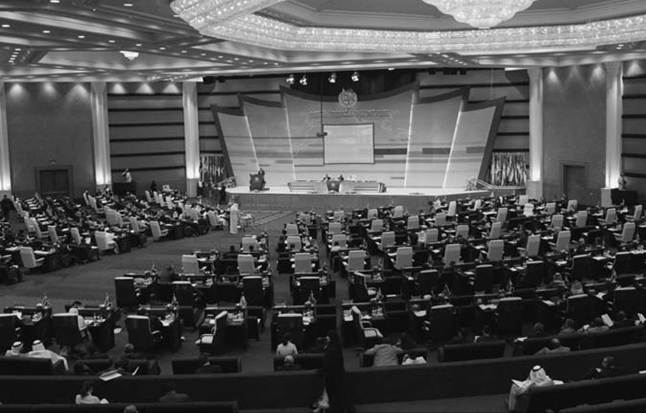
Plate 13.1 Dohar, Qatar, Group of 77, 15 June 2005. The second summit of the South, an alliance of 132 developing countries which gathered 50 heads of state or government officials from the Group of 77 and China, opened with the issues of South-South co-operation, South-North relations and the huge debt crisis of poor nations. (Photo: Rabih Moghrabi/AFP/Getty Images)
globalization
The cultural, social and economic changes caused by the growth of international trade, the rapid transfer of investment capital and the development of high-speed global communications.
Mercosur
Or the Southern Cone Common Market. A Latin American trade organization established in 1991 to increase economic co-operation in the eastern part of South America. Full members include Argentina, Brazil, Paraguay and Uruguay. Bolivia and Chile are associate members. Mercosur's goals include the gradual elimination of tariffs between member states and harmonization of external duties.
see Chapter 21
see Chapter 19
Association of South-East Asian Nations (ASEAN) Organization founded in 1967 by Indonesia, Malaysia, the Philippines, Singapore and Thailand to provide a forum for regional economic cooperation. From 1979, and the Third Indochina War, it took on more of a political and security role. Membership increased with the accession of Brunei in 1984, Vietnam in 1995, Burma in 1997 and Cambodia in 1999.
European Union (EU)
A political and economic community of nations formed in 1992 in Maastricht by the signing of the Treaty on European Union (TEU). In addition to the agreements of the European Community, the EU incorporated two intergovernmental — or supranational — ‘pillars' that tie the member states of the EU together: one dealing with common foreign and security policy, and the other with legal affairs. The number of member states of the EU has expanded from twelve in 1992 to twenty-seven in 2007.
America or the Association of South-East Asian Nations (ASEAN), to engage in negotiations with the United States and the European Union to try to gain the best trading conditions possible through collective bargaining. This did not mean, however, that the idea of globalization was universally welcomed for, as the world moved from the 1990s into the twenty-first century, resistance began to manifest itself in a variety of forms, such as the rise of political Islam and the emergence of a new generation of radical socialist leaders such as Hugo Chavez of Venezuela. However, whether such disparate voices could ever provide the Third World with power and unity was a moot point.
More on the topic The fragmentation of the Third World:
- DETECTION OF DNA FRAGMENTATION
- Fragmentation alters evolutionary processes
- Territorial Fragmentation
- Habitat Loss and Fragmentation
- Ukraine—Whole-Land Independence or Foreign Fragmentation?
- CONCEPT 24.2 Habitat loss and fragmentation decrease habitat area, isolate populations, and alter conditions at habitat edges.
- India, the seventh largest country in the world, is the most populous country in the world.
- On 4 February 2005, military guards welcomed guests arriving at the Livadia Palace near Yalta, as they had done sixty years earlier on the first day of the Yalta Conference, which brought together Franklin D. Roosevelt, Winston Churchill, and Joseph Stalin to discuss the shape of the world after the Second World War.
- World Peace
- IX The Game of the World
- Community and World Order[‡‡]
- Epilogue: The Puzzle of World Peace