The Inca Imperial Economy
Inca infrastructure existed to serve the military needs of the expanding empire, which in turn ensured the implementation of state economic strategies. As described earlier, economic conditions varied widely across the Andean region at the time of Inca conquest, and Inca policies adapted to the situation on the ground in each new province.
A key Quechua concept influencing imperial economic policies was chapaccuy: the power of leaders to appropriate unutilized resources, to transform them, and to allocate them under central administration. In highland areas where local societies pursued diversity-oriented economic strategies that relied on kin networks to average out domestic risks, the Incas invested labor tribute in agricultural intensification and specialized herding, creating a parallel state economy that in theory expropriated only labor tribute that was owed to the ruler. Agricultural intensification consisted of the construction of new infrastructure (irrigation canals and terrace groups in valley-bottom areas), as well as the improvement of soils using organic fertilizers (camelid dung and guano brought from coastal islands) and the cultivation of high-yield strains of maize and other crops. Food surpluses sustained those who labored, traveled, and fought for the state, and a network of storehouses (qollqa) held staples and other necessary goods at intervals along major Inca roads (Figure 25.5).[1777] In highland provinces, Inca rule appears to have flattened out some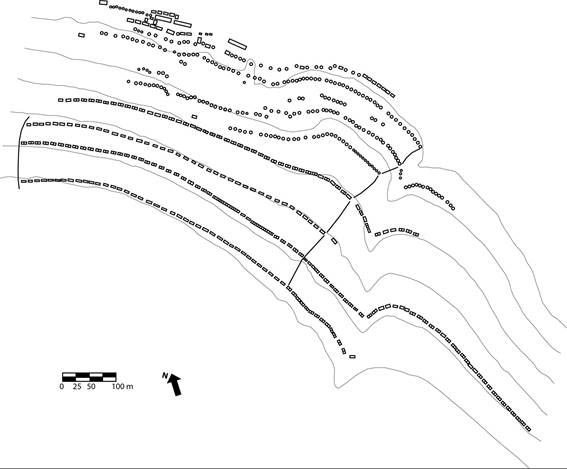
Figure 25.5. Storehouses at Huanuco Pampa.
R. Alan Covey and Craig Morris.
local status differences, with surplus staples, craft goods, and wealth channeled to administrative centers and the imperial capital.[1778]
On the Pacific coast, especially in what is today northern Peru, the Incas encountered specialized economies with full-time fishing, farming, artisan, and merchant populations.
The aridity of coastal valleys facilitated central control over the agrarian economy, as coordinated labor was necessary to build and maintain irrigation networks, as well as military investments to protect canal outtakes. Although local elites probably dominated most sources of water and arable land, they could not monopolize the rich fisheries of the coast, and some kinds of fishing could be done without major investments in tools and watercraft. Coastal kingdoms engaged in the specialized production and trade of fine craft goods, which were part of a millennium-long tradition of local statecraft and evolving elite identities.[1779] Inca economic strategies on the Pacific coast worked around existing hierarchies, focusing on areas where centralized states were not well established. This included the mid- and upper valley regions of the coastal valleys, as well as coastal areas to the south of the Nasca region, where local populations were modest and politically decentralized.[1780] This is not to say that there was no economic impact in coastal kingdoms. The Chimu Empire saw many of its best artisans resettled to Cuzco for the service of Inca lords, and coastal craft traditions evolved to meet broader imperial demands. For example, Inca-era burials in the Chincha Valley show an increase in Spondylus shell necklaces fashioned from uniformly shaped beads, a departure from the zoomorphic fabrications of the pre-Inca era.[1781]The final stages of Inca territorial expansion targeted the Amazonian slope, where cleared lands could be used to cultivate warm-climate crops like coca leaf, cotton, and chile peppers. Inca informants and indigenous chroniclers describe the region as uncivilized and unhealthy, a place with desirable natural resources, but inhabited by barbarians.[1782] Accounts of Inca incursions into the lowlands have a “Heart of Darkness” flavor to them—in one, an Inca general dons the pelt of a jungle cat and begins to burn local villages and cannibalize his enemies (Figure 25.6).[1783] Stories of the corrupting effects of the lowlands were intended to justify Inca policies in the Amazonian slope, where the empire seized local lands and resources for direct exploitation by highland populations.
Imperial officials initially sent tributaries from directly administered highland provinces into the lowlands to acquire exotic raw materials, including hardwoods for carving, gold, silver, colorful bird feathers, and live animals.[1784] While barter might be sufficient to acquire some goods, a direct presence was needed for large-scale coca production, mining, and other activities. In some regions the Incas achieved this by driving local Amazonian tribes from their territories and colonizing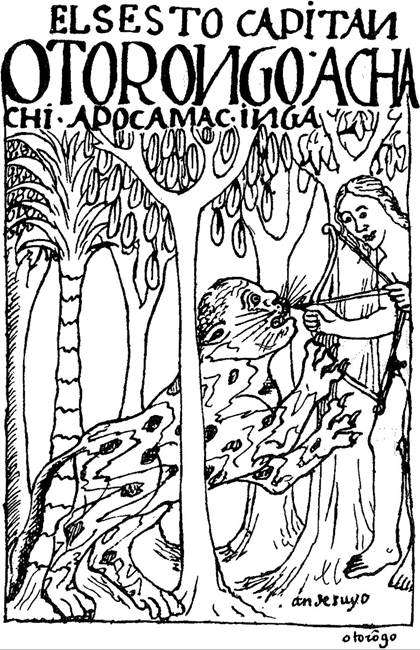
Figure 25.6. Felipe Guaman Poma de Ayala's depiction of Otorongo (Jaguar) Achache. Illustration from Felipe Guaman Poma de Ayala's 1615 chronicle.
them with subordinate highland populations.[1785] For example, in the Cochabamba Valley of what is today Bolivia, the ruler Huayna Capac settled colonists from several highland societies, intermixing households from ethnic groups so that each would be surrounded by people from other groups.[1786] The successful annexation of the maizeproducing parts of the valley was part of a larger state expansion project that included expansion into lower elevation lands where coca could be cultivated, a process that also involved expelling local populations.[1787]
Taken as the sum of its ecological parts, Inca economic strategy can be summarized as the investment of labor tribute to create and maintain imperial infrastructure, as well as the redirection of wealth—finished goods, and the materials and expertise necessary to produce them—to the ruling family and its close relatives. Provincial tribute records mention regional administrative centers as the final destination of staple surpluses, while fine wool, feathers, dyes, hardwood, coca leaf, and precious metal were sent along to Cuzco, where they were worked into fine craft goods by specialists resettled from the provinces.[1788] Skilled women (mamakuna) affiliated with the sun cult also engaged in fine textile work and the production of ritual goods.
In theory, wealth that accumulated or was produced at the capital belonged to the ruling couple and the state religion, although there is evidence that estates of earlier rulers also commanded resources and labor sufficient for such production.[1789] Wealth objects served as gifts to loyal subjects, but they were also deposited with the dead and offered to supernatural entities in religious rituals. It is difficult to reconcile eyewitness accounts of the wealth of Inca Cuzco at the moment of contact with the material record, as the imperial capital was plundered rapaciously by the members of the Pizarro expedition. Our material sense of Inca wealth is strongly influenced by objects taken from looted tombs on the Pacific coast, a region whose history of producing, consuming, and disposing of such artifacts contrasts significantly with other archaeologically known parts of the empire.