Military Dimensions of Inca Imperialism
Inca military power was initially expressed as an offensive capacity to invade the domains of neighboring groups and coerce them to subservience. Archaeological settlement patterns from the Cuzco region indicate that the Incas and some of their more populous neighbors lived in large, undefended valley-bottom settlements, whereas smaller communities were located atop ridges and prominent places affording visibility and natural defense.[1763] As noted earlier, this latter pattern of regional decentralization and defensive settlement is typical of most other parts of the Andean highlands in the centuries leading up to Inca imperial campaigns.[1764] The construction of defensive works reflects local elite military power at the level of the community, as well as some cases of supra-local confederations that could coalesce in troubled times.[1765]
Chronicles describe the first campaigns of expansion outside the Cuzco region as rare mobilizations that began with the Inca ruler mustering all available people and resources under his power.
This overwhelming force journeyed to a decentralized highland region, building roads, waystations, and bridges en route. Before attacking, Inca messengers went to local leaders, threatening them with destruction while simultaneously offering alliances and rich gifts (Figure 25.4).[1766] Some chroniclers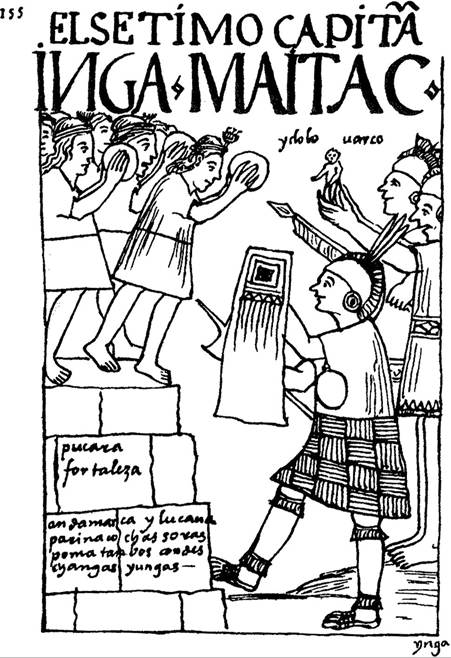
Figure 25.4. Felipe Guaman Poma de Ayala's depiction of an Inca attack of a local fortress.
Illustration from Felipe Guaman Poma de Ayala's 1615 chronicle.
state that the early campaigns were motivated by the Inca ruler's need to defend his title (Sapa Qhapaq, “The Peerless King”) from lesser rulers who pretended to be his equal, although other sources claim that the Incas viewed rival kings as a military threat and conquered them to preempt their imperial designs.
Alliances with one local group frequently led to bloody siege warfare against that group's local enemies, followed by reorganization of the local social order of defeated peoples.[1767] This often involved resettlement to undefended sites located closer to the valley floor as part of the introduction of a pax Incaica that signifies a general elimination of military defense as a meaningful source of local power. In several highland provinces, Inca armies returned to suppress revolts inspired by local leaders anxious to maintain their power and social relevance in the face of imperial consolidation.[1768]The chronicles mention the construction of military installations in some Inca campaigns—most notably the conquest of the coastal kingdom of Guarco—but the development of a defensive aspect of imperial military power seems to have followed a shift to direct administration that was not achieved uniformly across the empire.[1769] Administrative intensification frequently was an outcome of the suppression of provincial rebellions (particularly at times of royal Inca succession), and there are accounts of reconquest campaigns that included extended sieges, largescale battles, and vicious reprisals against defeated rebels. Several sources describe rebel leaders executed and their bodies defiled—cannibalized in the presence of their followers, heads harvested to be used as drinking cups, skin flayed and preserved to use as the heads of war drums. Some resistors were brought to Cuzco and thrown into pits filled with wild beasts. Those who survived the ordeal were stripped of their identities and were made retainers on royal Inca estates.
These brutal tactics seem to have been effective in suppressing open rebellion in the central highland provinces. At the time of the Spanish conquest, the imperial interior was largely free from the threat of large-scale uprisings or foreign invasions, and state infrastructure—roads, bridges, messenger posts, waystations, and storage complexes—functioned primarily to support the quick movement of strategic information and military personnel.[1770] Guards were placed at bridges and other key locations, but in most Inca provinces military power consisted of periodic flows of troops along the road system, rather than permanent garrisons.
Reducing a province to direct rule brought with it new tributary requirements that included military service by a subset of the population.[1771] For example, the four waranqa (1,000-household) units of the Chupaychu group of the Huanuco highlands were required to provide 400 households for the garrisons of the northern frontier (in the Chachapoyas region and Quito area), while another 328 households served as guards of state facilities and noble households (Map 25.2).[1772]At the frontiers, imperial expansion slowed to a more deliberately paced pattern of territorial annexation, fortification of the new frontier, and introduction of civilian population to hold the new province.[1773] By the early sixteenth century, the Incas viewed their frontier as a formal divide between highland civilization and savage peoples of the Amazonian slope, and expansion into this region emphasized pushing indigenous groups back to take their lands for populations already under Inca rule. Juan de Betanzos describes how Inca leaders played on highland fears of the lowlands and their inhabitants, using some Amazonian groups as enforcers against resistant highland subjects.[1774] As imperial frontier policies coalesced, military service also became more permanent and specialized, with certain highland
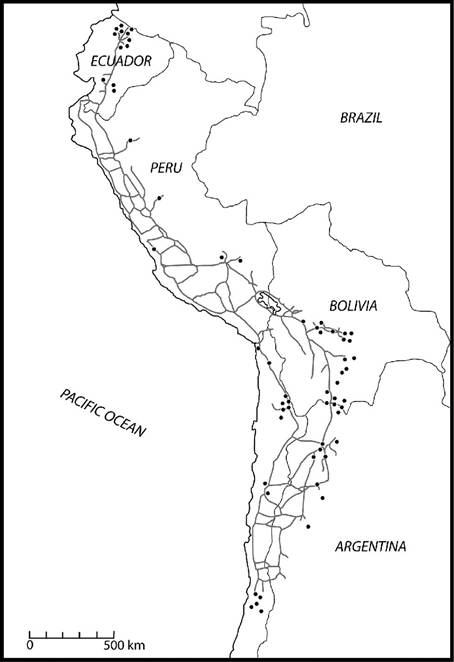
Map 25.2. Inca Fortifications.
Copyright: R. Alan Covey, How the Incas Built 'Their Heartland, Ann Arbor: University of Michigan Press, 2006. Map based on D'Altroy 2002; Hyslop 1984.
groups (especially the Chachapoyas and Canaris) providing long-term service in place of the rotational levies of highland farmers.[1775] The development of Inca militarism is highlighted in the civil war between Huascar, the last independent ruler in Cuzco, and his half-brother, Atahuallpa, the governor of Quito and commander of troops on the northern frontier. When Atahuallpa rebelled and unleashed his generals and frontier troops in the imperial interior, Huascar's generals were able to raise massive conscript armies, but Atahuallpas veterans soundly defeated the inexperienced farmers and herders who assembled to fight them, scattering them in a relentless southward campaign that captured all major highland centers lying between Quito and the Inca capital.[1776]