The Korean War
In August 1945 the Americans proposed to the USSR that their forces should share the responsibility for taking the Japanese surrender in the Korean peninsula. The division of their respective zones was demarcated at the 38th parallel, with the United States taking control of the south and Russia of the north.
The intention was that they would then work to implement the long-term plan that had been drawn up by the Great Powers for the political future of Korea, which was that it should come under a United Nations trusteeship that would prepare the country for eventual independence.On their arrival in Korea in the late summer of 1945 the Americans and Russians discovered that the imposition of a political solution from above was not so easy, for the Korean people were eager for immediate independence. Unfortunately, however, for the Koreans, independence was about the only matter upon which they could agree, for a vast variety of groupings emerged after the Japanese surrender, ranging across the political spectrum from far Right to far Left. This diversity of opinion was a direct consequence of Japanese colonial rule. One problem was that the period of Japanese domination had destroyed the authority and legitimacy of the traditional landowning elite in Korea which had shown a marked propensity to engage in collaboration. There was therefore no chance that a new nation could be built around the compromised monarchy or aristocracy (yangban). Furthermore, the Japanese authorities in Korea had been notoriously intolerant of resistance with the result that the Korean nationalist movement was atomized, its key members scattered into political exile in the United States, China and Russia. These activists drew up a number of radically different interpretations of why Korea had lost its independence in 1910 and varied prescriptions for how a strong, modern, independent state could be constructed in the future.
Some, such as Syngman Rhee, leaned towards a state-driven modernization akin to that pursued by the Guomindang in China, while others, such as Kim Il-Sung, proselytized communist solutions to Korea's problems.If the Koreans had been the masters of their own fate, it is possible that a centreleft coalition might have emerged from this confusion, but the presence of the Russians and the Americans made this an impossibility. In the Soviet zone preference was given to the formation of political groups based on the Korean Communist Party, particularly the faction controlled by Kim Il-Sung. In the American zone, authority rested with General John Hodge, who came to his post with no knowledge of Korea whatsoever. He saw his task as instilling political order, and was prepared to use the former Japanese colonial apparatus to achieve this goal. In so doing he broke with the centre-left factions, whom he saw as fomenting disorder in their desire for retribution against the collaborationist Right. Alienated from all but the right-wing factions, Hodge therefore looked to conservative former exiles such as Syngman Rhee to provide leadership.
Republic of Korea (ROK) The official name of South Korea. The ROK came into existence in 1948 under the leadership of Syngman Rhee.
Democratic People's Republic of Korea (DPRK) The official name of North Korea. The DPRK came into existence in 1948 under the leadership of Kim Il-Sung.
The result of Soviet and American policy was the emergence of rival groups from the North and South, each vehemently opposed to trusteeship and to any form of unification which would favour the other. In desperation the Americans in 1947 turned the problem over to the UN. The UN solution was for nationwide elections to take place under its auspices. However, the political representatives from the North rejected this idea on the grounds that the South would interfere with any free ballot. Thus the election that took place in May 1948 was restricted to the south, and as it turned out the ballot, as the north had predicted, was far from untainted.
The victor was Syngman Rhee, who in July became the first president of the Republic of Korea (ROK). The response in the north was that in September the Soviets passed control into the hands of Kim Il-Sung, who became the leader of the Democratic People’s Republic of Korea (DPRK).In understanding the origins of the Korean War, it is useful to refer to these two new regimes by their proper names rather than as South Korea and North Korea, for both governments saw themselves as the rightful leaders of the whole country and not just the geographical area that they currently administered. Moreover, for each, the prime goal was the destruction of the other and the assumption of leadership over the whole of Korea. In order to achieve this aim, from 1948 the DPRK supported an anti-ROK insurrection in the south by providing both weaponry and cadres. Meanwhile, the ROK attempted to provoke the DPRK into an open attack in the hope that it might win American support for an assault on the North. Thus well before the outbreak of full-scale conventional war, it is possible to see Korea as mired in civil war, a perspective that has been convincingly argued by the leading historian of the conflict, Bruce Cumings.
In 1948—49 the fighting in the Korean peninsula remained localized and inconclusive. The ROK was able to contain the insurrection against it, while the DPRK refused to be provoked into all-out war. In 1950, however, the situation changed drastically. Realizing that guerrilla warfare in the South was insufficient to topple the ROK, Kim Il-Sung appealed to Stalin in January 1950 to approve a conventional attack over the 38th parallel. Kim argued that, with the DPRK's armed forces boosted by the return of troops who had fought alongside the CCP in the Chinese Civil War, the military balance had swung clearly in Pyongyang's favour. Furthermore, he stressed that, as the ROK was only able to retain power through the use of repression, the DPRK's attack might spark a popular uprising against Rhee's government.
In such circumstances, Kim predicted that victory would take a matter of days rather than weeks, and would be so sudden that the Americans would have no time to intervene.Previously the Soviet leader had turned down such requests from Kim, but this time he provided a green light, the only proviso being that Mao should also concur. Stalin's motives are far from clear, as historians lack sufficient documentation to come to any definite conclusion. Some have speculated that he desired to divert American attention away from Europe, perhaps to pave the way for an attack on Yugoslavia. Others have seen the Soviet leader as still suspicious of Mao, and therefore keen to create a Sino-American confrontation that would draw China closer to the USSR. Another possibility is that, disturbed by American activities in Japan, Stalin desired to bring all of continental North-East Asia under communist control, thus denying Japanese militarism its traditional springboard for expansion and bringing home to Tokyo the cost of collaboration with Washington. Whatever his reason, Stalin's approval set the scene for a marked escalation of tensions within the region.
Having gained Mao's approval, on 25 June 1950 the DPRK launched its assault over the 38th parallel. In Washington news of the attack was met with horror. To Truman this act of unprovoked aggression was analogous to the tactics that had been followed by Hitler, and, drawing the lesson that appeasement was a morally and politically bankrupt policy, he decided that the ROK must be assisted. The Americans therefore took the ROK's case to the UN Security Council and in the absence of the Soviet delegation, which was boycotting its proceedings, a resolution was passed calling for aid to be given to Rhee's regime. Under the UN's auspices, American forces in Japan were ordered to Korea under the command of General MacArthur. In addition, in order to thwart any attack by the PRC on Taiwan, the American Seventh Fleet was ordered into the Taiwan Straits.
With American assistance the ROK forces were able to stem the DPRK offensive and by August had launched a counter-attack. The DPRK retreat became a rout when, on 15 September, MacArthur's forces initiated an amphibious landing at Inchon that threatened to cut the North's supply lines. As victory beckoned thought in Washington turned to the question of whether the UN should accept the restoration of the status quo ante bellum, or fulfil its mandate from 1947 and bring about the unification of Korea by advancing beyond the 38th parallel and completing the destruction of Kim's forces. The latter was a tempting proposition, as Stalin had failed to come to Kim's aid and it seemed unthinkable that the war- weary PRC would attempt to resist American might. In these circumstances Washington decided to roll back communism in Korea, and on 1 October ROK forces moved into the North.
see Map 10.2
appeasement
A foreign policy designed to remove the sources of conflict in international affairs through negotiation. Since the outbreak of the Second World War, the word has taken on the pejorative meaning of the spineless and fruitless pursuit of peace through concessions to aggressors. In the 1930s, most British and French officials saw appeasement as a twin-track policy designed to remove the causes of conflict with Germany and Italy, while at the same time allowing for the buildup of sufficient military and financial power to bargain with the dictators from a position of strength.
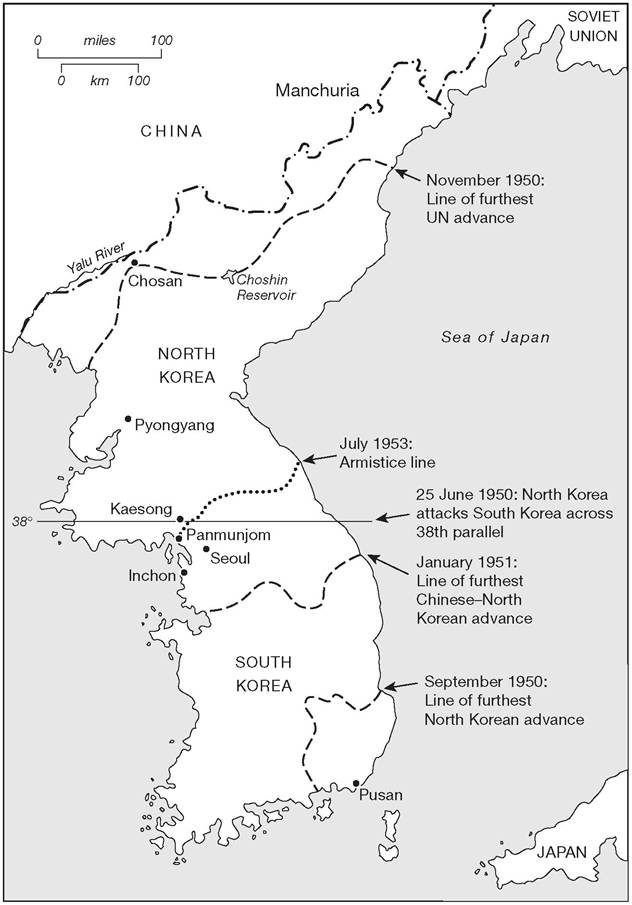
Map 10.2 The Korean War
Source: After Leffler (1992)
In retrospect, this was a foolish decision, for the crossing of the 38th parallel precipitated Chinese intervention. To Mao the American move into the DPRK, which came only three months after the US navy had started patrolling in the Taiwan Straits, was part of a broader plan to bring about a counter-revolution in China. From his perspective it appeared as though the Americans were readying themselves for a future three-front assault on China, attacking from Indochina, Taiwan and Korea, which might be combined with counter-revolutionary agitation within China.
The PRC therefore was faced with a choice: it could either wait passively for the United States to choose its moment to attack, or it could launch a pre-emptive strike to remove the Western presence from Korea before it was too late. From the first, Mao favoured the latter approach. His thinking, however, reflected more than purely strategic concerns, for he realized that to acquiesce in the destruction of the DPRK would damage the PRC's revolutionary credentials and thus undermine both its domestic and international standing. Another important factor was that Stalin was urging the PRC to intervene, although he failed to indicate clearly how much support he was willing to provide. As the Soviet Union was a guarantor of Chinese security, Mao believed that there was a need to demonstrate to Moscow that the PRC was steadfast in its allegiance to the communist cause.Therefore in October 1950 detailed preparations were made for intervention and the People's Liberation Army (PLA) began to infiltrate its forces over the Yalu River. In late November, with American intelligence having failed to pick up warning of the impending attack, the PLA launched a massive attack on the UN/ROK forces, forcing them to retreat beyond the 38th parallel. If any event set the tone of the Cold War in Asia, it was this unexpected attack, which revealed for the first time that the PRC was a very different creature to China under the GMD. This was a regime so radical and so confident of its military prowess that it was prepared even to challenge the might of the United States. Within Washington the reaction was one of shock, even generating loose talk of the need to use atomic bombs to stem the red tide and to widen the war to attack targets in China itself.
Luckily, the fear that escalation might activate the Sino-Soviet alliance led to restraint, and the war remained limited to the Korean peninsula. The conflict continued for another two and a half years. Armistice talks began in the summer of 1951 when it was clear that neither side had the ability to win a complete victory, but they soon became bogged down in endless discussions over the fate of Chinese and North Korean prisoners. Finally the war-weariness of the Chinese and the Americans meant that the deadlock was broken, and an armistice was reached in July 1953 with the border between the DPRK and the ROK only marginally different to that of 1950.
More on the topic The Korean War:
- Asia and the consequences of the Korean War
- ‘Roman way of war' in the title of this chapter is a variant of ‘Western way of war', the theory first articulated by Victor Davis Hanson that has been the subject of much critique, and which I do not accept.1
- CHAPTER 9 The War at Home: Toys, Media, and Play as War Work
- From European war to World War
- Capabilities for War and Operations Other than War
- during the russian-ukrainian war, which began in early 2014 and was somewhat misrepresented in Western media as a kind of Ukrainian “civil war,” rather than a Russian invasion, there emerged a number of supposedly new images of Ukrainian warriors.
- 50 War and Peace, and More War
- The state made war but war did not make the state
- No one is fool enough to choose war instead of peace—in peace sons bury fathers, but in war fathers bury sons.—King Croesus of Lydia (Herodotus I: 87)
- War or Just War