The opening to America and the death of Mao
Mao's desire to build a relationship with the United States was reciprocated by the new administration in Washington, led by President Richard Nixon, which took office in January 1969.
Even before announcing his nomination Nixon had affirmed that the United States could not go on pretending that a state which ruled more than a quarter of humankind did not exist, and that China could not be left in isolated hostility indefinitely. Once in office Nixon was also influenced by two other considerations, first, that better relations with China would reduce tensions in Asia and thus allow the United States to retreat from Vietnam, and second, that he could use the prospect of a Sino-American alignment to put diplomatic pressure on the Soviet Union, thus paving the way for detente.The normalization was a long-drawn-out affair, in part because events in Indochina, such as the American incursion into Cambodia in the spring of 1970, led to delays in the negotiations between the two sides. In addition, Mao faced some internal resistance to his new diplomatic revolution, most notably from Lin Biao, his over-ambitious political heir. Lin, however, steadily lost influence in 1970 and in 1971 died in mysterious circumstances, possibly after launching an abortive coup. The breakthrough in the talks came in July 1971 when Nixon's national security adviser, Henry Kissinger, travelled in secret to Beijing for talks with Zhou Enlai. This was followed in February 1972 by Nixon's visit to China and his meetings with both Zhou and Mao.
Republic of China (ROC) The official name for the government of China in Taiwan.
The Sino-American opening was a complicated process, because neither Nixon nor Mao had any intention of moving towards any kind of alliance or doing anything that would sacrifice diplomatic independence. For both leaders the normalization process was a limited but eminently practical expedient.
Both sides therefore recognized that there was no need to try to settle all of their differences and that, in fact, any attempt to do so could wreck the whole exercise. As a result they agreed to disagree over a large range of issues, most notably the fractious issue of Taiwan. The PRC's position was that Taiwan was nothing more than a renegade province of China. The United States, however, still recognized the Republic of China (ROC) in Taiwan as the legitimate government of the whole country. There were clearly no grounds for complete settlement of this issue, but it was possible for the United States to declare that it saw Taiwan as an integral part of China and therefore would not support its independence, while the PRC promised to pursue peaceful liberation, thus allowing the Americans an opportunity to reduce their forces on the island. The problem of Taiwan had one other effect which is often forgotten, namely that, despite Nixon's visit, the United States did not at this time open full diplomatic relations with the PRC.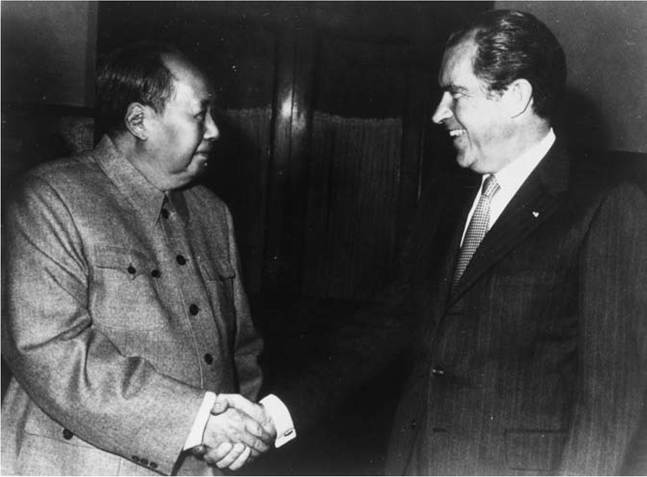
Plate 15.1 Mao and Nixon, February 1972. Chinese communist leader Chairman Mao Zedong shakes hands with American President Richard Nixon in Beijing during his visit to China. (Photo: Keystone/Getty Images)
The normalization process brought the PRC out of its international isolation in other ways as well. In 1971 the United Nations (UN) voted in favour of the PRC taking over the Chinese permanent seat on the Security Council. Then in 1972 the new Japanese prime minister, Kakuei Tanaka, followed Nixon's example and visited China. However, unlike the Americans, the Japanese were so entranced by the prospect of trading with the PRC that they were willing to break off relations with Taiwan and recognize the Beijing regime instead. Over the following years this practice became an international trend, leading to Taiwan's international isolation at least at the level of formal diplomatic ties.
There were, however, limits to how far China's position could change. Both in the United States and in the PRC obstacles meant that it was difficult to build on the foundations laid down in 1971—72. From 1973 the Nixon administration became mired in the Watergate affair, which naturally forestalled any further initiatives. Moreover, the weakening of the executive branch temporarily strengthened the hand of Taiwan's supporters in Congress. In the PRC further progress was hindered by the declining health of both Mao and Zhou and the attacks made on the latter by the Gang of Four. Zhou sought during this period to repair some of the damage caused by the Cultural Revolution and Deng briefly reemerged to help with this process. However, early in 1976 Zhou died and shortly afterwards Deng was again purged. Then on 9 September Mao himself passed away.
Mao's death clearly marked the end of an era in Chinese history. Ever since the foundation of the PRC he had dominated its political life by creating and then destroying the alliance with the Soviet Union, initiating the Great Leap, turning the people against the party in the Cultural Revolution, and finally in his twilight years making the opening to Washington. This undoubtedly constituted dynamic leadership but had anything been gained? Under Mao standards of education and health and the position of women in society had improved, but steady economic development had all too often been sacrificed to ideological principle. Moreover, his frequent changes of policy had come at a high human cost with many lives lost and shattered as a result of his arrogance and his predilection for unleashing violence in the cause of class struggle. In addition, his imaginative rhetoric and feel for brinkmanship might have brought China to international prominence, but the country was by no means a superpower, for it remained economically, technologically and militarily backward. Thus Mao may have been a great revolutionary but once in power he failed his people.
United Nations (UN)
An international organization established after the Second World War to replace the League of Nations. Since its establishment in 1945, its membership has grown to 192 countries.
see Chapter 14
Deng and the ‘Four Modernizations'
Association of South-East Asian Nations (ASEAN) Organization founded in 1967 by Indonesia, Malaysia, the Philippines, Singapore and Thailand to provide a forum for regional economic cooperation. From 1979, and the Third Indochina War, it took on more of a political and security role. Membership increased with the accession of Brunei in 1984, Vietnam in 1995, Burma in 1997 and Cambodia in 1999.
see Chapter 12
Khmer Rouge
The Western name for the communist movement, led by Pol Pot, which came to power in Cambodia in 1975. The new government carried out a radical political programme that led to 1.5 million deaths. In 1979 it was overthrown by Vietnam, but continued to fight a guerrilla war campaign into the 1990s.
Mao’s death left China at a crossroads, for it was by no means clear what would follow him. On one side there was the possibility that his removal from the scene might lead to a new phase in the Cultural Revolution with the Gang of Four taking power. On the other side of the political spectrum was the prospect that the more moderate policies which Liu and Deng had espoused in the early 1960s might now be revived. Mao tried to ensure that neither would be the case by making the relatively inexperienced party loyalist Hua Guofeng his political heir. At first Hua lived up to the expectations placed in him by turning on the Gang of Four almost as soon as Mao was dead. However, marginalizing Deng was not such an easy matter. Deng had many important supporters within the CCP and, moreover, stood as the figure who could deliver the one thing which most Chinese wanted — the end of the Cultural Revolution. With these attributes on his side Deng did not take long to sideline Hua, and in 1978 he emerged as the PRC’s new paramount leader.
Deng’s taking on of the mantle of leadership coincided with dramatic events in foreign affairs as Indochina once again slid into war, this time between proSoviet Vietnam and pro-Chinese Cambodia. Alarmed by what it perceived as Vietnam’s attempt to achieve hegemony in Indochina, which threatened to increase Soviet encirclement of China, the PRC negotiated a peace treaty with Japan ending the state of hostilities left over from the Sino-Japanese War, and cooperated with the Association of South-East Asian Nations (ASEAN) to support the Khmer Rouge and its allies. Most significantly, the United States, which was itself concerned about Soviet power in Indochina, finally decided to open diplomatic relations with the PRC and cut off its formal ties with Taiwan.
In some ways this was a fortunate harvest for Deng, for it strengthened not only the PRC’s international position but also his own domestic standing. More was to follow. Over the next few years Cold War tensions deepened even further, with the Soviet intervention in Afghanistan in December 1979 and the suppression of the Solidarity Movement in Poland. This benefited China because it meant that the Reagan administration in Washington, which had threatened to take a more positive view of Taiwan, was in fact forced through circumstance to deepen the American relationship with Beijing by, for example, sharing intelligence on Soviet activities in Central Asia.
The heightened tensions along China's borders did, however, reveal one major problem. In the winter of 1979 the PRC launched a limited incursion into the north of Vietnam in order to intimidate the government in Hanoi. The invasion, however, was not a success, for the PLA fought poorly and clearly suffered from inadequate material and organization. Here in microcosm was the main dilemma that China faced, that its efforts to exert influence in Asia were compromised by its technological and economic inferiority.
The desire to overcome China's relative backwardness was to prove to be the main hallmark of Deng's rule over the next twenty years.
His policy, which was first announced in 1978, was to push the PRC to engage in the ‘Four Modernizations' — of agriculture, industry, science and national defence. The first major changes came in agriculture, with a marked shift away from collectivization to cultivation based on private family plots, resulting in a substantial increase in productivity. For the long term, however, the most significant move was that state controls over industry were loosened, with private industrialists allowed to operate in a capitalist manner. In order to create rapid growth China also looked to outside assistance. This meant not only purchasing Western goods and technology, but also encouraging foreign companies to invest in China. In 1980 four ‘Special Economic Zones' (SEZs) were created, of which the most important was Shenzhen which bordered on Hong Kong. Foreign investors were allowed to establish factories in the SEZs and use cheap Chinese labour to produce goods for export.The PRC's pursuit of economic growth naturally affected the shape of its foreign policy: trade and investment, for example, became the cornerstone of its relationship with Japan. It also influenced the PRC's stance towards a number of territorial issues left over from the days of imperialism and civil war. One of these was the issue of the future of Hong Kong. The island itself and the peninsula at Kowloon were British in perpetuity, but the New Territories had been acquired by Britain as a ninety-nine-year lease in 1898. As the colony was not viable without the New Territories this naturally raised the question of what would happen in 1997. Owing to the need to eradicate China's past humiliation at the hands of the imperialists, Deng was determined that Hong Kong should be returned, but at the same time he recognized its value as a hub of capitalist trade and investment. To demand its complete integration into socialist China risked capital flowing out of Hong Kong, and therefore Deng negotiated the return of the colony under the auspices of a ‘one country, two systems' model, in which the territory would retain substantial autonomy. The agreement was sealed by the signing of a Joint Declaration in 1984. By accepting this compromise Chinese policy was also serving another function, namely trying to assure Taiwan that if it returned to the fold it too could prosper under the ‘one country, two systems' scenario. Reunification did not in fact make any progress, but the more conciliatory stance taken by Beijing did encourage the development of closer trade links between the PRC and Taiwan during the 1980s.
In the late 1970s and into the 1980s the PRC was therefore able to strengthen itself by throwing off the last vestiges of its years of international isolation and achieving high rates of economic growth. To a substantial degree it appeared that the country had turned its back on Mao and his legacy, even if in public due respect was shown to his memory. Some commentators even questioned whether the PRC could still be defined as a Marxist-Leninist state. Such assessments were, however, dangerously naive, for the CCP still reigned supreme and, moreover, still could not rid itself of Mao's ghost.
More on the topic The opening to America and the death of Mao:
- From the first permanent English settlement in North America to 1800, the character and causes of violence in Anglo-America revealed both continuities and changes.
- DEATH CRITERIA AND BRAIN DEATH
- Traumatic brain injury (TBI) is a major cause of death and disability in children. It is the leading cause of death in those over 1 year of age.
- The Opening of the South
- Reciting the Opening Formula Aloud (al-Jahr bi'l-Basmala)
- Opening. The Great Powers and the Elementary Forces of the World
- From the Opening of the Straits to Steam Navigation
- Opening: What World History Context for Rome?
- As we saw in the opening chapter, there are many ways of defining “empire.”
- Over the last three decades a resurgence of interest in Chinese legal history and the opening of archives for the Qing dynasty (1644-1911) has contributed to an outpouring of scholarship on interpersonal violence, homicide and capital punishment in eighteenth-century China.
- North America
- America's conundrums: hyperpower humbled
- Hinduism and Sikhism in America
- Russian Orthodoxy Colonizes America
- The unipolar moment: America at the apex
- Ukrainian History in North America
- The Church of England in Colonial America
- German Sectarians in British America
- Buddhism in America