Opening: What World History Context for Rome?
That is the question;2 and as the epigraph excerpted from the writings of Ibn Khaldun serves to indicate, the answer should be sought among the universal empires of Eurasia in general, and Muslim state-craft in particular.
But to substantiate this claim, first a little patience is required while we weigh the alternatives and, for a moment, turn from Khaldun to another set of reflections on the place of subject foreigners in the rule of empire, namely those of Cicero, the Roman lawyer, politician and man of (Latin) letters: “This law is for our allies; this right belongs to the foreign peoples; this is the fortress they have for their protection.” A modern skeptic might distrust the praise that the high-sounding rhetoric of the ancient statesman here lavishes on the Roman law establishing a tribunal for provincial subjects to prosecute extortionate administrators from the capital sent to govern their lands. “It may, to be sure,” Cicero immediately conceded in the speech claiming the right to represent the people of Sicily against their former Roman governor, Gaius Verres,1 Ibn Khaldun 1967, 124. This chapter attempts to develop an idea of the late Patricia Crone which she presented in 2006 and again at a conference in Vienna in 2008 organized under the auspices of the COST network, Tributary Empires Compared. The last time we had a chance to converse about the problem of empire was in 2011. That occasion saw us improvise an excursion to the palace of the Escorial while otherwise attending a conference in Madrid, a small transgression that I think of with gratitude, and now offer this analysis in the same playful spirit as a tribute to her work.
2 On the centrality of this question, see Pollard 2008.
Peter Fibiger Bang, The Roman Empire In: The Oxford World History of Empire. Edited by: Peter Fibiger Bang, C.A.
Bayly, Walter Scheidel, Oxford University Press (2021). © Oxford University Press. DOI: 10.1093/oso/9780197532768.003.0009. “be less strongly fortified than in the past, but if there is any hope remaining which may offer our allies consolation, that hope now resides wholly in this law.”[608]Against the basic fact of empire, law was often a feeble protection. Extortion was habitual, a part of empire's raison d'etre. In grand triumphal processions, victorious generals and their armies would parade through the streets of Rome while displaying vast amounts of plunder and captive slaves gained in the conquest of enemy territory.[609] Later, emperors would entertain the population of the capital with exuberant displays of the resources made available to the ruling people by empire. For games in the newly opened Colosseum of the early 80s ce, exotic animals were brought in from the furthest corners of the Earth to symbolize the boundless reach of Rome. Nothing less than a giant rhinoceros was once included in the thrilling spectacle, a distant marvel even among the wonders immortalized by Martial in a book of elegant miniature poems written to commemorate the performances in the arena.[610] Empire meant the imposition of hierarchy; and subjection was, in the ruling ideology, a mark of slavery.[611]
But if Roman political culture made little secret of, indeed celebrated, the violence and exploitation of empire, it nevertheless managed to forge a dialogue with subject elites, enabling brute force to give way to moderate, routine extraction. Cicero, as it turned out and much against expectations, was actually able roundly to defeat the extortionate governor in court. In the end, Verres simply gave up his defense and voluntarily went into exile. The speeches laying out the case still exist because they were published by the triumphant prosecutor as a monumental testimony to his oratorical powers.[612] Although, as a general rule, a rapacious governor might never expect to be held to account, there were some limits, and provincials could often find rival members of Roman aristocratic society to champion their cause, or simply to act as patrons for their interests.
The Roman ruling class spun a dense web of connections to provincial communities and to their leading families in order to secure their cooperation in running the empire.[613] Conquests were consolidated into a stable and enduring form of rule—so successfully, in fact, that Roman predominance in the greater Mediterranean region was to last for more than half a millennium and would come to be the paradigmatic case of empire.For better or worse, the Roman example has served as a touchstone for many, especially, but not solely, Western builders of empire. Later generations have seen themselves mirrored in the Roman experience and have sought to emulate its rich store of models. The very language and symbolism of empire has to a large extent been derived from the Roman paradigm. Russian czar or Ottoman sultan— Washington, Paris, London, or New Delhi—rulers and capitals alike articulated their identities in Roman style. In the contemporary general literature on empire, Rome simply represents the unavoidable archetype, the baseline from which analysis begins.[614] Everywhere traces of Roman monuments and texts can be found to have shaped and influenced the modern discourse on empire. Our opening text by Cicero, for instance, would rise to prominence and play a key role at a foundational moment for British colonialism. When the British parliamentarian Edmund Burke (1729-1797) set out to impeach one of the early governors of the newly acquired Indian colony, he naturally crafted his indictment on the model provided by the so- called Verrine orations. For more than six years, as the case dragged along, Burke staged himself in the House of Lords as a latter-day Cicero who would take Warren Hastings, cast as the Verres of his times, to task for his extortionate misconduct in the Indian colony: “The credit and honour of the British nation will itself be decided”;[615] “Let him fly where he will, from law to law. Law thank God meets him everywhere.”[616] The echo of Cicero's rhetorical figures and stylish ornamentation is hard to miss in Burke's sonorous sentences.
Just as in the case of his great predecessor, Burke insisted it was the very honor and credibility of the empire and its governing institutions that were at stake. A ruthless governor had brutally trampled the rights of provincial subjects and had violated both metropolitan, provincial, and natural law in the process. Empire carried responsibilities toward its subjects, and governmental abuse of power had to be checked.[617]Just as the Roman model was commonly mobilized to lend guidance to the colonial condition, so too perhaps Western colonialism might serve the modern historian as a useful foil to illuminate the ancient experience. Certainly, classicists, as educators of many colonial administrators of the nineteenth and early twentieth centuries, were prone to view the Roman Empire in light of the projects of their contemporaries. This is a baggage that the current practitioners of the discipline must continue to be aware of and tackle.[618] One way would be to learn and draw inspiration from recent trends in colonial historiography in order to explore new themes of research in parallel fashion for the Greco-Roman world. Rome sports its own gallery of liminal characters traveling to distant countries, reaching beyond familiar horizons and crossing cultural boundaries, a topic so prominent on the pages of modern postcolonial writing. Among the poems of Catullus, the reader will find lamentations for family members who died on foreign shores in the business of empire. Meanwhile, the trilingual inscription put up by the general Cornelius Gallus in Egyptian, Greek, and Latin on the Nilotic island of Philae boasts of his forays as a Roman governor across the first cataract deep into Nubia “where the arms of neither the Roman people, nor the kings of Egypt had previously been brought forward.”[619] Equally, the classicist may learn to discern the hidden voices, the indirect imprint left by subject cultures in the articulation of high imperial civilization, or notice the very “discrepant experiences” of empire among different segments of provincial populations.[620]
Yet to the world historian, the implicit reaffirmation of a narrative that sees the mantle of empire passing seamlessly from Rome to Europe, with the rest of the globe left on the side as a passive bystander, must be dissatisfying.
It offers an eerie reminiscence of the age of high colonialism that calls out for alternative storylines to be explored. Burke, it should be remembered, fell short of his Ciceronian precedent by losing the case and suffering the complete acquittal of Hastings. In the Roman- inspired call for justice, as his modern editor, P. J. Marshall has emphasized, Burke was not pointing toward the bureaucratic colonial state of the nineteenth century. Burke's critique was informed by an older, Christian vision of government: “We are all born in subjection, all born equally, high and low, governors and governed, in subjection to one great, immutable, pre-existent law... by which we are knit and connected in the eternal frame of the universe... This great law does not arise from our conventions or compacts. On the contrary, it gives to our conventions and compacts all the force and sanction they can have.”[621] That law, that fundamental force of order, depended in the eyes of Burke on the one true God and was the same for every person across the planet, including Indians.This ecumenic embrace of all the children of God had also grown out of the Roman Empire. When, in 167 bce, the Roman state had defeated the last of its major rivals, a decisive turning point had been reached, as the Greek historian Polybios immediately realized. Rome had acquired a hegemonic position in the greater Mediterranean world and no power remained that could successfully oppose the inexorable grind of its legions.[622] Over the next century and a half, the empire steadily expanded. Neighboring and contiguous territories were annexed one by one until the rule of the Romans had come to encircle the Mediterranean and unify what to them simply represented the world, the orbis terrarum. From then on, empire and ecumene— a Greek term for the civilized world—could, with only a slight conceit, be seen as the same. One world, one empire: all that was missing was one God to complete and sanctify the edifice.
Eventually a formula, based on the political elevation of Christianity, emerged to cap the gradual formation of a thin empire-wide cultural and civilizational discourse. The monotheistic creed of the Christians was adopted by the emperors of the fourth century ce to reaffirm imperial unity through a process that saw the institutional consolidation of the Catholic Church. Yet, as Garth Fowden has taught us, this story culminated not in Roman Christianity but in Islam, its monotheistic claim, and its conquests of Sasanid Persia, the Roman Near East, and North Africa. The caliphate had eclipsed the two great imperial powers of West Eurasian antiquity to impose its universal sway and to found a Muslim ecumene from Afghanistan to the shores of the Iberian Peninsula.[623]As a forceful impulse, monotheism was a product of a broader and deeper ecumenic trend in world history. The Achaemenid kings of kings had extended their power far beyond the old world of the Near Eastern Bronze Age to proclaim universal lordship over numerous, not to say all the, peoples.[624] The scale of empire had increased enormously and it was an indication that peasant populations were growing dense enough to sustain state-formation outside of the old, irrigation-based river valley civilizations. Universal empires began to form in a vast expansive movement across Afro-Eurasia. Alexander and the Hellenistic successor kingdoms, the Mauryan dynasty and Asoka in India, the Qin and Han dynasties in China—all of these belong to a group among whom Rome represents the western-most extension, as well as one of its most enduring and influential specimens.
In late antiquity, the quest for universal unity intensified and a virtual competition of monotheist beliefs emerged. Constantine, who is known as the Great in the history books, called a council of bishops to meet under his presidency in Nicea in 325. Their task was nothing less than to reach an understanding on the character of God and to define a creed to ensure a unity for the Church that would match the unity in the empire's government, which the mighty emperor had just restored in victory over his last remaining competitor for the throne. Not a dynasty meekly to stand behind their Roman rivals, the Sassanians of Persia soon also found themselves hosting debates between the several universalistic creeds in their realm.[625] Eventually, Islam emerged from this environment in the seventh century, and proclaimed its supremacy with all the backing of successful arms. At the much later court of Akbar (r. 1556-1605), who consolidated the Mughal Empire in India, debates were still famously hosted in this old Persian style. Here Zoroastrians, Christians, Jains, and Hindu sages were cordially invited to engage in discussion with representatives of the sundry varieties of the politically dominant Islam about the nature of God and the true faith. Themselves Muslim, the Mughals searched for a new ecumenic dispensation that would allow them to rise above dissention and embrace the varied religious sects and communities of faith under their rule.[626]
It was, therefore, more than mere coincidence that the other main text upon which Burke chose to rely in constructing his argument against Hastings was a recently published translation from Persian that he referred to as the Institutes of Tamerlane. Penned in seventeenth-century India, the text reflected the pride which the Mughals took in their descent from Timur; they presented themselves as world-conquering rulers in the fashion of the fabled Central Asian lord. As a mirror for princes, the text narrated Tamerlane’s conquests and set out his principles of ideal rulership. With these in hand, Burke launched a scathing attack on the notion of Oriental despotism that succeeding generations of colonizers would increasingly come to think of as characteristic of Asian societies. But the great realms of the East, he objected, were not governed according to arbitrary and despotic standards, no more than the West. In the discussion of Mughal kingship, he found a set of principles that were fully compatible with Cicero’s appeal to a just, imperial government respecting the rights of their subjects.[627]
If one of the tasks of world history is to provincialize the old European master narrative, some might think this would require us to marginalize the Roman experience.[628] However, that would be a mechanical, not to say unthinking response and cannot possibly constitute an adequate answer to the challenge. Sporting probably the biggest city in the world up to that point, the largest standing army for centuries to come, and one of the most extensive and enduring empires, it simply will not do to relegate Rome to a modest, eccentric place outside the main arenas of history.[629] Rather, the intuition of Burke should serve as a guide to recontextualize the position of Rome and explore the old realm less as the precursor of European colonialism than as a member of the group ofvast Eurasian universal empires. In contrast to these latter polities, European colonial empires never enjoyed a Polybian moment where, in ecumenic fashion, they could suspend competition and swallow their neighbors. On the contrary, they were heirs to the Reformation of the sixteenth century that finally destroyed the ecumenic aspirations, surviving from antiquity, and locked their metropolitan centers into enduring competitive and destabilizing struggle.
To gain some analytical distance on this paradigmatic empire, then, the history of Rome might usefully be reframed in the context of the far-flung ecumenic realms that bestrode the great Afro-Eurasian landmass for hundreds of years.[630] With the current economic and political rise of China, the Qin/Han dynasty empire and its several later successors provide an attractive template against which to measure Rome.[631] However, if Islam can in some sense be seen as a the logical conclusion to the ambitions of the late Roman and Sasanian worlds, then its history may offer a no less illuminating and perhaps even closer set of comparisons.[632] From the caliphate of the formative era to the mature periods of the Ottomans and Mughals, this chapter will draw mainly on the Muslim imperial experience for examples and parallels to reflect and structure the discussion of Rome. A leitmotif of Roman history is the manner in which the conquering city-state, located in central Italy, was eventually undermined by the acquisition of extensive empire. Instead, the provinces and their populations gradually took over the reins of power, until by late antiquity the city on the Tiber was completely sidelined and ceased to be the seat of government. Meanwhile, the empire was both conquered and governed from the previous margins. Out of the dominion of a vigorously expansive power had emerged a civilizational commonwealth. This theme is closely mirrored in the history of Islam.
In the quote that opened this chapter, the fourteenth-century Maghrebi historian, Ibn Khaldun, summarized the Muslim imperial experience as one in which the Arabs had progressively lost power as their leaders increasingly began to rely on personnel from the conquered territories. Only here, Patricia Crone remarked in a lucid analysis, the provincial takeover transpired much faster than in the case of Rome. Little more than a century was required for the process to run its course, punctuated by two revolutions. The first of these saw the consolidation of an imperial monarchy under the Umayyads and the transfer of the capital from Mecca/ Medina to Damascus. The second brought the Abbasids into power, assisted by an army recruited from the old Persian population, and saw the foundation of a new capital, Baghdad, not far from the former seat of the Sasanians at Ctesiphon. To be sure, one may be struck by the speed of the provincial takeover in the Arab case, but the underlying similarity of the process seems more fundamental.[633] If Islam facilitated the absorption of provincials through conversion and Arabs therefore quickly found themselves a minority within the ruling society, then it would still be a long time before a majority of the conquered had become Muslim. Conversely, Rome might have been a little slower in granting citizenship to provincials. After some three centuries of stable imperial hegemony, no more than perhaps a quarter of the male population had obtained the status of Roman citizen, empire-wide. Yet, an African was already on the throne, the senate approaching a majority of members hailing from provincial families, and Italy had long since ceased to be the main recruiting ground for the army.[634] A Khaldunian perspective on Rome, in other words, would focus on the challenges involved in making a transition from unstable—successful, but disruptive—conquest regime. It would also emphasize,
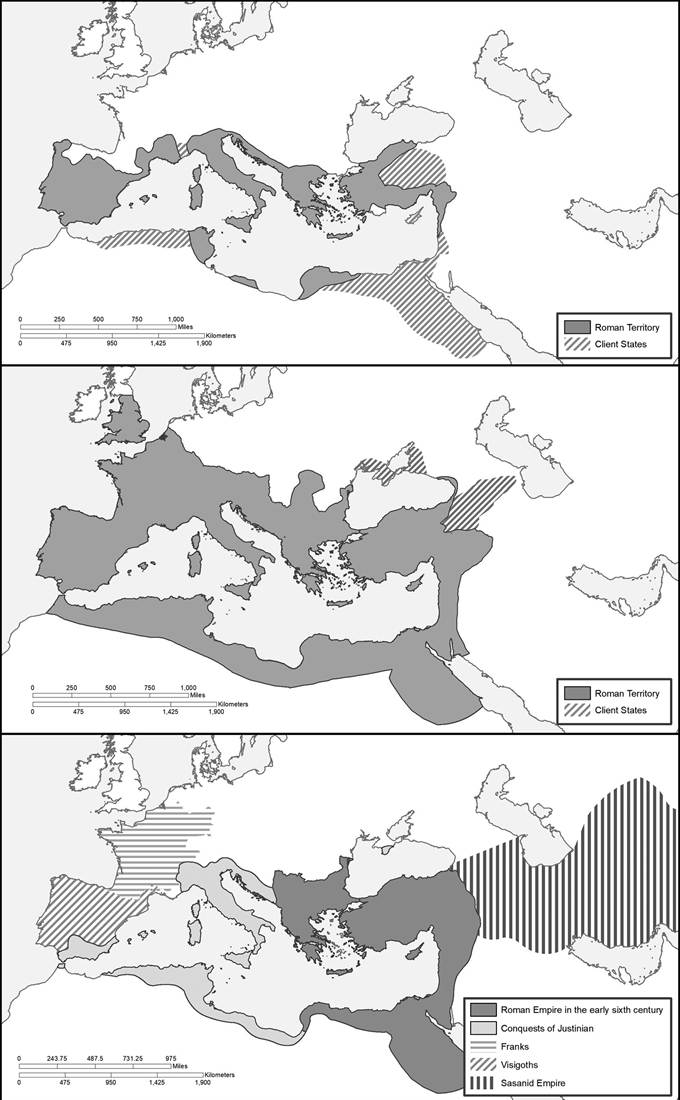
Map 9.1. The Roman Empire: The Three Phases of Imperialism. (1) 60s BCE. (2) Second Century CE. (3) Sixth Century CE.
Copyright: Peter Fibiger Bang with Jonathan Weiland.
in the process of imperial consolidation, the strong link between absolutist monarchy and, in place of the original conquering group, an increasing reliance on segments of provincial societies to maintain power. Conquest, monarchical consolidation, and provincial takeover, this is a set of analytical themes that, in fact, neatly corresponds to the three main chronological phases into which Roman history has traditionally been divided: the Republic (509-31 bce), the so-called Principate (i.e., the imperial monarchy of Augustus, 31 bce-235 ce), and finally late antiquity (3rd-7th century ce).[635] These periods will provide the structure for the following discussion of Rome and its empire.
More on the topic Opening: What World History Context for Rome?:
- Opening. The Great Powers and the Elementary Forces of the World
- From the Second World War to the Treaty of Rome
- Bang Peter F., Bayly C.A., Scheidel Walter (eds.). The Oxford World History of Empire. Volume Two: The History of Empires. Oxford University Press,2020. — 1352 p., 2020
- Part Two Ancient Rome Moneta: Sacred Memory in Mid-Republican Rome*
- Ukrainian History in Context
- Over the last three decades a resurgence of interest in Chinese legal history and the opening of archives for the Qing dynasty (1644-1911) has contributed to an outpouring of scholarship on interpersonal violence, homicide and capital punishment in eighteenth-century China.
- THE CONTEXT IN TERMS OF CULTURAL HISTORY AND THE STUDY OF RELIGION
- VI World History
- General Introduction: Violence in World History
- Alpers Edward A.. The Indian Ocean in World History. Oxford University Press,2014. — 182 p., 2014
- The period covered in this chapter, from the death of Herod the Great, King ofthejews, in 4 все to the end of the secondjewish war with Rome in 135 ce, is a period of lingering and terminal crisis in the history of Israel