The Sokoto Caliphate
What we now call the Sokoto Caliphate in the nineteenth century covered an area approximately 1,000 miles from west to east (from Dori in Burkina to Maroua or Tibati in Cameroun), and about 450 miles north to south (from Tahoua in Niger to beyond Ilorin in Nigeria).
In nineteenth-century terms, that area was expressed as four months' journey west to east and two months north to south.[2456] In fact, if a traveler could keep up the normal average of 15 miles a day, he'd do it in half the time; but his beasts of burden—horses, mules, donkeys, oxen—were the limiting factor. Specialized runners wearing sandals were used for swift messaging, not post horses; and the routes between major cities could be as narrow as two feet wide.[2457] The caliphate had some major rivers—the Niger and the Benue being the largest, but they were not massively important, either militarily or for trade: when in flood they were a barrier, but canoes could ferry passengers across. There were no “gun boats.” Nor were there bridges over rivers in the northern parts of the caliphate: travelers waded, or waited.Overall, the population density of the whole area remained low, with 50 percent child mortality not uncommon, and malaria (especially in September- October) and epidemics (usually in May) such as cerebrospinal meningitis and measles causing regular rises in mortality. Labor could be seriously affected by guinea-worm, with
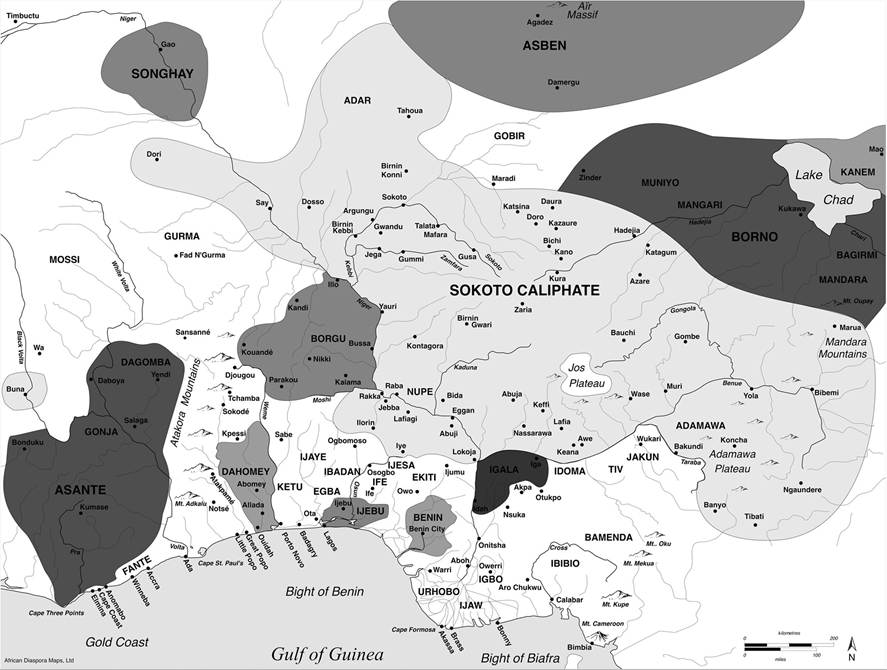
Map 40.1. The Sokoto Caliphate.
Source: Lovejoy, 2016, Jihad in West Africa during the Age of Revolutions, map 3.2. Copyright: Henry Lovejoy.
THE SOKOTO CALIPHATE 1085
river blindness reducing access to water-side farms; smallpox and leprosy required isolation in separate settlements. Islamic and herbal medicine was available: it was most effective for the everyday repair of wounds, but of little use for diseases of infancy.
Severe mental illness was treated traditionally by specialists, who used heavy logs to restrain patients, followed by spirit-possession therapy. There were no formal hospitals (of the classic Islamic kind), though key Islamic books of recipes and prayers were consulted, and some texts composed: the correlation between Middle Eastern and West African plants could be problematic. It seems that the reproduction rate of the slave population remained relatively low; slaves did run away, but mass slave revolts never occurred. Up to almost the end of the nineteenth century, labor thus remained short and the market in slaves made up for the shortfall. Settlement within walled towns and fenced villages offered better security but made infections spread unless purdah was strict (servants, however, were never in purdah). Locally, the success of an emirate or of the caliphate as a whole was judged by the scale of a famine or an epidemic: responsibility for the health (in its widest sense) of the Muslim jama'a lay with the state's rulers. A disaster was seen as Allah's way of punishing them for their failures: thus the overt piety of an emir or a caliph was essential for the well-being of his people. The caliphate's initial success was seen as proof of Allah's approval of their jihad.Though the area of the caliphate was vast, it was broken up by large zones of woodland or waterless bush in which dissidents, radicals, and robbers could take refuge and use as a base for raiding into caliphal lands. Ranges of hills or even major plateaus might afford territory which was effectively closed to the caliphal cavalry (which used large horses rather than mountain ponies). Non-Muslims and runaway slaves created independent communities there (with new local languages), and kept caliphal forces at bay or agreed to treaties of peace.
The caliphate was set up initially following a successful jihad (1804-1808) waged against the Muslim rulers of the great trading states of Hausaland—Gobir, Kebbi, Katsina, Kano, Zaria, and Daura; the rulers were based in large walled cities, several centuries old, surrounded by a densely populated and farmed hinterland consisting of walled or stockaded villages.
The jihad's leader, Shaikh ‘Uthman ibn Fudi (or Shehu Usuman Dan Fodio, in Hausa), was a rural preacher and Sufi calling for Islamic reform.[2458] He was from a long line of scholars, with a large network of scholarly kinsmen in the region. But his preaching attracted the rural youth, some to convert to Islam but more to improve their knowledge and practice of Islam. His explicit focus was on properly re-establishing the practice of Shari‘a law and insisting upon justice for Muslims in everyday life: as he said in his book Bayan wujub al-hijra (p. 142), quoting the anonymous Diya’ al-khulafa, “A kingdom can endure with unbelief but it cannot endure with injustice.” His followers were not initially encouraged to take up arms, yet as the movement grew, so did conflicts with the existing Muslim authorities whom Shaikh ‘Uthman was criticizing. Eventually, when the emir of Gobir was known to be preparing an expedition against the shaikh, the shaikh was formally elected the imam of the community and he declared formally a jihad; but first he organized a hijra (as the Prophet Muhammad had done) to a place of greater safety. There, the first attack against them took place, and the Community won.Many of his students, unused to fighting, died from their wounds in the series of battles that followed; others perished from disease and starvation. But the jihad then attracted ex-pastoralist freelance fighters who helped the reformers finally win the war, but at the expense of the Islamic rules the jihad commanders sought to enforce. Expectations of fine loot (silk clothes) and young women as captives ran high.[2459] Four of the major cities were evacuated by their Muslim Hausa rulers without any siege; they sought to resettle elsewhere. The new Muslim Imamate was securely established.
While Shaikh ‘Uthman and his equally scholarly brother ‘Abdullah were in charge of the area around Sokoto, they had exported the enthusiasm for jihad to other scholars across the wider region, and issued white flags of command to selected scholars (not “chiefs”), most of whom were Fulbe (and not Hausa or Wangarawa, though many of both groups were Muslim scholars based in cities).
The flag-bearers then took over the cities and states from their previous (mainly Hausa) rulers, and established emirates that recognized the twin leadership of the Shaikh ‘Uthman or his heirs at Sokoto, and his brother Abdullah and his heirs in nearby Gwandu. Any new appointment to the command of an emirate had to be done through either Sokoto or Gwandu. The area that was won by the jihadi forces was so great that by about 1810 the overall command was split into four segments: in the shape of an X, the northern and eastern quarters of the entire caliphate were allocated overall to Shaikh ‘Uthman's son Muhammad Bello, with the northern quarter under the amir al-jaish (“commander of the army”), while the western and southern quarters were under Shaikh ‘Uthman's vizier and amir Abdullah ibn Fudi, who had under him another son of Shaikh ‘Uthman, Abdullah's nephew Muhammad al-Bukhari, in charge of the southern quarter.[2460] Over this dual mandate presided the elderly Shaikh ‘Uthman as imam of the new state. By 1815, he was sick; in 1817 he died—and his son, Muhammad Bello, took over the overall command (to his uncle's dismay) and became amir al-mu'minin (“commander of the faithful”), or caliph.The death of Shaikh ‘Uthman gave rise to widespread revolts by jihadi Muslims against Shaikh ‘Uthman's successors. The personal homage paid to Shaikh ‘Uthman as the imam of the entire Muslim community lapsed on his death—and this rejection of successors occurred in several emirates as well. In short, from ca. 1817 on, for the next decade a second jihad was fought, to re-establish the right to rule. It is this caliphate that was reaffirmed from the 1820s on that we really label the Sokoto Caliphate; and, importantly, it refers primarily to the emirates that were administered from Sokoto, that is, the eastern emirates that constitute the core of modern northern Nigeria. The southern emirates under Gwandu (namely Nupe and Ilorin) are normally included in the “caliphate,” but the western emirates which under colonial rule largely fell to the French are rarely analyzed, at least not by Anglophone researchers.
In this chapter, I will focus on the great eastern emirates and how they were administered and controlled: it is these emirates that the Britons called the “Fulani Empire,” and in 1914 turned them into the “Northern Region” of the new country they called Nigeria. Though the caliphate as a whole extended across several colonies, for practical reasons I will focus here on only the Nigerian elements of the Sokoto Caliphate.The eastern emirates were not all homogeneous: for example, the far-eastern ones spoke Fulfulde as their lingua franca and had large herds of cattle; these emirates had been set up amid large numbers of non-Muslim groups, who were encouraged not to convert to Islam but to remain tributaries.[2461] By contrast, the great central emirates continued to speak Hausa as their lingua franca and farmed on large plantations or traded, using caravans and huge markets. Both sub-cultures had vast numbers of first- or second-generation slaves acquired from non-Hausa and non- Fulfulde speaking populations; it is they who turned both Hausa and Fulfulde into a local lingua franca. But the formal language of the caliphate, used in worship as well as in correspondence, was classical Arabic; it was taught to the elite young, but the majority of the population (including women) used a lingua franca. By ca. 1850, the language of even the elite in Sokoto had become Hausa; jihadi poems in Fulfulde then needed translating.
The polity we know as the Sokoto Caliphate extended westward as far as Dori (now in Burkina) and south to beyond Ilorin: these western and southern quarters of the caliphate fell under the direct administration of Gwandu, whose emir was subordinate to the caliph in Sokoto but traditionally autonomous as descendants of Abdullah ibn Fudi, the junior brother of the Shaikh ‘Uthman and a very notable scholar in his own right. Gwandu never exerted its authority over either the Lamido (emir) of Liptako at Dori or the emir at Say, except letters announcing changes of ruler were sent to Gwandu and acknowledged by them.[2462] Gifts were sent, too, but no military or legal involvement seems to have taken place.
In short, both the rulers at Dori and Say were concerned to confirm their legitimacy by recognizing the amir al-mu'minin through their allegiance to the emir at Gwandu. The ultimate authority of Shaikh ‘Uthman was sufficiently significant, especially for pious Fulbe in the region. Interestingly, even the new emir of Masina at Hamdullahi, having built up his state militarily, then offered to recognize the overall suzerainty of Shaikh ‘Uthman, but as Shaikh ‘Uthman died before Masina's formal recognition took place, at his city of Hamdullahi, Shaikh Ahmad (though himself a very pious Pullo) withdrew his recognition of Sokoto/Gwandu and declared himself an independent caliph—to the annoyance of Shaikh ‘Uthman's heirs in Sokoto and Gwandu.[2463] But as many Muslims threw off their allegiance to Shaikh ‘Uthman's heirs at this time, too, Hamdullahi's decision to do the same is perhaps not surprising. Nonetheless, the emirs at Dori and Say (both Pullo) piously continued their recognition of Gwandu throughout the nineteenth century.