Turning Cortes into Columbus
On the walls of the grand staircase in the old Mexican embassy in Washington, DC there is a captivating but perplexing mural. A visitor climbing the stairs is faced with a depiction of the Aztec capital city of Tenochtitlan, a peaceful scene of settlement, agriculture, artisanry and family life.
Painted in the early twentieth century, this romantic rendering faithfully reflects how the Aztecs were represented by the great Mexican muralists of the early decades of the century.But that idyll is a calm before the storm, for on the wall to the left the Spanish conquistadors are advancing. Soldiers, priests and administrators row to shore from an oversized sailing ship - symbolically larger even than an Aztec pyramid - and, on land, one invader plants a cross while another wields a sword. That red- bearded conquistador with a sword is recognisable as Pedro de Alvarado, a captain in the conquest wars against both the Aztecs of Mexico and the Mayas of Guatemala, a man whose reputation for violence has survived to this day. One might therefore expect the figure towering over the scene to be Hernando Cortes, the leading Spanish captain of the conquistador expedition that destroyed Tenochtitlan - and indeed such was the muralist’s original plan.
But after Mexico became an independent nation in 1821, Cortes became unpopular, an uneasy symbol of the colonial past that Mexicans were putting behind them; and after the Mexican Revolution that began in 1910, his unpopularity increased. Roberto Cueva Del Rio, the Mexican painter who began the mural in 1933, intending at first to depict Cortes, decided by the time he completed the work in 1941 to replace the infamous conquistador with Christopher Columbus - a more neutral figure, who could be depicted in non-military clothing, holding an unfurled banner rather than a sword. The inclusion of Columbus would have made sense - and still makes sense - to local US visitors to the embassy.
For in the nineteenth century the Genoese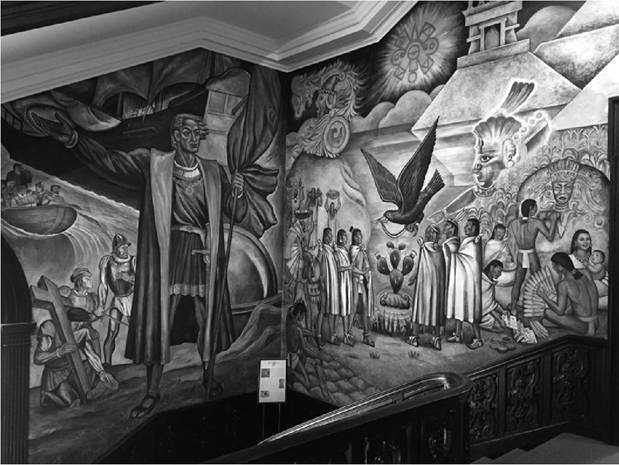
Figure 7.1 The stairway corner separating Columbus and the Spanish conquistadors from the Aztecs and their capital city of Tenochtitlan; mural painted by Roberto Cueva Del Rio in 1933-41 in the Mexican Embassy in Washington, DC, now the Mexican Cultural Institute.
discoverer of the New World was appropriated by the United States as a patriotic icon, a founder of ‘America', depicted in dozens of statues and paintings in public places across Washington, DC.[223]
Thus for North Americans, those of the United States and Mexico alike, substituting Columbus for Cortes emphasised discovery over conquest, exploration over invasion, peaceful encounter over violence. While Columbus's inclusion in the embassy mural is therefore initially discordant - his transatlantic voyages of 1492-1504 did not touch upon the Aztec Empire, which was not discovered by Spaniards until 1519 - it nonetheless invokes a pair of important themes for this chapter. First, I argue that we can better understand the wars of invasion and conquest that swept the Caribbean, Mexico and Central America in the half-century after 1492 by viewing them as part of a single process - albeit a complex, multi-staged one. The point is not to assign responsibility to Columbus, but to emphasise that the historical phenomenon that would bring upheaval to Aztecs, Mayas and other Mesoamericans began in the decade of Columbus's early voyages.
Second, the modern invention of Columbus as a US patriotic icon, eclipsing Cortes as a problematic figure, prompts us to ponder what it was about those wars that causes discomfort even centuries later. The answer is not simple, but for our purposes a simple one will act as a reasonable focus: violence. Those wars were characterised by multiple forms of violence above and beyond the violence of battlefield casualties or other military encounters.
Invasion and colonisation are inherently violent, but in the case of the Americas the invaders brought new diseases that devastated indigenous communities. They also failed to respect the indigenous tradition of a war season, thereby disrupting agricultural cycles and creating famine. Their demand for labour and their insistence on the abandonment of religious, marital and other cultural practices prompted further social, political and economic disruptions that often had violent effects on indigenous families.Above all, the conquistadors and early generations of colonisers enslaved indigenous peoples by the hundreds of thousands. Under Spanish law, it was illegal to enslave ‘Indians', but two loopholes were mercilessly exploited. ‘Indians' could be branded and sold if already enslaved by other ‘Indians', in which case they were not freed but ‘rescued' through enslavement to Spaniards. They could also be taken as slaves if they could be classified as rebels against the Spanish monarch. Fighting-age men were often slaughtered, but women and children were routinely enslaved and sold at auction or relocated away from their home towns - even as far away as Spain. There was a brisk traffic in young indigenous girls as sex slaves; one such victim, Malinztin or Malinche, achieved some status and lasting fame as Cortes's intepreter, although her story - and thus that of the trade in general - has been distorted into one of opportunism (by her) or romance (she bore him a son).[224]
It is thus hard to imagine there was a family in the Caribbean or Mesoamerica, let alone a village, that was not impacted, if not torn apart, by one or more of these forms of violent disruption. Indeed, the violence of the invasion was so multifaceted and widespread that it is has even been suggested that we debate categorising it as genocidal.[225]