Widening and deepening in the shadow of the Cold War
Enlargement is a central part of the story of European economic integration, but it was by no means pre-ordained. For four decades after the Treaty of Rome the Cold War division of Europe set clear parameters as to how ‘wide' Europe could become.
Meanwhile, different notions about the direction and the nature of European integration, and particularly the degree to which it should be a political as well as an economic process, made a number of states reluctant to join the EEC. That some countries, particularly France, were bent on using the EEC to further their own nationalist agenda, rather than succumb to the loss of national sovereignty that true integration necessitated, cast an additional shadow over European integration in its first decades.France's president from 1958 to 1969, Charles de Gaulle, symbolized this tendency. Although he disliked the federalist elements of the Rome Treaty, de Gaulle did not challenge it directly. Instead, he sought to use the EEC as a means of advancing French power. EURATOM, for example, was quickly sidelined in favour of France's own nuclear programme. De Gaulle's efforts to portray France as the leader of a continental European bloc did little to further the integration process. Nor did his insistence on the centrality of the CAP, which granted significant subsidies to French farmers, endear him to his fellow Europeans. Eventually his intransigence led in 1965—66 to the ‘Empty Chair' crisis, during which France boycotted the meetings of the Council of Ministers — the highest body and executive arm of the EEC — for a six-month period. The solution to what amounted to the first serious internal crisis within the EEC was the so-called Luxembourg Compromise of 1966 which, in essence, gave France a veto right over such key issues as agricultural policy. Following this compromise, the EEC was able to complete a customs union in 1968, earlier than the Rome Treaty had required.
This, perhaps more than anything else, signified the emergence of the EEC as an important trading bloc with significant bargaining power on tariff and trade matters vis-à-vis the United States.De Gaulle's dominance of French politics not only prevented any rapid moves towards further integration, but also acted as an obstacle to EEC enlargement. Concerned at the prospect of Europe's and France's relative loss of power vis-à-vis the United States, de Gaulle was determined to pursue a more independent line in foreign policy, where French political and military power would be supplemented by the vitality of Western European economic growth. Naturally, de Gaulle was jealous of any development that might threaten to undermine France's revival, and it was this that led him to oppose an enlargement that promised a substantial enhancement of the EEC's economic strength but a diminishing of French influence — the accession of Britain.
In the early to mid-1950s, with its empire and associated trade links still largely intact, Britain had been distinctly lukewarm about European integration. It recognized the latter's political potential for solving the German problem, but felt little need to become directly involved. However, by the late 1950s, with decolonization under way in South-East Asia, the Middle East and Africa, Britain looked again at the idea of expanding its trade links with Europe. Its first move was the creation of the European Free Trade Area (EFTA) in 1960. As the name implies, EFTA's purpose was to promote free trade among its member countries without any forging of institutional, systemic or political integration. With seven members (Austria, Denmark, Great Britain, Norway, Portugal, Sweden and Switzerland), EFTA was not inconsequential as a trading zone, but it was handicapped by the fact that less than a year into its existence, the largest EFTA member, Britain, applied for membership of the EEC. For the government of Harold Macmillan, the Outer Seven (as EFTA was called) had always essentially been a bargaining chip that was intended to obtain better conditions for entry into the Inner Six of the EEC.
De Gaulle, however, had no intention of allowing British membership of the EEC. The entry of such a sizeable political, economic and military Power clearly had the potential to clip France's wings. Moreover, de Gaulle was not convinced that Britain was sincere in its sudden conversion to the European ideal, believing that it would merely act as a ‘Trojan horse' that would in reality do America's bidding. Thus in 1963 de Gaulle announced that France would veto British entry. In 1967, when the government of Harold Wilson put together a second bid for membership, de Gaulle declared himself still unconvinced and repeated the veto. It was only with de Gaulle gone from the scene that Britain, along with Denmark and Ireland, finally negotiated its way into the EEC in January 1973. Building on the foundations of the customs union established five years earlier, the EEC was now, with its three new members, clearly on its way to becoming a key player in the world economy. Thus, while the Americans may have officially promoted further integration and Britain's entry into the EEC, they were by 1973 beginning to rue the results of their sponsorship. Following the entry of the new members, Time magazine marked the event with the headline ‘America's new rival', and for the next two years relations between Washington and the Western European capitals went through a difficult patch.
In the subsequent decade and a half the EEC continued its widening and deepening. The 1980s saw southern enlargement as Greece (1981), Portugal and Spain (both in 1986) became members. All three had moved from authoritarian to democratic governments prior to joining; thus the southern enlargements set a precedent: membership of the integrated European community became a means of solidifying democratic rule in new member countries. In the post-Cold War era, a variation of this argument would often be used to justify the entry of the former Soviet bloc countries into the EU.
The latest enlargements were significant, but it was the ‘deepening' of European integration that was the truly distinctive feature in the new wave of integration.
One important development was the push towards direct democracy. In 1979 the European Parliament (EP), which had started its life in 1952 as the Common Assembly of the ECSC, held its first direct election. Until then, the representatives of the national assemblies had selected the Parliament's members. Since 1979 the EP has grown in size every time new member states have been added. It has also gradually grown in importance by acquiring continent-wide legislative powers and can no longer be described as a mere ‘talking shop'. Nevertheless, the EP's significance continues to be hampered by its sheer size (capped at 750 members in the twenty-first century), and the democratic deficit created by the geographical distance of its headquarters in Strasbourg from most voters. Nor does the constant decline in voter participation in EP elections (45 per cent in 2004) augur well for the success of this sort of deepening.Bretton Woods
The site of an inter-Allied conference held in 1944 to discuss the post-war international economic order. The conference led to the establishment of the IMF and the World Bank. In the postwar era the links between these two institutions, the establishment of GATT and the convertibility of the dollar into gold were known as the Bretton Woods system. After the dollar's devaluation in 1971 the world moved to a system of floating exchange rates.
A second important development towards a ‘deeper' Europe in the late 1970s was the creation of the European Monetary System (EMS) and the defining of the European Currency Unit (ECU). Although not a new idea, the EMS was pushed forward as a response to the uncertainties in global currency markets in the 1970s following the end of the post-war Bretton Woods system. Already in 1972 the EEC countries had agreed not to allow their currencies to fluctuate more than 2.25 per cent against each other and had created a European Monetary Co-operation Fund to help countries stay within this range. The EMS retained this agreement (with Italy being allowed 6 per cent fluctuations) by creating a basket of currencies known as the ECU.
The 1979 agreement also created an exchange rate mechanism to help keep fluctuations to the minimum and extended European credit facilities. All this amounted to the first step towards a common currency.The next important step towards further integration was, undoubtedly, the passing of the Single European Act (SEA) in December 1985—January 1986. This constituted the first major revision of the Rome Treaty and established a single European market. In addition, the SEA also formalized the notion of European Political Co-operation (EPC) by extending the EEC's competencies into the foreign policy arena. Floated in various reports since the early 1970s, the adoption of the EPC, highly contested though it was and remains, signalled another important deepening of the EEC's raison d’etre.
Notwithstanding the security and foreign policy aspects of the agreements, the SEA was ultimately a response to a contemporary dilemma. European economies had stagnated in the 1970s and this had given rise to the derogatory term ‘eurosclerosis'. To many, the heart of the problem was the fact that, despite the abolition of tariffs, a number of invisible barriers to internal EEC trade remained intact. Both business and political leaders noted the need to harmonize laws and remove policy discrepancies between the EEC countries; indeed, they listed no fewer than 300 specific issues that needed to be fixed. The basic argument of the French mastermind behind the SEA, Jacques Delors, was that Europe could only improve its competitiveness and escape stagnation by becoming a true common market.
However, only a few years after the passing of the SEA, the future of European integration became far less predictable. In 1989 the Berlin Wall came down, and this and other related events, such as the dissolution of the Soviet bloc and the disintegration of the USSR, inevitably had a profound effect on the path that the EEC would follow in the 1990s.
An ever-wider Europe and the conundrums of success
The end of the Cold War opened up new possibilities for both the widening and the deepening of European integration.
At the time that the Berlin Wall came down, both the German chancellor, Helmut Kohl, and the French president, Francois Mitterrand, were committed to the cause of integration. Both, in particular, supported the idea that a single European currency was the obvious next step. Needless to say, however, bargaining and self-interest continued to play crucial roles. After 1989, Kohl needed French support to bring about German unification; Mitterrand, much like Robert Schuman with the creation of the ECSC in the early 1950s, wished to anchor an enlarged Germany into an integrated Europe and saw a common currency as a useful way of achieving this goal. The stage was therefore set for another dramatic step forward in the integration process, the Maastricht summit of 1992.By creating a unique entity, the European Union, the 1992 Maastricht Treaty (or the Treaty on European Union, TEU) laid to rest most concerns about the
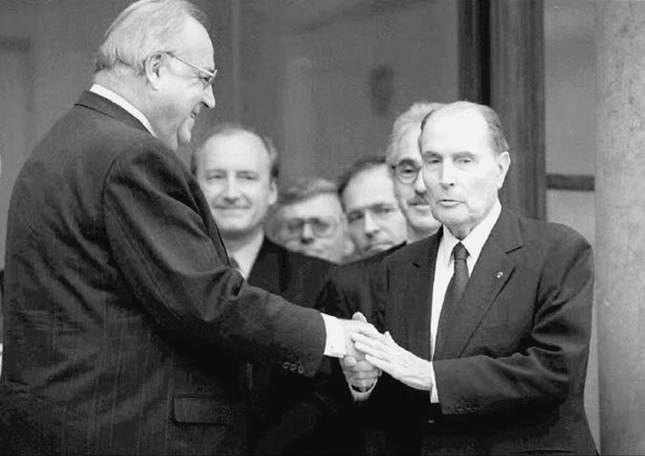
Plate 21.1 Paris, September 1992. German Chancellor Helmut Kohl, left, says goodbye to French President Francois Mitterrand, after their meeting at the Elysee Palace to discuss the construction of a European Union following the narrow French approval by referendum of the Maastricht Treaty. (Photo: Joel Robine/AFP/Getty Images)
revival of old national rivalries. It was divided into three so-called pillars: first, the European communities; second, common foreign and security policy; and, third, police and judicial co-operation in criminal matters. Among the most significant outcomes was the harmonization of monetary matters: the TEU provided for the creation of a common currency (the first euro coins and notes would be in circulation ten years after the Maastricht Treaty) and the European Central Bank. The Maastricht Treaty also enhanced the power of various supra-national European institutions (particularly the EP), introduced a social chapter and dropped ‘Economic’ from the title of the EEC, and thus became the founding contract of today’s European Union (EU).
Like any treaty related to European integration, Maastricht was a compromise and it left few of those involved in the negotiations satisfied. The British, even after the staunchly anti-integrationist prime minister Margaret Thatcher had left the premiership in 1990, remained deeply sceptical. Her successor, John Major, insisted that Britain would not join the common currency and during the tough negotiations his continental counterparts eventually accepted this decision (Denmark followed Britain in also refusing to join the euro). In the end the treaty was ratified by all twelve member states of the EC, but the Danes had to hold a second referendum to reach that point, while French voters gave the treaty only a slim majority. In Britain, politicians did not dare to ask the public’s view. Ratification was instead pushed through the House of Commons (the final vote in May 1993 was 292—112 in favour). In other key countries, such as Germany, there was little opposition in the legislature but much scepticism in the press.
Historic but unsatisfactory and unpopular, the Maastricht Treaty was followed by several further attempts to deepen European unity. In 1997 EU member states negotiated the Amsterdam Treaty, which stressed the need for a Europe-wide employment policy as well as a true common foreign and security policy. Perhaps most tellingly, the Amsterdam Treaty, which entered into force in 1999, aimed to enhance individual rights and freedoms while strengthening the powers of the European Parliament. Equally significant, the Treaty of Nice (signed in 2001 and in force two years later) fixed the relative voting powers of individual countries in the Council of the European Union, the highest decision-making body of the EU. It also enlarged the number of seats in the EP to reflect the forthcoming enlargement of the EU. These initiatives all reflected the biggest dilemma and irony for the EU as the twentieth century drew to a close. Never before had democracy been so widely accepted in Europe, but the citizens participating in that historic experiment felt increasingly alienated from the faceless institutional hybrid that the EU had become. Perhaps because of this, the role of national parliaments and national politics retained their significance and popularity (voting percentages were customarily much higher in national elections than European ones).
The scepticism of the multitude did not, however, stop the rapid widening of the EU. After the end of the Cold War Europe saw three significant enlargements: in 1995 (three countries), 2004 (ten) and 2007 (two). As a result, six decades after the Rome Treaty, in 2007 the EU consisted of twenty-seven member states. The Franco-German dominance that had characterized much of the history of the EEC was thus increasingly challenged by influential newcomers like Poland, while the EU’s geographical balance shifted towards the east. In terms of population growth, the six nations that concluded the Rome Treaty in 1957 had a total combined population of 167 million. In 2007 the EU’s population was 493 million, of which ‘only’ 215 million lived in the ‘original Six'. Unlike in traditional states like China or India where population rises with a decrease in mortality rates, the EU’s rapid population growth was mainly due to the external expansion that had taken place since the end of the Cold War. But in contrast to most cases of expansion in European history, the unique feature of EU expansion was its peaceful nature. Nations had voluntarily joined this new realm, and when doing so they accepted a number of economic, political and social contracts.
This presented no real problem during the first post-Cold War enlargement. The entry of Austria, Finland and Sweden into the EU in 1995 simply meant the arrival of three ‘like-minded’ countries (liberal democracies for several generations), whose citizens, in fact, enjoyed income levels above the average of the original twelve EU nations. In EU parlance, this meant that the three countries met the three so-called Copenhagen criteria for enlargement: that is, first, stability of democratic institutions; second, a functioning and competitive market economy; and, third, an ability and willingness to adapt to the obligations of EU membership. In fact, the refusal of such countries as Norway and Switzerland to join was in large part based on fears that membership would translate into a net
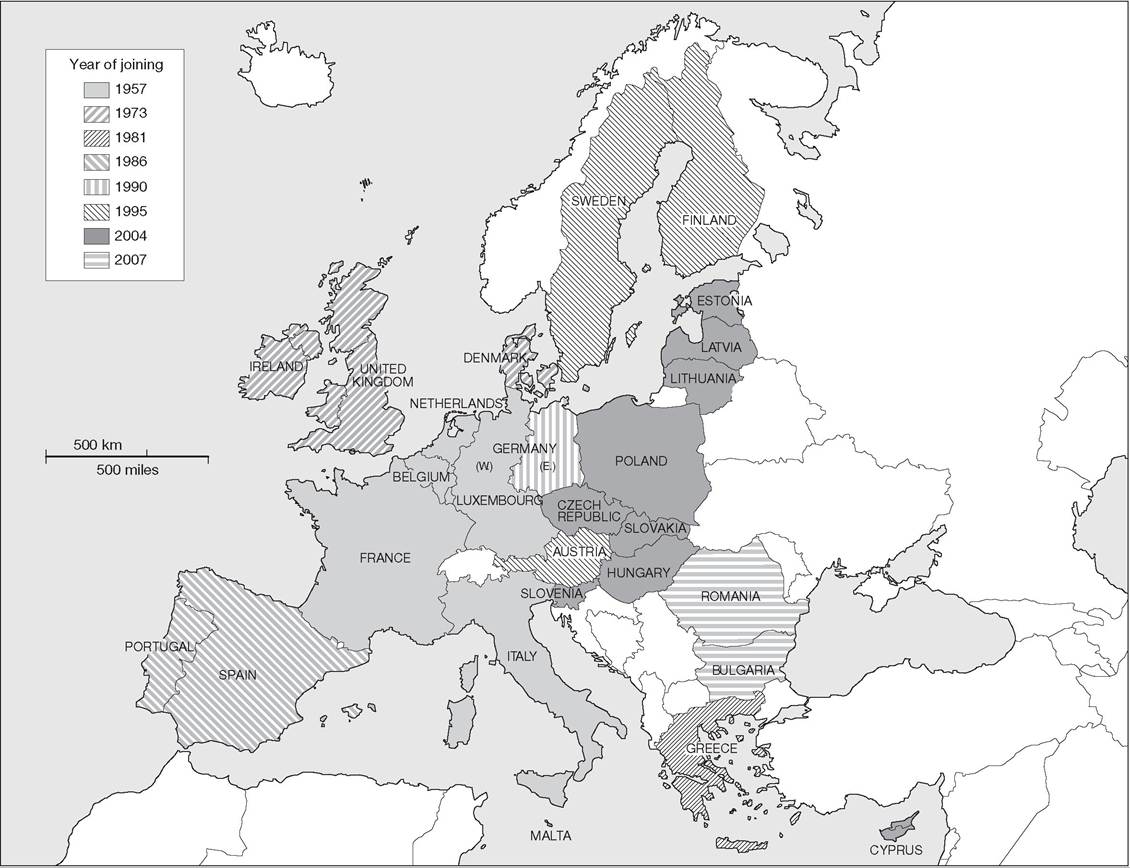
Map 21.1 EEC/EU enlargements
economic loss, as well as a potential loss of national identity. However, while the Cold War neutrality that had kept Austria, Finland and Sweden out until 1989 no longer presented an obstacle to membership in ‘Europe’, issues of national and economic suitability were soon to be at the forefront in the debates related to enlargement into Eastern Europe.
In 2004, in the largest wave of expansion yet, ten countries, Cyprus, the Czech Republic, Estonia, Hungary, Latvia, Lithuania, Malta, Poland, Slovakia and Slovenia, joined the EU. The bulk of these new members were from the former Soviet bloc, with limited experience in democratic governance, and most possessed emerging economies. The average per capita income of the ten accession countries in 2004 was just over €9,000, while the figure for the existing members was more than €20,000. The contrast with the two 2007 entrants was even starker. While EU per capita GDP had actually increased to €26,000 by this date, the combined figure for Bulgaria and Romania, which were also not great beacons of democracy in the eyes of most West Europeans, was less than €9,000.
Why was there such a rush to join the EU? Why did the wealthy countries accept the poorer countries of Eastern and Central Europe into their midst? Where will enlargement end? Such big questions require complex answers. Different countries had different motivations when submitting their applications for accession to the EU, but it seems that the overriding rationale among applicants was twofold: EU membership provided access to a large, wealthy market and assurances against future intervention into their internal affairs from abroad. The last point was particularly significant to the countries that had lived under Soviet domination throughout the Cold War and had proved eager to join NATO in the 1990s. Concerns within these nations about the loss of their newly gained freedom to a faceless EU bureaucracy were outweighed by the assumed benefits of belonging to one of the world’s wealthiest and most stable clubs.
see Chapter 20
The explanation for the willingness of the prosperous West Europeans to accept poor cousins from the East also has its economic and security components. To most of the former, the EU represents an island of democratic stability and a wellfunctioning market economy, but EU leaders also had their own collective threat perceptions, ones that were dramatically increased during the wars in the former Yugoslavia. In this sense, EU enlargement provided a way of removing instability on the outskirts of ‘Europe’ by holding the prize of membership as a carrot for ‘good behaviour’. The wealthier Western Europeans (or at least their representatives) were also willing to pay the economic price for such a policy: the initial bill for the 2004 enlargement, such as new subsidies to the accession countries, was estimated at more than €40 billion for the 2004—06 period. Further billions of euros will be transferred through the EU’s so-called structural funds in forthcoming years.
There was also another side to this particular equation. As noted above, the countries that joined the European Union in the new millennium were responsible for the rapid expansion of the EU’s population. Equally significantly, however, the new entrants clearly gave a boost to the ‘new’ Europe of the early twenty-first century. In 2007, for example, Poland and the Czech Republic, two of the top performers of the ‘class of 2004’, enjoyed annual growth rates of approximately 6 per cent, which was double the EU's average. In addition, the accession of the new states provided some older members with access to a new labour force that contributed to economic growth, with Britain and Ireland in particular benefiting from the arrival of East European migrant workers.
This expansion of the EU into Eastern Europe, did not, however, do much to overcome one of the EU's central problems, its ability to take on a global role in the post-Cold War world. Perhaps the biggest challenge for the EU remains the need for a well-defined and commonly accepted interpretation of its Common Foreign and Security Policy (CFSP). Defined in the 1992 Maastricht Treaty as one of the three pillars of the EU, the CFSP has never worked well. The inability of the twelve, fifteen, twenty-five and now twenty-seven countries to co-ordinate their foreign policies is a well-documented fact. The French and the British, for example, continue to bicker over transatlantic relations as much as they did in the 1960s during the presidency of Charles de Gaulle. And it is difficult to imagine how states such as Finland and Portugal, or Malta and Denmark, could have similar security interests.
To be sure, there has intermittently been successful co-ordination, but it has tended to be confined to the economic arena. The EU countries have been increasingly successful in harmonizing their approach over issues of tariffs and trade, for example forming a cohesive group in the negotiations at the World Trade Organization. The EU is also the world's biggest donor of development aid. Originally concentrating on Africa, the EU has developed comprehensive policies for virtually all continents (save North America). In addition, the EU's external relations are characterized by a focus on humanitarian aid and the promotion of human rights. In the autumn of 2007, for example, the EU was quick to condemn human rights abuses and institute economic sanctions after the brutal crackdown by Burma's ruling military junta against widespread prodemocracy protests.
The EU does, however, lack unity and effectiveness when it comes to some of the most pressing international issues of the twenty-first century. It has worked closely with other countries and international organizations on issues like the environment, terrorism, international crime, drug trafficking and illegal immigration, but it lacks the type of collective capacity that may be needed to carry out military operations, an issue that has been on the table ever since the failure of the EDC in the early 1950s. As a result, on most large-scale security issues, such as the intervention in Kosovo in 1999 or Afghanistan after 2001, the EU has yielded to NATO; this, in turn, has naturally prolonged the European countries' reliance upon the United States in the security field.
An added, perhaps the most fundamental, problem is the sheer confusion about where the power lies when it comes to foreign and security policy. Since 1999 the EU has had a high representative for foreign and security policy, but there is also a commissioner for external relations, a Council of Foreign Ministers (in which all twenty-seven member states' foreign ministers meet regularly), as well as a large number of committees. Each country, naturally, has its own specific needs and interests, which further complicates the process of unified decision-making. In fact, although EU leaders agreed in 2004 to create the post of EU foreign minister, the plan remains on hold owing to the rejection by French and Dutch voters of the EU Constitutional Treaty in 2005.
In short, in the international arena the EU has yet to replace the dwindling influence of individual European Powers with something more substantial. National differences and bureaucratic confusion play a major role in explaining the paradox that one of the world's richest regions remains — sixty years after the Treaty of Rome that created the EEC — a virtual dwarf when it comes to global political influence.
The EEC/EU as inspiration: integration in Asia and the Americas
The success of European integration is not just evident in the fact that most of the former members of the Warsaw Pact aspired to membership after the end of the Cold War, for the EU's achievements have also inspired politicians and intellectuals outside Europe. As with the countries of Central and European Europe, what has interested its extra-European admirers has been the ability of integration to bring both political stability and economic growth. With decolonization and superpower rivalry in the Cold War having created profound and long-lasting instability, the potential of regional integration to deliver a respite from territorial disputes and from an unhealthy reliance on the superpowers for trade and security is undoubtedly beguiling.
South-East Asia Treaty Organization (SEATO)
An alliance organized in 1954 by Australia, France, Great Britain, New Zealand, Pakistan, the Philippines, Thailand and the United States. SEATO was created after the Geneva conference on Indochina to prevent further communist gains in the region. However, it proved of little use in the Vietnam War and was disbanded in 1977.
see Chapters 10 and 12
The first indication that another region might step along the same road came in 1967 with the formation of ASEAN. The idea that South-East Asia might benefit from economic integration was not, however, new. As early as 1945 the British had used their paramount influence in the region to push for a multinational approach towards post-war reconstruction. This culminated in 1950 with the establishment of the Colombo Plan, in which the British Commonwealth and the United States offered economic aid to the newly independent states and colonies of South and South-East Asia. However, contrary to the pattern in Western Europe, where the Marshall Plan proved an important stimulus to economic integration, the Colombo Plan did little to encourage co-operation between the newly independent states. Moreover, integration was impossible in the light of the fact that the region was deeply divided about how to react to the Cold War. Indonesia and Burma, which had both experienced a turbulent journey to independence, were jealous of their newly acquired sovereignty and mistrustful of the West, and thus became enthusiastic advocates of neutralism. Meanwhile, the Philippines, with its close ties to Washington, and Thailand, with its fear of communist control of Indochina, became in 1954 members of the American- dominated South-East Asian Treaty Organization (SEATO).
The first indigenous step towards economic integration came in July 1963 when Malaya, the Philippines and Thailand formed the Association of South-East Asia (ASA). Any further efforts to build on this platform were, however, soon frustrated by the controversy later that year over the creation of Malaysia, which
was opposed by the Philippines diplomatically and Indonesia militarily. Two events in 1965—66 helped to break the logjam. First, the United States, in the face of the escalating war in Vietnam, tried to stabilize the region and isolate the communist bacillus by sponsoring the cause of regional economic development and encouraging Japanese capital investment. Second, the South-East Asian states suddenly found themselves in a position to take advantage of this encouragement because the most destabilizing and divisive politician in the region, President Sukarno of Indonesia, was removed from power. Sukarno's ousting and the rise to prominence of General Suharto provided a catalyst for profound change, for Indonesia now emerged as an anti-communist state that was willing to accept Malaysia's existence and to play a decisive part in developing the region. Accordingly, in August 1967 ASA metamorphosed into ASEAN, consisting of Malaysia, Singapore, Thailand, Indonesia and the Philippines.
see Chapter 12
At first ASEAN was a rather loose organization, which concentrated entirely on economic, social and cultural matters. Before too long, however, it was forced to extend its remit into the political field. The stimulus for this was the steady American de-escalation of its presence in South Vietnam. Fearing that this might encourage Soviet and Chinese machinations, in November 1971 the ASEAN states adopted the idea of regional neutralization and declared that South-East Asia was ‘a zone of peace, freedom and neutrality'. ASEAN's move towards greater cohesion was then further cemented later in the decade by the Vietnamese invasion of Cambodia in 1978—79, which raised the prospect of a threat to Thai security. ASEAN's ability to talk for the region, its moves to encourage Western capital investment and its average annual economic growth rates of 6—9 per cent meant that it soon found international sponsors. The United States, with its animus towards Vietnam still running high, was willing after 1978 to support the organization's political pretensions, while Japan emerged at this point as its major trading partner and source of international aid, as well as the inspiration for the individual states' development of export-orientated economies.
see Chapter 14
However, while the organization did much to encourage trade and investment, it differed from the EEC in that it lacked any solid institutional base or any outright commitment to the ideal of greater integration and the formal pooling of sovereignty. It was only in 1994 that it finally launched the ASEAN Free Trade Area and it has never followed the EEC/EU's example in regulating agricultural production, allowing for the free movement of labour and introducing a parliament to oversee legislation. Moreover, while it began in the 1990s to espouse the cause of democracy, it has found it difficult to live up to this rhetoric owing to the arrival of new members such as Brunei Darussalam in 1984, Vietnam in 1995, the Lao People's Democratic Republic and Burma in 1997, and Cambodia in 1999.
al-Qaeda (Arabic: Base)
Islamist umbrella organization established by Osama Bin Laden drawing upon the network of international jihadists established during the Afghan War to support the mujahedeen. Founded as early as 1988, al-Qaeda emerged into the public eye in 1990.
Moving into the twenty-first century, ASEAN faced two key challenges: first, formulating a security response to the threat emanating from Jemaah Islamiyya (JI), a regional jihadist network with links to al-Qaeda (see Chapter 22); and second, Burma's lack of progress towards democracy. The authoritarian nature of Burma's military government became the focus of ASEAN discussions as Burma's turn to chair ASEAN in 2006 approached. Burma's military government and its poor human rights record were seen as detrimental to ASEAN interests. It was feared that under Burmese chairmanship ASEAN would lose vital trade and economic relations with Western countries which had levied sanctions against Burma's military regime. This would have damaged ASEAN's ‘Vision 2020', which saw the organization playing a pivotal role in the international community. In an almost unprecedented fashion, given ASEAN's principle of non-interference in the domestic affairs of its member states, legislators from Malaysia, the Philippines and Singapore urged Burma to withdraw from the chairmanship. At the same time, in an attempt to keep this an ‘internal issue', they rejected Western calls to suspend Burma's ASEAN membership. The chairmanship crisis was resolved in July 2005 when Burma's foreign minister requested a postponement so that Burma could focus on national reconciliation. Reconciliation, however, has remained elusive. In September and again in November 2007, pro-democracy demonstrators and Buddhist monks were brutally suppressed as they took to the streets in what was called the ‘Saffron Revolution'. While ASEAN condemned the Burmese military government's crackdown and pressed for the release of prodemocracy leaders, it failed to take concrete steps to deal with Burma.
Thus ASEAN has remained rather limited in scope. However, its success both in the political and in the economic field has enabled it to provide a useful foundation for other attempts to develop new international fora. For instance, in the field of security, the rise of China under Deng Xiaoping's leadership led in 1993 to ASEAN seeking to reduce potential international tension by sponsoring the development of an ASEAN Regional Forum (ARF). This organization brings together the main Powers with interests in the region in the hope that a consensus on security issues can be found. In addition, from 1996 biennial conferences were established between the EU and ASEAN. Another regional development came in the economic field with the foundation in 1989 of an organization called Asia- Pacific Economic Co-operation (APEC), which was an Australian initiative with significant American and Japanese support. Again the organization existed primarily as a force that was designed to pave the way for greater trade liberalization, but, as it included the United States, the PRC, Russia and Japan, it also proved another useful forum for consultation and dialogue.
There has also been talk of ambitious plans to move beyond the establishment of regular ASEAN, ARF and APEC summit conferences and to attempt more directly to emulate the work of Schuman, Monnet and Delors. Most notably in December 2005 a summit meeting of Asian-Pacific Powers was held in Kuala Lumpur to investigate the possibility of moving towards the formation of an Asian Community. After a year in which PRC—Japanese relations had fallen to their lowest ebb since relations were opened in 1972, the idea of a move towards an EU- type organization that would overcome past hostilities echoing the reduction of Franco-German rivalry held great attraction. However, the diversity of political ideologies and practices in Asia, to say nothing of the strategic rivalries and huge discrepancies in economic power, made progress extremely difficult to achieve.
In the 1990s the Western Hemisphere also saw a movement towards free trade and regional integration, which were considered by many as the best long-term solutions to Latin America's economic difficulties. The principal and most ambitious attempt to bring about hemispheric integration was the North
American Free Trade Agreement (NAFTA). Signed in October 1992, NAFTA brought together the United States, Canada and Mexico into a trading bloc of 370 million people. The three countries pledged to eliminate trade barriers, duties and tariffs over the subsequent fifteen years. Its most substantial impact was on Mexico, for NAFTA opened up the country to American (and Canadian) investment. However, it also raised the spectre of companies moving south to take advantage of cheaper labour, and understandably, American and Canadian labour unions were NAFTA's most persistent foes. In the end, NAFTA did boost the growth of regional trade (American-Mexican trade, for example, doubled between 1993 and 1997, from $83 billion to $157 billion).
North American Free Trade Agreement (NAFTA)
A 1992 accord between Canada, Mexico and the United States establishing a free-trade zone in North America from 1 January 1994. NAFTA immediately lifted tariffs on the majority of goods produced by the signatory nations. It also calls for the gradual elimination of barriers to cross-border investment and to the movement of goods and services between the three countries.
NAFTA was, in fact, probably most significant for Mexico. It allowed President Carlos Salinas to push through aggressive economic reforms of privatization and liberalization and, so it was hoped, to move away from the semi-authoritarian rule of the Institutional Revolutionary Party (PRI). Unfortunately for those dreaming of Mexico's ‘democratization', Salinas was faced with a sudden explosion of guerrilla warfare when the Zapatista movement in the poor Chiapas region denounced and, in 1994, forcefully opposed both NAFTA and Salinas. The following year Mexico faced a currency crisis that could only be solved with an American-backed IMF bailout of $50 billion. Suddenly, Mexico looked like a Third World country in the midst of a political and economic crisis, rather than a fast-developing democratic partner in the NAFTA bloc. Yet by 1997 the internal stability as well as the economic state of Mexico began to improve, in large part as a result of the boost in the American economy. By the end of the century Mexico, Canada and the United States shared, albeit in differing degrees, in the boom of the late Clinton years. Yet it is worth noting that underneath the facade of prosperity lay a deep undercurrent of poverty: in Mexico, an estimated one-third of the population lived below the poverty line at the end of the millennium. In large part owing to continued discontent within Mexico, the July 2000 elections resulted in the final end of Mexico's one party-rule as the PRI, after seventy-one years, lost the presidency to Vicente Fox Quesada's centre-right National Action Party (PAN).
In the 1990s there was also much talk about extending NAFTA eventually to incorporate all of the Western Hemisphere (generally called WHFTA, the Western Hemisphere Free Trade Area). Many, including President Clinton, spoke of NAFTA as a mere starting point. With many economic analysts predicting a boom in the Latin American economies, the hopes of a hemispheric trading bloc dwarfing that of the European Union were high. Yet, by the end of the decade, there was neither a WHFTA nor an expansion of NAFTA. A number of political and economic obstacles help explain this. First, the Latin American countries, perhaps most significantly Brazil, were concerned that WHFTA might endanger their attempts to diversify their trade portfolios and lead to increased political dependency on the North. Second, NAFTA, unlike the European Union, had little to offer beyond removing trade barriers. There were no provisions for the free movement of people and no political superstructure. This point linked closely with the question of the nature of regimes to be allowed to join a prospective WHFTA. Should membership in a prospective WHFTA be based on political criteria (in the same way as in the EU)? If so, what should one make of Mexico's
Mercosur
Or the Southern Cone Common Market. A Latin American trade organization established in 1991 to increase economic co-operation in the eastern part of South America. Full members include Argentina, Brazil, Paraguay and Uruguay. Bolivia and Chile are associate members. Mercosur’s goals include the gradual elimination of tariffs between member states and harmonization of external duties.
early membership, for as a de facto one-party state it hardly constituted a democracy. Last, one needs to stress the continued American reluctance to submit to any sort of supra-governmental authority. Thus, by the end of the 1990s, the talks about WHFTA (or the alternative Free Trade Area of the Americas, FTAA) were in deadlock, a situation made worse by an emerging economic crisis in Latin America that would soon plunge such countries as Argentina into a serious recession. Instead, the concrete results of the free trade movement in the Western Hemisphere were (in addition to NAFTA) limited to such smaller-scale regional free trade zones as the Mercosur, the Common Market of the South that linked Argentina, Brazil, Uruguay and Paraguay in 1991.
More on the topic Widening and deepening in the shadow of the Cold War:
- Cold War Divisions
- Decolonisation and the Cold War
- Has the Ukrainian crisis sparked a new Cold War?
- Neutrality in Cold War Europe
- Cold War Legacies
- Imperial Overstretch after the Cold War
- Cold War/Hot Peace
- China, Japan and the Cold War in Asia
- The Cold War occupies a rather unusual place in the history of organised mass violence.
- Decolonization, the Cold War regime and postwar East Asian growth
- The Cold War in Africa
- The Violence of the Cold War
- Insurgency and Military Rule in the Cold War, c. 1945 to c. 1990
- The ‘first' Cold War in Europe, 1945-61
- From Cold War to detente, 1962-79
- The end of the Cold War and the ‘new world order', 1980- 2000
- Other actors: widening the scope