POSTSCRIPT
Throughout the 1990s, the professional lives of the three authors intersected daily while delivering conflict resolution programs through the International Center for Cooperation and Conflict Resolution at Columbia University.
Subsequently, in different arenas, all have taken on the difficult, complex, and exciting task of applying collaborative skills to large-scale, systemic change. In the following paragraphs, we talk about the challenges this has presented for us, what we have learned, and the critical questions and dilemmas with which we are currently grappling.Ellen Raider
By teaching negotiation and mediation to individuals and groups, I know that I have helped thousands deal more collaboratively with the many interpersonal and intergroup conflicts in their lives. I am extremely proud of this work. I spend much of my time now advocating for fundamental change in an urban public education system. I can confirm from this experience that collaborative negotiation and mediation skills are extremely useful in building the needed coalition of like-minded allies. These same skills, however, have little direct effect, in the short run, on an entrenched education and political bureaucracy intent on maintaining the status quo. As is the case in other important policy areas such as health, housing, the environment, and so on, the “playing field” in education is not level among ordinary folks—parents, students, and their communities on the one hand, and the other powerful stakeholders on the other (that is, the politicians at the local, state, and federal levels, the unions, and the business community). These latter stakeholders have considerable political power, money, and the organizational and legal support needed to move their respective agendas. Unorganized parents do not.
Although we failed to mention it in the earlier version of this chapter, we frequently talk briefly in the workshop about what is to be done when neither cooperative nor competitive negotiation is possible (see Figure 31.7, Corrective Action).
The first part of the figure follows from Deutsch’s Crude Law. It shows that cooperation leads to cooperation, competition leads to competition. If, however, the powerful are not willing to cooperate and the powerless are not yet organized to effectively compete as equals (as is the case with organized labor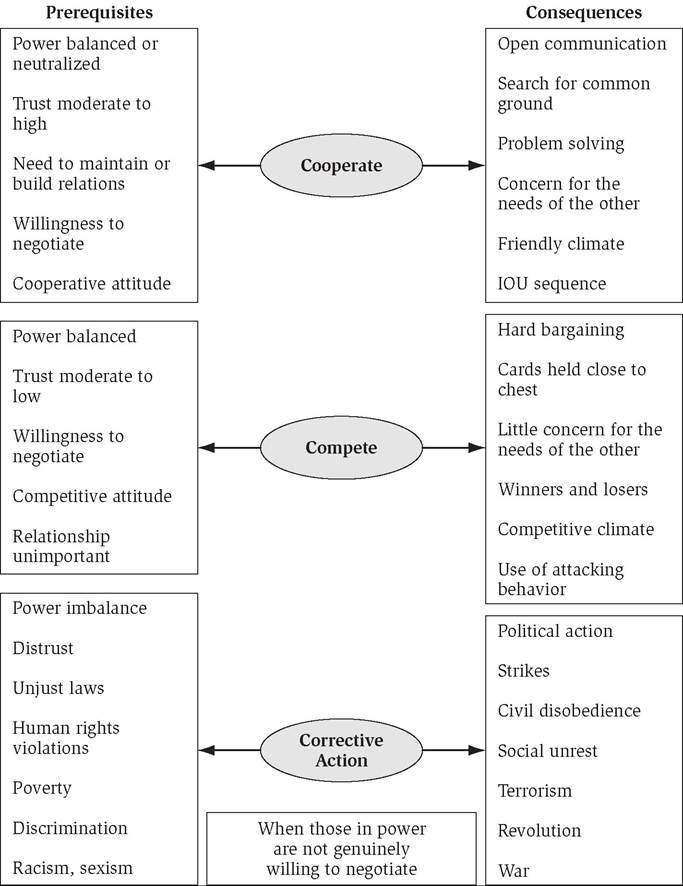
Figure 31.7 Negotiation Strategies
in some workplaces), then the powerless must engage in what we call “corrective action”—boycotts, strikes, marches, demonstrations, and/or forms of civil disobedience—to build their numbers and organize and attract the attention of the public, the politicians, and the press, thereby creating readiness on their part to come to the table.
Here then is my current dilemma. Can education advocates develop creative nonviolent strategies and tactics, capable of building a powerful mass movement to fundamentally change the education system from its current form—a bureaucratic top-down factory model, to a more cooperative school/community- based system where parents, students, and teachers work together to build learning communities based on mutual trust and respect? And should these tactics and strategies be consistent with the goals of the collaborative system we are trying to create? It is so easy given the current “savage inequalities” (Kozol, 1992; Schwebel, 2003) in the public educational system to want to organize within an adversarial frame.
Our advocacy group has decided to lead with a proactive collaborative strategy that relies on a human rights framework developed in various international treaties and covenants as an explicit values base on which to build a shared vision of a new system (Web reference to National Social and Economic Rights Initiative, www.NSERI.org). Launching a multiyear campaign, we are calling for an independent taskforce made up of educators, academics, community advocates, students, and parents to work collaboratively over the next two years to design what a new human-rights-based system of education could look like.
We hope this approach will be able to unite, under one umbrella, the many single-issue struggles currently being waged against the education establishment. We want to model the kind of changes we would like to see happen and not just rail against the things we find objectionable. We want to seed an open, transparent dialogue and strategic visioning process among all stakeholders in the city who wish to work collaboratively. We will stay open to those who do not want to join this effort now and hope they will come on board as this education-as-a-human-right movement builds.In light of this advocacy work, I feel that the aspect of the workshop briefly described in this postscript needs to be expanded by explicitly including it as a full module with references, readings, and an extended class discussion about the other essential skills such as community organizing and nonviolent civil disobedience techniques to give participants a broader range of tools in our collective quest for a more just and equitable society. In addition, students should be encouraged to take additional workshops that explicitly teach these skills. (See section on Janet Gerson.) Without knowledge of these tools and how they have been used in other similar struggles, hope for peaceful change will be fleeting and the mounting frustration of the powerless could lead to violence and the continued use and glorification of the worst in our species.
Susan Coleman
I am currently an organizational consultant specializing in conflict resolution and collaboration.
While always a mediator, for most of the last decade, I have also been ensconced in implementing conflict resolution programs in large, multinational quasi- governmental organizations. In that capacity, I have provided training to professionals from all continents and most nations. With few exceptions and only some variation depending on culture, participants have provided excellent ratings of the programs and found them transformational.
Nonetheless, participants have always been faced with the prospect of returning to a hierarchical context where conflict is managed more by who has the power than by any other means.With the events of September 11, 2001, it is my perception that this reality only became more extreme. As the world climate became more competitive and collaboration less valued (even though more needed than ever), it permeated into organizational culture and reduced the value placed on a conflict resolution workshop.
In this larger context, I transitioned professionally from “trainer” to “consultant.” Given systemic pressures, I needed to expand my ability to scan systemically and offer wider choices to my clients about choice points for creating desired change. If they wanted to become more collaborative and manage conflicts more effectively, sometimes leadership coaching, interdepartmental mediation, or a system-wide large-group process might be the better vehicle given various goals and constraints. Nonetheless, the conflict resolution workshop has remained in my mind one of the most profound vehicles for giving people a turbocharged sense of what is possible through collaboration.
What exactly do I mean? In a recent chapter that I wrote with Ellen Raider, “Intercultural Conflict Resolution Training,” The Sage Handbook of Conflict Communications, we argued that, based on our years of working with intercultural groups around conflict, whether the climate is competitive or collaborative is more important than any possible cultural difference or conflict. In other words, if the climate is collaborative, the group will manage cultural differences well, and, if competitive, it will polarize them. As trainers, we know the myriad ways we can enhance understanding of collaboration and create an experience of a collaborative community in a group. When we have been successful in that regard, we and the participants experience firsthand how much more easily the group is able to manage the conflicts we address pertaining to race, class, or other aspects of identity, or conflicts in general, that in other circumstances would disintegrate into tense and polarized interactions.
I think our observations from the human laboratory of a training context have important implications for our organizational, local, and even global communities. When we endorse our leaders in creating a more adversarial environment, we think identity group tensions and other conflicts will increase exponentially. And, if we pressure them to do the reverse, people will be able to manage those same conflicts more effectively. In other words, the more attention we place on creating a collaborative climate, the less conflict we need to manage because people will manage it themselves. But the more emphasis we place on creating a competitive, adversarial climate, the more difficult it will be for any conflict resolution intervention, skills training or other, to stick.
This raises a “Which came first, the chicken or the egg?” kind of dilemma. Can we really implement system-wide collaboration if individual leaders have not internalized how to be collaborative? Will leaders who desire to lead in a collaborative fashion ever be able to do that within systems that are entrenched in power and rights-based processes? In my view, and given the enormity of the task, efforts are needed at all levels of system—individual to large scale—to shift toward more collaborative functioning. If Deutsch’s Crude Law is correct—that collaboration leads to collaboration—each positive shift in any level of system will reverberate in others. And, if those reverberations become strong enough, is it possible that we will achieve a critical shift in human consciousness where the interdependence of all life is organically understood and no longer questioned.
Janet Gerson
I am director of training and acting director of the Peace Education Center, Teachers College, Columbia University. I also consult internationally in the development of peace education programs and trainings.
While the end of the Cold War brought hopes for a peaceful world, the reality has been a proliferation of deadly conflicts—the multiple wars in Africa, Afghanistan, Iraq, and Israel-Palestine.
Nor has the end of the Cold War mitigated an increase of poverty side by side with extreme wealth, ecological destruction, and other types of structural violence. In response to these developments, I find among both my academic and professional students an intensified urgency to learn skills they need to address these real-world conflicts. Internationally and locally, I encounter individuals courageously accomplishing nonviolent social change. For example, the massive transnational antiwar mobilization and the World Tribunal on Iraq dramatize the possibilities to criminalize state-perpetuated aggression and create a more peaceful world order. These developments—and many more—invigorate my enthusiasm and hope.With collaborative conflict skills as a foundational base, my teaching is currently guided by two overarching concerns—how to separate violence from conflict and how to educate for a more humane and inclusive world community. Pedagogically, I encourage my students to see violence as intentional or preventable harm in order to help them learn how to separate conflict from violence. This definition underscores human agency and responsibility and, therefore, points to the possibilities for action. To define violence more thoroughly, we use matrices to map out manifestations of social, cultural, and political violence on all social levels: from intra- and interpersonal to family, community, regional, national, and global. In this way, learners are able to see the interrelationships of different types of violence. This also helps bring to the surface the students’ own experiences of violence.
Each course focuses on a particular problem, a complex of related aspects of violence. We examine current conflict and peace problems through the lens of nonviolence, human rights, social justice, equity, and ecological balance. Inquiry questions focus the analysis. Examples of this process might include:
• How might governance diminish violence and increase well-being?
• How are militarism and gender imbalance linked?
• How has international law been used to reduce or prevent global conflicts?
Then particular cases of these issues are analyzed. Keeping in mind the maxim “She or he who hits first has run out of ideas,” we work to develop alternatives to force and preventable harm.
Having articulated a problem of violence, we next address visions, alternative strategies, and plans of action. In this case, human rights documents are valuable teaching tools because they articulate multiple aspects of visions for peace. An expanded array of conflict processes also is presented. These include anticipation, problem analysis, resolution, institutional mechanisms for conflict management, nonviolent action, reconciliation and reconstruction, and constructing positive relations. (These conflict processes are elaborated in Learning to Abolish War: Teaching Toward a Culture of Peace [Reardon and Cabezudo, 2001] and available on the Internet.)
As in the conflict resolution workshop, I try to build a “learning community” in our classroom. This provides a collaborative experience for the students. The values of interconnectedness, interdependence, and moral inclusion developed in the classroom expand the basis of understanding global community (Opotow, Gerson, and Woodhouse, 2005). We explore ways in which conflict management can be used to build common ground through an expanded sense of humanity. We combine these with an investigation of the institutions that manage conflict structurally. This offers the participants an opportunity to question the basic purposes of governance, as well as the limits and possibilities of justice systems. Finally, country-specific cases are presented that demonstrate how international law has been used to increase fairness and minimize destructiveness.
I have found that teaching models, practices, and methodologies for challenging power imbalance, discrimination, and resource inequities are vital components of educating for peace. Recently, in my teaching I have increasingly emphasized the importance of strategies that promote nonviolent escalation of latent conflict. To do this, I include teaching about social movements and their use of nonviolent strategic action to confront latent conflict. My goal is to help students discover the indirect violence that is structured into our society. Specific cases range from the work of Gandhi, Martin Luther King, Jr., and Gene Sharp to the more recent transnational social movements that have promoted human rights, gender equality, environmental protection, and the formation of the International Criminal Court.
As in the conflict resolution workshop, we use experiential learning through dialogue and skills-based activities in conjunction with each theoretical section. I have found that the role-plays and theater games developed by Augusto Boal (1992) are particularly useful to express latent conflicts, to energize or “dynamize” them, and to form creative alternatives. This embodied conflict methodology encourages participant collaboration and facilitates personal and group transformation.
Teaching peace education is exciting and rewarding. Participants bring into the classroom an enormous diversity of life experience and, in most cases, concrete experiences in attempting to be a good peace educator. Our world is immersed in war and violence. The relevance of peace education and the tension that exists in all of us to find effective ways to work for peace make the classroom electrified by the power of learning.
Notes
We wish to express special thanks to Marc Roennau for preparing the graphics for this chapter.
1. The author is grateful for wonderful conversations about conflict in large groups with the following practitioners whose ideas contributed greatly to this chapter: Billie Alban, Dick and Emily Axelrod, Bridgett Bolton, Al Fitz, Robert Jacobs, Harrison Owen, Larry Peterson, Kris Quade, Nancy Cebula, and Roland Sullivan.
2. A person with a polychronic orientation will prioritize relationships over tasks; a person with a monochronic orientation will get tasks done and then focus on the relationship. A monochronic orientation is characterized by tightly controlling time. A polychromic orientation is more loose with time. See Hall, 1976 for further discussion of these cultural dimensions. (taken from sage article)