A Theory of Propositions
It follows that even for a supervaluationist there is no straightforward way to independently characterize the individuation conditions for propositions: in order to state them it seems one has to adopt the ideology of worlds and precisifications.
It would be preferable to avoid putting so much theoretical weight on the coherence of these technical entities. In what follows, I shall propose instead that propositions be individuated by their role in thought. Roughly speaking, the role a proposition plays in thought is somewhat analogous to a conceptual role, although it is something which applies to propositions and not sentences or thoughts. At least in the context of the present theory of vagueness, it is natural to articulate this in terms of conceptually coherent priors and utilities.The kernel of this idea can be traced to a broadly Stalnakerian way of making sense of possible world talk. According to Stalnaker [140], one begins with a set of indices understood as primitive objects playing a special role in a theory of rational agency. Whatever structure indices have is abstracted from this theory, and beyond this their nature is left open. From this sort of theory, one gets a handle on the individuation conditions for the indices, and thus a handle on the individuation conditions for propositions.
Stalnaker is not explicit about what this theory is exactly, but he does say the following:
What is essential to rational action is that the agent be confronted, or conceive of himself as confronted, with a range of alternative possible outcomes of some alternative possible actions. The agent has attitudes, pro and con, towards the different possible outcomes, and beliefs about the contribution which the alternative actions would make to determining the outcome.
One explains why an agent tends to act in the way he does in terms of such beliefs and attitudes. And, according to this picture, our conception of belief and of attitudes pro and con are conceptions of states which explain why a rational agent does what he does. (Stalnaker [140], p. 5)On this picture of the metaphysics of indices, they are not things which are deeply tied to metaphysics, as a possible world in Lewis' sense would be: ‘they obviously are not concrete objects or situations, but abstract objects whose existence is inferred or abstracted from the activities of rational agents' (Stalnaker [140], pp. 50-1).
From the above passage, you would be forgiven in thinking that Stalnaker individuates the ‘possible outcomes' according to a rational agent's bouletic attitudes (‘attitudes, pro and con') and doxastic attitudes. It is worth noting, however, that Stalnaker individuates propositions and possible outcomes modally, and indices, in the sense abstracted above, are identified with possible worlds. Stalnaker's reasons for doing this seem to have little to do with the picture outlined so far, and have more to do with his reductionist ambitions with respect to the problem of intentionality.11
For those who do not have any reductionist ambitions, there does not seem to be any barrier to individuating these objects epistemically. Indeed, we have compelling reasons for thinking that the entities we abstract from a theory of rational decision will be more fine-grained than possible worlds.[149] [150] An astronomer who believes that Hesperus is a planet may display very different behaviour, both verbally and nonverbally, from someone who believes that Phosphorus is a planet. It furthermore seems perfectly possible that this astronomer may have very good evidence that Phosphorus is a planet, which is not also evidence that Hesperus is.
In which case, it seems to me perfectly rational for this agent to believe that Hesperus is a planet without believing that Phosphorus is and rational for her to act accordingly.Since I am arguing for a moderately fine-grained theory—I am claiming that propositions are more fine-grained than possible worlds but not as fine-grained as to distinguish logical equivalents—it's natural to ask at what point we stop individuating. How fine-grained are propositions? A broadly Stalnakerian theory provides a perfectly principled answer to this question: indices are as fine-grained as we need them to be to specify the functional role of the belief that p as a function of the indices at which p is true. In other words, indices are whatever they need to be so that functional roles do not distinguish more finely than sets of indices.[151]
style='font-size:9.0pt;line-height:122%'>To formally represent the doxastic and bouletic attitudes of an agent, we shall make reference to a set Coh of pairs (Pr, V) consisting of conceptually coherent conditional probability functions and value functions (related by Jeffrey's equation). The sort of account of propositional individuation we endorse can then be stated:[152]
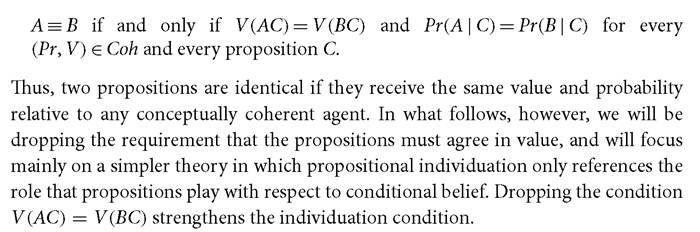
Might a proposition's role in desire not also be a source of fine-grainedness? This weaker theory might be natural for modelling moral propositions that play the same doxastic role, but differ in their motivational properties—to rationally believe them would require you to care about certain things. Such a theory might be useful for moral expressivists wishing to have some kind of lightweight theory of propositions.
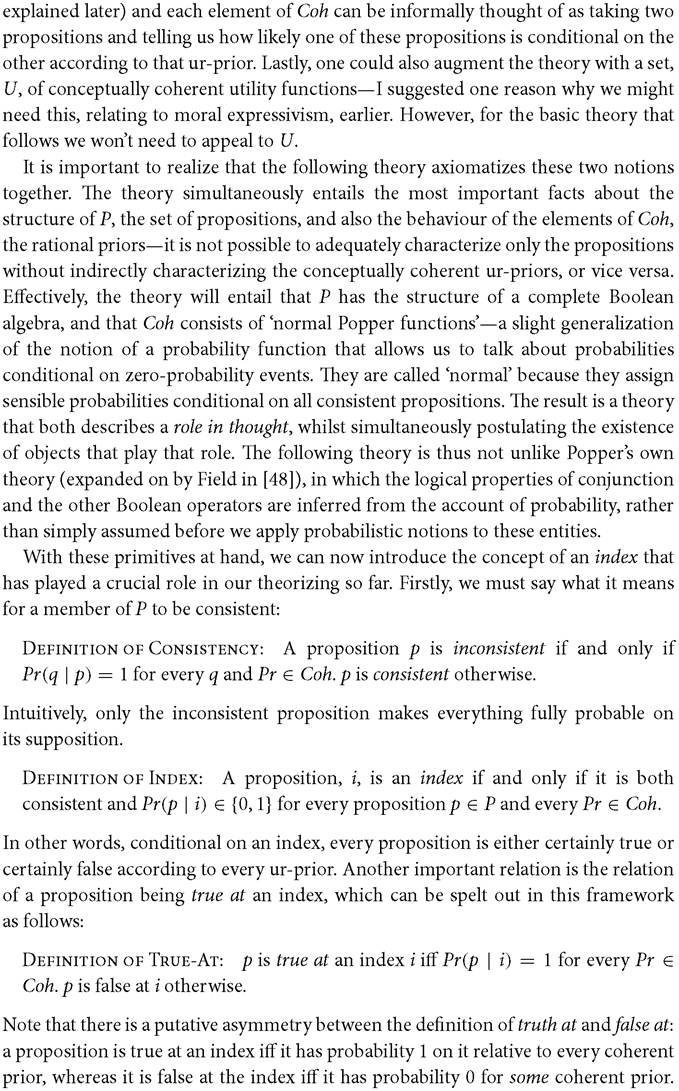
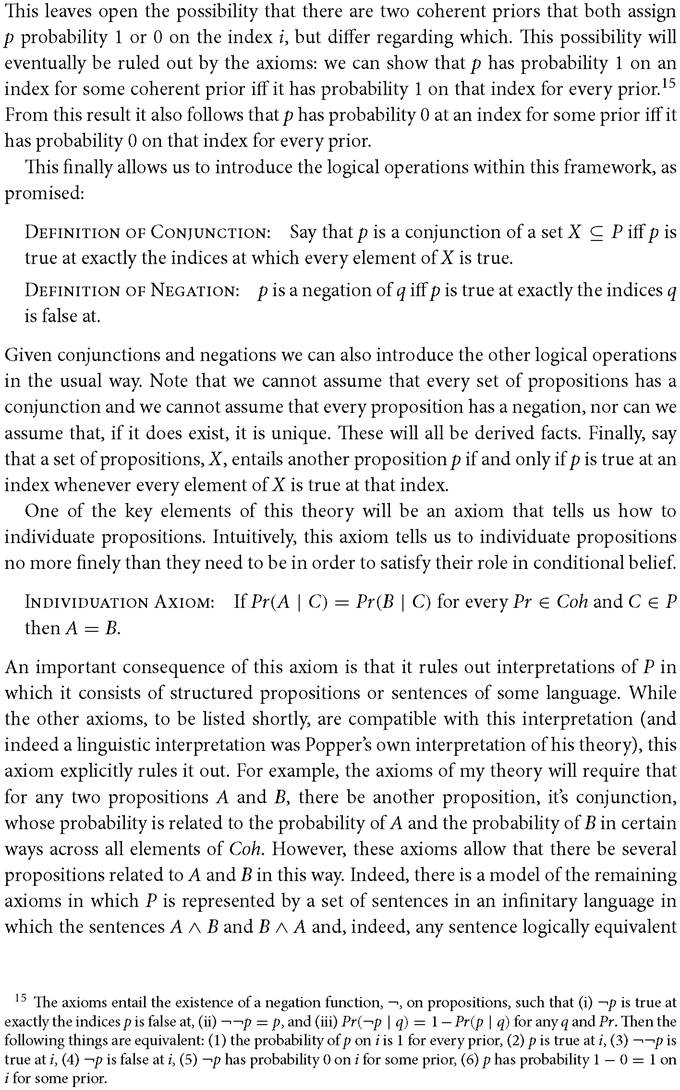
Although this is worth investigating, it goes well beyond my purposes here so I shall concentrate on the stronger but simpler version of the individuation axiom.Let us now pin down some of the formalities. According to the Stalnakerian picture, indices are to be abstracted from a theory of rational action. The theory I shall adopt for this purpose contains two primitives. Firstly, a set of objects, P, to be understood informally as representing the set of propositions. However, although this will be the ultimate interpretation of P we do not assume that this set has any structure, Boolean or otherwise, from the outset. We shall not even assume that the standard logical operations are defined on P; definitions of conjunction, negation, and so on and their logical properties will arise out of the theory. Secondly, we posit a set, Coh, of binary functions taking two elements of P to arealnumber in [0,1]. Coh informally represents the set of conceptually coherent conditional ur-priors (these terms will be
VAGUE PROPOSITIONS 215
VAGUE PROPOSITIONS 217
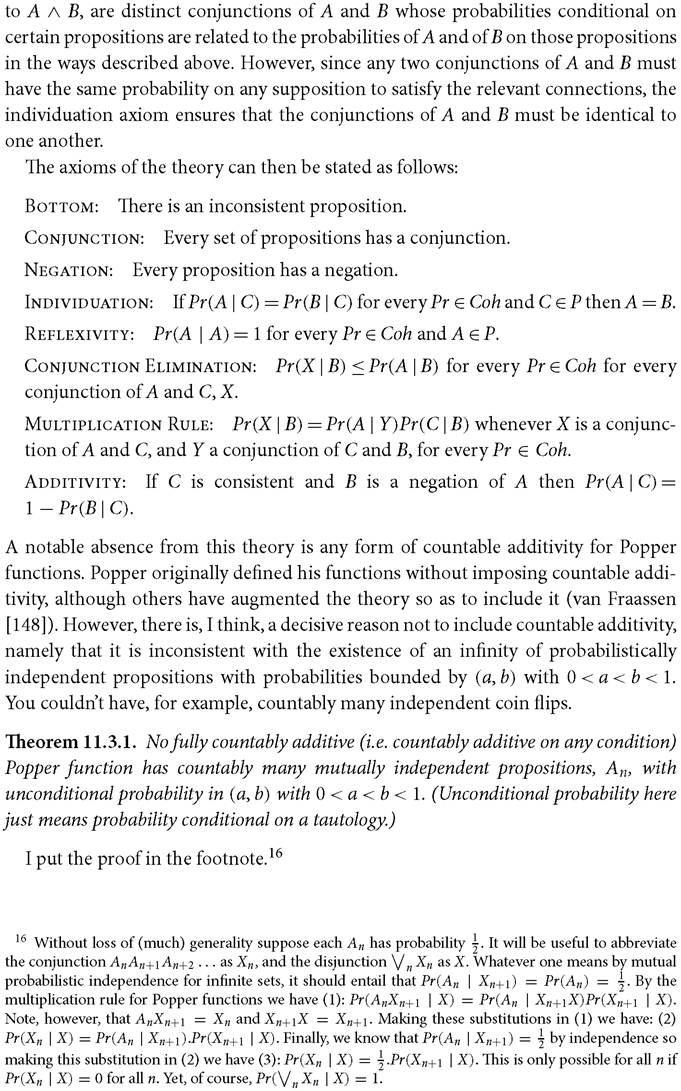
While the pure mathematical theory puts important structural constraints on the space of propositions, there are many questions it does not settle. For example, it does not tell us whether it is conceptually coherent to assign necessarily equivalent propositions different conditional credences.
Under the assumption that it is incoherent to do so, the individuation axiom entails, among other things, the view that propositions are individuated by necessary equivalence. More importantly, the proposition that Harry is bald would be identical to a precise proposition about Harry's hairline that it is necessarily equivalent to. This hypothesis about which priors are coherent therefore makes the theory unsuitable as a theory of vague propositions.Conversely, one could also insist that it is conceptually coherent to have a different prior credence in the proposition that John is a bachelor than one has in the proposition that John is an unmarried man. So, by Leibniz's law, these would be different propositions. On my understanding of ‘conceptually coherent prior’, however, it is simply incoherent to assign these propositions different credences. So on my preferred interpretation of this theory, these two propositions would be identified.
The take-home message is that, although the formal axioms force us to make some choices—such as identifying logical equivalents—the informal notion of ‘conceptual coherence' is also doing important work. Although I cannot hope to explicitly define the notion, it can be elucidated by examples which, I hope, should be enough to give the reader a reasonably good grasp on the notion (see also the discussion in section 8.3). For example, although I am sceptical of the idea that a sentence can be true purely in virtue of the meanings of its constituents, I suspect that many standard examples of analytic sentences express propositions that get probability 1 according to every conceptually coherent prior. A prior which assigns less than full credence to the proposition that vixens are foxes represents a conceptual confusion of some sort and according to our theory, that proposition's role-in-thought is the same as the tautologous proposition's role-in-thought.
Vagueness introduces more interesting examples.
For instance, I take it that to be conceptually coherent, you should be certain that Harry is bald conditional on the proposition that he has no hairs at all. This seems like a fairly straightforward example of a proposition expressed by a conceptual truth, analogous to those mentioned above. However, conditional on the proposition that Harry has N hairs, where N is in the borderline region, I take it that it is conceptually incoherent to have anything other than some intermediate credence that Harry is bald. If you furthermore have a description of all the precise facts about Harry's head, then, as I argued in chapter 8, there is a particular credence which all conceptually coherent priors assign to the proposition that Harry is bald, conditional on Harry satisfying that description.In the rest of the book, I will also apply the notion of conceptual coherence to utility functions, measuring how much people care about certain matters. I believe the notion of conceptual coherence, as it applies to desires, also has some pretheoretic appeal. Its relation and importance to the study of vagueness has already been discussed in literature. For example, in Field [55], Hartry Field contrasts two examples.
One involves a character, Roger, who thinks that if his bank account password has the same last digit as the number of nanoseconds Bertrand Russell was old for, then his life will go better. The other involves Sam, who thinks that his life will go better if the last digit of his bank account password is the seventeenth significant digit of the centigrade temperature at the currently hottest point in the interior of the sun. According to Field, while Sam's belief is thoroughly irrational, Roger's is intuitively even worse, as it is conceptually confused. The distinction between being merely irrational and conceptually confused will play an important role in the theory I am endorsing.
11.4
More on the topic A Theory of Propositions:
- Meaning Propositions
- BUSINESS MODELS OF ALGORITHMIC SELECTION
- The Preconditions of Rational Legal Discourse
- Rhetoric and the Argumentation Theory
- PRACTICE AND THEORY
- Confronting the theory with some facts
- Stoic Household Theory and Clement’s Citations from Colossians 3 and Ephesians 5
- Optimal foraging theory addresses behavioral choices that enhance the rate of energy gain
- Intuitionistic logic
- TAXONOMY OF INTERNET BUSINESS MODELS