Introduction
Real per-capita income in the developing world grew at an average rate of 2.3 percent per annum during the four decades between 1960 and 2000.[DLXI] This is a high growth rate by almost any standard.
At this pace incomes double every 30 years, allowing each generation to enjoy a level of living standards that is twice as high as the previous generation’s. To provide some historical perspective on this performance, it is worth noting that Britain’s per-capita GDP grew at a mere 1.3 percent per annum during its period of economic supremacy in the middle of the 19th century (1820-1870) and that the United States grew at only 1.8 percent during the half century before World War I when it overtook Britain as the world’s economic leader [Maddison (2001), Table B-22, p. 265]. Moreover, with few exceptions, economic growth in the last few decades has been accompanied by significant improvements in social indicators such as literacy, infant mortality, life expectation, and the like. So on balance the recent growth record looks quite impressive.However, since the rich countries themselves grew at a very rapid clip of 2.7 percent during the period 1960-2000, few developing countries consistently managed to close the economic gap between them and the advanced nations. As Figure 1 indicates, the countries of East and Southeast Asia constitute the sole exception. Excluding China, this region experienced per-capita GDP growth of 4.4 percent over 1960-2000. Despite the Asian financial crisis of 1997-1998 (which shows as a slight dip in Figure 1), countries such as South Korea, Thailand and Malaysia ended the century with productivity levels that stood significantly closer to those enjoyed in the advanced countries.
Elsewhere, the pattern of economic performance has varied greatly across different time periods. China has been a major success story since the late 1970s, experiencing a stupendous growth rate of 8.0 percent (as compared to 2.0 percent in 1960-1980).
Less spectacularly, India has roughly doubled its growth rate since the early 1980s, pulling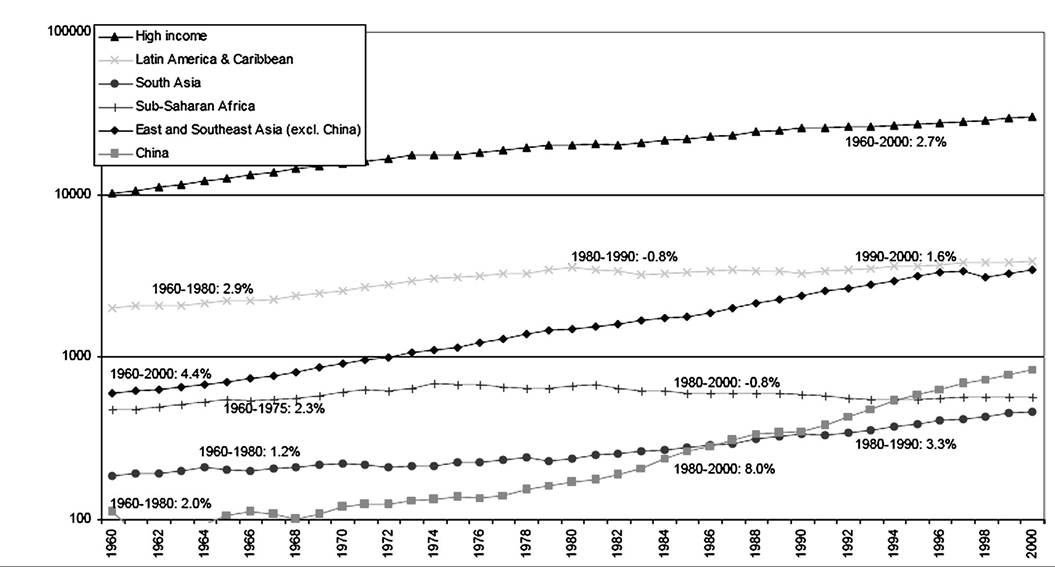
Figure 1. GDP per capita by country groupings (1995 US$).
970 D. Rodrik
South Asia’s growth rate up to 3.3 percent in 1980-2000 from 1.2 percent in 1960-1980. The experience in other parts of the world was the mirror image of these Asian growth take-offs. Latin America and Sub-Saharan Africa both experienced robust economic growth prior to the late 1970s and early 1980s - 2.9 percent and 2.3 percent respectively - but then lost ground subsequently in dramatic fashion. Latin America’s growth rate collapsed in the “lost decade” of the 1980s, and has remained anemic despite some recovery in the 1990s. Africa’s economic decline, which began in the second half of the 1970s, continued throughout much of the 1990s and has been aggravated by the onset of HIV/AIDS and other public-health challenges. Measures of total factor productivity run parallel to these trends in per-capita output (see Table 1).
Hence the aggregate picture hides tremendous variety in growth performance, both geographically and temporally. We have high growth countries and low growth countries; countries that have grown rapidly throughout, and countries that have experienced growth spurts for a decade or two; countries that took off around 1980 and countries whose growth collapsed around 1980.
This paper is devoted to the question: what do we learn about growth strategies from this rich and diverse experience? By “growth strategies” I refer to economic policies and institutional arrangements aimed at achieving economic convergence with the living standards prevailing in advanced countries. My emphasis will be less on the relationship between specific policies and economic growth - the stock-in-trade of cross-national growth empirics - and more on developing a broad understanding of the contours of successful strategies. Hence my account harks back to an earlier generation of studies that distilled operational lessons from the observed growth experience, such as Albert Hirschman’s (1958), Alexander Gerschenkron’s (1962) or Walt Rostow’s (1965) books.
This paper follows an unashamedly inductive approach in this tradition.A key theme in these works, as well as in the present paper, is that growth-promoting policies tend to be context specific. We are able to make only a limited number of generalizations on the effects on growth, say, of liberalizing the trade regime, opening up the financial system, or building more schools. The experience of the last two decades has frustrated the expectations of policy advisers who thought we had a good fix on the policies that promote growth - see the shift in mood that is reflected in the two quotes from Harberger that open this paper. And despite a voluminous literature, cross-national growth regressions ultimately do not provide us with much reliable and unambiguous evidence on such operational matters.[562] An alternative approach, and the one I adopt here, is to shift our focus to a higher level of generality and to examine the broad design principles of successful growth strategies. This entails zooming away from the individual building blocks and concentrating on how they are put together.
The paper revolves around two key arguments. One is that neoclassical economic analysis is a lot more flexible than its practitioners in the policy domain have generally
Table 1
Sources of growth by regions, 1960-2000 (percent increase)
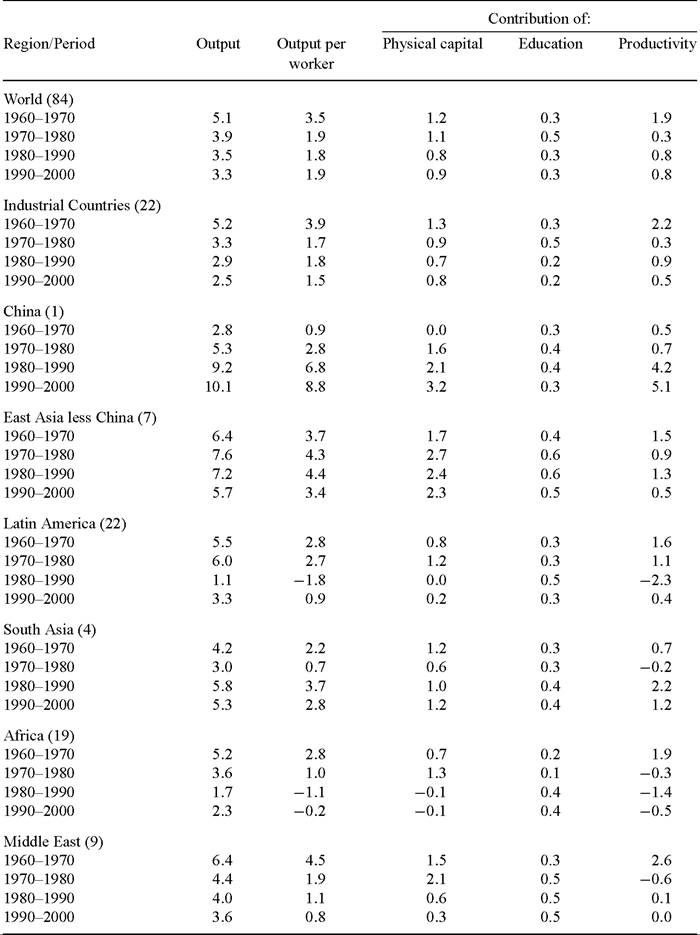
Source: Bosworth and Collins (2003).
given it credit. In particular, first-order economic principles - protection of property rights, contract enforcement, market-based competition, appropriate incentives, sound money, debt sustainability - do not map into unique policy packages. Good institutions are those that deliver these first-order principles effectively. There is no unique correspondence between the functions that good institutions perform and the form that such institutions take. Reformers have substantial room for creatively packaging these principles into institutional designs that are sensitive to local constraints and take advantage of local opportunities.
Successful countries are those that have used this room wisely.The second argument is that igniting economic growth and sustaining it are somewhat different enterprises. The former generally requires a limited range of (often unconventional) reforms that need not overly tax the institutional capacity of the economy. The latter challenge is in many ways harder, as it requires constructing a sound institutional underpinning to maintain productive dynamism and endow the economy with resilience to shocks over the longer term. Ignoring the distinction between these two tasks leaves reformers saddled with impossibly ambitious, undifferentiated, and impractical policy agendas.
The plan for the paper is as follows. The next section sets the stage by evaluating the standard recipes for economic growth in light of recent economic performance. Section 3 develops the argument that sound economic principles do not map into unique institutional arrangements and reform strategies. Section 4 re-interprets recent growth experience using the conceptual framework of the previous section. Section 5 discusses a two-pronged growth strategy that differentiates between the challenges of igniting growth and the challenges of sustaining it. Concluding remarks are presented in Section 6.
2.
More on the topic Introduction:
- Introduction
- Introduction
- Introduction
- Introduction
- INTRODUCTION
- Introduction
- CONTENTS
- AVIAN CHOLERA
- Contents
- Hare C., Neo D. (eds.). Trade Finance: Technology, Innovation and Documentary Credit. Oxford University Press,2021. — 417 p., 2021