Chapter 50 Impact Evaluation of Customer Knowledge Process on Customer Knowledge Expansion: An Empirical Study in Jordanian Banking Sector
Samer Alhawari
The World Islamic Sciences and Education University, Jordan
ABSTRACT
The article aim is to investigate how Customer Knowledge Processes used in practice by Jordanian banks to achieve customer knowledge expansion.
The empirical study is based on a sample of the data collected from 165 respondents, drawn randomly from six banks. The results show that the seven selected factors (Customer Knowledge Codification, Customer Knowledge Representation, Customer Knowledge Sharing, Customer Knowledge Application, Design of Customer Knowledge, Execution of Knowledgefrom Customer, and Verify of Knowledge from Customer) have a significant impact on Customer Knowledge Expansion. The findings did reveal the potential relationship between the customer knowledge processes and customer knowledge expansion. It also provides advice for the Information Technology (IT) Industry as to how an analytical knowledge process from customers should be taken into account in developing countries to attain proper customer knowledge expansion because of cultural, social and educational disparities.1. INTRODUCTION
In order to have a new knowledge economy and business, organizations are now facing major challenges due to external pressures as well as
DOI: 10.4018/978-1-4666-6268-1.ch050
the nature of the workplace. This gives rises to the necessity of improvement of a strategic, comprehensive, holistic and adoption Knowledge Management (KM) to enhance the process and get competitive advantage.
.
The globalization introduces many challenges, to meet these challenges, companies may require being innovative by introducing new ideas. Obviously, this trend is magnified by the rapid development of Customer Relationship Management (CRM) systems and the adoption of the customercentric orientation (Stefanou et al., 2003).
They are concerned with the expansion of customers; Based on that Knowledge has become strategic resource of organization and the basis of competitive advantage.
In addition, it has been recognized as an important asset for sustaining a competitive advantage (Papoutsakis & Valles, 2006).Customer expansion plays the role of expanding the organizations customer base through word of mouth marketing and active interactions with the company (Park & Kim, 2003). As well, Bibiano and Pastor (2006) describe the Evolution phase refer to the integration of more capabilities into the CRM system.
Undoubtedly, Customer Knowledge Management (CKM) creates new knowledge sharing platforms and processes between companies and their customers. It is a continuous strategic process by which companies enable their customers to move from passive information sources and recipients of products and services to empowered knowledge partners (Gibbert et al., 2002). Through, review and study of selected fundamentals related literature, that focuses on developed countries and accordingly based on cultural, educational, technological, social and economical factors applicable to advanced Western societies rather than developing countries.
Our study is therefore special, because it addresses one of the important issues in Middle Eastern area because the adoption and use of IT is new for most businesses (Nehari Talet et al., 2010). We strongly consider that our study will assist and provide guidance for the IT Industry, and researchers as to how a logical knowledge process from customers should be kept in mind in developing countries to help in order to attain customer knowledge expansion.
This paper is organized as follows. In the next section, we review relevant literature; section three proposes the research model and hypotheses, section four is about the research methodology in which we discuss the design of the questionnaire, sample, data collection, hypotheses analysis and results. The last piece of this paper is our conclusion.
2. LITERATURE REVIEW
2.1. Concept of Customer Knowledge
Study of the KM process is important for the organization to validate the obj ective.
Therefore, CRM process can be considered as knowledge oriented process with the characteristics of knowledge intensity and process complexity (Lin et al., 2006). For a deeper understanding of the KM processes, an attempt to express the hidden meaning of data, information and knowledge is necessary. Data mean a set of discrete and objective facts concerning events. Therefore, they can be construed as a structured record of transactions within an organization. Information is data with attributes of relevance and purpose, usually having the format of a document or visual and/or audible message. Knowledge is linked to the capacity for action. It is intuitive, therefore hard to define. It is linked to the users’ values and experience, being strongly connected to model recognition, analogies and implicit rules (Joia, 2000).Customer knowledge managers seek opportunities for connecting with their customers as equal co-creators of organizational value. This is also in stark contrast to the desire to maintain and care for an existing customer base (Gibbert et al., 2002). The literature shows that managers concentrate on how to produce expansion for the company through attain new customers and through engaging in an active and value-creating dialogue with them, and are much less concerned with customer expansion information. Furthermore, Gebert et al. (2002) maintains that CRM and KM have been gaining recently wide interest in business environment. It is an approach that is used to capture, create, and apply knowledge to make the CRM process successful (Alryalat et al., 2007).
2.2. Customer Knowledge Flows
To become more innovative, responsive to customers and adaptable to change, leading organizations are learning how to learn from high numbers of knowledgeable people. Today, Knowledge Flow continues to concentrate its efforts on innovations that are customer-focused, trustworthy, and dynamic and intelligent. When customers, suppliers and staff willingly share expertise and experiences with one another, customers are loyal, everyone wins and business advantage is undeniable.
Technology and humans must interact in effective CRM processes that bring the latest knowledge from all stakeholders to the management of customer relationships. However, experience has also shown that CRM is more than a technology issue. It is not just about software for organizing customer data. It is about changing the processes, interactions and culture of all of the partners in order to satisfy the ever-changing needs of the customer relationship and to provide seamless service.Salomann et al. (2005) distinguish between three kinds of knowledge flows that play a vital role in the interaction between an organization and its customers: Knowledge for, from and about customers. Knowledge for customers to support customers in their buying cycle, a continuous knowledge flow directed from the company to its customers. Knowledge from customers has to be incorporated by the company for product and service innovation, idea generation as well as for the continuous improvement of its products and services. Knowledge about customers is collected in CRM service and support processes and analyzed in CRM analysis processes.
2.3. The Task of Customer Knowledge Process in Achieving Customer Knowledge Expansion
The CRM research draw attention to the importance of KM, culture change to develop a customer-oriented organization, and technological readiness essentially CRM is about customer interaction and about learning about customers’ needs and preferences in order to provide more suitable products and services to customers in the future. The importance of technology in enabling CRM is confirmed by the attempts at defining the concept. One view of CRM is the utilization of customer related information or knowledge to deliver relevant products or services to customers (Levine, 2000). Furthermore, Newell (2000) discusses a range of CRM case studies that used customer knowledge to deliver relevant products and services. CRM has been also defined as the alignment of business strategies and processes to create customer loyalty and ultimately corporate profitability enabled by technology (Rigby et al., 2002).
In a similar vain, Ryals (2001) defines it as the lifetime management of customer relationships using IT.Kumar and Ramani (2004) viewed CRM as the process of getting and maintaining an ongoing relationship with customers across multiple customer touch points through differential and tailored treatment of individual customers based on their likely responses to alternative marketing programs, such that the contribution of each customer to the overall profitability of the firm is maximized. Therefore, to realize CRM success, business and IT executives should implement CRM processes and technologies and foster employee behavior that supports coordinated and more effective customer expansion throughout all customer channels.
A high degree of CRM process implementation is characterized as where firms are able to adjust their customer interactions based on the life-cycle stages of their customers and their capacity to influence or shape the stages (i.e., extending relationships, (Reinartz et al., 2004). E-CRM is defined as the application of CRM processes utilizing IT and relies on technology such as relational databases, data warehouses, data mining, computer telephony integration, the Internet, and multi-channel communication platforms in order to get closer to customers (Chen & Chen, 2004). Interestingly, the level of technological sophistication of CRM technology makes no contribution to economic performance and supports the view that CRM is more than just software (Reinartz et al., 2004). CRM can be conceptualized at three levels:
1. Company wide,
2. Functional, and
3. Customer facing (Buttle, 2004).
Bhaskar and Zhang (2005) confirm that the most significant changes in the practice of marketing during the last decade is the shift in emphasis from a transaction orientation customer interaction to the CRM, However, in large organizations, it is not very easy to collect and to transform the customer data necessary for creating systems to support it as the basis of the organizations wide customer relationship strategy, In terms of marketing strategies, CRM systems allow organizations to manage customer data, analyze customer relationships to keep existing customers and attract potential new customers.
Therefore, the goal of every organization is to get new customers and keep customers involved in organization Also, retention existing Customer within the organization, and enhancing the relationship with customers to develop the expansion of customer relationship.The enhancement of existing relationships is important to organizations, since attracting new customers is known to be more expensive. Therefore, as part of their CRM strategy, the need to understand and react to changes of customer behavior is an inevitable aspect of surviving in a competitive and mature market, (Lariviere & Poel, 2004).
2.4. Phases of Customer Knowledge Expansion
In recent years companies have integrated their CRM and KM efforts because they realize that KM plays a key role in CRM process (Dous et al., 2005). Additionally, CRM is a strategy which aims at acquiring customers, retaining and expanding the relationship with the customers (Alryalat & Alhawari 2008). Generally, CRM is defining as an interactive process that achieves an optimum balance between corporate investment and the satisfaction of customer needs to generate the highest profit through customer expansion.
Based on the theoretic al b ackground and literature review, a conceptual model was developed to examine the role of Customer Knowledge process (Customer Knowledge Codification, Customer Knowledge Representation, Customer Knowledge Sharing, Customer Knowledge Application, Design of Customer Knowledge, Execution of Knowledge from Customer, and Verify of Knowledge from Customer) on Customer Knowledge Expansion. To achieve the Customer Knowledge Expansion, need to investigate seven phases that can be seen in Table 1.
The first stage deals with “Customer Knowledge Codification.” The codification stage involves the conversion of validated customer knowledge into explicit form. It is used to represent customer knowledge in transferable, comprehensible and easily accessible format.
The second stage deals with “Customer Knowledge Representations.” It describes the knowledge in familiar terms. The aim of this phase is to represent the customer knowledge in explicit form to make the view simple.
The third stage is concerned with “Customer Knowledge Sharing.” It refers to the transfer of the customer knowledge to others by boosting individual’s innovativeness and performance.
The fourth stage focus on “Customer Knowledge Application” to organization’s products, services and processes aiming in certain ways to
Table 1. Taxonomy of customer knowledge expansion
| Main Dimension/Customer Knowledge Expansion | Sub Dimension/Parts of Process | References |
| Customer Knowledge Expansion | Customer Knowledge Codification | Miltiadis and Pouloudi (2003) |
| Customer Knowledge Representation | Stollberg et al (2004) | |
| Sun and Gang (2006) | ||
| Customer Knowledge Sharing | Lai and Chu (2000) | |
| Alavi and Leidner (2001) | ||
| Bouthillier and Shearer (2002) | ||
| Sun and Gang (2006) | ||
| Abdullah et al (2005) | ||
| Customer Knowledge Application | Lai and Chu (2000) | |
| Parikh (2001) | ||
| Alavi and Leidner (2001) | ||
| Stollberg et al (2004) | ||
| Design of Customer Knowledge | Alryalat and alhawari (2008) | |
| Execution of Knowledge from Customer | Bueren et al (2005) | |
| Salomann et al (2005) | ||
| Dous et al (2005) | ||
| Gebert et al (2002) | ||
| Verify of Knowledge from Customer | Sunassee and Sewry (2002) |
improve them. This stage helps individuals utilize the customer knowledge possessed by other individuals.
The fifth stage is “Design of Customer Knowledge”: which is defined as the systematic plan or a guide for extending the relationship with the customers. It is not only concerned with preserving the relationship with the customer. But it also prepares the company for a profound and longterm relationship. It determines the important steps needed to achieve an insightful affiliation between the organization and their customers.
The sixth stage “Execution of Knowledge from Customer”: This phase produces knowledge base called knowledge from customer that includes customer knowledge to improve products and services.
The final stage is “Verify of Knowledge from Customer.” The main objective of this stage is to verify the knowledge from customers. The main objective of the verification stage is to reveal the reliability of the source by providing evidence, conducting tests and investigating the reference to ensure its accuracy.
3. RESEARCH MODEL
CRM is often described as a strategy or a set of activities the organizations employs to gain a competitive advantage. Also, CRM helps organizations make sense of customer needs and help organizations manage these relationships and helps to predict the future. Therefore, customer knowledge expansion is very important for the survival of organizations to achieve the competitive advantage.
In addition, Customer Knowledge expansion is the process of deepening and sustaining the relationship with the most valuable customers
(Alryalat & Alhawari 2008). It is concerned with developing a value proposition relationship management with the customer. This act of sustaining the relationship will automatically results in turning the customers into profitable ones. Also, CRM helps organizations make sense of customer needs and help organizations manage these relationships and helps to predict the future. Therefore, “Customer Knowledge Expansion” is important for the survival of organizations to achieve the competitive advantage.
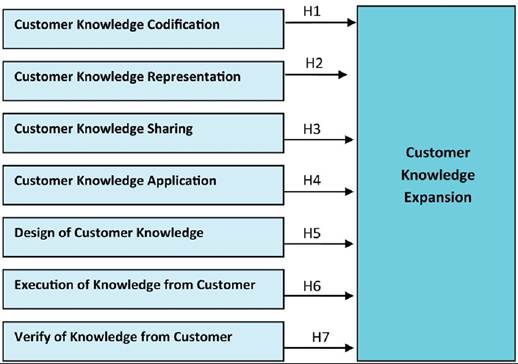
Based on the theoretic al background and literature review, a conceptual model was developed to examine the role of Customer Knowledge process (Customer Knowledge Codification, Customer Knowledge Representation, Customer Knowledge Sharing, Customer Knowledge Application, Design of Customer Knowledge, Execution of Knowledge from Customer, and Verify of Knowledge from Customer) on Customer Knowledge expansion. Figure 1 presents the research model, dependent on Table 1.
Seven hypotheses address the associations between Customer Knowledge process and “Customer Knowledge Expansion.” The seven hypotheses which guided this line of inquiry are as follows:
There is no significant relationship between “Customer Knowledge Codification” and “Customer Knowledge Expansion” at level (α ≤ 0.05);
There is no significant relationship between “Customer Knowledge Representation” and Customer “Customer Knowledge Expansion” at level (α ≤ 0.05);
There is no significant relationship between “Customer Knowledge Sharing” and “at level (α ≤ 0.05);
There is no significant relationship between “Customer Knowledge Application” and “Customer Knowledge Expansion” at level (α ≤ 0.05);
There is no significant relationship between “Design of Customer Knowledge” and “Customer Knowledge Expansion” at level (α ≤ 0.05);
There is no significant relationship between “Execution of Knowledge from Customer” and “at level (α ≤ 0.05);
There is no significant relationship between “Verify of Knowledge from Customer” and “Customer Knowledge Expansion” at level (α ≤ 0.05).
Figure 1. Research model
4. RESEARCH METHODOLOGY
4.1. Justification of Selecting the Quantitative Research
The quantitative approach supplied a suitable research data collection strategy, allowing the collection of a large amount of data from a sizeable population in a highly economical way. The construct was subjected to the scale reliability procedure of SPSS 11.0, using the Cronbach’s Alpha Cronbach (1951) criterion to assess the internal consistency of the studied construct. The Cronbach' Alpha coefficient is above 0.75 the value exceeds the accepted cut-off value of 0.75, as suggested by Nunnally (1978). This indicates that each individual item is internally consistent and highly reliable.
4.2. Justification of Selection the Questionnaire
The questionnaire started with a brief description of the meaning of the main concepts, and it gave instructions on how to answer each section of the questionnaire. An initial draft was developed based on an extensive literature review. It includes many questions which are in line with the research aims. For that reason, the research survey could be described as being comprehensive. It is divided into two parts. The first part includes the personal information of the respondents such as gender, area of profession and years of experience. The second part includes the questions related to variables that affect the integrated Customer Knowledge process regarding Customer Knowledge Acquisition.
4.3. Sample
The sample of the survey is divided into four Jordanian Bank which apply the CRM system. A total of 185 questionnaires were sent to six Jordanian banks. A total of 172 questionnaires were returned, 165 of which were completed and 7 were uncompleted. A total of 13 questionnaires were not returned. To increase the return rate, each bank was assigned a contact person to collect and return the questionnaires. Table 2 shows the summary of the sample size.
5. DATA ANALYSIS AND RESULT
This study contains 139 males with a percentage of 84.2% and 26 females with a percentage of 15.8%. The largest group of respondents (54.5 %) indicates that their area of specialization was Information Technology (IT). The smallest group area of specialization of respondents indicated Management Information system (4%). Additionally, the largest group Ofrespondents (36.4%) indicates that their years of experience range from (1-2 years). Finally, the smallest group of respondents (17%) indicates that their years of experience is (Less than 1years). This demographic data are detailed in Table 3.
Table 2. Summary of the sample size
| Category | Number of Questionnaires Distributed | Number of Questionnaires Returned | Number of Questionnaires Unreturned | Number of Completed Questionnaires Returned | Number of Uncompleted Questionnaires Returned |
| Bank 1 | 30 | 29 | 1 | 28 | 1 |
| Bank 2 | 40 | 36 | 4 | 34 | 2 |
| Bank3 | 45 | 41 | 4 | 40 | 1 |
| Bank 4 | 30 | 28 | 2 | 26 | 2 |
| Bank5 | 20 | 20 | 0 | 20 | 0 |
| Bank6 | 20 | 18 | 2 | 17 | 1 |
| Total | 185 | 172 | 13 | 165 | 7 |
Based on the objectives and hypotheses of the study, the researchers applied the regression Analysis (ANOVA). The following in Tables 4 through 10 represents the test of the hypotheses by using Analysis of variance (ANOVA), based on the significant level of (0.05).
Referring to Table 4, 5% of the variance in “Customer Knowledge Expansion” accounted by “Customer Knowledge Codification,” the significance equal 0.00, which is less than (0.05). For that reason, there is an effect of “Customer Knowledge Codification” on “Customer Knowledge Expansion.” Previous research on the use of “Customer Knowledge Codification” is mainly conceptual. The present study is one of the first to use empirical quantitative data to investigate concept of “Customer Knowledge Codification” to improve customer knowledge expansion. The implication of this finding for Jordanian Bank is that they may need to pursue a combined strategy aimed at managing “Customer Knowledge Codification” and “Customer Knowledge Expansion” in order to improve customer satisfaction.
Referring to Table 5, 9% of the variance in “Customer Knowledge Expansion” accounted by “Customer Knowledge Representation,” the significance equal 0.00, which is less than (0.05). For that reason, there is an effect of “Customer Knowledge Representation” on “Customer Knowledge Expansion.” Previous research on the use of “Customer Knowledge Representation” is mainly conceptual. The present study is one of the first to use empirical quantitative data to investigate concept of “Customer Knowledge Representation” to improve customer knowledge expansion. The implication of this finding for Jordanian Bank is that they may need to pursue a combined strategy aimed at managing “Customer Knowledge Representation” and “Customer Knowledge Expansion” in order to improve customer satisfaction.
Referring to Table 6, 7% of the variance in “Customer Knowledge Expansion” accounted by “Customer Knowledge Sharing,” the significance equal 0.00, which is less than (0.05). For that reason, there is an effect of “Customer Knowledge Sharing” on “Customer Knowledge Expansion.” Previous research on the use of “Customer
Table 3. Demographic data
| Description | Variable | Result | Percentage |
| Gender | Male | 139 | 84.2% |
| Female | 26 | 15.8% | |
| Area of Specialization | Information Technology | 90 | 54.5% |
| Management Information system | 11 | 6.7% | |
| Marketing | 22 | 13.3% | |
| Customer Relationship Management | 42 | 25.5% | |
| Experience | Less than 1years | 28 | 17% |
| 1-2 years | 60 | 36.4% | |
| 3-5 years | 31 | 18.8% | |
| 6 years or more | 46 | 27.8% |
Table 4. ANOVA test for “customer knowledge codification” and “customer knowledge expansion”
| R | R Square | Adjusted R Square | Sig |
| 0.22 | 0.05 | 0.046 | bgcolor=white>0.00
Table 5. ANOVA test for “customer knowledge representation” and “customer knowledge expansion”
| R | R Square | Adjusted R Square | Sig |
| 0.30 | 0.09 | 0.087 | 0.00 |
Table 6. ANOVA test for “customer knowledge sharing” and “customer knowledge expansion”
| R | R Square | Adjusted R Square | Sig |
| 0.28 | 0.07 | 0.07 | 0.00 |
Knowledge Sharing” is mainly conceptual. The present study is one of the first to use empirical quantitative data to investigate concept of “Customer Knowledge Sharing” to improve customer knowledge expansion. The implication of this finding for Jordanian Bank is that they may need to pursue a combined strategy aimed at managing “Customer Knowledge Sharing” and “Customer Knowledge Expansion” in order to improve customer satisfaction.
Referring to Table 7, 8% of the variance in “Customer Knowledge Expansion” accounted by “Design of Customer Knowledge,” the significance equal 0.00, which is less than (0.05). For that reason, there is an effect of “Design of Customer Knowledge” on “Customer Knowledge Expansion.” Previous research on the use of “Design of Customer Knowledge” is mainly conceptual. The present study is one of the first to use empirical quantitative data to investigate concept of “Design of Customer Knowledge” to improve customer knowledge expansion. The implication of this finding for Jordanian Bank is that they may need to pursue a combined strategy aimed at managing “Design of Customer Knowledge” and “Customer Knowledge Expansion” in order to improve customer satisfaction.
Referring to Table 8, 6% of the variance in “Customer Knowledge Expansion” accounted by “Customer Knowledge Application,” the significance equal 0.00, which is less than (0.05). For that reason, there is an effect of “Customer Knowledge Application” on “Customer Knowledge Expansion.” Previous research on the use of “Customer Knowledge Application” is mainly conceptual. The present study is one of the first to use empirical quantitative data to investigate concept of “Customer Knowledge Application” to improve customer knowledge expansion. The implication of this finding for Jordanian Bank is that they may need to pursue a combined strategy aimed at managing “Customer Knowledge Application” and “Customer Knowledge Expansion” in order to improve customer satisfaction.
Referring to Table 9, 14% of the variance in “Customer Knowledge Expansion” accounted by “Execution of Knowledge from Customer,” the significance equal 0.00, which is less than (0.05). For that reason, there is an effect of “Execution of Knowledge from Customer” on “Customer Knowledge Expansion.” Previous research on the use of “Execution of Knowledge from Customer” is mainly conceptual. The present study is one of the first to use empirical quantitative data to investigate concept of “Execution of Knowledge from Customer” to improve customer knowledge expansion. The implication of this finding for
Table 7. ANOVA test for “design of customer knowledge ” and “customer knowledge expansion ”
| R | R Square | Adjusted R Square | Sig |
| 0.29 | 0.08 | 0.08 | 0.00 |
Table 8. ANOVA test for “customer knowledge application” and “customer knowledge expansion”
| R | R Square | Adjusted R Square | Sig |
| 0.25 | 0.06 | 0.06 | 0.00 |
Table 9. ANOVA test for “execution of knowledge from customer” and “customer knowledge expansion”
| R | R Square | Adjusted R Square | Sig |
| 0.38 | 0.14 | 0.139 | 0.00 |
Jordanian Bank is that they may need to pursue a combined strategy aimed at managing “Execution of Knowledge from Customer” and “Customer Knowledge Expansion” in order to improve customer satisfaction.
Referring to Table 10, 4% of the variance in “Customer Knowledge Expansion” accounted by “Verify of Knowledge from Customer,” the significance equal 0.00, which is less than (0.05). For that reason, there is an effect of “Verify of Knowledge from Customer” on “Customer Knowledge Expansion.” Previous research on the use of “Verify of Knowledge from Customer” is mainly conceptual. The present study is one of the first to use empirical quantitative data to investigate concept of “Verify of Knowledge from Customer” to improve customer knowledge expansion. The implication of this finding for Jordanian Bank is that they may need to pursue a combined strategy aimed at managing “Verify of Knowledge from Customer” and “Customer Knowledge Expansion” in order to improve customer satisfaction.
The relation between the Customer Knowledge process (Customer Knowledge Codification, Customer Knowledge Representation, Customer Knowledge Sharing, Customer Knowledge Application, Design of Customer Knowledge, Execution of Knowledge from Customer, and Verify of Knowledge from Customer) and Customer Knowledge Expansion was confirmed in this study. The findings are summarized as follows:
1. “Customer Knowledge Codification” had a positive impact on “Customer Knowledge Expansion.”
2. “Customer Knowledge Representation” had a positive impact on “Customer Knowledge Expansion.”
3. “Customer Knowledge Sharing” had a positive impact on “Customer Knowledge Expansion.”
4. “Customer Knowledge Application” had a positive impact on “Customer Knowledge Expansion.”
Table 10. ANOVA test for “verify of knowledge from customer” and “customer knowledge expansion”
| R | R Square | Adjusted R Square | Sig |
| 0.22 | 0.04 | 0.04 | 0.00 |
5. “Design of Customer Knowledge” had a positive impact on “Customer Knowledge Expansion.”
6. “Execution of Knowledge from Customer” had a positive impact on “Customer Knowledge Expansion.”
7. “Verify of Knowledge from Customer” had a positive impact on “Customer Knowledge Expansion.”
Moreover, although the importance of terms of Customer Knowledge Processing such as the (Customer Knowledge Codification, Customer Knowledge Representation, Customer Knowledge Sharing, Customer Knowledge Application, Design of Customer Knowledge, Execution of Knowledge from Customer, and Verify of Knowledge from Customer) is often acknowledged in the literature, this study enhances understanding of these relationships in providing empirical results based on quantitative data. Further, the findings are based on data that was gathered from the perspective of employee of Jordanian banks. In our view this is an important contribution because Customer Knowledge Processing related Customer Knowledge Expansion may vary significantly.
6. CONCLUSION
The article attempts to build a more complete framework of the factors that influence Customer Knowledge Expansion. The results of this study clearly show that seven of the selected factors (Customer Knowledge Codification, Customer Knowledge Representation, Customer Knowledge Sharing, Customer Knowledge Application, Design of Customer Knowledge, Execution of Knowledge from Customer, and Verify of Knowledge from Customer) have a significant impact on Customer Knowledge Expansion in Jordanian banks. Consequently, the paper illustrated the role Customer Knowledge process achieves Customer Knowledge Expansion. These processes help to acquire more customers by providing the members of the organization with real information enabling correct reaction in making the right decisions in order to gain the competitive advantage. This research contributes to the understanding of the Customer Knowledge process and Customer Knowledge Expansion. The research has succeeded in proposing a model that enriches current research by offering specification, justification, and empirical validation of a set of interrelationships between important factors.
This research describes an integration of Customer Knowledge process and Customer Knowledge Expansion. Hopefully these findings will shed some light for policy makers allowing them to integrate Customer Knowledge process and Customer Knowledge Expansion to improve customer satisfaction in Jordanian banks. To the best of our knowledge, no existing studies have empirically tested for an interaction effect on expand of customer knowledge and Customer Knowledge process. Similarly, while the interaction effect between Customer Knowledge processes has been suggested as phases, empirical support has been scant. Our study fills these two major gaps in the literature.
Due to lack of Customer Knowledge process in Jordanian bank, the banks are not aware of Customer Knowledge Expansion facilities. This is also the reason for a lack of trust in Customer Knowledge process. Therefore, the vital contribution of values based recruitment and selection, innovative and need-based training and development, comprehensive, and reasonable performance evaluation, foster satisfaction, and quality of work life are essential dimensions that have positive effects on superior performance for sustained competitive advantage that need to be capitalized by executive “Customer Knowledge Expansion” at all level by using (Customer Knowledge Codification, Customer Knowledge Representation, Customer Knowledge Sharing, Customer Knowledge Application, Design of Customer Knowledge, Execution of Knowledge from Customer, and Verify of Knowledge from Customer).
REFERENCES
Abdullah, R., Selamat, M. H., Sahibudin, S., & Alias, R. A. (2005). A framework for knowledge management system implementation in collaborative environment for higher learning institution. Journal of Knowledge Management Practice, 6.
Alavi, M., & Leidner, D. (2001). Review: Knowledge management and knowledge management system: Conceptual foundations and research issues. Management Information Systems Quarterly, 25(1), 107-136. doi:10.2307/3250961
Alryalat, H., Alhawari, S., & AL-Omoush, K. (2007, June 20-22). An integrated model for knowledge management and customer relationship management. In Proceedings of the 8th International Business Information Management Association Conference(IBIMA) in the Networked Economy, Dublin, Ireland (pp. 446- 453). ISBN: 0-9753393-7-0.
Alryalat, H., & Alhawari, S. (2008, January 4-6). A review of theoretical framework: How to make process about, for, from knowledge work. In Proceedings of The 9th International Business Information Management Association Conference (IBIMA) in the Information Management in Modern Organization, Marrakech, Morocco (pp. 37-50). ISBN: 0-9753393-8-9.
Bhaskar, R., & Zhang, Y. (2005). CRM systems used for targeting market: A case at Cisco systems. In Proceedings of the International Conference on e-Business Engineering, IEEE.
Bibiano, L. H., & Pastor, J. A. (2006). Towards a definition of a CRM system life cycle. In Proceedings of the European and Mediterranean Conference on Information Systems (EMCIS), Costa Blanca, Alicante, Spain.
Bouthillier, F., & Shearer, K. (2002). Understanding knowledge management and information management: The need for an empirical perspective. Information Research Journal, 5(1), 1-39.
Bueren, A., Schierholz, R., Kolbe, L., & Brenner, W. (2005). Improving performance of customer processes with knowledge management Business. Process Management Journal, 11(5), 573-588. doi:10.1108/14637150510619894
Buttle, F. (2004). Customer relationship management. Oxford, UK: Elsevier Butterworth- Heinemann.
Chen, Q., & Chen, H. (2004). Exploring the success factors of eCRM strategies in practice. Database Marketing & Customer Strategy Management, 11(4), 333-343. doi:10.1057/palgrave. dbm.3240232
Cronbach, L. J. (1951). Coefficient alpha and the internal structure of tests. Psychometrika, 16, 297-333. doi:10.1007/BF02310555
Dous, M., Salomann, H., Kolbe, L., & Brenner, W. (2005). Knowledge management capabilities in CRM: Making knowledge for, from and about customers work. In Proceedings of the Eleventh Americas Conference on Information Systems, Omaha, NE (pp. 167-178).
Gebert, H., Geib, M., Kolbe, L., & Riempp, G. (2002). Towards customer knowledge management: Integrating customer relationship management and knowledge management concepts. In Proceedings of the 2nd International Conference on Electronic Business, Taipei, Taiwan.
Gibbert, M., Leibold, M., & Probst, G. (2002). Five styles of customer knowledge management and how smart companies use them to create value. European Management Journal, 20(5), 459-46. doi:10.1016/S0263-2373(02)00101-9
Joia, L. A. (2000). Measuring Intangibles corporate assets: Linking business strategy with intellectual capital. Journal of Intellectual Capital, 1(1), 68-84. doi:10.1108/14691930010371636
Kumar, V., & Girish Ramani (2004). Taking customer lifetime value analysis to the next level. Journal of Integrated Communications (pp. 2733).
Lai, H., & Chu, T. H. (2000). Knowledge management: A review of theoretical frameworks and industrial cases. In Proceedings of the 33rd Hawaii International Conference on System Sciences, IEEE.
Lariviere, B., & Poel, D. V. D. (2004). Investigating the role of product features in preventing customer churn, by using survival analysis and choice modeling: The case of financial services. Expert Systems with Applications, 27, 277-285. doi:10.1016/j.eswa.2004.02.002
Levine, S. (2000). The rise of CRM. America’s Network, 104(6), 34.
Lin, Y., & Su, H.-Y., & Chien Shihen. (2006). A knowledge enabled procedure for customer relationship management. Industrial Marketing Management, 35, 446-456. doi: 10.1016/j.indmar- man.2005.04.002
Miltiadis, D. L., & Pouloudi, A. (2003). Project management as a knowledge management prime: The learning infrastructure in knowledge-intensive organizations: Projects as knowledge transformations and beyond. The Learning Organization Journal, 10(4), 237-250. doi:10.1108/09696470310476007
Nehari-Talet, A., Alhawari, S., & Alryala, H. (2010). The outcome of knowledge process for customer of Jordanian companies on the achievement of customer knowledge retention. International Journal of Knowledge Management IJKM, 6(1).
Newell, F. (2000). Loyalty.com: Customer relationship management in the new Era of Internet Marketing. New York, NY: McGraw-Hill.
Nunnally, J. C. (1978). Psychometric theory (2nd ed.). New York, NY: McGraw-Hill.
Papoutsakis, H., & Valles, R. S. (2006). Linking knowledge management and information technology to business performance: A literature review and a proposed model. Journal of Knowledge Management Practice, 7(1).
Parikh, M. (2001). Knowledge management framework for high-tech research and development. Engineering Management Journal, 13(3), 27-34.
Park, C. H., & Kim, Y. G. (2003). A framework of dynamic CRM: Linking marketing with information strategy. Business Process Management Journal, 9(5), 652-671. doi:10.1108/14637150310496749
Reinartz, W., Krafft, M., & Hoyer, W. (2004). The customer relationship management process: Its measurement and impact on performance. JMR, Journal of Marketing Research, 61(1), 293-305. doi:10.1509/jmkr.41.3.293.35991
Salomann, H., Dous, M., Kolbe, L., & Brenner, W. (2005). Rejuvenating customer management: How to make knowledge for, from and about customers work. European Management Journal, 23(4), 392-403. doi:10.1016/j.emj.2005.06.009
Stefanou, J., & Sarmaniotis, C., & Stafyla. (2003). ACRM and customer-centric knowledge management: an empirical research. Business Process Management Journal, 9(5), 617-634. doi:10.1108/14637150310496721
Stollberg, M., Zhdanova, A. V., & Fensel, D. (2004). H-TechSight- A next generation knowledge management platform. Journal of Information and Knowledge Management, 3(1), 47-66. doi:10.1142/S0219649204000651
Sun, Z., & Gang Gao. (2006). HSM: A hierarchical spiral model for knowledge management. In Proceedings the 2nd International Conference on Information Management and Business, Sydney Australia.
Sunassee, N., & Sewry, A. (2000). A theoretical framework for knowledge management implementation. In Proceedings Annual Research Conference of the South African Institute of Computer Scientists and Information Technologists (SAIC- SIT) on Enablement Through Technology (pp. 235-245).
This work was previously published in International Journal of Knowledge Society Research (IJKSR), 4(1); edited by Miltiadis D. Lytras, pages 30-42, copyright 2013 by IGI Publishing (an imprint of IGI Global).
932
More on the topic Chapter 50 Impact Evaluation of Customer Knowledge Process on Customer Knowledge Expansion: An Empirical Study in Jordanian Banking Sector:
- Chapter 50 Impact Evaluation of Customer Knowledge Process on Customer Knowledge Expansion: An Empirical Study in Jordanian Banking Sector
- Market Research: What Your Customer Wants
- Plato: Knowledge as justified true belief
- ‘Knowledge is power’
- SPIRITUAL WISDOM AND SCIENTIFIC KNOWLEDGE
- Knowledge miscalibration and its origins
- THE EMPIRICAL FOUNDATIONS OF THE EMH
- CONTRIBUTION OF STUDY
- Section 6 Emerging Trends
- THE THEORY OF KNOWLEDGE