Chapter 49 Managing Customer Knowledge in Service Economy: Proposing a onceptual Model of CKM for Services
Satyendra C. Pandey
Xavier Institute of Management, India
Mahendra Kumar Shukla Xavier Institute of Management, India
Upendra K. Maurya
National Institute for Micro, Small, and Medium Enterprises (Ni-MSME), India
ABSTRACT
In the age of service and knowledge economy, firms have realized that obtaining, managing, and sharing customer knowledge can be a valuable resource to have advantages over their competitors.
However, the review of the literature of Customer Knowledge Management (CKM) area suggests that firms often fail in applying the true notion of CKM, thinking it only as a new technological innovation related to IT. Moreover, the terms Knowledge Management (KM), Customer Relationship Management (CRM), and Customer Knowledge Management (CKM) are not well differentiated in the extant academic literature. This chapter aims to present a conceptual differentiation between these terms by analyzing and comparing the various components of KM, CRM, and CKM. The effort has been made in the chapter to map CKM practices in the Indian service market by presenting case studies of two Indian commercial banks. The authors also made an attempt to propose a conceptual framework of CKM, which can be applied in service firms to successfully implement CKM practices in their organizations.1. INTRODUCTION
In the increasingly competitive economy, providing superior value to customers has become a hallmark of businesses all over. However, this task
DOI: 10.4018∕978-1-4666-6268-1.ch049
of providing superior value is not easy anymore as customers have become more informed and aware of the product and services at their disposal. To compete effectively in today’s marketplace, organizations must seek innovative methods of doing business and quickly react to customer demand. Marketplace has become more competitive, complex and intense with the increase in globalization and opening of economy.
.
Successful organizations world over are relying heavily on knowledge as a critical driver of business success and possibly an essential asset of business survival in the age of globalization (Davenport & Prusak, 2000). Amongst the various emerging trends in businesses, managing customer knowledge for establishment of long term rewarding relationship with the customers is catching up thick and fast (Zhang, 2001). Companies have identified that customer knowledge is important for all businesses and it is at the origin of most improvements in customer value.
Companies know that relationships with the customers can be highly rewarding in case they are managed effectively and knowledge flow seamlessly between the customers and the organization. This will lead to co-creation of services maintaining a win-win situation for both the parties. To leverage on this resource i.e. knowledge from the customers, companies have started taking a leap forward from the normal path of customer relationship management by integrating customer relationship management and knowledge management. Resultant of this integration and organizational approach of co-creation of values is Customer Knowledge Management (CKM). CKM can be generally considered as the process of capturing, sharing, transferring and applying the data, information and knowledge related with customers for the benefit of organization as well as the customers.
Despite the growing awareness and interest in CKM, firms are grappling up with the issue of getting the things right and getting the desired outcome. The frameworks present in the literature do not sufficiently guide the organizational leaders and managers to collaborate with the customers in a manner to bring the desired value. Specifically, this research is an attempt to propose a comprehensive model to guide the managers on ‘how’ part of management of customer knowledge.
Describing further, the objectives of the research reported in this paper are (a) to define Customer Relationship Management (CRM), Knowledge Management (KM) and Customer Knowledge Management (CKM); (b) to bring out the difference between CRM, KM and CKM; and (c) to propose a conceptual model of customer knowledge management for services.
The remainder of this paper is structured as follows. The next section presents the literature, definitions of the three key terms which form the genesis of this paper, CRM, KM and CRM are presented to develop an understanding among the readers. Section three elaborates the key differences in each of the three against the key differentiating factors such as vision, objectives, outcomes, etc. A conceptual framework is proposed in section four. Section five discusses two Indian case studies from service industry using customer knowledge management efficiently and effectively to gain competitive advantage. Following that, discussions and managerial implications are presented in section six.2. DEFINITIONS: CUSTOMER RELATIONSHIP MANAGEMENT, KNOWLEDGE MANAGEMENT, CUSTOMER KNOWLEDGE MANAGEMENT
It is imperative that, prior to discussing the detailed model and dwelling into the role of customer knowledge management in services, the definitions of each of the concepts like customer relationship management, knowledge management and customer knowledge management is discussed in detail. This discussion will lead to a common understanding of each of these definitions and a summary of definitions from the literature will form basis of the proposed model.
2.1 Customer Relationship Management
Extant literature has proposed a number of definitions of customer relationship management over past two decades. Customer relationship management has garnered the interest of both academic and practitioner community with the emergence of thought that customers are the key drivers of business growth and gaining economic edge. Several of the these definitions as we observe from the literature define CRM from a technology point of few while authors like Payne and Frow (2005) have pointed out that CRM should be positioned in the broad strategic context. According to them a strategic and holistic approach to CRM should emphasize upon the selective management of customer relationship to create value for stakeholders (Payne and Frow, 2005).
The above view is also present in the writings of other authors like Glazer (1997) and Swift (2001), where they argue that customer relationships should be managed selectively and strategically to bring rewards to the stakeholders.The most comprehensive and widely accepted definition of customer relationship management is the one proposed by Payne and Frow (2005, p. 168); they define customer relationship management as
[.] a strategic approach that is concerned with creating improved shareholder value through the development of appropriate relationships with key customers and customer segments. CRM unites the potential of relationship marketing strategies and IT to create profitable, long-term relationships with customers and other key stakeholders.
CRM provides enhanced opportunities to use data and information to both understand customers and co create value with them. This requires a cross-functional integration of processes, people, operations, and marketing capabilities that is enabled through information, technology, and application. (p.168)
Authors like Payne and Frow (2005) and Parvatiyar and Sheth (2001) argue that CRM focuses on establishing, maintaining, and enhancing long-term relationships with attractive customers. Parvatiyar and Sheth (2001) also proposed that CRM is
[.../a comprehensive strategy and process of acquiring, retaining and partnering with selective customers to create superior value for the company and the customer. (p. 5)
Morgan et al. (2009) summarized that role of CRM is to
[.] identify attractive customers and prospects, initiate and maintain relationships with attractive customers, and leverage these relationships into customer level profits.
In consistent with broader marketing and strategic frameworks we define customer relationship management as a strategically motivated objective of a business to develop long term sustainable relationships with the customers which can bring rewards to the firm in the form of increased reputation, increased profit share and providing win-win situation for all the stakeholders.
2.2 Knowledge Management
Both, scholars and practitioners have realized that markets shift, technology proliferates, competitors multiply and products become obsolete overnight. This realization has brought the phenomenon of organizational knowledge management to the forefront of scholarly and practitioner attention. With this surge of interest in knowledge management lot of scholarly worked started appearing in academic journals. However, despite a huge volume of literature now available, there is no readily acceptable definition of knowledge management.
According to Jennex (2005), Knowledge management is
[...] the practice of selectively applying knowledge from previous experiences of decision making to current and future decision making activities with the express purpose of improving organization’s effectiveness. (p. 7)
Definitions given by organizations are also suggestive of their efforts of management of knowledge. IBM and Lotus define knowledge management as
[.] a discipline that systematically leverages content and expertise to provide innovation, responsiveness, competency, and efficiency. (Pohs et al., 2001)
Literature is replete with the definitions of KM, but if analyzed systematically these can lead to one common understanding. KM can be understood as a deliberate and systematic effort of an organization to enable effective planning, improved innovation, better decision making, improved problem solving and subsequently increasing organizational performance through identification, selection, capture, storage, dissemination and application of knowledge.
2.3 Customer Knowledge Management
In an age of stiff competition, there is little reason to doubt that customer knowledge is an important asset for all businesses (Rowley, 2002). Customer knowledge management (CKM) refers to the management of organizational knowledge on the customer side. To attain the objective of long term relationship of CRM companies need to capture the customer-related knowledge.
Garcia-Murillo and Annabi (2002) advocated the need of knowledge management as the regular practices in CRM and marketing fail to acquire, transfer, and utilize customer knowledge.Gebert et al. (2003), in their work, suggested that knowledge flows in customer relation management processes can be classified into three categories. These can be understood as three CKM strategies: management of knowledge for customers, management of knowledge from customers, management of knowledge about customers. Management of knowledge for customers refers to the strategies in which flow of knowledge from organization to customers is managed. Horovitz (2000) contends that continuous flow of knowledge from organization is required to help customers in making an informed buying decision. This will also lead to support in the usage of product or service. Management of knowledge from customers essentially refers to the strategies which help in the flow of knowledge from customers to the organization. This includes feedback and grievance reporting mechanism. Knowledge acquired from customers by means of this strategy is useful in enhancing the quality of services as well as in developing the new services (Garcia-Murillo & Annabi, 2002; Zanjani et al., 2008). Management of knowledge about customers refers to strategies that organizations use to manage knowledge about customers. This encompasses customers past transactions, buying preferences, future needs, change in buying behavior and ongoing trends (Gebert et al., 2003).
3. CRM, KM, AND CKM: IDENTIFYING DIFFERENCES
Before proceeding further there is a need to understand how CRM, KM and CKM are different from each other. Summarily, CKM is said to be an integrated approach evolving out of customer relationship management and knowledge management. Customer approach to knowledge management with a motivation to establish long term relationship for the creation of value for all the stakeholders can be understood as CKM.
Where Customer Relationship Management emerged as an amalgamation of relationship marketing and information technology approach (Gebert et al., 2003) aimed at gaining the customer and establishing a long term relationship. Knowledge Management gained importance in the information age with the amalgamation of several disciplines (Pandey & Dutta, 2013) like philosophy, social science, management science, knowledge engineering, information systems, etc. (Kakabadse et al., 2003) to manage the knowledge within the employees, teams, company and group of company i.e. inter-firm management of knowledge. Customer knowledge management is an emergent theme in concurrent management literature evolving from the amalgamation of two practitioner disciplines of CRM and KM, this evolution is primarily focused on the management of customer experiences, creativity, satisfaction/ dissatisfaction with products or services (Gibbert et al., 2002). Differences on these are marked clearly in Table 1.
4. IMPORTANCE OF CUSTOMER KNOWLEDGE IN BANKING SERVICES: CASE STUDIES OF
In this section we present case studies of two large commercial banks in India, one public sector and the other being a private sector bank. Private bank discussed in the case implemented Knowledge Management systems and practices at first and then slowly evolved with the integrated practices of Customer Knowledge Management. Public sector bank recently implemented the integrated KM system which is capable of addressing all the issues relating to the management of customer knowledge.
Table 1. Differences between CRM, KM and CKM
| Differentiating Factor | CRM | KM | CKM |
| Vision | To develop a long lasting relationship with the customers | To develop a culture of sharing, unlocking the knowledge present with the employees about processes, practices, customers, best practices, etc. | Co-creating value in tandem with the customers. Direct engagement of customers |
| Objective | Managing and nurturing customer base for the company | Managing knowledge of knowhow, know-why and know- what essentially present within the organization for achieving competitive advantage | Collaborating with customer for greater value creation. Knowledge for customers, from customers and about customers come to forefront |
| Consequences | Customer retention | Cost saving in reinventing the things, build up to innovative products and services | Customer value addition to the company. |
| Information | Data - about customers, minimalistic value attached | Know how of processes and practices mostly on employee side | Customer experiences |
| Role of customers | Moderate or captive, mostly tied to product or service by loyalty schemes. | Very low or passive | High and active engagement. Partner in value creation |
| Role of Employees | Little, if it involves work like providing an information in catalogue or brochure upon request from the customer | Low, if the focus is on creation of knowledge within which is mostly the case. | High, active engagement with the customers in gathering knowledge through repeated and multiple conversations with the customers. |
| Role of Organization | Thrust on building long term relationship with the customers | Focus on encouraging and building a culture of knowledge sharing among the employees. Incentivizing sharing and learning outcomes | Encouraging customers to become partners in the creation of value for themselves and also the organization. |
Case 1: ICICI Bank
ICICI is a large Indian multinational bank headquartered in Mumbai. It is the second largest bank in India by assets and third largest by market capitalization. Knowledge Management initiative in the bank started back in the year 2000 when the size of the bank and the customer base were small. With the growth that the bank was pegged to it was necessary to have a KM strategy in place to maintain the knowledge base. ICICI’s KM intranet portal - WiseGuy came as an answer to be a one stop place to capture, disseminate, discuss and amalgamate all knowledge within the organization and best practices from outside. In order to maintain long lasting customer relationship, the bank started installing customer knowledge databases with the help of knowledge management initiatives.
With the increased importance of managing customer knowledge, top management inducted several other features. There is a daily update feature on the portal which is known as Daily Dose consisting headlines, market happenings and customer appreciation. Query board which is a central, interactive repository of frequently asked questions features customer credit queries, customer requirement queries. The interactive feature has made the communication a two way process. Customer service team and staff which are directly responsible for handling the customers can share almost everything related to customer complaints, service quality issues, and customer satisfaction terms. Customer satisfaction benchmarks and those achieving it are also a regular feature on the intranet.
Case 2: Union Bank of India (UBI)
Union Bank of India is one of the largest public sector banks in India. UBI started c atching up with the current competition in the banking industry slowly with the repositioning exercise in the year 2008. Engagement with the young customers was not an easy exercise for the bank. It started with a huge marketing campaign to revive its identity as a trusted banker, maintaining its equity with the existing customers and gaining new customers.
The idea of having a KM solution to grab service preferences of customers as a form of customer knowledge came late to the UBI. Having implemented a comprehensive KM solution earlier this year (2013) in April, UBI has taken baby steps to develop a fully grown customer knowledge management processes and practices. The current system developed by Infosys Technologies as implementation partners allows the bank to effectively handle customer query and provide solutions as required. WebSphere Portal which is company intranet is now allowing the bank to handle more customer query more efficiently. More knowledge is made available for the customers about the services; more knowledge from the customers is being received about the customer satisfaction level, issues in using services, etc. This portal is also helping the bank in managing knowledge about customers by updating the choice of services made in the past, likelihood of usage of services in future and also preferences.
The cases presented above are from one industry but at a different maturity level. At one hand there is a private sector bank which has a decade old system in place to manage knowledge present inside and outside the bank. On the other there is a public sector bank which recently underwent a rebranding exercise and started taking cognition of factors like attracting and building long term relationships with the ever demanding young customers. The point that needs to be understood here is that the management of knowledge, especially from the customers is not an easy task. Establishing and maintaining a long term and rewarding relationship is a major challenge. Involving customers in co-creation of value should be dealt with high level of carefulness.
5. CONCEPTUAL MODEL OF CUSTOMER KNOWLEDGE MANAGEMENT
In light of the above two cases from Indian banking sector it can be said that the level of CKM maturity has not been attained which can said to be holistic. The processes are in nascent phase and need to be worked upon from the existing ones to achieve long term benefits. From the sections above, it is also clear that customer knowledge management is concerned with the acquisition, developing, sharing and maintaining of customer knowledge in order to maximize customer value. Whereas, customer knowledge can be referred as
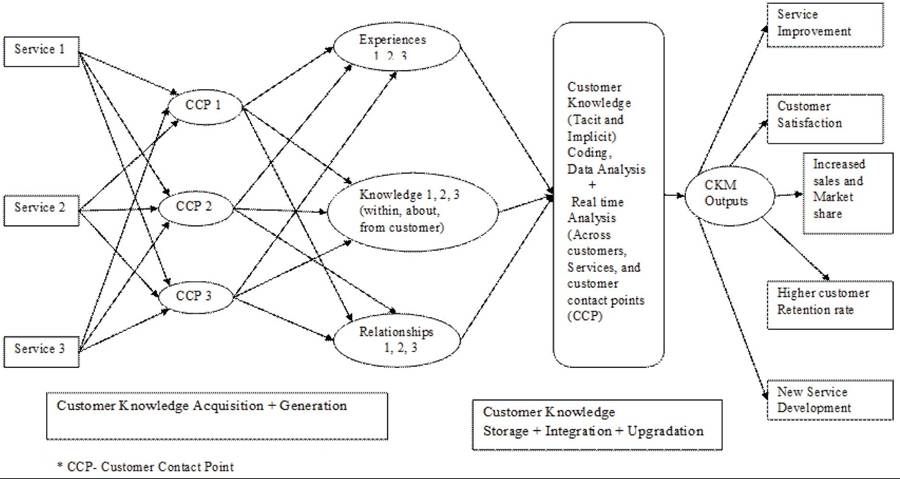
the experience, value (social, economical, and rational), situational information and relationships which are needed, produced or possessed to enhance the value perception of the customers with respect to service provider firms (Hualin & Zhongdong, 2010). Customer knowledge may also be seen as knowledge about customers whether it may be potential customers, customer segments or individual customers; and knowledge possessed by customers. It is different from customer data and customer information in a sense that it can be either explicit and structured or tacit in mind of employees and customers (Sedighi et al., 2007). However, effective utilization of all customer data, information is very much essential to gain the key insights about need, want and preference about customers and hence customer knowledge. Therefore in this section, we have proposed a conceptual model (see Figure 1) to understand the various processes or stages of customer knowledge management. The stages are discussed in the following subsections.
Figure 1. Conceptual model for customer knowledge management
5.1. Customer Knowledge Acquisition
This is the first stage of CKM process: acquiring the customer knowledge. A customer may purchase a service from different contact points (for example, in the model it is CCP-1, CCP-2, and CCP-3) of a firm. Also he or she uses these contacts points for different services (in the model it is 1, 2, and 3).Therefore, when the customer and the service personnel at these contact points come together, they both bring their knowledge and experiences to the interaction. In some cases customers exactly know what they want from the service provider. However, there are cases when the service personnel have to provoke the customer to assess the actual needs of the customer.
In the context of customer knowledge management, the role of the service personnel changes considerably and, instead of just providing basic information about the enquiry or availability of a service, they have to listen the customers’ need and interact with them to know more about their service choices and preferences with caring attitude (Garcia-Murillo & Annabi, 2002). Thus at each customer contact point, service personnel can gather knowledge from the customer about: service preferences and requirements; service attributes that appeal to the customer; and trends of service offerings of that particular service industry. The service firm must acquire the knowledge across customer contact points or channels, across service types and across customers.
5.2. Customer Knowledge Generation
Apart from acquiring customer knowledge, service firms must also try for customer knowledge generation. It can be done through primary as well as secondary data sources. Firms launch various awareness programs to make the customer familiar with the service offerings. While doing these activities, CKM requires getting the knowledge about choices and preferences of the customers for existing and proposed new service offering by own firm as well as service offerings by the competitors (Romano Jr. & Fjermestad, 2003). Offline as well as online surveys are also done to get insights of existing customers of the firm. Text mining techniques also play an important role in customer knowledge creation through social media. In the era of Internet, firms garner great amount of information and knowledge about customers through blogs, tweets, and Facebook updates.
5.3. Customer Knowledge Storage and Integration
At this stage of CKM, firms store the customer knowledge gained from various sources and prepare vast databases of customer preferences, needs, wants, frequency of purchasing the service, switches of service users, competitor service offerings etc. on regional as well as national level. These databases are stored for the further analysis to achieve higher level of understanding about the customers. Data mining techniques are used to extract or detect the knowledge of hidden customer characteristics and behaviors from these large databases (Ngai, Xiu, & Chau, 2009). In data mining, a model is developed from the data (Carrier & Povel, 2003). During data mining the types of data modeling frequently used are association; classification; clustering; forecasting; regression; sequence discovery; and visualization (Carrier & Povel, 2003; Turban et al., 2007). The firm should choose data mining techniques based upon the data characteristics and business requirement.
Association model establishes relationships among items existing together in a given record (Ahmad, 2004). The examples of this type of data modeling are market based analysis and cross selling programs (Nagai et al., 2009). Classification model is used to predict future customer behavior by classifying the data into various classes based on certain criteria (Chen, Hsu, & Chou, 2003). The tools used in this data model may be decision trees and neural network analysis (Nagai et al., 2009). In clustering, homogeneous groups are formed from a heterogeneous population. A similarity of characteristics within the group and differences in the characteristics across the groups can be observed. Discriminant analysis and K-mean clustering are used in this type of modeling for customer segmentation. In forecasting, future value is estimated based on current records. Survival analysis is an example of this type of data modeling. Regression analysis is used for the modeling of causal relationships and testing the hypotheses regarding business models. Linear, logistic, probit, and LPM models are the some examples of regression analysis. Sequence discovery is nothing but a kind of trend analysis of a variable over time (Mitra, Pal, & Mitra, 2002). The tools used in it are plotting, graphical representation and set theory. Visualization technique is used to view the complex pattern of the data (Shaw et al., 2001). 3D graphs are an example of this type of data modeling. By these techniques firms successfully integrates the data from all the data bases and customer knowledge is stored for the further use.
5.4. Customer Knowledge Upgradation
In upgradation stage new knowledge from data analysis and other sources are updated in customer databases. These updates are conveyed to all the service centers and customer contact points for further verification. If these do not hold true in majority of the cases, these are resent to knowledge storage centers to check the abnormality of the data and used for niche services after confirmation of finding no abnormality. There are installed numbers of check points to analyze the authenticity of a data set.
5.5. CKM Outcomes
After all the process of customer knowledge management is done, a firm is in a position to successfully predict the behaviors and characteristics of service customer. Accordingly it can match and even take completive advantages over its rivals by adding new features or attributes to its service offerings that compel customers the most. Customer knowledge management helps in maintaining long lasting relationship with the customer by knowing his or her preferences better than the competitors. Thus the customer retention rates of the firm become high and the firm can now focus on acquiring new customer bases which in turn increase the market share of the firm. CKM also helps for the development of new service types which a firm lacks and for which there is a high demand in the market. Therefore, CKM helps the firm in service improvement, customer satisfaction, developing new service offerings and increasing customer retention rate and market share.
6. DISCUSSIONS AND MANAGERIAL IMPLICATIONS
Management of knowledge has become one of the most important issues for organizations to gain competitive advantage. The unprecedented change in the sophistication level of customer demand and ever changing preferences has led to a paradigm change in CRM and KM towards a dynamic customer centric approach leading to the evolution of CKM.
In practice, the management of knowledge is a huge managerial challenge. As pointed out by Davenport and Klahr (1998), customer knowledge is one of the most complex types of knowledge because it is taken from various sources, it has a contextual meaning, it is dynamic, and changes rapidly. Identifying this level of complexity associated with management of customer knowledge, this paper made an attempt to synthesize the literature on three parallel strands i.e. customer relationship management, knowledge management and customer knowledge management and distinguished the three based on some key differentiators. This research also made an attempt to propose a conceptual model of CKM for a better management of customer knowledge.
The proposed CKM model specifies the need of a cohesive process approach where customer knowledge can be acquired, stored, integrated and upgraded in a two way manner with participation from the company’s employees and the customers. This kind of cohesion will lead to improved service quality, satisfaction level, retention rate and also bring in innovative services. This model demands for an increased coordination among the service personnel, because in the complex Web of managing knowledge the knowledge may already exist with another service personal and reinventing the wheel in such case will lead to reduced efficiency. Top management must understand that they need to champion the cause by providing support to the service personnel as well as those overseeing the operations of customer knowledge management. Effective reward and recognition policies should be devised to encourage the employees to co-create value in association with the customers. Finally, it should also be understood that the returns will be long term and provide competitive edge to the firm and hence sustained efforts are a precondition to achieve success with the CKM efforts.
REFERENCES
Ahmed, S. R. (2004, April). Applications of data mining in retail business. [IEEE]. Proceedings of Information Technology: Coding and Computing, 2, 455-459.
Chen, Y. L., Hsu, C. L., & Chou, S. C. (2003). Constructing a multi-valued and multi-labeled decision tree. Expert Systems with Applications, 25(2), 199-209. doi:10.1016/S0957-4174(03)00047-2
Davenport, T. H., & Klahr, P. (1998). Managing customer support knowledge. California Management Review, 40, 195-208. doi:10.2307/41165950
Garcia-Murillo, M., & Annabi, H. (2002). Customer knowledge management. The Journal of the Operational Research Society, 875-884. doi:10.1057/palgrave.jors.2601365
Gebert, H., Geib, M., Kolbe, L., & Brenner, W. (2003). Knowledge-enabled customer relationship management: Integrating customer relationship management and knowledge management concepts. Journal of Knowledge Management, 7(5), 107-123. doi:10.1108/13673270310505421
Gibbert, M., Leibold, M., & Probst, G. (2002). Five styles of customer knowledge management, and how smart companies use them to create value. European Management Journal, 20(5), 459-469. doi:10.1016/S0263-2373(02)00101-9
Giraud-Carrier, C., & Povel, O. (2003). Characterising data mining software. Intelligent Data Analysis, 7(3), 181-192.
Glazer, R. (1997). Strategy and structure in information-intensive markets: The relationship between marketing and IT. Journal of Market-Focused Management, 2(1), 65-81. doi:10.1023/A:1009793717081
Horovitz, J. (2000). Information as a service to the customer. In Competing with information: A manager’s guide to creating business value with information content. Chichester, UK: Wiley.
Hualin, W., & Zhongdong, Y. (2010). The research of customer knowledge management in CRM. [ICICTA]. Proceedings of Intelligent Computation Technology and Automation, 3, 901-904.
Jennex, M. E. (2005). What is KM. International Journal of Knowledge Management, 1(4), 1-9.
Kakabadse, N. K., Kakabadse, A., & Kouzmin, A. (2003). Reviewing the knowledge management literature: Towards a taxonomy. Journal of Knowledge Management, 7(4), 75-91. doi:10.1108/13673270310492967
Mitra, S., Pal, S. K., & Mitra, P. (2002). Data mining in soft computing framework: A survey.
IEEE Transactions on Neural Networks, 13(1), 3-14. doi:10.1109/72.977258 PMID:18244404
Morgan, N. A., Vorhies, D. W., & Mason, C. H. (2009). Market orientation, marketing capabilities, and firm performance. Strategic Management Journal, 30(8), 909-920. doi:10.1002/smj.764
Ngai, E. W., Xiu, L., & Chau, D. C. (2009). Application of data mining techniques in customer relationship management: A literature review and classification. Expert Systems with Applications, 36(2), 2592-2602. doi:10.1016/j. eswa.2008.02.021
Pandey, S. C., & Dutta, A. (2013). Role of knowledge infrastructure capabilities in knowledge management. Journal of Knowledge Management, 17(3), 435-453. doi:10.1108/JKM-11 -2012-0365
Parvatiyar, A., & Sheth, J. N. (2001). Customer relationship management: Emerging practice, process, and discipline. Journal of Economic and Social Research, 3(2), 1-34.
Payne, A., & Frow, P. (2005). A strategic framework for customer relationship management. Journal of Marketing, 167-176. doi:10.1509/ jmkg.2005.69.4.167
Pohs, W., Thiel, G., & Earley, S. (2001). Practical knowledge management: The lotus knowledge discovery system. IBM Press.
Romano, N. C. Jr, & Fjermestad, J. (2003). Electronic commerce customer relationship management: A research agenda. Information Technology Management, 4(2-3), 233-258. doi:10.1023/A:1022906513502
Rowley, J. E. (2002). Reflections on customer knowledge management in e-business. Qualitative Market Research: An International Journal, 5(4), 268-280. doi:10.1108/13522750210443227
Sedighi, M. M., Mokfi, T., & Golrizgashti, S. (2012). Proposing a customer knowledge management model for customer value augmentation: A home appliances case study. Journal of Database Marketing & Customer Strategy Management, 19(4), 321-347. doi:10.1057/dbm.2012.32
Shaw, M. J., Subramaniam, C., Tan, G. W., & Welge, M. E. (2001). Knowledge management and data mining for marketing. Decision Support Systems, 31(1), 127-137. doi:10.1016/S0167- 9236(00)00123-8
Swift, R. S. (2001). Accelerating customer relationships: Using CRM and relationship technologies. Upper Saddle River, NJ: Prentice Hall Professional. doi:10.1007/978-3-642-57547-1_5
Zanjani, M. S., Rouzbehani, R., & Dabbagh, H. (2008). Proposing a conceptual model of customer knowledge management: A study of CKM tools in British dotcoms. Management, 7(8), 19.
Zhang, Z. J. (2011). Customer knowledge management and the strategies of social software. Business Process Management Journal, 17(1), 82-106. doi:10.1108/14637151111105599
KEY TERMS AND DEFINITIONS
Customer Knowledge: Understanding your customers, their needs, wants, and aims. It is essential if a business is to align its processes, products, and services to build real customer relationships. It includes intimate and tacit knowledge such as that of key account managers, and distant or analytic knowledge including database information about sales, web-behaviour, or other analytical pieces of data.
Customer Knowledge Management: A strategic initiative employed by companies to acquire intelligence from their customers as it relates to their organization. Companies using CKM will effect organizational and behavioral changes based on knowledge obtained from their customers.
Knowledge Management (KM): The process of capturing, developing, sharing, and effectively using organisational knowledge. It refers to a multidisciplined approach to achieving organisational objectives by making the best use of knowledge.
This work was previously published in Handbook of Research on Strategic Business Infrastructure Development and Contemporary Issues in Finance, edited by Nilanjan Ray and Kaushik Chakraborty, pages 417-428, copyright 2014 by Business Science Reference (an imprint of IGI Global).
More on the topic Chapter 49 Managing Customer Knowledge in Service Economy: Proposing a onceptual Model of CKM for Services:
- Chapter 60 Measurement of Service Efficiency in Different Types of Banking Services: Mass Services, Service Factories, Service Shops, and Professional Services
- Chapter 50 Impact Evaluation of Customer Knowledge Process on Customer Knowledge Expansion: An Empirical Study in Jordanian Banking Sector
- Chapter 7 The Situation of Knowledge Economy in the Arab and EEE Regions
- Chapter 5 Production, Trade, Knowledge Economy, and ICTs in Arab Countries
- Service-performance chain: A triangle conceptual model
- TO WHAT EXTENT KNOWLEDGE ECONOMY VARIABLES COULD HAVE DRIVEN PRODUCTION
- DESCRIPTIVE FACTS REGARDING THE KNOWLEDGE ECONOMY INDICATORS
- A Model of Political Economy: Embedded Coordination, Cooperation, and Conflict
- PRODUCTION, TRADE, AND KNOWLEDGE ECONOMY IN ARAB COUNTRIES
- In the last chapter, we argued that there are two and only two plausible models of legal reasoning, the natural model and the rule model.
- Managing uncertainty vs. managing death
- Chapter 61 An Uncertain Decision Making Process Considering Customers and Services in Evaluating Banks: A Case Study
- Chapter 55 Establishing the Linkage between Internal Market Orientation and Service Innovation
- This chapter looks at changes in the palliative care of HIV disease before offering practical guidelines in pain and symptom control and managing the days prior to death.
- Chapter 39 Self-Service Technology Banking Preferences: Comparing Libyans’ Behaviour in Developing and Developed Countries
- Chapter 54 Enabling Factors for Knowledge Sharing among Employees in the Workplace
- Chapter 13 Appendix V: Comments FROM THE DEPARTMENT OF HEALTH and Human Services
- PROPOSING A COMPREHENSIVE INVESTMENT ANALYSIS METHOD