Effective Communication Skills
A good communicator will command respect through their ‘presence' (the ability to present oneself as a person of authority who deserves to be heard). Judgments are made by others about a person early on based on both their speech and appearance.
Following court etiquette on appearance and order of speech will ensure that an advocate holds the attention of the court.3.4.1 Court Communication Etiquette
You should observe both oral and written communication etiquette when working with others such as judges and court officials. For example, CPR Part 39.8 provides that any communication between a party and the court must be disclosed to the other party unless there is a compelling reason not to do so. Such communication must explicitly state it is being copied to the other party with details of their identity and capacity in the proceedings.
When appearing before a judge in a civil case, the claimant will usually start speaking first. In a criminal case, the prosecution will make the opening speech. However, where the hearing involves an interim application then the party that made the application will speak first.
It is also important to address judges and opponents with their correct titles when writing or speaking to them. In court, barristers will usually address each other as ‘my learned friend' and address a solicitor as ‘my friend' (although solicitor-advocates may be called ‘my learned friend'). Avoid referring to your client as ‘my client' in court and instead use their litigation status, e.g. ‘claimant' or ‘defendant', or simply the client's name.
Always ensure that you check the court list to find out which level of judge will be hearing your case so that you can address them by their correct title when you are in court. If in doubt, always check with the court clerk before entering the courtroom. See Figures 3.3 and 3.4 for examples.
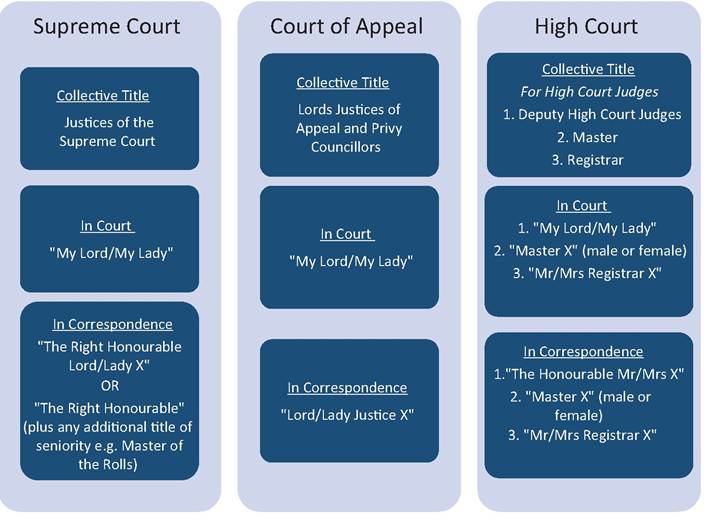
Figure 3.3 How to Address a Judge in the Higher Courts. Source: The Criminal Practice
Directions 2015 XII B and www.judiciary.uk
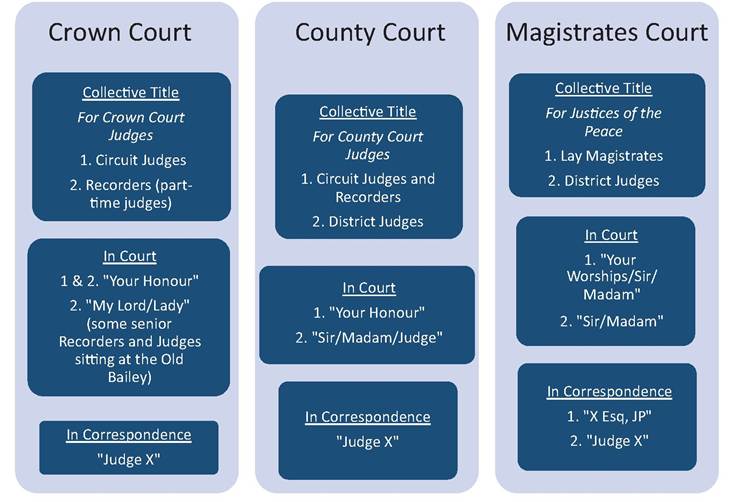
Figure 3.4 How to Address a Judge in the Lower Courts. Source: The Criminal Practice
Directions 2015 XII B and www.judiciary.uk

Judges sitting in tribunals (e.g. employment tribunals) are referred to as ‘Sir’ or ‘Madam’ and are referred to as ‘Judge’ in correspondence.
3.4.2 Communication Through Appearance
Appearance can affect the way that others respond to you and whether you are perceived as having authority and commanding respect. An advocate will be expected to observe certain traditions relating to the operation of the court and legal process. One of these is to appear in ‘court dress’. This involves wearing a suit in dark colours (‘business attire’). These colours are normally black, navy and grey to reflect the sombre occasion of the business at hand. For some proceedings and courts an advocate will also need to wear a wig and gown (‘court dress’) depending on the level of their rights of audience. The Criminal Practice Directions 2015 XII A sets out guidance on court dress. For example, the practice direction states that advocates do not need to wear robes or wigs in the Magistrates’ Court (including youth courts) but are expected to do so in all other criminal courts (except for bail applications heard in chambers). Court robes will differ depending on whether an advocate is Queen’s Counsel (‘QC’), junior counsel or a solicitor advocate.
In the civil courts court dress is required in the High Court (except commercial, admiralty and technology courts) and in the Family Division. Business attire is sufficient for interim applications in the County Court, but court dress is usually expected at a trial or an appeal from a trial.
3.4.3 Communicating with Vulnerable
Clients and Witnesses
An advocate should be mindful of the need to adapt the method and style of their communication when dealing with clients and witnesses. A person may be vulnerable due to lacking mental capacity or due to age. In Chapter 4 we will consider in more detail the court processes surrounding vulnerable parties. It is useful for an advocate to acquaint themselves with court terminology relating to vulnerable parties. For example, when dealing with children varying terminology is used for child defendants. Those under 14 are termed ‘children’, those between 14 and 18 are termed ‘young persons’ and collectively all those under 18 are referred to as ‘juveniles’. This includes those who are 17 when arrested or appear to be under 18 (see R (C) v Secretary of Statefor the Home Department and Another [2013] EWHC 982 (Admin) and the Criminal Justice and Courts Act 2015, s. 42). In addition, the courts tend to avoid referring to ‘sentence’ or ‘convictions’ of a child but instead refer to ‘findings of guilt’ or ‘orders’.
3.4.4 Video Conferencing
Courts are increasingly using video conferencing for communication and this increased substantially during the Covid-19 pandemic. For example, the Coronavirus Act 2020 modified court practice and procedure to allow for remote working and virtual attendance at hearings and to extend the broadcast of public hearings as well as
the use of electronic bundles of court documents. These changes also included a new temporary Civil Procedure Practice Direction 51Y on ‘Video or Audio Hearings During Coronavirus Pandemic.' However, only the court, rather than the parties or members of the public, can record the hearings.
The use of cameras in the courtroom is not new and the use of cameras was extended by ss. 31 and 32 of the Crime and Courts Act 2013. Stephen Mason (2012) argues that the introduction of cameras in courtrooms can increase transparency and need not necessarily lead to human rights breaches if the broadcast itself is controlled by the courts.
Cameras and live transmissions would also act to counter the way in which the media report events in court as the public would be able to judge the proceedings for themselves. Paul Lambert (2011), however, argues that social media has permeated the courtroom to the extent that everyone is now a journalist and that the rise of social media has the potential to change the traditional method of court reporting.An advocate should be flexible and adaptable as court practices are constantly evolving with new ways of working. This includes familiarisation with software platforms that enable live group chat and collaboration or the use of audio or live streaming. This places new demands on how an advocate communicates using body language, deals with interruptions resulting from technology failures (rather than questions from the judge), and pays attention not just to their own physical appearance but also to the physical appearance of the room that they are in.
When attending a virtual hearing it might be helpful to run through a simple checklist of ‘remote-ready' actions. Whilst the judge will be responsible for directing any virtual proceedings, it is helpful to check that you know how to carry out the following tasks:
1. Have you blurred/changed/tidied your background to maintain privacy?
2. Have you muted your microphone when you are not speaking (this will prevent ‘feedback' noise)?
3. Have you remembered to unmute your microphone when you are speaking?
4. Do you know how to use the ‘raised hand icon' when you want to speak so that you do not interrupt other speakers?
5. Do you know how to lower the ‘raised hand icon' when you have finished speaking so that others know that you have finished your contribution?
6. Do you know how to share your screen so that you can display documents to your audience when needed?
7. Have you cleared other non-relevant documents from your desktop to maintain privacy when sharing your screen and avoid sharing content unintentionally?
8. If your internet connection is weak, do you know what to do if your screen ‘freezes' or if the connection is lost or do you have IT support?
9. Do you need to appear on screen in ‘court dress' (gown/wig) or has the court dispensed with this?
Ensuring that you have an ethernet cable connected to your device and your internet portal will ensure that you have a stronger connection. Turning off incoming video and muting your microphone will also ensure that the connection remains more stable than otherwise.
More on the topic Effective Communication Skills:
- Medical Education and Training Programs
- Key Chapter Points
- Dialogue as a Conflict Management Strategy
- Algert Nance, Rogers Kenita S.. Conflict Management and Dialogue in Higher Education. Information Age Publishing,2020. — 227 p., 2020
- Conflict Competence Features
- Communication
- EDUCATION
- Occurrence of Conflict in Health Care Provider-Patient Relationships
- Emergency Room Communication Issues: Dealing with Crisis
- Practical Suggestions for Providers and Families