All organisms are either consumed or end up as detritus
All organisms in an ecosystem are either consumed by other organisms at higher trophic levels or enter the pool of dead organic matter, or detritus (Lindeman's “ooze” in Figure 20.3 or, as songwriter Tom Waits put it, “We're all gonna be just dirt in the ground”).
In most terrestrial ecosystems, a relatively small proportion of the biomass is consumed, and most of the energy flow passes through detritus (FIGURE 21.4). Because most of this energy flow occurs in the soil, we are not always aware of its magnitude and importance. Dead plant, microbial, and animal matter and feces are consumed by a multitude of detritivores (primarily bacteria, archaea, and fungi) in a process known as decomposition. We will describe decomposition in more detail in Chapter 22 in the context of nutrient cycling. Since detritus is part of the first trophic level, detritivores are placed with herbivores in the second trophic level. Although autotroph-based and detritus-based trophic levels are sometimes considered separately, they are tightly linked through primary production, nutrient cycling, and the many organisms that acquire energy from both plants and detritus.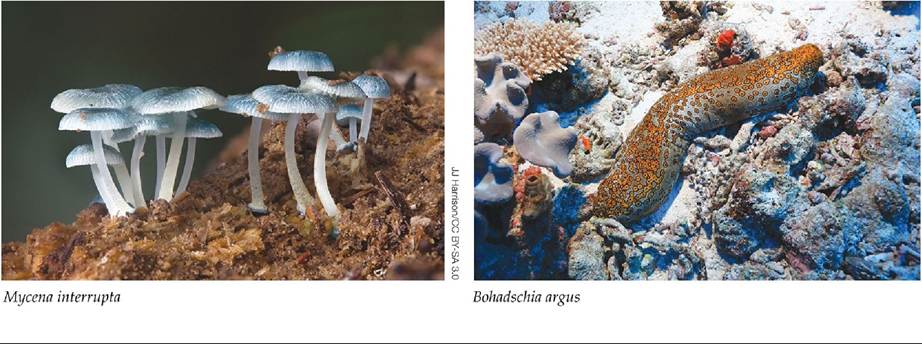
© aquapix/Shutterstock.com
FIGURE 21.4 Ecosystem Energy Flow through Detritus Detritus is consumed by a multitude of organisms, including fungi such as Mycena interrupta in Myrtle Forest and Leopard sea cucumber (Bohadschia argus) in the Great Barrier Reef. View larger image
Energy flow through detritus is important in both terrestrial and aquatic ecosystems. Detritus in terrestrial ecosystems comes primarily from plants within the ecosystem. On the other hand, a large proportion of the input of detritus into stream, lake, and estuarine ecosystems is derived from terrestrial organic matter, which is considered external to the aquatic ecosystem. External energy inputs are referred to as allochthonous inputs, while energy produced by autotrophs within the system is known as autochthonous energy.
Allochthonous inputs into aquatic ecosystems include plant leaves, stems, wood, and dissolved organic matter. These inputs fall into the water from adjacent terrestrial ecosystems or flow in via groundwater. Allochthonous inputs tend to be more important in stream and river ecosystems than in lake and marine ecosystems. For example, Bear Brook, a headwater stream in New Hampshire, receives 99.8% of its energy as allochthonous inputs; the rest is net primary production (NPP) derived from benthic algae and mosses in the stream (Fisher and Likens 1973). In contrast, autochthonous energy accounts for almost 80% of the energy in nearby Mirror Lake (Jordan and Likens 1975). Allochthonous energy is often of lower quality, however, because of the chemical composition of the carbon compounds that enter the system. As a result, the fraction of allochthonous energy that is actually used as an energy source is lower than the inputs would suggest (Pace et al. 2004). The importance of autochthonous energy inputs usually increases from the headwaters toward the middle reaches of a river, in concert with decreases in water velocity and increases in nutrient concentrations, as suggested by the river continuum concept (described in Concept 3.2).As this aquatic example shows, grouping organisms into trophic levels makes it easier to trace the flow of energy through an ecosystem. That flow is the topic to which we'll turn next.
1
- This definition contrasts with our earlier definition of omnivores in Chapter 20 as heterotrophs that consume both plants and animals