Answers to Analyzing Data 6.1 Questions
1. Releasing moths at densities and proportions similar to those observed in the field helped to remove potential complicating factors; this makes the experiment more realistic and the results easier to interpret.
For example, some predators prefer to attack abundant prey, so if moths had been released at unusually high densities, predators might have devoted more effort to catching the moths than they typically do, thus making the results of the experiment more difficult to interpret.2. We can see from the table from the Analyzing Data exercise for this chapter that in 2002 about 13% (101/807) of the moths that Majerus released were dark in color. Over time, that percentage dropped—from 13% in 2002 to 10% in 2003, 7% in 2004, 7% in 2005, 4% in 2006, and 2% in 2007. Because the proportions of dark moths that Majerus released were similar to those he observed in the field, this indicates that dark-colored moths were declining in frequency in the area where he conducted his experiment.
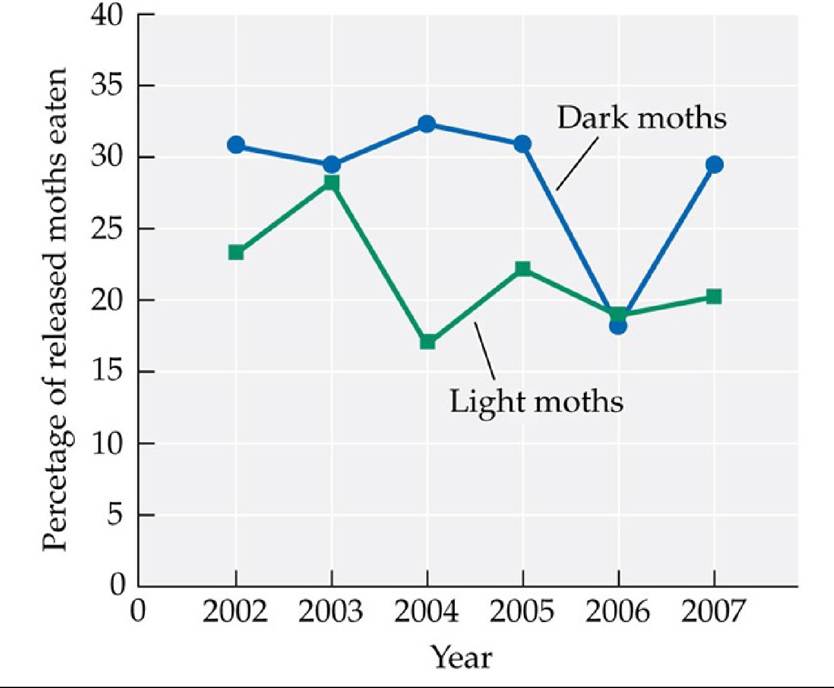
3. In every year but one (2006), the percentage of released dark-colored moths that were eaten was higher than the percentage of released lightcolored moths that were eaten. Since the trees in the region in which the experiment was conducted were light in color, this result supports the hypothesis that natural selection caused the frequency of dark-colored moths to decline over time.