APPROACH
A national and international comparative point of view - a view from 30 000 feet - does not address the precise nature of the impacts of digital technology on individual firm and consumer behavior.
But it is a fitting place to begin given the importance of understanding the technological forces shaping future opportunities for growth in business and household incomes. Figure 6.1 shows that the trend in global labor productivity growth has been declining since the mid-2000s, stymied by the impact of the global financial crisis and its aftermath in Europe and the USA, and also by weakening performance among large emerging economies such as China and Brazil.Will ICTs boost US productivity growth again as they did with the emergence of the
120
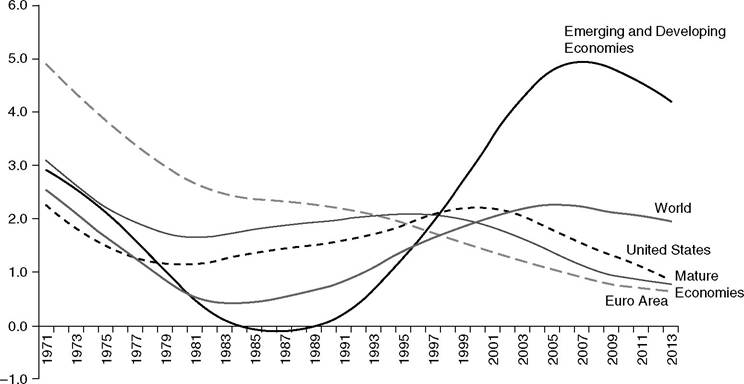
Source: The Conference Board Total Economy Database™ (The Conference Board, 2015).
Figure 6.1 H-P (Hodrick-Prescott) filter trend growth in labor productivity (GDP per person employed), 1970-2013
Internet in the 1990s? Can Europe’s Horizon 2020 strategy to realize the potential of ICT spur its long-term growth? To answer these questions one needs to appropriately frame the mechanisms through which the Internet, and technologies spawned by the Internet, impact economies. In the mainstream productivity and sources-of-growth (SOG) literature, assessments center on the impact of ICT capital investments on labor productivity and the rate of increase in total factor productivity (TFP): are these the appropriate metrics? Where in the data does one ‘go’ to see the impact of the Internet? What about the unmeasured consumer surplus or, for that matter, why not consider jobs?
We rely primarily on the SOG framework for the analysis reported in this chapter. The advantages of the growth accounting framework are well known, chief of which is its general equilibrium perspective. New technologies inevitably displace some existing economic activity, and the SOG framework naturally accounts for these effects (unlike many microeconomic analyses or case studies of specific innovations). Against this advantage, the data requirements are steep (Griliches, 1994), suggesting that Solow’s famous 1987 quip could be paraphrased for today’s times as, ‘You see the InternetZSmartphoneZCloud Computing age everywhere but in the productivity statistics’. Let us begin, then, by reviewing and analyzing these statistics.
6.3
More on the topic APPROACH:
- Contents
- BACKGROUND AND DEFINITIONS
- ON GIVING UNIVERSAL STATEMENTS EXISTENTIAL IMPORT
- Contents
- Different types of tradable emission rights
- The third leading jurisprudent: Muhammad b. Idris al-Shafi'i (d. 204/819)
- Hare C., Neo D. (eds.). Trade Finance: Technology, Innovation and Documentary Credit. Oxford University Press,2021. — 417 p., 2021
- In this Propter Honoris Respectum, I want to begin by quoting from a review that I had the pleasure of writing some years ago of one of Tom Shaffer’s books:
- Policy Provisions for Bovine and Zoonotic Tuberculosis in Uganda
- Contents