Competition can lead to character displacement and resource partitioning
When two species compete for resources, natural selection may favor individuals whose phenotype either (1) allows them to outcompete their competitors, resulting in competitive exclusion, or (2) allows them to partition their limiting resources, thus decreasing the intensity of competition.
For example, when two fish species live apart from each other (each in its own lake), the two species may catch prey of similar size. If some factor (such as dispersal) were to cause members of these two species to live in the same lake, their use of resources would overlap considerably (FIGURE 14.11A). In such a situation, natural selection might favor individuals of species 1 whose morphology was such that they ate smaller prey, hence reducing competition with species 2; similarly, selection might favor individuals of species 2 that ate larger prey, hence reducing competition with species 1. Over time, such selection pressures could cause species 1 and species 2 to evolve to become different when they live together than when they live apart (FIGURE 14.11B). Such a process illustrates character displacement, which occurs when competition causes the phenotypes of competing species to evolve to become different over time.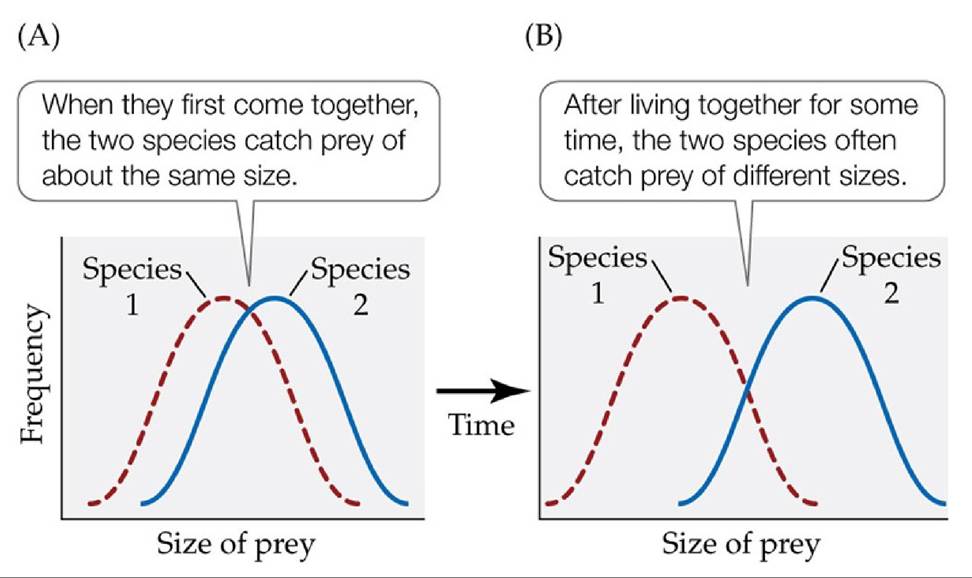
FIGURE 14.11 CharacterDisplacement Competitionforresourcescancausecompeting species to change over time. Imagine that two fish species that once lived apart and tended to catch prey of about the same size are brought together in a single lake. (A) When the two species first come together, there is considerable overlap in the resources they use. (B) As the two species interact over time, the characteristics they use to obtain prey may evolve such that they tend to catch prey of different sizes. View larger image
Character displacement appears to have occurred in two species of finches on the Galapagos archipelago.
Specifically, the beak sizes of the two species, and hence the sizes of the seeds the birds eat, are different on islands where both species live than on islands that have only one of the two species (FIGURE 14.12). Field observations suggest that these two finch species probably differ when they live together because of competition, not because of other factors, such as differences in food supplies (Schluter et al. 1985; Grant and Grant 2006).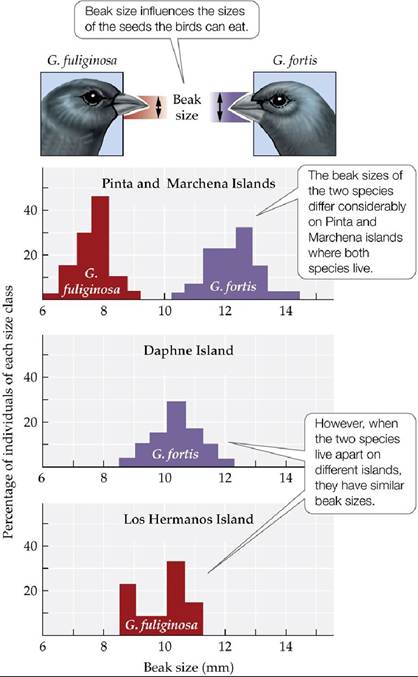
FIGURE 14.12 CompetitionShapesBeakSize OnislandsharboringbothGeospzza fuliginosa and G. fortis, competition between these two species of Galapagos finches may have had a selective effect on the sizes of their beaks. (After D. Lack. 1947. Darwin’s Finches. Cambridge University Press: Cambridge.) View larger image
Data suggestive of character displacement have also been observed in plants, frogs, fishes, lizards, birds, and crabs: in each of these groups, there are pairs of species that consistently differ more where they live together than where they live apart. Additional evidence is needed, however, if we are to make a strong argument that such differences result from competition (as opposed to other factors). Strong support for the role of character displacement can come from experiments designed to test whether competition occurs and has a selective effect on morphology. Such experiments were conducted on sticklebacks of the genus Gasterosteus, a group of fish species whose morphology varies most when different species live in the same lake (Schluter 1994). The results indicated that individuals whose morphology differed the most from that of their competitors had a selective advantage: they grew more rapidly than did individuals whose morphology was more similar to that of their competitors. Support for character displacement has also been found in field experiments with spadefoot toad tadpoles (Pfennig et al. 2007) and in laboratory experiments with the bacterium Escherichia coli (Tyerman et al. 2008). In each of these studies, experimental results suggest that competition caused the observed morphological differences —that is, that character displacement occurred—and the species were better able to partition their resources as a result.
Evidence for resource partitioning has been used as an explanation for the patterns of species diversity found in communities, as we will see in Chapter 19. For now, let's next turn to mathematical models designed to predict whether the outcome of competition results in competitive exclusion or competitive coexistence.