Competitors may coexist if they use resources differently
In natural communities, many species use the same limiting resources yet manage to coexist with one another. This observation does not violate the competitive exclusion principle, because a key point of that principle is that species must use limiting resources in the same way.
Field studies often reveal differences in how species use limiting resources. Such differences are referred to as resource partitioning (or, sometimes, niche partitioning).Thomas Schoener studied resource partitioning in four lowland Anolis lizard species that live on the West Indian island of Jamaica. Although these species all live together in trees and shrubs and eat similar foods, Schoener (1974) found differences among them in the height and thickness of their perches and in the time they spent in sun or shade. As a result of these differences, members of the different Anolis species competed less intensely than they otherwise would.
In a marine example, Maayke Stomp and her colleagues (2004) studied resource partitioning in two types of cyanobacteria collected from the Baltic Sea. The species identities of these cyanobacteria are unknown, so we will refer to them as BS1 and BS2 (standing for Baltic Sea 1 and Baltic Sea 2). BS1 absorbs green wavelengths of light efficiently, which it uses in photosynthesis. However, BS1 reflects most of the red light that strikes its surface; hence, it uses red wavelengths inefficiently (and is red in color). In contrast, BS2 absorbs red light and reflects green light; hence, BS2 uses green wavelengths inefficiently (and is green in color).
Stomp and colleagues explored the consequences of these differences in a series of competition experiments. They found that each species could survive when grown alone under green or red light. However, when they were grown together under green light, the red cyanobacterium BS1 drove the green cyanobacterium BS2 to extinction (FIGURE 14.10A)—as might be expected, since BS1 uses green light more efficiently than does BS2. Conversely, under red light, BS2 drove BS1 to extinction (FIGURE 14.10B), as also might be expected.
Finally, when grown together under “white light” (the full spectrum of light, including both green and red light), both BS1 and BS2 persisted (FIGURE 14.10C).Taken together, these results suggest that BS1 and BS2 coexist under white light because they differ in which wavelengths of light they use most efficiently in photosynthesis.
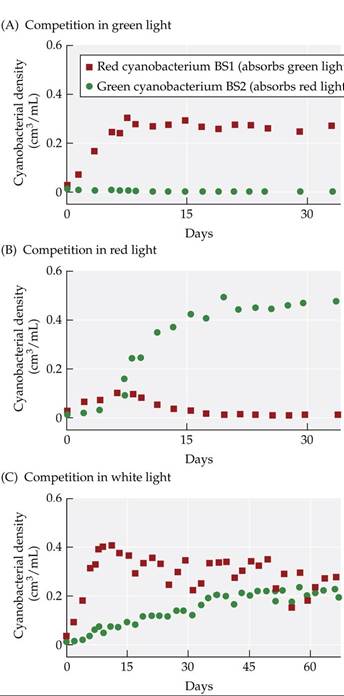
FIGURE 14.10 Do Cyanobacteria Partition Their Use of LightVTwotypesof cyanobacteria, BS1 and BS2, were grown together under (A) green light (550 nm), (B) red light (635 nm), and (C) “white” light (the full spectrum, which includes both green and red light). BS1 absorbs green light more efficiently than it absorbs red light; the reverse is true for BS2. Only BS1 persists when the two types are grown together under green light, and only BS2 persists when they are grown under red light. However, both types persist under white light, suggesting that BS1 and BS2 coexist by partitioning their use of light. (After M. Stomp et al. 2004. Nature 432: 104-107.) View larger image
Following up on their laboratory experiments, Stomp et al. (2007) analyzed the cyanobacteria present in 70 aquatic environments that ranged from clear ocean waters (where green light predominates) to highly turbid lakes (where red light predominates). As could be predicted from Figure 14.10, only red cyanobacteria were found in the clearest waters and only green cyanobacteria were found in highly turbid waters—but both types were found in waters of intermediate turbidity, where both green and red light were available. Thus, the laboratory experiments and field surveys conducted by the researchers suggest that red and green cyanobacteria coexist because they partition the use of a key limiting resource: the underwater light spectrum.