Competitors that use limiting resources in the same way cannot coexist
In the 1930s, the Russian ecologist G. F. Gause performed laboratory experiments on competition using three species of the single-celled protist group Paramecium. He constructed miniature aquatic ecosystems by growing paramecia in tubes filled with a liquid medium that contained bacteria and yeast cells as a food supply.
He found that grown alone, P. caudatum and P. bursaria populations showed logistic growth and reached a stable carrying capacity (FIGURE 14.9A). When grown together, each species showed slower population growth, but they were able to coexist. However, when P. aurelia was grown in competition with P. caudatum, P. aurelia drove P. caudatum to extinction (FIGURE 14.9B). The difference in outcome, Gause suggested, was a consequence of P. caudatum and P. aurelia competing for bacteria as a food source, while P. bursaria avoided competition by eating yeast cells that settled to the bottom of the tubes. Thus, P. caudatum and P. bursaria partitioned their food resource in the presence of one another and were able to coexist as a result.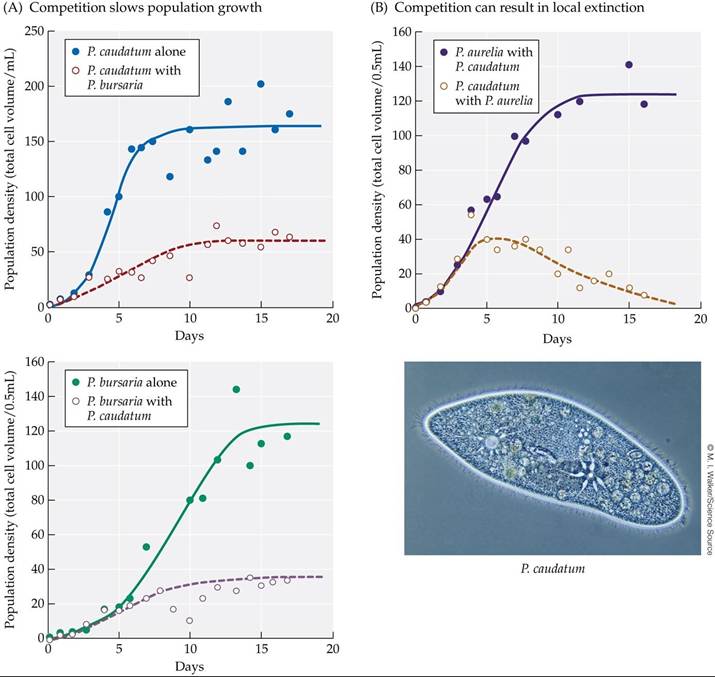
FIGURE 14.9 CompetitioninParameczum G. F. Gause grew three species of Paramecium in tubes filled with a liquid medium containing bacteria and yeast cells. (A) When grown alone, Paramecium caudatum and P bursaria each showed logistic population growth and reached carrying capacity. When grown together, each species showed slower population growth, but they were able to coexist by feeding on different food items. (B) When P. caudatum was grown with P. aurelia, it experienced local extinction.
Predict what would happen if P. aurelia and P. bursaria were grown together. Explain.
(A after G. F. Gause. 1935. Verifications Experimentales de la Theorie Mathematique de la Lutte pour la Vie. Hermann et Cie: Paris; B after G. F. Gause. 1934. The Struggle for Existence. Williams & Wilkins: Baltimore, MD.) View larger image
Experiments with a wide range of other species (e.g., algae, flour beetles, plants, and flies) have yielded similar results: one species drives the other to extinction unless the two species use the available resources in different ways. Such results led to the formulation of the competitive exclusion principle, which states that two species that use a limiting resource in the same way cannot coexist indefinitely. As we'll see next, field observations are consistent with this explanation of why competitive exclusion occurs in some situations but not others.