Conservation of Biodiversity
Since many of the species are under serious threats of extinction, it is a matter of prime concern that biodiversity should be conserved. Unlike other environmental problems such as pollution or global warming, the loss Ofbiodiversity cannot be reversed.
Once a species is lost, it is gone forever and it will not come into existence again.India is one of the 17-mega diverse countries. It can be divided into 10 biogeographic zones and 26 biotic provinces, which represent all the major ecosystems of the world. Such a rich diversity needs a multifaceted approach for its conservation. Various initiatives have been taken at various levels for the conservation Ofbiodiversity.
The conservation measures include not just marking reserve areas of land but much more than that. Preservingjust the endangered species is not enough. Its relation to other species in its habitat, its predators or preys etc. also needs to be studied and a holistic approach is required for conservation. In fact, the ecosystems, natural to the species concerned, should be regenerated and provided for its survival. Thus, one should have a complete knowledge about the types of species present in an ecosystem, their inter-relationships and their type of habitat and other factors affecting their survival. Hence, the study of number and types of different species and documentation of this data over different intervals of time, is an important feature in knowing and conserving the biodiversity.
Since certain areas are richer in biodiversity, their identification for the purpose of conservation is of great interest. Such areas which are extremely rich in species and have high endemism, are facing significant threats to biodiversity. These areas are called Hotspots. The term hotspot was coined by Norman Myers (1988). Among the 25 hotspots in the world, 2 are found in India which extend into neighbouring countries, see Fig 13.2.
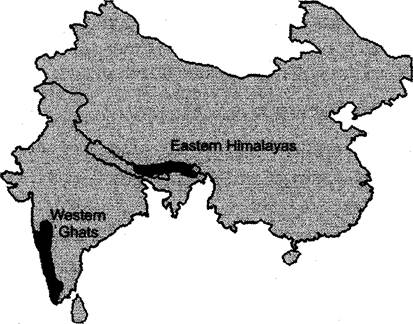
Fig 13.2: Hotspots in India
These hot spots are Western Ghats and the Indo-Burma region covering the Eastern Himalayas. These are rich in floral wealth and are highly endemic with respect to flowering plants, reptiles, amphibians, some mammals and butterflies.
13.7.1 Conventions, Protocols and Acts
Various agreements and conventions have been adopted worldwide to conserve biodiversity and environment. India is also a party to many such international protocols and conventions. Also, at national level, various legislative, participatory and regulatory mechanisms have been initiated to protect biodiversity. These are discussed below:
1. Convention on Biological Diversity (CBD)
In 1992, the biological diversity was put on the international agenda when the Convention on Biological Diversity was signed in the ‘Earth Summit’- the United Nations conference on Environment and Development. So far, 180 countries have become a Party to this Convention. The main objectives of the convention are given below:
• Iheconservationofbiologicaldiversity,
• the sustainable use of its components, and
• the fair and equitable sharing of benefits arising out of the utilization of genetic resources by appropriate transfer of relevant technologies, taking into account all rights over those resources and technologies and by appropriate funding.
The convention addresses many issues such as habitat preservation, intellectual property rights, bio-safety and indigenous people’s rights. It also covers the ecological, economic and social aspects of biodiversity and related technologies evolved through research and development.
It envisages several actions as given below:
(1) Preparation of a national biodiversity strategy or action plan
(2) Reviewofbiodiversityrelatedinstitutionsandlegalframeworksexisting in the country
(3) Identification of important ecosystems and habitats, their conservation and sustainable use
(4) Preparation of inventories at the species level
(5) Identification of threatened components of biodiversity and implementation of various measures for their conservation and sustainable use
(6) Research and training taking into account special needs of developing countries for conservation and sustainable use Ofbiodiversity
(7) Exchange of relevant information related to technical, scientific and socioeconomic research, specialised knowledge, indigenous and traditional knowledge amongst contracting parties
(8) Promotion of technical and scientific cooperation through national and international institutions in the implementation of national policies, development and strengthening of national capabilities through human resource development and institution building
(9) Establishment of joint research programmes and joint ventures for development of technologies
India ratified the Convention on 18th February 1994 and became party to the Convention in May 1994.
So far, seven meetings of COP (Conference of Parties) have been held. The Ministerial Meeting of COP-7 was held in Kuala Lumpur where India has taken over Presidency of the Like-minded Mega diverse Group of countries on 19,h February 2004.2. Convention on International Trade in Endangered Species of Wild Fauna and Hora (CITES), 1973
It aims to control or prevent international commercial trade in endangered species of products derived from them. India became party to CITES in 1976. A species may be placed on one of the three lists (Appendices) by vote of members.
Appendix I lists species in danger of extinction that are, or may be, affected by commercial trade.
Appendix II includes species that may become endangered if their trade is not brought under control.
Appendix ΠI lists species that individual treaty nations identify as subject to domestic regulations to restrict or prevent over exploitation.
In India, the international trade in all wild flora and fauna as well as species covered under CITES is regulated jointly through provisions of the Wildlife (Protection) Act, (1972), the Import/ Export Policy and the Customs Act, 1962.
3. The Cartagena Protocol on Bio-safety
The Bio-safety Protocol was signed by 65 countries during the High Level Segment of the 5th meeting of Conference Of Parties (COP) to the CBD. It is the first international regulatory frame work for safe transfer, handling and use ofliving modified organisms (LM0s).
The Protocol was adopted on 29th January, 2000 and has been signed by 103 countries so far. India signed the Protocol on 23rd January 2001 and acceded to the Protocol on 17th January 2003. The Protocol came into force on 11th September 2003 and 84 countries have already ratified it.
It seeks to protect the biological diversity from the potential risks posed by LMOs. It established an Advance Informed Agreement (AIA) procedure for ensuring that countries are provided with the information necessary to make informed decisions before agreeing to import such organisms into their territory.
The Protocol also established a Biosafety Clearing House for facilitating the exchange of information on LMOs and assisting the countries in implementation of the Protocol.
The first meeting of Conference Of Parties serving as the Meeting of the Parties to the Protocol (COP-MOP) was held at Kuala Lumpur, Malaysia from 23rd to 27th February 2004.
4. Biodiversity Act, 2000
As a follow up action of Party to CBD, the National Policy and Action Strategy on Biodiversity was released by Government of India in May 2000 and Biodiversity Bill 2000 was placed in the Parliament. The bill was finally passed in December 2002.
The Act provides for the establishment of State Level Boards and Local Level Biodiversity Management Committees to deal with matters concerning conservation Ofbiodiversity, its sustainable use and fair and equitable sharing of benefits arising out of the use of biological resources and associated knowledge. The detailed rules are notified in the Gazette on 15th April 2004. A National Biodiversity Authority has been set up at Chennai on 1st October 2003 under this Act.
5. Forest (Conservation) Act, 1980
First Forest Act was enacted in 1927. Since then, many changes have occurred, so relevant amendments have been suggested in the Act. The Act was adopted to protect and conserve forests.
The MoEF has constituted a National Forest Commission on 7th February 2003 to review the working of Forests and Wildlife Sector.
6. The Wildlife (Protection) Act, 1972 and Amendments 1982,1991
The Wildlife (Protection) Act provides for protection to listed species of flora and fauna and establishment of a network of ecologically important protected areas. It empowers the Central and State Governments to declare any area,a wildlife sanctuary, national park or closed area. There is a ban on carrying out any industrial activity in such an area. It provides for regulation of hunting of wild animals, protection of specified plants, sanctuaries, national parks and closed areas, restricting trade or commerce in wild animals or animal articles. The 1982 Amendment introduced a provision permitting the capture and transportation of wild animals for scientific management of animal population.
The 1991 Amendment Act made the near total prohibition on hunting more effective.13.7.2 Other National Initiatives
Besides the above regulatory provisions, other measures to protect and conserve biodiversity are as described below:
(1) An All India Coordinated Project on Capacity Building in Taxonomy (AICOPTAX) had been initiated in the Ninth Plan which will continue up to Tenth Plan. It aims to encourage excellence and research in lower groups of plants and animals, viruses, bacteria, microbes etc.
(2) The Botanical Survey of India (BSI) established in 1890 was revised and reorganized in 1954. Its aims and objectives have been reviewed in 2002. It is entrusted with exploration and documentation of phytodiversity, hot spots, fragile ecosystems etc. and identification and conservation of species with traditional economic value. It is also assigned the monitoring of phytodiversity and compilation of national database of plant species, herbarium and live specimens.
BSI has conserved and maintained germplasm of 25 rare, endangered and wild relatives of ornamental and medicinal plant species. Its collection includes 17 rare and threatened plant species, 362 ornamental plant species and 264 medicinal and economically important plant species.
(3) The Zoological Survey of India was established in 1916. Its headquarters are at Kolkata. It has five major survey programmes.
(4) An ex-situ conservation scheme of assistance was initiated in 1992 for the conservation of rare endemic plants by botanical gardens.
(5) The Botanic Garden of Indian Republic (BGIR) has been established at NOIDA in April 2002 as part of Botanical Survey of India for the exsitu conservation of threatened plants and building public awareness for conservation of biodiversity. It is also identified as a project under the Prime Minister’s Jai Vigyan Science and Technology Mission Scheme.
(6) The Joint Forest Management Programme has been implemented in all 28 States. The programme covers 17.33 million ha forest area.
(7) A National Board for Wild Life (NBWL) has been constituted on 21st September 2003.
(8) There are 92 National Parks and 500 wildlife sanctuaries having an area of 15.67 million hectares.
(9) There exist many rules for prevention of cruelty to animals. The Animal WeVfare Board of India looks after various issues related to animal welfare.
(10) Underthe ‘Project Tiger’ which was Iaunchedin 1973,281 tiger reserves in 17 States have been established. They are spread over 37761 sq km of area and provide a variety of habitats for tigers. The habitats include mountainous terrains of Arunachal Predesh, rainfall areas of Assam and West Bengal, Mangrove of Sunder bans, dry forests of Rajasthan, Central High lands of Madhya Pradesh, Maharashtra and Chattisgarh, tropical and evergreen forests of Orissa, evergreen forests of Kerala and Kamataka and dry and moist deciduous forests of Andhra Pradesh and Tamil Nadu, respectively.
The population of tigers increased from 1827 to 3642 in a period of about last 30 years. Tigers come at the apex of the ecosystem and their numbers indicate the health of the ecosystem.
(11) The ‘Project Elephant’ was launched in Febraary 1992 for conserving the elephants in their natural habitats. It is under operation in 12 States and covers an area of 60,000 sq km. It aims to save Asiatic elephant besides conservation of habitats, research, public education and veterinary care. There are 24 elephant reserves as on March 2004.
(12) The Wildlife Institute of India (WΠ) established in 1982 imparts training and carries out research work for conservation and management of wildlife.
(13) A Central Zoo Authority (CZA) has been established in 1992 under the provisions of Wild Life (Protection) Act, 1972. It aims to manage zoos on scientific lines. It also identifies endangered species of wild animals and gives recognition to zoos on the basis of evaluation of their functioning. There are 165 recognized zoos in the country.
In the year 2003,1830 and 500 star tortoises were rescued and brought back to India from Singapore and Malaysia, respectively and were rehabilitated in different zoos. Similarly Hons, tigers, bears, panthers and monkeys have been rescued from circuses and have been rehabilitated; the government bans their performance in the circus.
(14) Forest Survey of India (FSI) was established in June 1981 for generating information and data base on forest cover and forest resources. It also prepares State of Forest Report, including National Vegetation Map every two years, as one of its assignments.
More on the topic Conservation of Biodiversity:
- The field of conservation biology arose in response to global biodiversity losses
- CONCEPT 23.1 Conservation biology is an integrative discipline that applies the principles of ecology to the protection of biodiversity.
- Biodiversity of India
- The Threatened Biodiversity
- 2 Trees in Conservation Areas
- 2 The UK Conservation Bodies
- Biodiversity
- The Richness of Biodiversity
- The Importance of Biodiversity
- Declining Biodiversity