Biodiversity of India
India has very rich biodiversity. The habitats range from tropical rainforests to alpine vegetation and from temperate forests to coastal wetlands. India has about 2.4% of the world’s area and it has 7.3% of global fauna; the number of faunal species being 89,451 (MoEF, 1999).
The important features of India’s biodiversity are as follows:(1) There are two major realms, viz. Palaearactic and Indo-Malayan. The three biomass areas include the tropical humid forests, the tropical dry/ deciduous forests and the warm desert / semi deserts.
(2) India has the following ten bio-geographical zones:
(a) The Trans- Himalayan
(b) The Himalayan
(c) The Indian Desert
(d) The Semi-arid Zones
(e) The Western Ghats
(f) The Deccan Peninsula
(g) The Gangetic Plain
(h) The North-East India
(i) The Islands
(j) The Coasts
These are shown in the map of India in Fig. 13.1.
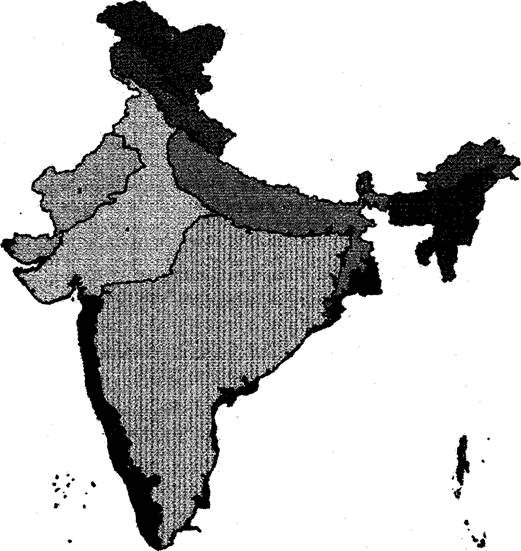
Fig. 13.1: Biogeographical Zones of India
(3) India has five world heritage sites (Table 13.1), twelve biosphere reserves (Table 13.2) and 6 Ramsar wetlands.
(4) India is one of the twelve centres of origin of cultivated plants.
(5) The protected areas amount to 1.53 lakh sq km and comprise 88 national parks and 490 sanctuaries.
Table 13.1 India’s Heritage Sites
| S.No. | Name | State |
| 1. | Kaziranga National Park | Assam. |
| 2. | Keoladeo Ghana National Park | Rajasthan |
| 3. | Manas Wildlife Sanctuary | Assam |
| 4. | Nanda Devi National Park | Uttar Pradesh |
| 5. | Sundarban National Park | West Bengal |
Table 13.2 Biosphere Reserves of India
| S. No. | Name | Area (sq km) | Location | Date of Notiflcation |
| 1. | Nilgiri | 5,520 | Part of Wynad, Nagarhole1 Bandipur and Madumalai, Nilambur1 Silent Valley and Siruvani Hills (Tamil Nadu, Kerala and Kamataka) | 01.08.86 |
| 2. | NandaDevi | 5,860.69 | Part of Chamoli1 Pithoragarh1 Almora Districts (Uttaranchal) | 18.01.88 |
| 3. | Nokrerk | 820 | Part of Gora Hills (Megalaya) | 01.09.88 |
| 4. | Manas | 2,837 | Part of Kokrajhar1 Bangaigaon1 Barpeta1 Nalbari1 Kamprup and Dareng district (Assam) | 14.03.89 |
| 5. | Sunderbans | 9,630 | Part of delta of Ganga and Brahamputra river system (West Bengal) | 29.03.89 |
| 6. | Gulf of Mannar | 10,500 | Indian Part of Gulf of Manar between India and Sri Lanka (Tamil Nadu) | 18.02.89 |
| 7. | Great Nicobar | 885 | Southernmost islands of Andaman and Nicobar | 06.01.89 |
| 8. | Simlipal | 4,374 | Part of Mayurbhanj district (Orissa) | 21.06.94 |
| 9. | Dibru Saikhowa | 765 | Part of Dibrugarh and Tinsukhia district (Assam) | 28.07.97 |
| 10. | Debang-Debang | 5,112 | Part of Siang and Debang Valley (Arunachal Pradesh) | 02.09.98 |
| 11. | Pachmarhi | 4,926.28 | Part of Betual1 Hoshangabad and Chindwara districts (Madhya Pradesh) | 03.03.99 |
| 12. | Kanchanjanga | 2,619.92 | Part of Kanchanjanga (Sikkim) | 07.02.2000 |
Source: MoEF 2000
A large variety of species are endemic to India.
It means they are native to India and are not found at any other place. About 33% of the recorded flora of India is endemic to the country, see Tables 13.3 and 13.4. They occur in the North-east, Western Ghats, North- west Himalaya and the Andaman and Nicobar Islands mainly.Table 13.3 Endemic Plant Species of India
| Group | No. of Species |
| Pteridophyta | 200 |
| Angiosperms | 4950 |
Table 13.4 Endemic Animal Species of India
| Group | No. of Species |
| Mollusca-Land | 878 |
| Mollusca-Fresh water | 89 |
| Insecta | 16,214 |
| Amphibia | 110 |
| Reptilia | 214 |
| Aves | 69 |
| MammaHa | 38 |
There are 49,219 plant species, out of which 5150 are endemic. These species are distributed over 141 genera under 47 families. These endemic species amount to about 30% of the world’s recorded flora. According to the Botanical Survey oflndia and the Zoological Survey of India, there are 47,000 species of plants and 81,000 species of animals. Tables 13.5 and 13.6 give details of plant and animal species recorded in India and the World.
Table 13.5 Number of Plant Species
| Species | % in India | ||
| India | World | ||
| Bacteria | 850 | 4000 | 21.25% |
| Viruses | Not known | 4000 | 21% |
| Algae | 6500 | 40000 | 16.25% |
| Fungi | 14500 | 72000 | 20.14% |
| Lichens | 2000 | 17000 | 11.80% |
| Bryophyta | 2850 | 16000 | 17.80% |
| Pteridophyta | 1100 | 13000 | 8.46% |
| Gymnosperms | 64 | 750 | 8.53% |
| Angiosperms | 17500 | 25000 | 7% |
Source: MoEF, 1999
Table 13.6 Number of Animal Species
| InIndia | InWorld | % in India | |
| Protista | 2577 | 31259 | 8.24 |
| Mollusca | 5070 | 66535 | 7.62 |
| Arthropoda | 68389 | 987949 | 6.90 |
| Other Invertebrates | 8329 | 87121 | 9.56 |
| Protochordata | 119 | 2106 | 5.65 |
| Pisces | 2546 | 21723 | 11.72 |
| 209 | 5150 | 4.06 | |
| Reptilia | 456 | 5817 | 7.84 |
| Aves | 1232 | 9026 | 13.66 |
| Mammila | 390 | 4629 | 8.42 |
The crop diversity of India is also quite rich.
It includes 167 cultivated species and 320 wild relatives of crop plants. India ranks seventh in terms of contribution to world agriculture. It is also considered as a centre of origin of 30,000-50,000 varieties of rice, pigeon- pea, mango, ginger, turmeric, sugar cane etc.Wetlands, Mangroves and Coral Reef
India has a wealth of wetland ecosystems which are directly or indirectly connected to the river systems. Wetlands are the lands transitional between terrestrial and aquatic systems. In wetlands, the water table is usually near the surface and the land is covered by shallow water. Wetlands are effective in flood control, wastewater treatment, reducing sediments and recharging of aquifers. In winters, a variety of birds take shelter in wetlands and breed there. They are also suitable as a habitat for fish, flora and fauna. They act as a buffer against the effects Ofhurricanes and cyclones. They also stabilize shoreline and check soil erosion by sea. In addition, they are a source of durable timber, fuel wood, fruits, vegetables, traditional medicines and protein rich fodder for cattle. Thus, wetlands are of great economic, aesthetic and scientific value. In India, there are 27 wetlands which are present in 15 States. There are 19 sites which have been designated as Ramsar sites and 6 more are proposed for the designation.
Mangroves are salt tolerant forest ecosystems. Mangrove plants survive in high salinity, tidal extremes, strong winds, high temperature and muddy anaerobic soil. These conditions are hostile for the other plants. Mangroves occur all along Indian coastline. They protect coastal people from cyclones and storms and prevent soil erosion. They provide medicines and fuel wood. They are a habitat for flora and fauna including crocodiles and tigers.
India has nearly 7% of the world’s mangrove area. Sunder bans in West Bengal is the world’s largest mangrove. It has also been included in the World list of Biosphere Reserves by UNESCO.
Many mangroves are being cleared and have been Unsustainably exploited. The mangrove area is shrinking due to various activities such as surface run off, siltation, encroachment, discharge of wastewater and industrial effluents. The National Committee on Mangroves and Coral Reefs is taking care of their protection. The five coastal States of West Bengal, Orissa, Andhra Pradesh, Tamil Nadu and Gujarat are cyclone prone states and mangrove conservation is being actively done in them. At present, there are 35 mangrove areas which have been identified by MOEF for intensive conservation and management.
The mangroves contain 69 species under 42 genera and 28 families. Out of these, two species are endemic to India.
India has four coral reef areas in the Gulf of Mannar, Gulf of Kutch, Lakshwadeep Islands and Andaman & Nicobar Islands. Their conservation and management is being implemented since 1987. There is a National Coral Reef Research Centre at Port Blair.
13.5
More on the topic Biodiversity of India:
- Some historians begin their discussion of “modern India” with the Islamic period because in many ways the presence of Islam on the subcontinent was a watershed in the self-perception and practice of Indian religion and culture, especially in Northern India.
- Conservation of Biodiversity
- Biodiversity
- The Threatened Biodiversity
- The Richness of Biodiversity
- The Importance of Biodiversity
- Declining Biodiversity
- The field of conservation biology arose in response to global biodiversity losses
- CONCEPT 23.2 Biodiversity is declining globally.
- Corridors can help maintain biodiversity in a fragmented landscape
- Protecting biodiversity is important for both practical and moral reasons
- Ecological restoration can increase biodiversity in degraded landscapes
- CONCEPT 23.5 Prioritizing species helps maximize the biodiversity that can be protected with limited resources.
- CONCEPT 23.1 Conservation biology is an integrative discipline that applies the principles of ecology to the protection of biodiversity.
- CONCEPT 24.3 Biodiversity can best be sustained by large reserves connected across the landscape and buffered from areas of intense human use.
- Buddhism in India