Energy flow between trophic levels differs among ecosystem types
What factors determine the amount of energy that flows from one trophic level to the next? In Concept 20.2, we evaluated the factors that influence NPP in terrestrial and aquatic ecosystems, emphasizing abiotic factors such as climate and nutrient availability as well as differences in the inherent ability of autotroph species to produce biomass.
It would be reasonable to assume that the flow of energy to higher trophic levels is associated with the amount of NPP at the base of the food web. As we will see, however, the situation is not quite so simple. The proportion of each trophic level consumed by the one above it; the nutritional content of autotrophs, detritus, and prey; and the efficiency of energy transfers also play roles in determining the flow of energy between trophic levels.A comparison of the proportions of autotroph biomass consumed in terrestrial and in aquatic ecosystems provides some insight into the factors that influence energy flow between trophic levels. When viewed from space, some parts of Earth's terrestrial surface appear green, while the ocean appears blue. Why is the land surface green and the ocean blue? Furthermore, in Concept 20.2, we saw that very productive lakes (e.g., those that are experimentally fertilized; see Figure 20.15) can appear green. What these green areas have in common is primary productivity that far exceeds rates of herbivory. Herbivores on land consume a much lower proportion of autotroph biomass than do herbivores in most aquatic ecosystems. On average, about 13% of terrestrial NPP is consumed (range 0.1%-75%), while in aquatic ecosystems, an average of 35% of NPP is consumed (range 0.3%-100%) (Cebrian and Lartigue 2004).
There is a positive relationship between NPP and the amount of biomass consumed by herbivores (FIGURE 21.6). This relationship, which holds within most ecosystem types, would seem to suggest that herbivore production is limited by the amount of food available.
Why, then, is the proportion of autotroph biomass consumed in terrestrial ecosystems relatively low? If herbivore production is limited by the supply of energy and nutrients from plants, why don't terrestrial herbivores consume a greater proportion of the biomass that is available?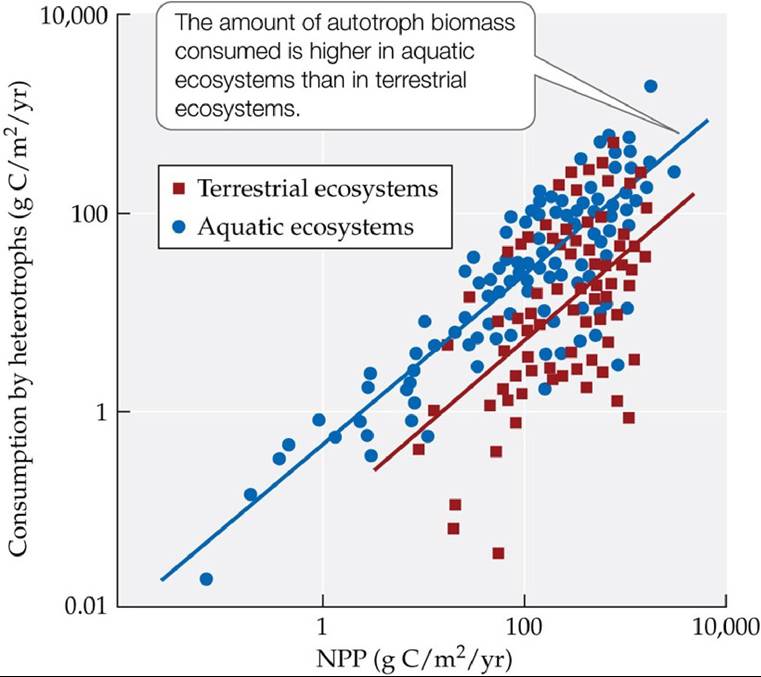
FIGURE 21.6 Consumption of Autotroph Biomass Is Correlated with NPP Theamount of autotroph biomass consumed increases with increasing available NPP in both terrestrial and aquatic ecosystems. (After J. Cebrian and J. Lartigue. 2004. Ecol Monogr 74: 237-259.) View larger image
Several hypotheses have been proposed to explain the lower proportion of autotroph biomass consumed in terrestrial ecosystems. First, Hairston and Hairston (1993) have argued that the population growth of herbivores is more constrained by predation in aquatic ecosystems than in terrestrial ecosystems because of the better-developed higher trophic levels in aquatic ecosystems. Predator removal experiments such as those described in Concept 12.4 and Concept 21.4 demonstrate that predators can effectively influence autotroph biomass through their influence on the abundance of herbivores.
Second, defenses against herbivory, such as the secondary compounds and structural defenses described in Concept 13.2, lower the amount of autotroph biomass that is consumed. Plants of resource-poor environments, such as desert and tundra, tend to be more strongly defended against herbivory than plants from resource-rich environments. This greater allocation to defense may explain why the proportion of plant biomass consumed is lower in resource-poor terrestrial environments. Unicellular algae make up the bulk of autotroph biomass in aquatic ecosystems, and they generally lack the chemical and structural defenses of their multicellular terrestrial counterparts.
Third, the chemical composition of phytoplankton makes them more nutritious for herbivores than terrestrial plants are.
Terrestrial plants contain nutrient-poor structural materials such as stems and wood, which are typically absent in aquatic autotrophs. Herbivores typically require large amounts of nutrients such as nitrogen and phosphorus to meet their demands for structural growth, metabolism, and protein synthesis. The ratio of nutrients to carbon (with carbon representing energy) is thus an important measure of food quality.Carbon:nutrient ratios differ markedly between autotrophs in terrestrial and in freshwater ecosystems. Freshwater phytoplankton have carbon:nutrient ratios closer to those of herbivores than terrestrial plants do (Elser et al. 2000) and thus better meet the nutritional needs of the herbivores that eat them. Each of these factors—predation, plant defenses, and food quality—contributes to differences in the proportion of NPP consumed among ecosystems and, in particular, the greater consumption of autotroph biomass in aquatic ecosystems (Shurin et al. 2006).