Exponential growth can occur when conditions are favorable
Many organisms, such as giant puffball fungi and the desert shrub Cleome droserifolia, produce large numbers of offspring. In such cases, if even a fraction of those offspring survive to reproduce, the population can increase in size very quickly, showing a pattern of exponential growth, or a J-shaped pattern (see Figure 11.4).
Exponential growth occurs when the rate of growth increases (or decreases) in proportion to the current number of individuals. Exponential growth cannot continue indefinitely, but when conditions are favorable, a population can increase exponentially for a limited time. Such periods of exponential growth can occur within the established range of a species, as when good weather occurs for several years running. They can also occur when a species reaches a new geographic area, either by dispersing on its own or with human assistance.An example of how dispersal can lead to exponential growth is provided by the cattle egret subspecies Bubulcus ibis ibis (FIGURE 10.4A). These birds originally lived in the Mediterranean region and in parts of central and southern Africa. Since the late 1800s and early 1900s, however, they have colonized new regions on their own, including South America and North America. Typically, after the subspecies reached a new area, its population in that area increased exponentially as it became established in its new habitat (FIGURE 10.4B). For example, after the cattle egret colonized the San Francisco Bay area in the 1990s, its populations there grew exponentially for over a decade (Kelly et al. 2007). As in cattle egrets, species that successfully colonize new geographic regions on their own typically do so by long-distance events. Local populations in the new region may then increase in size—often growing exponentially— while also expanding (by relatively short-distance dispersal events) to occupy
nearby areas of suitable habitat.
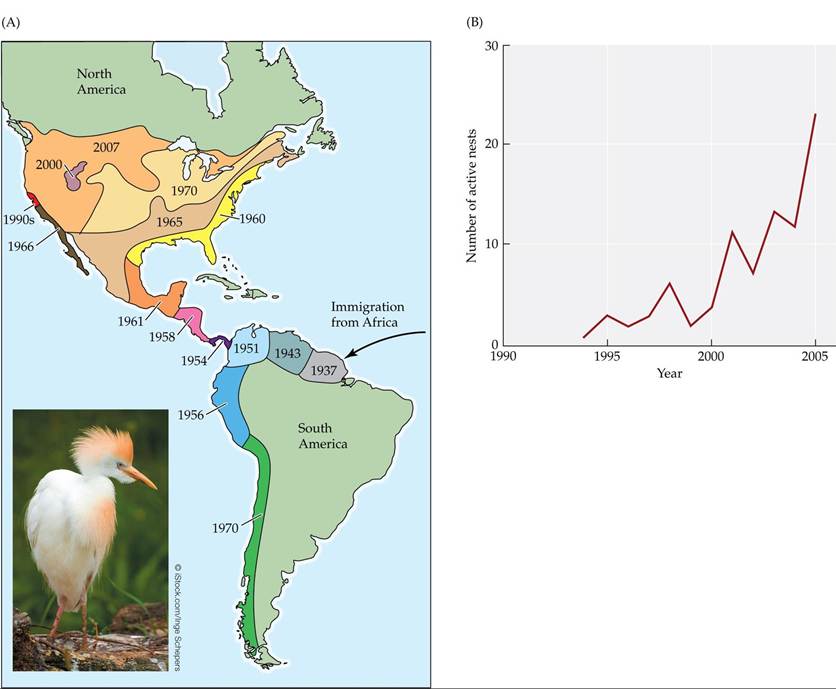
FIGURE 10.4 Colonizing the NewWorld (A) The cattle egret subspecies Bubulcus ibis ibis dispersed from Africa to South America in the late 1800s. Once it established colonies in the northeastern region of South America, it then spread rapidly to other parts of South and North America. The contour lines and dates show the edges of the cattle egret's range at different times. (B) The number of active cattle egret nests observed annually within wetlands of the San Francisco Bay area after it first colonized this region in the early 1990s. (A after R. L. Smith. 1974. Ecology and Field Biology, 2nd ed. Harper & Row: New York; S. Osborn. 2007. In The Birds of North America Online, A. Poole [Ed.]. Cornell Lab of Ornithology: Ithaca, NY; B. after J. P. Kelly et al. 2007. Waterbirds 30: 455-478.) View larger image