Impact of Water Pollution on Human Health
We now know that water is easily polluted by physical and chemical agents present in the atmosphere, microbial disease causing germs, nuisance organisms like slime, molluscs, sewage and industrial effluents and agricultural based effluents.
All these pollutants affect our health by causing various diseases. They also effect our other resources such as animals, forests etc. on which we directly and indirectly depend for food and survival.6.5.1 Water as a Carrier for the Transmission of Diseases
A number of micro-organisms (eg. Bacteria, viruses, protozoans, insects and helminthes etc) present in polluted water can cause infectious diseases.
These diseases are called water-borne diseases. These water-borne diseases can be present in the form of outbreaks. This usually happens if the dose of contamination is heavy. Cholera and jaundice (hepatitis) usually occur in the form of outbreaks, which can be very explosive. However, when contaminated water is treated or not used, the outbreak subsides (eg. In the case of cholera). The following table gives diseases caused by micro-organisms commonly in the polluted water. These diseases are the important causes of ill health particularly among the people in the developing countries.
Table 6.10 Diseases caused by micro-organisms commonly in pollutant water
| Organism | Diseases | Remarks |
| Ascaris sp. | Nematode worms | Danger to man from polluted water and dried sludge used as a fertilizer |
| Bacillus anthracis | Anthrax | Found in waste water spores are resistant to treatment. |
| Brucella sp. | Brucellosis, Malta fever in man, contagious abortion in sheep, goat and cattle. | Transmitted by infected milk by contact, by waste water |
| Entameoba histolytica | Amoebic Dysentery | Spread by contaminated water |
| Leptospira sp. | Leptospirosis (Weil’s Disease) | Caused by sewer rats |
| Mycobact.tuberculi | Tuberculosis | Isolated from waste water |
| Salmonella paratyphi | Paratyphoid fever | Common in waste water. |
| Salmonella typhi | Typhoid fever | Common in waste water. |
| Salmonella sp. | Food poisoning | Common in waste water. |
| Shigella sp. | Bacillary dysentery | Polluted water |
| Vibrio cholarae | Cholera | Polluted water |
| Virus | Poliomyelitus hepatitis | Waste water treatment plants |
| E. coli | Diarrhoea | Polluted water |
6.5.2 Chemical Toxicants in Water Affecting Health
We are aware that there are a number of chemicals in drinking water. These may be naturally occurring or reach the water due to human activities. The presence of these chemicals in water do not pose health problems if their levels are below the threshold level. However, if these toxicants are present in excessive amounts, their presence is a matter of great concern since excessive amounts are detrimental to the health. Various chemicals which may pose a threat are: Fluoride, Arsenic, Lead, Nitrates, Pesticides, Cadmium, Chromium and Cobalt. Let us see these chemicals one by one.
Fluoride
The major source of fluoride to man is drinking water. In most parts of India the fluoride content is about 0.5 mg∕L^1. There are, however some areas where fluoride content in drinking water may be as high as 3-12 mg∕L^1. The recommended level of fluoride in drinking water in India is 0.5 to 0.8 mg∕L^1.
High intake of fluoride causes humped back. Continuous consumption causes stiffness ofbonejoints, particularly spinal cord. It accumulates in bones causing outward bending of legs from knee-called Knock Knee Syndrome. Water rich in fluoride cause endemic fluorosis. It was first detected among cattles by the farmers of Andhra Pradesh in early 1930’s.
Excess fluoride is removed by Nalgond techniques. It involves the addition of lime and alum in sequence followed by flocculation, sedimentation and filtration.
Arsenic
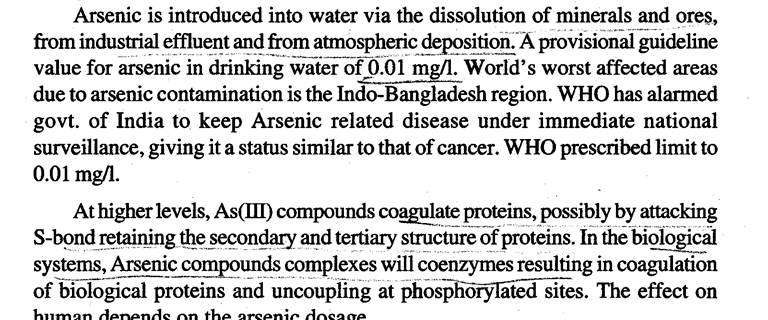
Mild Dose - nausea, fainting, salivation, vomiting, burning pain in Stomach.
HigherDose - diarrhoea, peripheral neuritis, hyperketosis, conjunctivitis.
Chronicdose - severe gastroenteritis, loss of weight, skin lesions, black food disease.
Lethal dose - death due to shock and vascular failure.
Arsenic is a cumulative poison. In animals, it affects the organs like liver lungs causing toxicity to biological systems. Arsenic in water may be carcinogenic in nature.
Lead
The important sources of lead for biological systems are mining, smelting, winning of metals, automobiles etc. In urban areas, citizens are exposed to it through emission of vehicles and food. About 200-300 mg/day of lead intake through food and about 10-15 mg/day through air and water is quite common in urban settlements. Lead is present in tap water to some extent as a result of dissolution from natural sources but mainly from household plumbing systems containing lead pipes. It is satisfying to note that emission of lead from vehicular emissions has ceased since leaded petrol is no more used in cities like Delhi.
When present in 100 mg/100 mL of blood is unacceptable.
Lead gets deposited in bones and is considered as a cumulative poison. Lead is a general toxicant that accumulates in the skeleton. Infants, children up to six years of age and pregnant women are most susceptible to its adverse health effects. Lead interferes with calcium metabolism, both directly and by interfering with vitamin D metabolism. Lead is toxic to both central and peripheral nervous system, inducing Subencepalopathic neurological and behavioral effects.
Since most of the lead in drinking water arises from plumbing in buildings and so the remedy consists in removing plumbing and fittings containing lead.
Nitrates C,∕4θ¾*)
Both nitrate and nitrites are naturally occurring ions that are part of the nitrogen cycle. Naturally occurring nitrate levels in surface and ground water are generally a few mg∕L~1. In many ground waters, an increase of nitrate level has been observed due to intensification of farming practice.
The danger of drinking water containing high nitrate content has long been recognized. Live stocks have been effected by well water containing 75-10 ppm of nitrate nitrogen.
Human infants have been susceptible, especially bottlefed infants, of less than 3 months of age are most susceptible.Nitrate poisoning brings about a condition called Inethemoglobinamia, resulting from change in the hemogldbin of the red blood cells that reduce their capacity to carry oxygen. This is referred to as blue baby syndrome.
The Table 6.11 given below gives the toxic and pathological effects of some heavy metals.
Table 6.11 Hazardous effects of some metals on Human beings
| Metals | Impact |
| Arsenic | - Adversely affect peripheral circulatory systems and CNS, hyperkeratosis, ulcer in gastrointestinal tract, liver cirrhosis. |
| Barium | - Abdominal pain, diarrhoea, vomiting, excess salivation |
| Cadmium | - Diarrhoea, growth retardation, malfunctioning of Urinogenital system, CNS, Kidney, Liver |
| Copper | - Sporadic fever, uremia, coma, hypertension |
| Cobalt | - Diarrhoea, lowering of blood pressure, paralysis, respiratory problems, deforming of skeleton |
| Chromium (Generally Hexavalent form) | - Malfunctioning of gastrointestinal, CNS and Urinogenital systems |
| Mercury | - Haemolysis, diarrhoea, severe headache, paralysis, desiccation of intestinal epithelium, ultimately death, loss of appetite, convulsions, brain damage, malfunctioning of liver, kidney, anaemia, vomiting |
| Zinc | - Abdominal cramps, vomiting, diarrhoea, renal damage |
6.5.3 Water as a Vector Habitat in Disease Transmission in Humans
Following are the most important water-related vector bome diseases
- Malaria
- Schistosomiasis (found mostly in sub Sahara Africa)
- Dengue fever
- Filariasis
- Japaneseencephalitis
6.5.4 Treatment of Waste Water
The waste water is the spent water supply of the community.
It comprises of sanitary sewage, domestic sewage (arising from kitchens, bathrooms, laundries, and laboratories etc.) and wastes (discharged into water bodies) arising from industrial units.The waste waters arising from industrial set ups must be treated appropriately to remove all possible impurities before discharging into water bodies. It is however, best course that the industrial units should use the spent water (after purification) in their own units.
The waste from sewage and domestic discharges must be treated before being discharged into the water bodies.
Methods of Sewage Treatment
The treatment procedures and generally divided into the following three groups,
- Primary Treatment
- Secondary Treatment
- Tertiary Treatment
Removal of Solids, which settle down is called primary treatment. Secondary treatment involves removal of solids with the aid of living organisms (biological treatment). The combination of primary and secondary treatment constitutes complete treatment. The purification of waste water by advanced biological, chemical processes and also the recycling of waste water constitute the tertiary treatment. For details see sec. 5.2.3, sub-sec. iv.
6.6.5 Eutrophication
When sewage and agricultural run-off containing phosphates (phosphates are major ingredients of most of the detergents) or other nutrients enter natural water bodies, they cause over nutrition leading to eutrophication. In such a situation the water bodies became highly productive or eutrophic and the phenomenon is called eutrophication. The ponds or lakes etc. during their early stages of formation are comparatively barren or nutrients-deficient-thus supporting no or poor aquatic life. This stage of these water bodies is known as Oligotrophic. With the introduction of nutrients, there is a stimulated luxuriant growth of algae in water. This growth depletes the dissolve oxygen and causes the death of the other aquatic flora and fauna and ultimately the lake dies.
More on the topic Impact of Water Pollution on Human Health:
- Types of Water Pollution
- Sources of Water Pollution
- 4 Water pollution offences
- B WATER POLLUTION
- Chapter 13 Appendix V: Comments FROM THE DEPARTMENT OF HEALTH and Human Services
- Water is essential for life. Water is the medium in which all biochemical reactions necessary for physiological functioning occur.
- Birth is a water-shed event in human life, necessitating various physiological changes to adapt from intrauterine to extrauterine life.
- CONCEPT 4.3 The water balance of an organism is determined by exchanges of water and solutes with the external environment.
- The history of HIV is brief but dense. It is filled with aggressive debates, politics, human tragedy, a rich vein of research in medical science, and a dramatic change in drugs and tests in 1996 that translated immediately into better health and longer life.
- Environmental Pollution
- Defining pollution