Learning Objectives
21.4.1 Explain how food webs are helpful for envisioning ecosystem energy flow, and outline the factors that compromise their accuracy in portraying the full extent of interactions among organisms.
21.4.2 Describe how the use of interaction strengths can aid in the construction of more accurate food web models.
21.4.3 Summarize how ecologists have viewed the relationship between the complexity of food webs and the stability of associated communities and ecosystem processes.
Ever since Charles Darwin, in The Origin of Species (1859), described “a tangled bank, clothed with many plants of many kinds, with birds singing on the bushes, with various insects flitting about,... dependent upon each other in so
complex a manner,” the interdependence of species has been a central concept in ecology. When we examine these links among species with a focus on feeding relations, they can be described by a food web, a diagram showing the connections among organisms and the food they consume. For the desert ecosystem we considered at the start of this chapter, we can construct a simplified food web showing that plants are consumed by insects and ground squirrels and that these herbivores are food for scorpions, eagles, and foxes (FIGURE 21.15A). In this way, we can begin to understand qualitatively how energy flows from one component of this ecosystem to another, and how that energy flow may influence changes in population sizes and the species composition of communities.
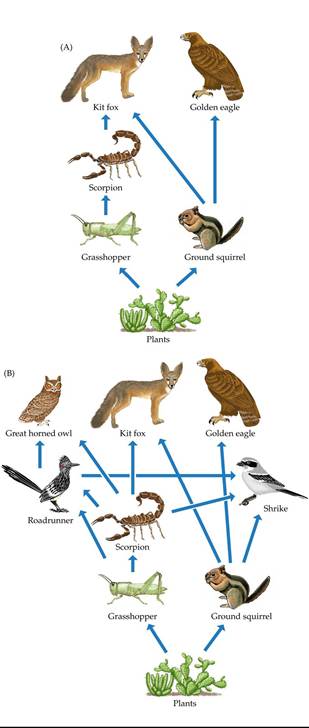
FIGURE 21.15 DesertFoodWebs Food webs may be simple or complex depending on
their purpose. (A) A simple six-member food web for a representative North American desert. (B) Addition of more participants to the food web adds realism, but the inclusion of additional species adds complexity. View larger image
More on the topic Learning Objectives:
- FIVE COMPONENTS OF LEGAL COMPETENCIES
- Agrawal M.. Textbook of Pediatrics. 3rd ed. — CBS Publishers,2025. — 973 p., 2025
- Preface
- CASE 145: Periods of Gestation