Food webs are complex
The desert food web in Figure 21.15A is far from complete. Depending on our purposes, we may wish to add other organisms and links to the food web, providing additional complexity.
For example, the scorpion consumes insects such as the grasshopper, but like the grasshopper, it may be food for birds such as shrikes and owls (FIGURE 21.15B). As we continue to add more and more organisms to the food web, we add complexity, such that the food web may take on the appearance of a “spaghetti diagram” (FIGURE 21.16). In order to add greater realism, it is important to recognize that the feeding relationships of animals can span multiple trophic levels (omnivory) and may even include cannibalism (half-circle arrows in Figure 21.16) (Polis 1991).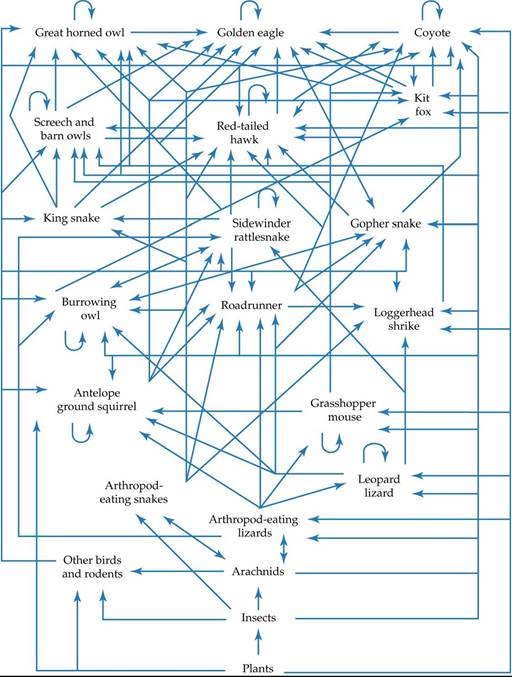
FIGURE 21.16 FoodwebsCanBeComplex In this North American desert food web, complexity overwhelms any interpretation of interactions among the members. Even this food web, however, lacks the majority of the trophic interactions in the ecosystem.
How many of the organisms or feeding groups depicted in this food web consume both plants and animals as food sources? What does this suggest about the frequency of omnivory in this food web?
(From G. A. Polis. 1991. Am Nat 138: 123-155.) View larger image
Although food webs are useful conceptual tools, even a simplified food web is a static description of energy flow and trophic interactions in a temporally dynamic ecosystem. Actual trophic interactions can change over time (Wilbur 1997). Some organisms alter their feeding patterns as they age. Maturing frogs, for example, make the transition from omnivorous aquatic tadpoles to carnivorous adults. Some animals, such as migratory birds, are relatively mobile
and are thus components of multiple food webs. Furthermore, most food webs fail to account for additional biological interactions among organisms that influence population and community dynamics, such as pollination mutualisms. (In community studies, this problem may be addressed by the use of interaction webs, as described in Figure 16.5.) The critically important roles of microorganisms are often ignored as well, despite their processing of a substantial amount of the energy moving through ecosystems. What are food webs good for, then? Despite these apparent shortcomings, food webs are important conceptual tools for understanding the dynamics of species interactions and energy flow in ecosystems and hence the community and population dynamics of their component organisms.
More on the topic Food webs are complex:
- Does complexity enhance stability in food webs?
- Food Webs
- Competition within the framework of food webs
- 21 Energy Flow and Food Webs
- CONCEPT 21.4 Food webs are conceptual models of the trophic interactions of organisms in an ecosystem.
- Food Allergy
- Food Allergy
- Food Safety
- Interspecific competition in a food web context
- Anansi and the Make-Believe Food