The strengths of trophic interactions are variable
As indicated in the quote from Darwin above and in earlier chapters, a core concept of ecological thought is that “everything is connected to everything else.” However, the links among the species in an ecosystem vary in their importance to energy flow and species population dynamics; in other words, not all connections are equally important.
Some trophic relationships play larger roles than others in dictating how energy flows through the ecosystem. Interaction strength is a measure of the effect of the population of one species on the population size of another species (see Ecological Toolkit 16.1). Determining interaction strengths is an important goal of ecologists because it helps us simplify the “spaghetti” in a complex food web by focusing attention on those links that are most important for basic research and conservation (Berlow 1999).How are interaction strengths determined? Several approaches have been used. Removal experiments, like those described in Concept 16.3 to determine competition or facilitation, can be employed, but performing such experimental removals to quantify every link in a food web would be logistically overwhelming. Therefore, much current ecological research is devoted to discovering simpler, less direct measures that can still give us a reliable estimate of the relative importance of different links. For example, simple food webs can be coupled with observations of the feeding preferences of predators and of changes in the population sizes of predators and prey over time to provide an estimate of which interactions are the strongest. Similarly, comparisons of two or more food webs in which a predator or prey species is present in some but absent in others may provide evidence for the relative importance of links. Predator and prey body sizes have been used to predict the strengths of predator-prey interactions because feeding rate is known to be related to metabolic rate, which in turn is governed by body size.
The best estimates of interaction strengths in food webs often come from a combination of these approaches.A series of classic studies examining interaction strengths in food webs was performed in rocky intertidal zones of the Pacific Northwest by Robert Paine. Paine (1966) had observed that the diversity of organisms in rocky intertidal zones declined as the density of predators decreased. He reasoned that some of those predators might be playing a greater role than others in controlling the diversity of these communities. One of Paine's critical observations was that one mussel species (Mytilus californianus) had the ability to overgrow and smother many of the other sessile invertebrate species that compete with it for space. Paine hypothesized that predators might play a key role in maintaining diversity in this community by consuming these mussels and preventing them from competitively excluding other species.
To test these hypotheses, Paine conducted an experiment in Washington State in which he removed the top predator in the system, the sea star Pisaster ochraceus, from experimental plots. Pisaster feeds primarily on bivalves and barnacles and to a lesser extent on other mollusks, including chitons, limpets, and a predatory whelk (Nucella sp.) (FIGURE 21.17). Following the continuous manual removal of Pisaster from 16-m2 plots, acorn barnacles (Balanus glandula) became more abundant, but with time, they were crowded out by mussels (Mytilus) and gooseneck barnacles (Pollicipes spp.). After 2½ years, the number of species in the community had decreased from 15 to 8. Even 5 years after the experiment began, when sea stars were no longer being removed, dominance by the mussels continued, as individual mussels had grown to sizes that prevented predation by sea stars, and diversity remained lower in the experimental plots than in adjacent control plots (Paine et al. 1985). Experimental removals of higher-level predators in other intertidal zones, including one in New Zealand, which shares no species with the intertidal zone of the Pacific Northwest, resulted in similar reductions in diversity.
Predators in these intertidal ecosystems are thus key to maintaining species diversity by preventing competitive exclusion. Such species are more important in food webs than their numbers would indicate.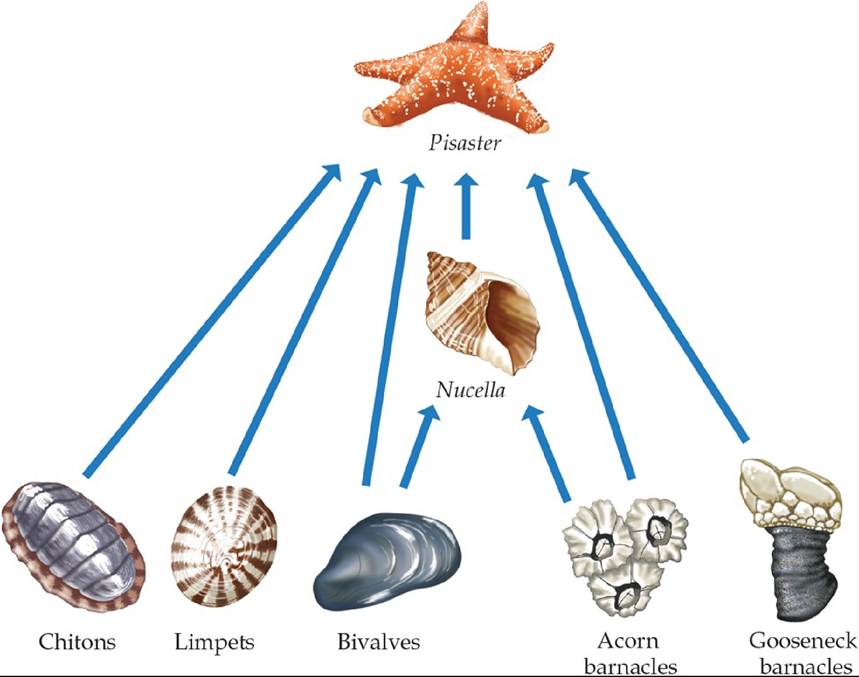
FIGURE 21.17 AnIntertidalFoodWeb This food web from the rocky intertidal zone of Mukkaw Bay, Washington State, was used by Robert Paine to investigate the strength of the interaction between the sea star Pisaster ochraceus and its prey. (After R. T. Paine. 1966. Am Nat 100: 65-75.) View larger image
The experimental research of Paine and others was an encouraging advance in ecology because it demonstrated that, despite the potential complexity of trophic interactions among species, patterns of energy flow and community structure might be governed by a small subset of those species. Paine called animals like it Pisaster keystone species, defining them as species that have a greater influence on energy flow and community composition than their abundance or biomass would predict (see Figure 16.16). The keystone species concept has become an important focus in ecology and conservation biology because it implies that protecting such species may be critical for protection of the many other species that depend on them (as we'll see in Concept 23.5). Many keystone species are predators at higher trophic levels, which tend to have large effects on prey populations relative to their own abundance.
Some species act as keystone species in only part of their geographic range, suggesting that interaction strengths are dependent on the environmental context. Several studies, including those described in Figure 16.19 and Ecological Toolkit 16.1, have found context-dependent variation in the degree to which species behave as keystone species. Thus, while the keystone species concept is intuitively simple, predicting when and where a particular species will behave as a keystone species remains a challenge.
One reason it remains difficult to predict the strength of trophic interactions is that the ecological importance of a keystone predator such as Pisaster manifests itself not only through one strong link, such as that between Pisaster and mussels, but also through strong indirect effects (see Figure 16.11), such as the effects Pisaster has on other species by reducing the abundance of mussels. If Pisaster consumed only the species that are inferior competitors for space (such as barnacles), it would not play a keystone role in the rocky intertidal community. Thus, predicting the effects of species losses on the remaining community requires an understanding of not only the strengths of individual links, but also the strengths of chains of indirect effects.
More on the topic The strengths of trophic interactions are variable:
- The strengths of trophic interactions are variable
- Organisms can be grouped into trophic levels
- Trophic interactions can trickle down through multiple trophic levels
- Energy flow between trophic levels differs among ecosystem types
- What determines the number of trophic levels?
- Trophic efficiencies can influence population dynamics
- Reviewers
- List of Illustrations