What determines the number of trophic levels?
What determines the variation in the number of trophic levels that occur among different ecosystems, and why do so few ecosystems have five or more trophic levels? These questions are not simply academic.
Through trophic cascades, the number of trophic levels in an ecosystem can influence movements of energy and nutrients as well as the potential for toxins in the environment to become concentrated at higher trophic levels, as we will see in this chapter's Case Study Revisited. Change in the number of trophic levels may be due to the addition or loss of a predator at the top of the food web, the insertion or loss of a predator in the middle of the food web, or changes in omnivore feeding preference for foods at different trophic levels (FIGURE 21.13).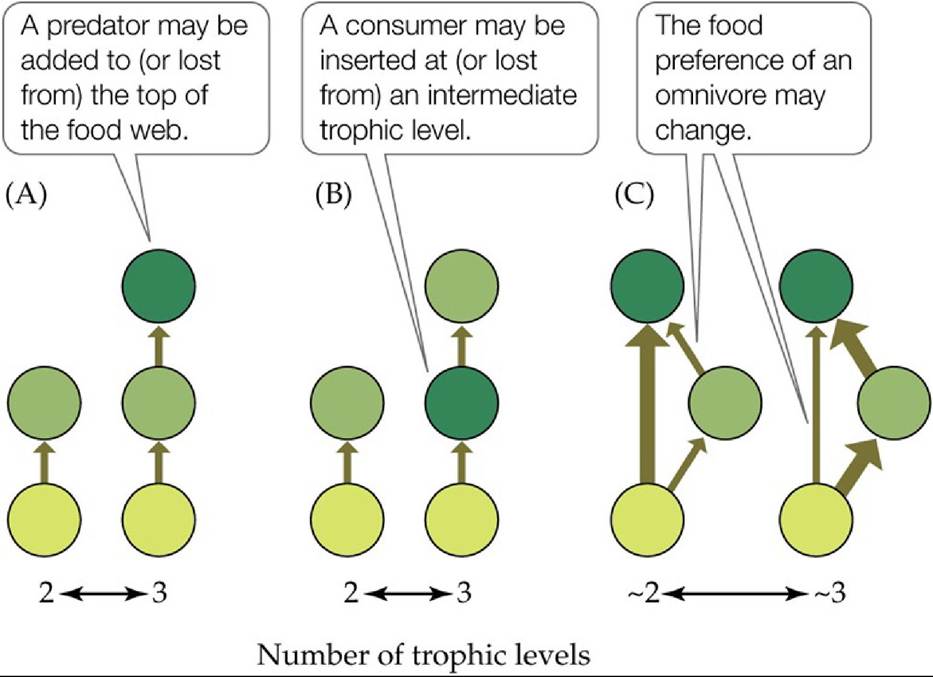
FIGURE 21.13 Changes in the Number of Trophic Levels Circlesrepresentspeciesat different trophic levels, and the thickness of the arrows represents the amount of energy flowing between species pairs. Differences among ecosystems in the number of trophic levels may occur because of (A) the addition or loss of a consumer at the top level, (B) the insertion or loss of a consumer at an intermediate level, or (C) a change in the preferred feeding level of an omnivore. (After D. M. Post and G. Takimoto. 2007. Oikos 116: 775-782.) View larger image
Several interacting ecological factors can control the number of trophic levels in ecosystems (Post 2002b). First, the amount of energy entering an ecosystem through primary production has been proposed as a determinant of the number of trophic levels. Because a relatively large amount of energy is lost in the transfer from one trophic level to the next, the more energy there is entering a system, the more is potentially available to support viable populations of higher-level predators (see ANALYZING DATA 21.1).
However, this explanation appears to be important primarily in ecosystems with low resource availability. Second, the frequency of disturbances or other agents of change, such as disease outbreaks, can determine whether populations of higher-level predators can be sustained. Because lower trophic levels are required to sustain higher trophic levels, there is a longer time lag for the reestablishment of the higher trophic levels following a disturbance. If disturbances occur frequently, then higher trophic levels may never become established, no matter how much energy is entering the system (Pimm and Lawton 1977). While some support for this hypothesis exists, the ability of some organisms to adapt to frequent disturbances and the potential for rapid colonization of disturbed sites (see Concept 17.1) result in a smaller effect of disturbance on trophic level number than expected. Finally, the area of an ecosystem can influence the number of trophic levels. Larger ecosystems support larger population sizes, which are less prone to local extinction (see Concept 11.3). Larger ecosystems also have more habitat heterogeneity and thus tend to have higher species diversity.ANALYZING DATA 21.1
Does the Identity of Organisms Influence Energy Flow between Trophic Levels?
Ecologists have noted that individuals and populations of some species (known as keystone species; see Concept 16.3) influence energy flow between trophic levels more than others. In particular, we've seen several examples in which invasive species have greatly altered energy transfers as well as diversity within communities. Attention has largely been focused on the behavioral characteristics of a species, such as how effective individuals of a species are at hunting or grazing, or its population dynamics (e.g., whether a population exhibits exponential growth; see Concept 10.3). Additionally, the thermal physiology and sizes of the species making up a trophic level can influence how much energy makes it from one trophic level to the next.
Using information from the text and Table 21.1, provide a rough estimate of how much energy would make it to the second, third, and fourth trophic levels in the following simplified food chains. Start with 100 units of energy in the autotrophic base of each of these food chains (i.e., plants or algae). Assume the production efficiencies for endotherms do not vary according to diet.
1. Plants → non-insect invertebrate herbivores → small mammals → large mammals
2. Algae → aquatic non-insect invertebrate herbivores → insect predators → fish
3. Plants → large mammal herbivores → large mammal predators → large mammal predators
4. Plants → insect herbivores → insect predators → insect predators
5. Remembering that the transfer of energy between trophic levels can influence the number of trophic levels an ecosystem can sustain, and that greater energy transfer usually enhances the establishment of higher tropic levels, which of the hypothetical food chains in Questions 1-4 would be most likely, and which least likely, to sustain the highest trophic level?
Support for the effect of ecosystem size on the number of trophic levels is derived primarily from studies of lakes and oceanic islands, ecosystems with discrete boundaries. For example, Gaku Takimoto and colleagues (2008) tested the relative effects of disturbance and island size on the number of trophic levels on 36 islands in the Bahamas. The effect of disturbance was tested by examining 33 of the smaller islands that were either exposed to (19 islands) or protected from (14 islands) storm surges. The number of trophic levels was estimated using isotopic ratios of carbon and nitrogen (as described in Concept 20.4) in tissues from the top predators, spiders and lizards. Takimoto and colleagues found that exposure to storm surges had no effect on the number of trophic levels. However, disturbance did influence the identity of the top predators: orb spiders were more frequently the top predators on exposed islands, and Anolis lizards were at the apex of the food web on protected islands.
Island size, however, was strongly correlated with the number of trophic levels (FIGURE 21.14), providing evidence that ecosystem size can influence the number of trophic levels in a terrestrial ecosystem.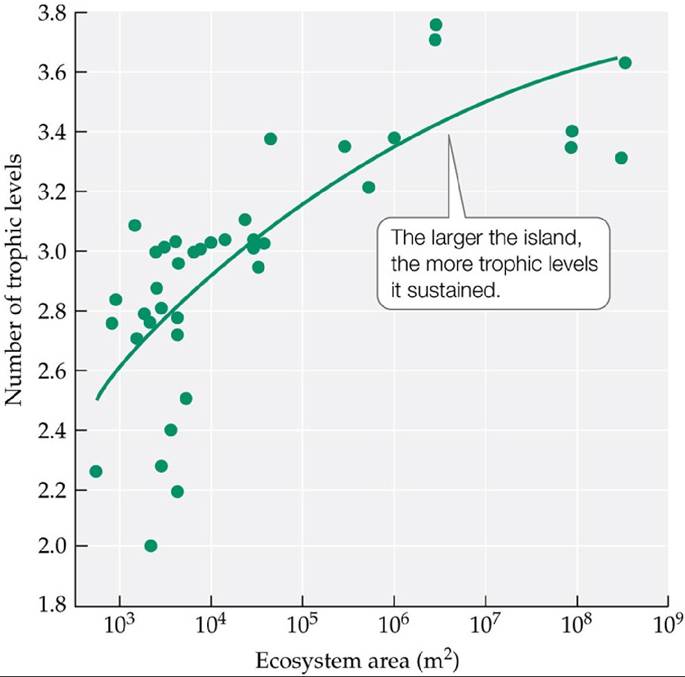
FIGURE 21.14 Ecosystem Size Is Correlated with the Number of Trophic Levels On islands in the Bahamas, Takimoto and colleagues found that as island size increased, the number of trophic levels also increased. (After G. Takimoto et al. 2008. Ecology 89: 3001-3007.) View larger image
We turn our attention next to a more detailed investigation of trophic relationships in ecosystems as we cross the disciplinary boundaries of ecosystem ecology and community ecology (the topic of Unit 5) to examine how energy flow can influence the diversity and stability of communities and ecosystems.
More on the topic What determines the number of trophic levels?:
- Trophic interactions can trickle down through multiple trophic levels
- CONCEPT 21.3 Changes in the abundances of organisms at one trophic level can influence energy flow at multiple trophic levels.
- Organisms can be grouped into trophic levels
- Energy flow between trophic levels differs among ecosystem types
- Energy Flow between Trophic Levels
- Energy flow between trophic levels can be depicted using energy or biomass pyramids
- CONCEPT 21.1 Trophic levels describe the feeding positions of groups of organisms in ecosystems.
- Habitat suitability determines distribution and abundance
- CONCEPT 4.1 Each species has a range of environmental tolerances that determines its potential geographic distribution.
- IMPACT OF ANTIRETROVIRAL THERAPY ON LEVELS OF LYMPHOCYTE APOPTOSIS
- The strengths of trophic interactions are variable
- Trophic efficiencies can influence population dynamics
- Trophic Cascades
- NPP can be estimated by a number of methods
- Levels of humility in science
- Appendix 1.1: Levels and trajectories of SHD at the local level