It must have been incredible to be a European scientific explorer 200 years ago.
You would have left the safety of your home to travel by ship to a destination largely unknown. You would have had to endure seasickness, disease, accidents of all kinds, and years away from your family, friends, and colleagues.
You might have had many years of financial debt to repay unless you were independently wealthy or could sell your collections. But you would have been the first scientist to document and collect animal and plant species of beauty, novelty, and rarity. It was under these circumstances that the science of biogeography was born and many important discoveries were made. Up to that point, European scientists had very little information about the natural history and ecology of other parts of the world; most was secondhand or anecdotal. What these early naturalists were able to bring back were specimens and, most of all, theories to help make sense of their observations.Although not the first in his field, Alfred Russel Wallace (1823-1913) rightly earned his place as the father of biogeography (FIGURE 18.8). Inspired by naturalists such as Alexander von Humboldt, Charles Darwin, and Joseph Hooker, Wallace came on the scene with considerably less wealth or education, but his intellect and motivation more than made up for what he lacked in financial resources and training. Wallace is best known, along with Charles Darwin, as the co-discoverer of the principles of natural selection, although he has always stood in the shadow of Darwin in that regard. But his main contribution was the study of species distributions across large spatial scales.
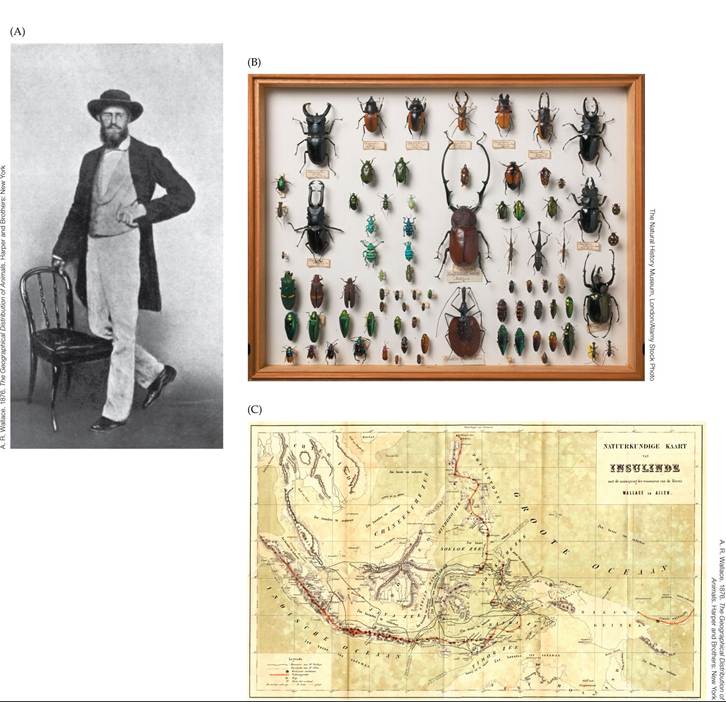
FIGURE 18.8 Alfred Russel Wallace and His Collections (A)AphotographofWallace taken in Singapore in 1862, during his expedition to the Malay Archipelago. (B) Part of Wallace's rare beetle collection from the Malay Archipelago, found in an attic by his grandson in 2005.
(C) A map of the Malay Archipelago illustrating Wallace's travels. View larger imageWallace left England for Brazil in 1848 and explored the Amazon rainforest for 4 years. On his way back, the ship he was traveling on burned in the middle of the Sargasso Sea, destroying all his specimens and most of his notes and illustrations. After 10 days in a lifeboat, he was rescued and made his way back to England, where he published an impressive six papers on his observations.
Even though he had vowed never to travel again, in 1852 Wallace left England for the Malay Archipelago (present-day Indonesia, the Philippines, Singapore, Brunei, East Malaysia, and East Timor). It was here that he made the puzzling observation described in his 1869 book The Malay Archipelago: that the mammals of the Philippines were more similar to those in Africa (5,500 km away) than they were to those in New Guinea (750 km away). Wallace was the first to notice the clear demarcation between these two faunas, which came to be known as Wallace's line. It turns out, as we'll see shortly, that these separate groups of mammals evolved on two different continents that have come into close proximity only within the last 15 million years.
Wallace's biogeographic research culminated in the publication of a two-volume work called The Geographical Distribution of Animals, published in 1876. In this book, Wallace overlays species distributions on top of geographic regions and reveals two important global patterns:
• Earth's land masses can be divided into six recognizable biogeographic regions containing distinct biotas that differ markedly in species diversity and composition.
• There is a gradient of species diversity with latitude: species diversity is greatest in the tropics and decreases toward the poles.
These two patterns are necessarily interrelated; the latitudinal gradient is superimposed over the biogeographic regions. For ease of explanation, we'll begin by exploring the biogeographic regions described by Wallace and the underlying forces that created them. We will then consider some of the processes likely to be responsible for the latitudinal gradient in species diversity.
More on the topic It must have been incredible to be a European scientific explorer 200 years ago.:
- About 14 years ago, Kim and Factor reported the first case of HIV-associated pulmonary hypertension[1].
- There is a reason why financial technology startups are taking off now instead of 20 years ago.
- In this Propter Honoris Respectum, I want to begin by quoting from a review that I had the pleasure of writing some years ago of one of Tom Shaffer’s books:
- The culturally defined Palaeolithic is a rather large time period spanning from the earliest stone artefacts around 2.6 million years ago until the end of the last glacial around 10,000 BP.
- Historiansof the Roman economy appear to agree that during the period 200 BC—AD 200 the Gross Domestic Product of the overall empire grew, however moderately.
- American religious history began some 30,000 to 50,000 years ago when, according to archaeologists, the first human beings set foot on the North American continent.
- Nearly thirty years ago, H. L. A. Hart observed that American jurisprudence “is marked by a concentration, almost to the point of obsession, on the judicial process, that is, with what courts do and should do, how judges reason and should reason in deciding particular cases.”[229]
- In a characteristically lucid and elegant essay written some thirty years ago Peter Stein observed that ‘The vague proposition that Scots law is “based on Roman law” is still widely canvassed today.’[331]
- A Century of Advance, 200—303 ce
- How European is the ‘European’ Legal Tradition?
- CASE 200: Legacy in Place of a Dowry
- Alexander Larry, Sherwin Emily. Advanced Introduction to Legal Reasoning. Edward Elgar,2021. — 200 p., 2021
- Around the year 200 C.E., Tertullian of Carthage ran into difficulties with a certain, otherwise unknown woman, a visiting teacher in the city.
- A SCIENTIFIC REVOLUTION IN THE MAKING
- On 25 October 1714, Charles XII set out on his famous ride across Europe. Riding at breakneck speed and incognito, he covered the distance between the Ottoman outpost at Pitesti and the Swedish fortress in Straslund in an incredible thirteen days and four and a half hours.