SCIENTIFIC UNCERTAINTY
If the impact of a particular activity is well known, that is, there is widespread scientific agreement about it, and the likelihood of its occurring is known with some confidence, the precautionary principle is not relevant.
However, preventative measures may still be necessary. 'The more uncertain the threat, the greater the degree of precaution required' (Deville & Harding 1997: 34-7).In the area of environmental policy, decisions often have to be made before scientific experts are 'able to present unambiguous and scientifically well-founded recommendations' (NENT 1998: 59). Scientists are usually unable to tell policy makers exactly where and how far a pollutant will spread, how it will interact with other pollutants, and how it will affect the health of people and the functioning of ecosystems.
Types of uncertainty
Steven Yearley (1991: 129-31), a British social scientist, identifies four different reasons why scientists face uncertainties when dealing with environmental problems.
Pragmatic uncertainty
Scientists are often asked to make recommendations when they do not have enough time or funds to investigate the answers fully. The available research may be of poor quality or not immediately applicable to the situation at hand. Pragmatic uncertainty arises from:
• Lack of data
• Doubts about accuracy of data
• Doubts about relevance of data.
Theoretical uncertainty
Ecological science is less developed than other sciences; consequently, there is less agreement than in other scientific disciplines, and more variety of interpretations of data and findings. Theoretical uncertainty arises from:
• Disagreements over interpretation of data
• Disagreements over scientific methodology
• Lack of knowledge about causal connections
• Doubts over knowledge framework - epistemological uncertainty.
Complexity in open systems
Uncertainty arises from 'the sheer complexity of large-scale phenomena taking place in open systems'. Nature is less knowable and less predictable than complex systems, such as nuclear power plants, that are created and controlled by humans. Complexity arises from:
• Variability of ecological processes
• Indeterminacy (explained on the next page).
Intangible damage
Environmental damage may not be easily observable and therefore may be difficult to monitor and understand. For example, depletion of the ozone layer can only be measured by high-technology equipment and would previously have been extremely difficult to predict.
A lack of data can result from a lack of past studies. Thousands of chemicals used commercially have not been tested for their ability to bioaccumulate in the food chain or for their toxicity to a whole variety of organisms because the cost seems to be prohibitive. Scientists try to fill gaps in knowledge by extrapolating from what they do know and estimating probabilities based on past experiences and observations (MacGarvin 1994). This can be done with computer modelling.
However, where processes are not known or understood, computer modelling may not be of much use because the relationships between various parameters, such as what happens to plankton when surface temperatures change, is unknown and may not change in a linear or predictable fashion (O'Riordan & Cameron 1994: 64). Even if the impacts of individual chemicals were known, their synergistic impact, that is, the effect of two or more chemicals interacting in the environment, would be difficult to predict.
Moreover, scientists lack full knowledge of the 'ecological interactions that maintain ecosystems'. A particular species may play a key role in maintaining the health of an ecosystem, yet because it appears to play a relatively minor role, remains unstudied. Marine ecologists, for example, study organisms that bioaccumulate contaminants in a way that can be easily measured, and study commercial fish species which need to be monitored for human health reasons.
Yet there is no reason to suppose that these are the species that are vital to the ecosystem, or whose health is a good indicator of the health of the ecosystem. This means that it is 'unreasonable to expect that we can predict the effect of human actions upon marine ecosystems with any accuracy' (MacGarvin 1994).Even when harm is beginning to occur it may not be self-evident because:
• the first signs of damage are not outside the bounds of normal variation in individuals or populations
• the first effects are not recognised to be harmful
• changes may be followed by a long time period before the consequences become evident
• the harm that is caused may be attributed to a number of causes (Myers et al. 2005: 2).
Ignorance and indeterminacy
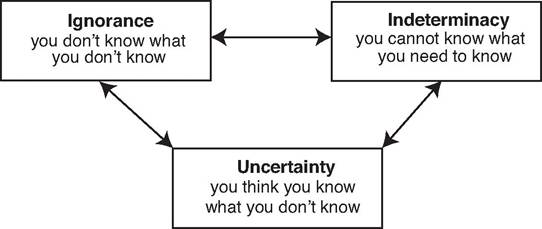
In a situation where change happens chaotically, or where relationships are unstable and subject to sudden dramatic change, the situation is indeterminate and traditional scientific methods have little to offer in terms of assessment (MacGarvin 1994: 65). 'If we cannot determine the accuracy of the scientific and social assumptions on which our assessment of risk is based, this is referred to as "indeterminacy".' For example, we may not know whether the questions that scientists are asking are the right ones, or be unable to understand the social context of an activity that may impact an environment because of political instability in the region (Deville & Harding 1997: 35).
The idea that more research will resolve uncertainties is not necessarily true. Further research may only serve to increase the uncertainties by raising more issues and questions. The ultimate uncertainty is 'ignorance', where we are completely unaware of possible threats (Deville & Harding 1997: 31). The relationship between uncertainty, indeterminacy and ignorance is shown in figure 3.1.
Figure 3.1 Levels of uncertainty
Source (Deville & Harding 1997: 34)
Jerry Ravetz (1986) argues that in dealing with environmental problems, policies must be made, despite uncertain facts and disputed values, on issues for which the stakes are high and about which decisions are urgently needed.
In other areas, researchers are able to choose problems that are likely to be solvable, but in policy-related areas they are faced with problems that are imposed by external forces, such as public need. Because of this, researchers are often forced to work in areas of knowledge that are poorly developed, and for which they lack adequate information. The reduction of uncertainties can be extremely difficult. Ravetz argues that in such situations it can be disastrous not to be aware of our ignorance. Decisions need to be iterative and closely monitored so that they can be altered as new information comes to hand.Alvin Weinberg (1986) also addresses the problem that policy makers face given such substantial uncertainties. He points out that science is best able to make predictions when it is dealing with things that happen regularly or often. When something is rare, or a one-off event, science loses its predictive power; it can only hope to explain what happened after the event. Policy makers have to deal with two types of non-routine events: one is the accident, and the other is the discovery of a chronic, low-level exposure to a chemical or radiation that might affect a few individuals in every thousand or one hundred thousand. Attempting to make predictions in such situations is labelled by Weinberg as 'trans-science'. He says that 'regulators, instead of asking science for answers to unanswerable questions, ought to be content with less far-reaching answers'.
Political uses of uncertainty
Scientific uncertainty is used by both sides in any environmental controversy as an opportunity to 'win'. Scientific uncertainties seem to increase with the increasing relevance of the science to the policy decision, because those with vested interests in the outcomes of the decision-making frequently seek an advantage by highlighting those uncertainties.
In a study of the politics of regulation in Europe and the USA, for example, Ronald Brickman and his colleagues (1985: 187) concluded that scientific uncertainties 'make it possible for proponents and opponents of regulation to interpret the scientific basis for cancer risk assessment in ways that advance their particular policy objectives'.
There is no scientific way to know whether a substance will cause cancer in humans without testing it on humans - which would be unethical. Scientists disagree over how chemicals should be tested and how the results of those tests should be interpreted. The tests that are used include short-term tests for mutagenic (cell-mutating) activity; high-dose tests on animals such as mice; and studies of humans who have been accidentally exposed to the substances.Brickman and his colleagues (1985: 197) found that the consequences that should follow from a positive test were disputed:
Some environmentalists resolutely maintained that positive evidence from one or more short-term tests should trigger regulation, even without convincing support from other sources. At the other extreme, some witnesses for industry argued that no significance should be attached to these tests until they are more thoroughly validated.
Using animal tests to determine whether a substance is carcinogenic (cancer causing) in humans is equally controversial, and not only for ethical reasons. There are also disagreements over such things as how experiments should be designed and whether tumours induced at high doses in animals are relevant to the exposure of humans to low doses of the same chemical.
The regulator is forced to make a decision even though there is scientific uncertainty and debate. He or she is often faced with the situation that a product which has high social or economic benefits has shown some indications of being carcinogenic. On the other hand, the costs of not limiting a chemical might be even greater in terms of human health and environmental damage than the benefits of leaving it freely on the market. A regulator generally does not have the luxury of waiting around until more compelling evidence comes in. Not acting on the given information is just as much a decision as acting.
National differences
Regulators react to this dilemma differently in different countries.
In the USA in the past, the EPA has been far more ready to regulate on the basis of experiments done in the laboratory than are the equivalent authorities in France and Germany. German regulators do not automatically view substances that cause cancer in animals as being a threat to humans. British regulators also require much more 'proof' than do US regulators. An example is the case of the pesticides aldrin and dieldrin, which were banned in the USA but not in Britain or Australia, although the same data was available to regulators in all three countries (Gillespie et al. 1982).The US regulators have also taken a more precautionary approach when it comes to the question of threshold effects. US regulators do not assume that there is a certain level - a threshold - below which a chemical has no effect. Australian and British regulators are far more willing to accept the idea of threshold levels. A US interagency agreement states that because threshold doses that cause cancer have not been established, 'a prudent approach from a safety standpoint is to assume that any dose may induce or promote carcinogenesis'. This stance was condemned by industry, the courts and sections of the public as being 'unduly restrictive and insensitive to socioeconomic costs' (quoted in Brickman et al. 1985: 208-10). In contrast, the British insistence that scientific evidence must support the existence of thresholds has been met with fierce union opposition in the area of occupational health and safety.
Even in the USA, laboratory evidence that a chemical causes cancer is not always enough to result in the banning of that chemical. For example, 2,4,5-T (the active chemical in some herbicides) received only a partial ban after there was evidence that human foetuses had been adversely affected by it.
How much evidence?
Where, between the extremes of speculation and the unattainable full scientific certainty, is the point where there is sufficient knowledge to act? How much evidence does there need to be before the precautionary principle is triggered? If no evidence were required, then any non-scien- tific speculation or irrational fear would be enough to require precautionary measures and the principle would become impractical. On the other hand, scientific proof would render the precautionary principle unnecessary.
Most definitions of the precautionary principle try to define the level of evidence in terms of 'reasonable grounds for concern' or 'reasonable scientific plausibility' or 'scientific credibility' or require decisions to be made 'on the basis of available pertinent information' (de Sadeleer 2002: 159-60).
David Resnik (2003: 329-44) has summarised a number of criteria that could be used to assess the scientific plausibility of a hypothesis:
Coherence. The hypothesis should be consistent with and supported by our background knowledge and theories. If a hypothesis requires us to reject widely accepted scientific theories and facts, then it is not plausible.
Explanatory power. The hypothesis should be able to explain important facts and phenomena. Hypotheses that have no explanatory power are less plausible.
Analogy. The hypothesis should posit causal mechanisms or processes that are similar to other well-understood mechanisms and processes. A hypothesis that posits radically new and unfamiliar mechanisms and processes lacks plausibility.
Precedence. Events posited by the hypothesis should be similar to previously observed events, which set an historical precedent for the hypothesis.
Precision. The hypothesis should be reasonably precise. Although there are limits to precision in science, a hopelessly vague hypothesis should not be regarded as plausible.
Simplicity. The hypothesis should be parsimonious. Recondite and complex hypotheses are not as plausible as parsimonious ones.
However, this leaves aside the question of ignorance. If the impacts of a new chemical, for example, are unknown and there is no reasonable scientifically credible case to say whether or not it will cause harm, should the chemical be approved for release? Policy makers have to deal with situations of ignorance as well as uncertainty.
More on the topic SCIENTIFIC UNCERTAINTY:
- Banks differentiate between risk and uncertainty.
- Key Features of Regulation under Extreme Uncertainty
- Uncertainty and hyper-regulation
- Vagueness and Uncertainty
- Indeterminacy, Uncertainty, and Insecurity
- Probability in the Absence of Uncertainty
- Into the new millennium: an age of uncertainty
- A new view of scientific theories
- Uncertainty in the Face of Higher-Order Vagueness
- A SCIENTIFIC REVOLUTION IN THE MAKING