SUMMARY
CONCEPT 21.1 Trophic levels describe the feeding positions of groups of organisms in ecosystems.
21.1.1 Describe how energy flow among trophic levels in an ecosystem is related to the food selection of consumers.
An organism’s trophic level is determined by the number of feeding steps by which it is removed from the first trophic level, which contains autotrophs and detritus.
Omnivores feed at multiple trophic levels, although their diets can be partitioned to reflect their consumption at each level.
21.1.2 Explain how both primary production and detritus can be at the base of food chains.
All organisms eventually end up as food for other organisms or as detritus.
Energy from both primary production and detritus supports the second trophic level of herbivores and detritivores, respectively.
21.1.3 Evaluate how terrestrial detrital energy inputs from outside an ecosystem (allochthonous) would change in a river from its source to where it reaches the ocean.
Allochthonous sources of energy dominate in the higher portions of river systems, with autochthonous energy sources becoming increasingly important as the rivers become larger and flow velocity decreases.
CONCEPT 21.2 The amount of energy transferred from one trophic level to the next depends on food quality and on consumer abundance and physiology.
21.2.1 Describe how the relationship between biomass and energy is influenced by the life span of primary producers.
Trophic energy and biomass pyramids portray the relative amounts of energy and biomass at different trophic levels.
21.2.2 Summarize the factors that may influence why a greater proportion of net primary production is consumed in aquatic ecosystems relative to terrestrial ecosystems.
The high turnover of autotroph biomass in aquatic ecosystems can result in biomass pyramids that are inverted relative to energy pyramids.
The proportion of autotroph biomass consumed in terrestrial ecosystems tends to be lower than that in aquatic ecosystems.
21.2.3 Evaluate how consumer thermal physiology, body size, diet preference, and digestive specialization can determine trophic efficiency.
The efficiency of energy transfer from one trophic level to the next is determined by food quality and the physiology of consumers.
CONCEPT 21.3 Changes in the abundances of organisms at one trophic level can influence energy flow at multiple trophic levels.
21.3.1 Compare the factors that influence energy flow in an ecosystem between bottom-up and top-down perspectives.
Changes in the numbers and types of consumers at higher trophic levels can influence primary production through influences on the consumption of herbivores.
21.3.2 Describe how changes in the abundance of organisms at the fourth trophic level may impact rates of primary production through a trophic cascade.
Trophic cascades tend to be more apparent in aquatic ecosystems than in terrestrial ecosystems, but they have been demonstrated in complex terrestrial ecosystems as well.
21.3.3 Explain how the size of an ecosystem, the rates of disturbance, and the amount of primary production can influence the number of trophic levels.
The number of trophic levels that can be sustained in an ecosystem is determined by the size of the ecosystem, the amount of energy entering the ecosystem through primary production, and the frequency of disturbances.
CONCEPT 21.4 Food webs are conceptual models of the trophic interactions of organisms in an ecosystem.
21.4.1 Explain how food webs are helpful for envisioning ecosystem energy flow, and outline the factors that compromise their accuracy in portraying the full extent of interactions among organisms.
Food webs are diagrams that portray the diverse trophic interactions among species in an ecosystem.
21.4.2 Describe how the use of interaction strengths can aid in the construction of more accurate food web models.
Although trophic interactions are extremely complex, food webs can be simplified by focusing on the strongest interactions among the component organisms.
Keystone species have greater effects on energy flow and community composition than their abundance or biomass would predict.
Indirect effects of a predator on a target prey species, including its effects on other species that compete with, facilitate, or modify the environment of the target species, can offset or reinforce the direct effects of predation on the target species. These indirect effects may have stabilizing effects on inherently unstable food webs.
21.4.3 Summarize how ecologists have viewed the relationship between the complexity of food webs and the stability of associated communities and ecosystem processes.
Although early considerations of food web complexity predicted that greater complexity confers more stability to food webs, models indicated the opposite. Recent modeling incorporating interactions’ strengths more closely resembles patterns found in nature.
REVIEW QUESTIONS
1. Suppose one population of coyotes (population A) demonstrates a greater degree of omnivory than another population (population B). Population A relies on a diet that includes road-killed animal carcasses, plants, and rotten food from dumpsters, while population B has a steady diet of small rodents. Which population should have a higher assimilation efficiency, and why?
2. Mammals in temperate terrestrial and temperate marine ecosystems occupying similar trophic levels may have different production efficiencies. Assuming similar food quality, food abundance, and food capture rates, explain why the production efficiencies of these mammals would differ between a marine ecosystem and a terrestrial ecosystem. (Hint: Consider how the mammals maintain their body heat, as well as the temperature variation of their environments as described in Chapter 2.)
3. Which ecosystem would you expect to have a greater total amount of energy passing through its trophic levels: a lake or a forest adjacent to the lake? Which of these ecosystems would have a higher proportion of NPP moving through all of its trophic levels, the forest or the lake?
HONE YOUR PROBLEM-SOLVING SKILLS
Generalist herbivores, which are often insects, consume a greater number of plant species than specialist herbivores do.
Specialist herbivores are often protected against predation by acquiring protective chemicals from their plant food sources. Thus, dietary specialization may have consequences for the impact of herbivory on the flow of energy and nutrients in ecosystems.1. Would you expect that a trophic cascade would have a greater or lesser effect on herbivory and NPP if only specialist herbivores were present? Assume a high diversity of plant species. Provide your answer in the form of a prediction, and describe an experiment in which you could test this hypothesis.
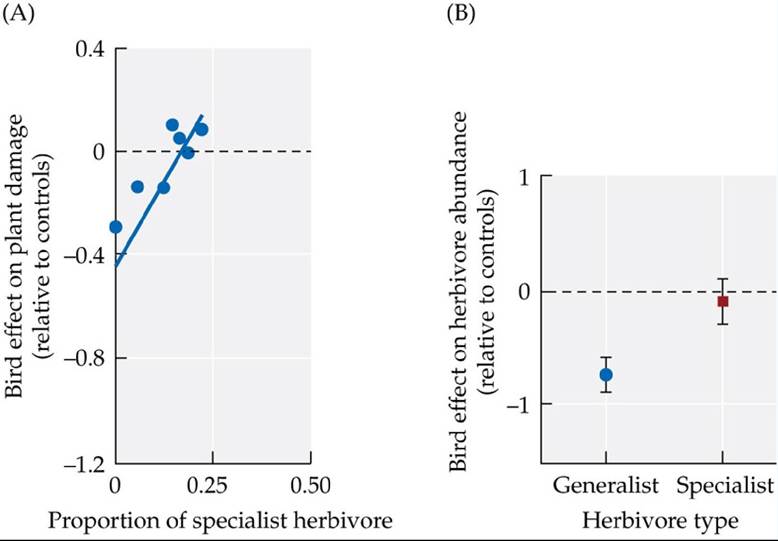
2. Michael Singer and colleagues investigated the influence of predatory birds on caterpillars and the subsequent effect on plant damage through herbivory in a deciduous forest ecosystem (Singer et al. 2014). They manipulated the presence and absence of birds (third trophic level) using exclosures, manipulated the proportion of specialist and generalist caterpillars (second trophic level), and measured abundances of the caterpillars and levels of damage to trees. FIGURE A shows the impact of bird predation on damage to the trees, expressed as relative to controls with no bird predation (zero point). Negative values indicate less
herbivore damage to trees as a result of the bird predation; positive values indicate more herbivore damage to trees as a result of bird predation. FIGURE B shows the effect of predation on abundance of herbivores according to whether they are generalists (G) or specialists (S). Error bars in Figure B show ± one SE of the mean.
a. How do these results support or refute the hypothesis you derived in Question 1?
b. What factors would have contributed to the observed result?
LIST OF KEY TERMS
allochthonous inputs assimilation efficiency autochthonous energy bioaccumulation biomagnification consumption efficiency food web omnivores production efficiency trophic cascade trophic efficiency trophic level
More on the topic SUMMARY:
- C. Summary
- Summary
- CONCLUSIONS
- Conclusion
- The disputes we have discussed in chapter 2 do not draw the lines youd initially expect.
- 3 Burning of crop residues
- UNIVERSAL SUCCESSION
- The validity of Muslim marriages
- The balance sheet is a remarkable invention, yet it has two fundamental shortcomings.
- Historical Perspectives