The rarest and the most rapidly declining species are priorities for protection
Many species have become rare as a result of anthropogenic threats we outlined earlier in this chapter. Other species may have always been rare. In either case, having a measure of how threatened a species is permits us to focus our efforts on those species that are most threatened: the rarest and the most rapidly declining.
We may be able to postpone attending to species that are naturally low in abundance but not particularly threatened.What do we mean by rarity, and how do we determine just how rare something is? To clarify the different concepts of rarity, we can use a matrix that sorts out whether a species has a wide or a narrow geographic range, whether it is broad or restricted in its habitat specificity, and whether its local populations tend to be small or large (FIGURE 23.18). There are some rare species, for example, that exist over a wide geographic area and are relatively broad in their habitat requirements, yet tend to occur in very small populations. Other rare species inhabit specific habitats within a narrow geographic range, but may have large populations in those specific locations (Rabinowitz et al. 1986). Conservation of these different types of rare species requires different approaches. Some species require small reserves to protect well-established populations; others require management practices that create habitat conditions suitable for a rare but geographically widespread species.
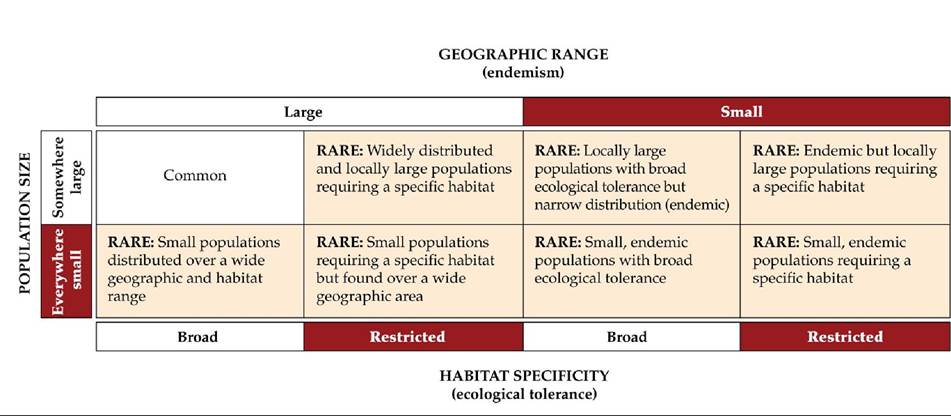
FIGURE 23.18 Seven Forms of Rarity Appropriate conservation measures for a rare species depend on the size of its geographic range, the sizes of its populations, and its habitat specificity. (After D. Rabinowitz. 1981. In The Biological Aspects of Rare Plant Conservation, H. Synge [Ed.], pp. 205-217. John Wiley & Sons Ltd: New York.) View larger image
An important scientific assessment of the conservation status of species began in 1963 with the establishment of the IUCN Red List (see Table 23.1).
A parallel effort was developed in the United States by The Nature Conservancy, which established the Natural Heritage Program (now NatureServe) in the early 1970s in order to assess the conservation status of U.S. species. Both organizations have developed a ranking structure that indicates how threatened a species is and an assessment protocol to determine its rank. The assessment protocol takes into account not only numbers of populations or individuals, but also the total geographic area the species occupies, the rate of its decline, and the threats it faces. Because of the challenge of creating a system that can be applied equally well to a skipper butterfly, a cycad, or a shark, and because the information available on rare species is often incomplete, both systems allow assessors to choose among different sets of criteria to decide whether a species is critically endangered, endangered, vulnerable, or under some lesser level of threat.Such assessments of conservation status can be used to locate clusters of threatened species and thus identify areas that are critical to protect (FIGURE 23.19). They are frequently consulted when development projects are planned, and they are important for keeping the public aware of the degree of threat faced by Earth's biota. These databases are dynamic in that they can change as scientific information is updated. The conservation status assigned to a species can be downgraded if its numbers increase or upgraded if its numbers decline.
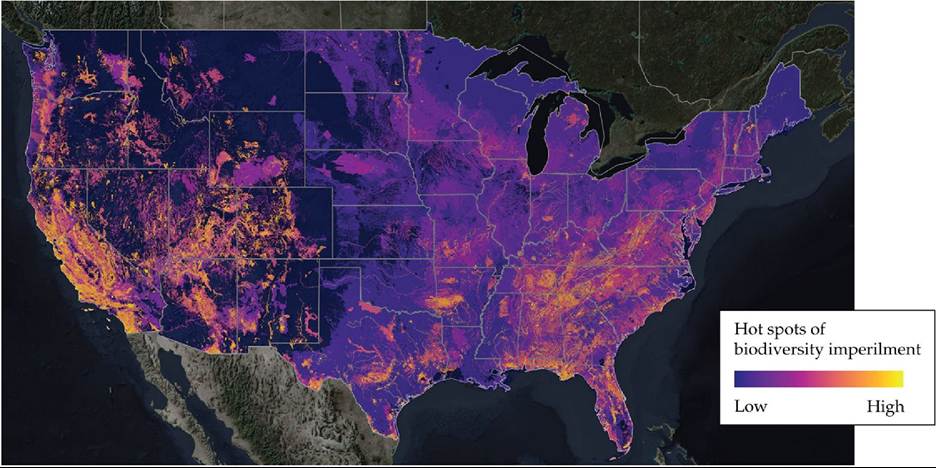
FIGURE 23.19 HotspotsofImperilment The compilation of NatureServe data on the location of imperiled species and their geographic ranges in the United States has permitted the identification of the critical areas to protect. California, Hawaii, the Florida Panhandle, and the southern Appalachian Mountains are “hot spots” of imperilment—they have high concentrations of imperiled species due to their high rates of endemism. (Copyright 2022, NatureServe and the NatureServe Network, 2550 South Clark Street, Suite 930, Arlington VA 22202, USA. All Rights Reserved) View larger image