The rate at which Earth is losing species is accelerating
How rapidly are species being lost? That is a difficult question to answer, in part because we do not know how many species exist that remain unknown to us. Most studies have estimated that there are about 5 million to 10 million eukaryotic species on Earth, but there may be as few as 3 million or as many as 50 million (Scheffers et al.
2012) or even more, particularly with greater consideration of microbial diversity (Locey and Lennon 2016).Despite this uncertainty, extinction rates can be estimated using several indirect measures (May et al. 1995; May 2011). For example, estimates of extinction rates from the fossil record can be used to establish a “background” extinction rate with which current rates can be compared. For the best-known taxonomic groups, the mammals and birds, paleontologists have estimated that the background extinction rate is around one extinction every 200 years, which is equivalent to an average species life span of 1 million to 10 million years. By contrast, there was about one extinction per year among the mammals and birds over the twentieth century, which is equivalent to an average species life span of only 10,000 years. Thus, overall, the rate of extinction in the twentieth century was 100 to 1,000 times higher than the background rate estimated from the fossil record (Jablonski 2005).
A second method for estimating extinction rates uses the species-area relationship discussed in Concept 18.3. In particular, the relationship between number of endemic species and area is used to estimate the number of species that would be driven to extinction by a given amount of habitat loss (Kinzig and Harte 2000). In a third approach, biologists have used changes over time in the assessed conservation statuses of species (e.g., a shift from endangered to critically endangered) to forecast rates of extinction (Smith et al.
1993). Finally, a fourth approach is based on the rates of population decline or range contraction of common species (Balmford et al. 2003). All of these methods have uncertainties affecting their estimates of extinction rates, yet they are the best ways we have to document losses of biodiversity.It can also be difficult to ascertain when a species is definitely extinct. Many species are known from a single specimen or location, and the logistics of relocating them can be daunting. Even an exhaustive hunt for a very rare species can fail to detect some remnant populations. Declaring a species extinct, however, has been known to stimulate biologists' search efforts, recently aided by the use of drones. Since the publication of a flora of Hawaiian plants in 1990, for example, 35 species listed there as extinct have been rediscovered, though only a few individuals have been found. The joy of their rediscovery is compromised by the realization that these extremely small populations cannot serve the same ecological functions as more substantial populations, and that 8% of Hawaii's native flora of 1,342 species is now considered extinct (Wagner et al. 1999).
Although humanity's growing ecological footprint (see Connections in Nature in Chapter 10) has accelerated the rates of biodiversity loss over the last century, people have had substantial effects on Earth's biota for millennia (see the Case Study in Chapter 3). David Steadman (1995) described how bones found on Pacific islands revealed the prehistoric extinction of up to 8,000 species of birds (of which perhaps 2,000 species were endemic flightless rails) after these islands were colonized by Polynesians. Most of these species were island endemics, and in some cases the extinctions encompassed entire ecological guilds (FIGURE 23.5). Ecologists can only speculate about the roles the lost frugivores and nectarivores played in maintaining endemic tree populations. Steadman's findings remind us that extinctions do not only eliminate individual species, but can also cause large changes in ecological communities.
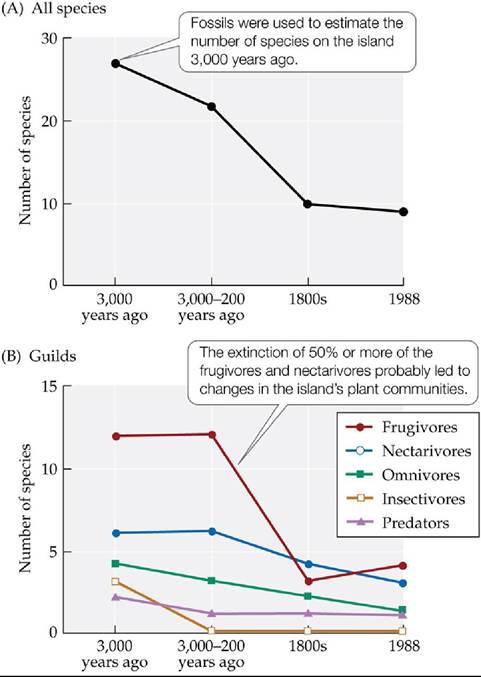
FIGURE 23.5 Humans Have Been Causing Extinctions for Millennia Trendsovertimein
(A) the total number of bird species and (B) the number of species classified by feeding guild found in the Pacific island ‘Eua in the nation of Tonga. Prehistoric extinctions (3,000-200 years ago) occurred on many Pacific islands as a result of hunting and the introduction of rats, dogs, and pigs.
Speculate on reasons why losses of birds that feed on fruit (frugivores) or nectar (nectarivores) may have affected the island's plant communities. (Hint: See the discussion of mutualism in Concepts 15.1 and 15.2.)
(After D. W. Steadman. 1995. Science 267: 1123-1131.) View larger image