Learning Objectives
23.2.1 Differentiate between the current anthropogenically enhanced rate of extinction and the long-term background extinction rate.
23.2.2 Describe the pathway to species extinction from changes in population growth to the disappearance of the species.
The tropical botanist Alwyn Gentry devoted his life to identifying, classifying, and mapping the immense diversity of plants found in Central and South America. He also became an eyewitness to plant species extinctions as the region underwent rapid deforestation. It was not uncommon for him to identify a new endemic plant species (i.e., a species that occurs in a particular geographic region and nowhere else) during an expedition to Ecuador or Peru, only to return to the same spot a few years later to find the forest cleared and the species gone (Dodson and Gentry 1991) (FIGURE 23.4). Gentry worked with a growing sense of urgency to identify rare species in order to protect them from this fate.
His death in a plane crash in the Ecuadorian forest in 1993, while doing an aerial survey of land proposed for conservation, cut this work short and was an enormous loss to conservation biology.
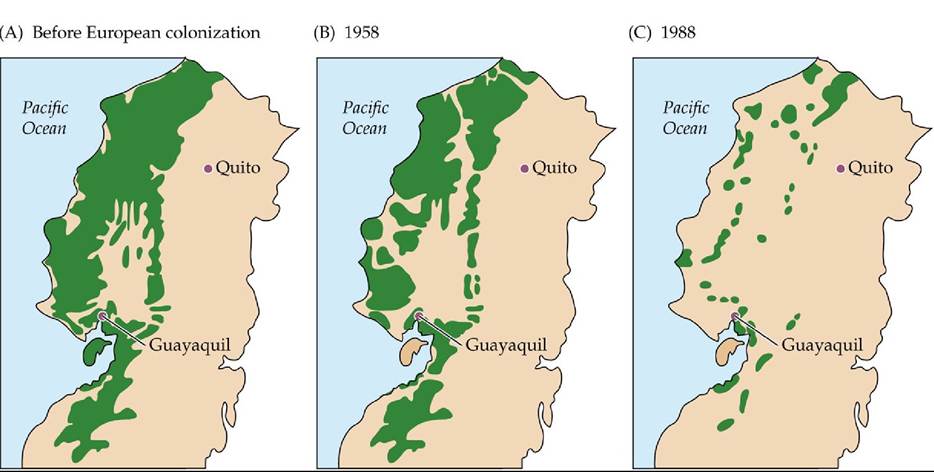
FIGURE 23.4 Loss of Forest Cover in Western Ecuador Between 1958 and 1988, a growing human population and government policies intended to stimulate economic development led to rapid deforestation in western Ecuador. Green indicates forest cover. The extensive loss of forest habitat in this region is estimated to have resulted in the loss of more than 1,000 endemic species. (After C. H. Dodson and A. H. Gentry. 1991. Ann Mo Bot Gard 78: 273-295. Permission granted by Missouri Botanical Garden Press, St. Louis.) View larger image
Gentry was just one of many taxonomists who have been finding and describing species while witnessing their rapid disappearance due to habitat destruction, disease, or climate change. Extinctions of barely known tropical species continue despite our decades-long recognition of the problem. Through greater efforts to explore Earth's ecosystems, ecologists are gaining knowledge of the world's biota and tabulating new species at a faster rate, but threats to those species are keeping pace with such gains in our knowledge about them.
More on the topic Learning Objectives:
- Learning Objectives
- Learning Objectives
- Learning Objectives
- Learning Objectives
- Learning Objectives
- Learning Objectives
- Learning Objectives
- Learning Objectives
- Learning Objectives
- Learning Objectives
- Learning Objectives
- Learning Objectives
- Learning Objectives