Extinction is the end point of incremental biological decline
In 1954, Andrewartha and Birch wrote that “there is no fundamental distinction to be made between the extinction of a local population and the extinction of a species other than this: that the species becomes extinct with the extinction of the last local population.” Sometimes the populations of a species gradually erode away, and sometimes they vanish in a spectacular collapse, as in the case of the passenger pigeon described earlier.
Conservation biologists have approached the process of biological decline and extinction in numerous ways. For example, as we saw in Concept 11.3, small populations are particularly vulnerable to genetic, demographic, and environmental stochasticity, each of which can reduce the population growth rate and increase the risk of local extinction as the population size declines further. Known as an extinction vortex, this pattern can doom a population to eventual extinction once its size drops below a certain point. With this in mind, Caughley (1994) argued that it is important to determine the causes of population declines in particular species, with the aim of identifying actions that could counteract these declines before the extinction vortex takes hold.
Ecologists may also study the declines of species using a spatial context by tracking changes in their geographic ranges. Ceballos and Ehrlich (2002) examined patterns of range contraction in 173 declining mammal species worldwide. They found that, collectively, these species had lost 68% of their range area over the past 100-200 years, with the greatest losses in Asia (83%). In a similar study, Channell and Lomolino (2000) examined patterns of range contraction in 309 declining species. They found that a decline often moves through the historical range of a species like a wave, from one end to the other; this could occur, for example, if an invasive species entered the range at one edge and then spread through the range, eliminating the declining species population by population.
Such a pattern contrasts with a retreat from all edges of the range into its center, which would probably occur if effects of small population size were prevailing.When populations are lost from an ecological community, there are consequences not only for the declining species, but also for its predators, prey, competitors, and mutualistic partners. The loss of bird pollinators, for example, can reduce the reproductive success of plants that depend on those pollinators (FIGURE 23.6), causing plant densities to drop as well (Anderson et al. 2011; Galetti et al. 2013). The resulting changes at the community level may bring about secondary extinctions and ultimately affect ecosystem processes. Examples from earlier chapters include the local extinctions and other changes caused by the loss or removal of such species as the amphipod crustacean Corophium volutator (see Concept 13.4), the marsh plant Juncus gerardii (see Concept 16.3), and the sea star Pisaster ochraceus (see Concept 21.4). Modeling results also suggest that while food webs can be resilient to species removal, the loss of certain species can trigger a cascade of secondary extinctions. As might be expected, the stronger the interactions of a species in the food web, the greater the effect of its removal (Sole and Montoya 2001). Overall, both empirical and modeling results demonstrate that incremental species loss can have broad ecological consequences.
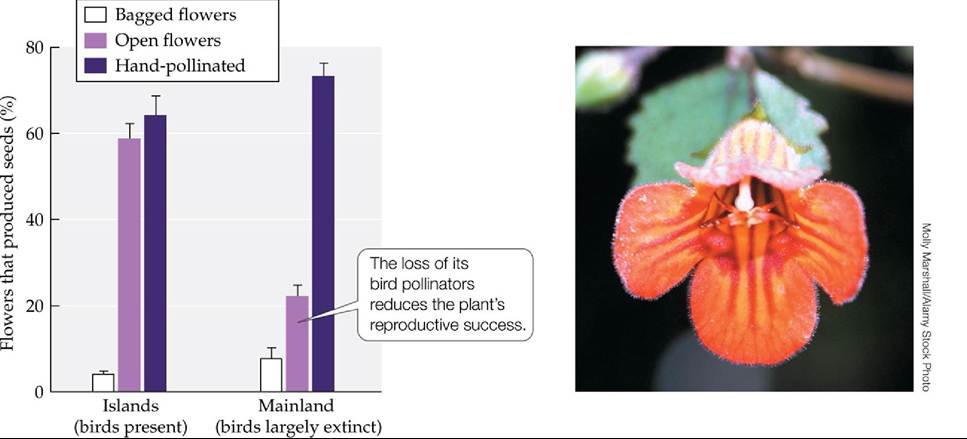
FIGURE 23.6 Loss of Bird Pollinators Reduces Reproductive Success in a New
Zealand Shrub Birds that pollinate the shrub Rhabdothamnus solandri are nearly extinct on the New Zealand mainland, but densities of these birds remain high on nearby islands. Researchers recorded the percentage of R. solandri flowers that reproduced successfully (produced seeds) on island and mainland sites for each of three treatments: bagged flowers (which allowed only selfpollination), open flowers (which allowed bird pollination), and open flowers that were hand- pollinated. Error bars show one SE of the mean.
Identify the control and experimental treatments in this study, and explain what can be learned from each of the three treatments.
(After S. H. Anderson et al. 2011. Science 331: 1068-1071.) View larger image
More on the topic Extinction is the end point of incremental biological decline:
- The goal in pediatric rehabilitation is not an end point as in the adult world. Rather, it is a process toward the continued development of ever-changing abilities and emotional, behavioral, and cognitive structures.
- Historians have traditionally regarded the Ottoman Empire's failed second siege of Vienna in 1683 as a turning point in the empire's long history, bringing to an end centuries of military success and expansion.
- Resource extinction and quasi-extinction in MacArthur’s model
- ‘uncontrolled expansion of libertarian ideology into lawyers’ common consciousness—to the point where lawyers have come to feel genuinely affronted and indignant when any authority tries to articulate a public obligation of lawyers that may end up putting them at odds with clients. We have no public obligations, they claim; we are private agents for private parties (though at the same time they claim privileges and immunities that ordinary citizens don’t have); our loyalties to clients must
- Causes of Extinction
- Parasites can drive host populations to extinction
- Extinction of Usufruct
- Extinction and colonization rates often vary among patches
- Decline in General
- Fluctuations in population size can increase the risk of extinction
- The diversity of life reflects both speciation and extinction rates
- Population Extinction