CONCLUSION
In this chapter we have discussed a variety of topics that lie in the somewhat fuzzy intersection of income distribution and macroeconomics. The choice of topics and approaches has surely been idiosyncratic, reflecting our tastes, interests, and expertise, and we have left out many topics from behavioral and nonoptimizing models to issues in development, to the analysis of the impact of the rise of inequality on the U.S.
economy. We have also touched other aspects only superficially, such as the role of globalization on the economy. In addition, we have only looked marginally at the implications of income inequality for consumption inequality or even for inequality in the duration of life,17 which is in the end what really matters to determine the welfare costs of inequality.We are very aware that a very different chapter covering the same could be written by other authors (in fact, the next chapter includes an example of this by providing some very different ideas of macro modeling of the wealth distribution). But we hope that this chapter has provided an idea of how macroeconomics is explicitly incorporating the analysis of inequality to improve our understanding of the dynamics of the aggregate economy, and also of how the discipline that macroeconomics brings to the table—that all pieces have to be mutually consistent and that dynamics is at the core of economics— shapes the way we think about income and wealth inequality.
ACKNOWLEDGMENTS
We are grateful for the comments from many people over the years. Many people contributed direct comments about and calculations for this paper. They include the editors for this handbook, but also Makoto Nakajima, Mariacristina De Nardi, Josep Pijoan-Mas, and Thomas Piketty. Others, such as David Wiczer and Moritz Kuhn, made even more direct contributions. We received research assistance from Kai Ding and Gero Dolfus, comments by Sergio Salgado and Annaliina Soikkanen, and editorial help from Joan Gieseke.
17
Pijoan-Mas and Rios-Rull (2014) argue that the welfare cost of inequality in life spans dwarfs that of inequality in consumption.
We thank all ofthem. Rios-Rull thanks the National Science Foundation forgrant SES-1156228. The views expressed herein are those of the authors and not necessarily those of the Federal Reserve Bank of Minneapolis or the Federal Reserve System.
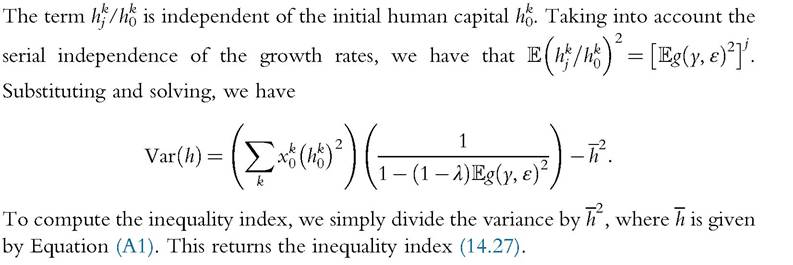
APPENDIX A. DERIVATION OF THE INEQUALITY INDEX
In each period, there are different cohorts of workers who have been employed for j periods. They also differ in terms of initial human capital h0 at birth. Because workers 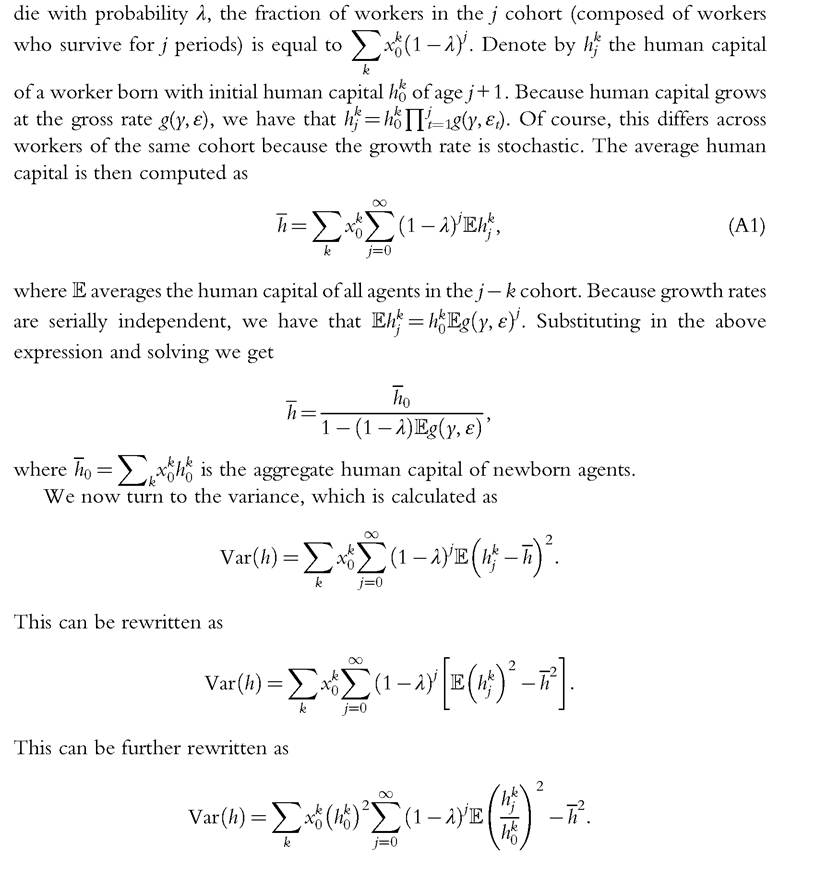
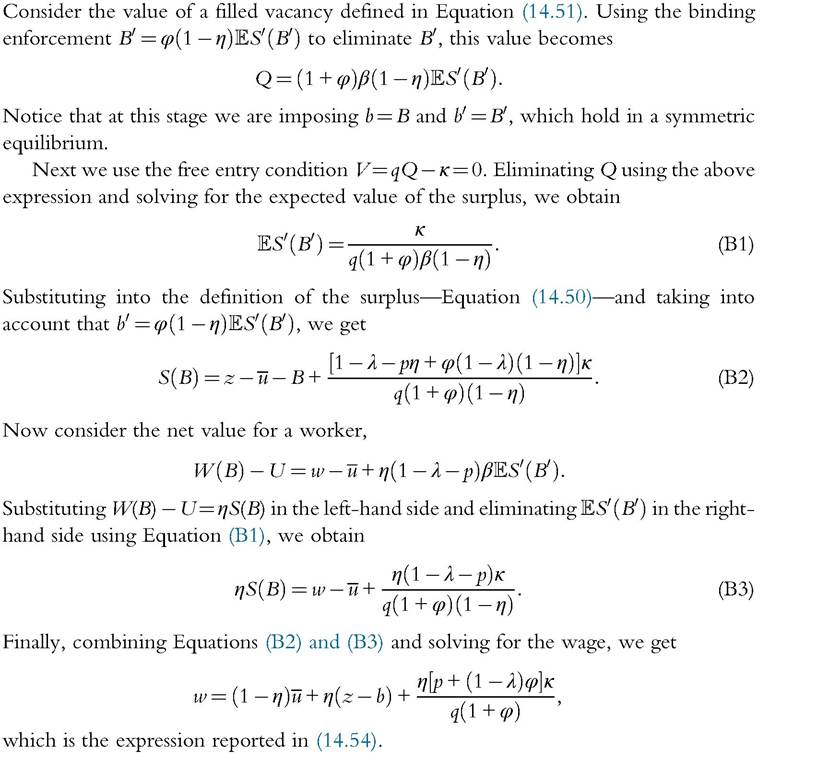
APPENDIX B. WAGE EQUATION WITH ENDOGENOUS DEBT
REFERENCES
Abowd, J.M., Card, D., 1987. Intertemporal labor supply and long-term employment contracts. Am. Econ. Rev. 77 (1), 50-68.
Acemoglu, D., 1998. Why do new technologies complement skills? Directed technical change and wage inequality. Q. J. Econ. 113 (4), 1055-1089.
Aghion, P., Bolton, P., 1997. A theory of trickle-down growth and development. Rev. Econ. Stud. 64 (2), 151-172.
Aguiar, M.A., Bils, M., 2011. Has consumption inequality mirrored income inequality? Working Paper 16807, National Bureau of Economic Research.
Aiyagari, S.R., 1994. Uninsured idiosyncratic risk and aggregate saving. Q. J. Econ. 109 (3), 659-684. Alesina, A., Rodrik, D., 1994. Distributive politics and economic growth. Q. J. Econ. 109 (2), 465-490. Alvaredo, F., 2011. A note on the relationship between top income shares and the Gini coefficient. Econ.
Lett. 110 (3), 274-277.
Angeletos, G.-M., 2007. Uninsured idiosyncratic investment risk and aggregate saving. Rev. Econ. Dyn. 10 (1), 1-30.
Atkinson, A.B., Piketty, T., Saez, E., 2011.
Top incomes in the long run ofhistory.J. Econ. Lit. 49 (1), 3-71.Attanasio, O., Battistin, E., Ichimura, H., 2004. What really happened to consumption inequality in the U.S.? Working Paper 10338, National Bureau of Economic Research.
Auerbach, A.J., Kotlikoff, L.J., 1987. Dynamic Fiscal Policy. Cambridge University Press, Cambridge.
Azzimonti, M., de Francisco, E., Quadrini, V., 2014. Financial globalization, inequality, and the rising public debt. Am. Econ. Rev. 104 (8), 2267-2302.
Bachmann, R., Bai, J.H., 2013. Politico-economic inequality and the comovement of government purchases. Rev. Econ. Dyn. 16 (4), 565-580.
Banerjee, A., Newman, A., 1993. Occupational choice and the process of development. J. Polit. Econ. 101 (2), 274-298.
Bell, B., Van Reenen, J., 2010. Bankers’ pay and extreme wage inequality in the UK. Economic Performance Special Papers CEPSP21, Centre for Economic Performance, London School of Economics and Political Science.
Benabou, R., Ok, E.A., 2001. Social mobility and the demand for redistribution: the Poum hypothesis. Q. J. Econ. 116 (2), 447-487.
Benhabib, J., Rustichini, A., 1996. Social conflict and growth. J. Econ. Growth 1 (1), 125-142.
Benhabib, J., Bisin, A., Zhu, S., 2011. The distribution of wealth and fiscal policy in economies with finitely lived agents. Econometrica 79 (1), 123-157.
Ben-Porath, Y., 1967. The production of human capital and the life cycle of earnings. J. Polit. Econ. 75 (4), 352-365.
Bernanke, B., Gertler, M., 1989. Agency costs, net worth, and business fluctuations. Am. Econ. Rev. 79 (1), 14-31.
Bernanke, B.S., Gertler, M., Gilchrist, S., 1999. The financial accelerator in a quantitative business-cycle framework. In: Taylor, J.B., Woodford, M. (Eds.), Handbook of Macroeconomics, vol. 1. Elsevier, Amsterdam, pp. 1341-1393 (Chapter 21).
Bertola, G., 2000. Macroeconomics of distribution and growth. In: Atkinson, A., Bourguignon, F. (Eds.), Handbook of Income Distribution, vol. 1.
Elsevier, Amsterdam, pp. 477-540 (Chapter 9).Bewley, T., 1977. The permanent income hypothesis: a theoretical formulation. J. Econ. Theory 16 (2), 252-292.
Blanchard, O.J., 1985. Debt, deficits, and finite horizons. J. Polit. Econ. 93 (2), 223-247.
Budria, S., Diaz-Gimenez, J., Quadrini, V., Rios-Rull, J.-V., 2001. New facts on the U.S. distribution of earnings, income and wealth. Unpublished Manuscript.
Buera, F.J., 2009. A dynamic model of entrepreneurship with borrowing constraints: theory and evidence. Ann. Finance 5 (3), 443-464.
Caballero, R.J., Farhi, E., Gourinchas, P.-O., 2008. An equilibrium model of “global imbalances” and low interest rates. Am. Econ. Rev. 98 (1), 358-393.
Cagetti, M., De Nardi, M., 2006. Entrepreneurship, frictions, and wealth. J. Polit. Econ. 114 (5), 835-869.
Cagetti, M., De Nardi, M., 2009. Estate taxation, entrepreneurship, and wealth. Am. Econ. Rev. 99 (1), 85-111.
Carlstrom, C.T., Fuerst, T.S., 1995. Interest rate rules vs. money growth rules: a welfare comparison in a cash-in-advance economy. J. Monet. Econ. 36 (2), 247-267.
Carrillo-Tudela, C., Visschers, L., 2013. Unemployment and endogenous reallocation over the business cycle. IZA Discussion Paper 7124, Institute for the Study of Labor (IZA).
Carroll, C.D., 1997. Buffer-stock saving and the life-cycle/permanent income hypothesis. Q. J. Econ. 112 (1), 1-55.
Caselli, F., 1999. Technological revolutions. Am. Econ. Rev. 89 (1), 78-102.
Caselli, F., Ventura, J., 2000. A representative consumer theory of distribution. Am. Econ. Rev. 90 (4), 909-926.
Castaheda, A., Diaz-Gimenez, J., Rios-Rull, J.-V., 1998. Exploring the income distribution business-cycle dynamics. J. Monet. Econ. 42 (1), 93-130.
Castaheda, A., Diaz-Gimenez, J., Rios-Rull, J.-V., 2003. Accounting for the U.S. earnings and wealth inequality. J. Polit. Econ. 111 (4), 818-857.
Chatterjee, S., 1994. Transitional dynamics and the distribution of wealth in a neoclassical growth model.
J. Public Econ. 54 (1), 97-119.Chatterjee, S., Corbae, D., Rios-Rull, J.-V., 2004. A Competitive Theory of Credit Scoring. University of Pennsylvania, CAERP.
Chatterjee, S., Corbae, D., Nakajima, M., Rios-Rull, J.-V., 2007. A quantitative theory of unsecured consumer credit with risk of default. Econometrica 75 (6), 1525-1589.
Chatterjee, S., Corbae, D., Rios-Rull, J.-V., 2008. A finite-life private-information theory of unsecured consumer debt. J. Econ. Theory 142 (1), 149-177.
Cooley, T., Marimon, R., Quadrini, V., 2012. Risky investments with limited commitment. Working Paper 19594, National Bureau of Economic Research.
Corbae, D., D’Erasmo, P., Kuruscu, B., 2009. Politico-economic consequences of rising wage inequality. J. Monet. Econ. 56 (1), 43-61.
Costain, J.S., Reiter, M., 2008. Business cycles, unemployment insurance, and the calibration of matching models. J. Econ. Dyn. Control. 32 (4), 1120-1155.
Cummins, J.G., Violante, G.L., 2002. Investment-specific technical change in the United States (1947-2000): measurement and macroeconomic consequences. Rev. Econ. Dyn. 5 (2), 243-284.
De Nardi, M., 2004. Wealth inequality and intergenerational links. Rev. Econ. Stud. 71 (3), 743-768.
DeBacker, J., Heim, B., Panousi, V., Vidangos, I., 2011. Rising inequality: transitory or permanent? New evidence from a panel of U.S. household income 1987-2006. Finance and Economics Discussion Series 2011-60, Board of Governors of the Federal Reserve System (U.S.).
Diaz, A., Pijoan-Mas, J., Rios-Rull, J.-V., 2003. Precautionary savings and wealth distribution under habit formation preferences. J. Monet. Econ. 50 (6), 1257-1291.
Diaz-Gimenez,J., Pijoan-Mas, J.,2011. Flat tax reforms: investment expensing and progressivity. Discussion Paper No. 8238, Centre for Economic Policy Research.
Diaz-Gimenez, J., Glover, A., Rios-Rull, J.-V., 2011. Facts on the distributions of earnings, income, and wealth in the United States: 2007 update. Q. Rev. (Federal Reserve Bank of Minneapolis) 34 (1), 2-31.
Duras, J., 2013. Amplification of Shocks in a Model with Labor and Goods Market Search. University of Minnesota.
Fernandez-Villaverde, J., Krueger, D., 2011. Consumption and saving over the life cycle: how important are consumer durables? Macroecon. Dyn. 15 (5), 725-770.
Gabaix, X., Landier, A., 2008. Why has CEO pay increased so much? Q. J. Econ. 123 (1), 49-100.
Galor, O., Moav, O., 2000. Ability-biased technological transition, wage inequality, and economic growth. Q. J. Econ. 115 (2), 469-497.
Galor, O., Zeira, J., 1993. Income distribution and macroeconomics. Rev. Econ. Stud. 60 (1), 6035-6052.
Garicano, L., Rossi-Hansberg, E., 2004. Inequality and the organization of knowledge. Am. Econ. Rev. 94 (2), 197-202.
Gertler, M., Trigari, A., 2009. Unemployment fluctuations with staggered Nash wage bargaining. J. Polit. Econ. 117 (1), 38-86.
Glomm, G., Ravikumar, B., 1992. Public versus private investment in human capital: endogenous growth and income inequality. J. Polit. Econ. 100 (4), 818—834.
Glover, A., Heathcote,J., Krueger, D., Rιos-Rull,J.-V., 2011. Inter-generationalredistributioninthe Great Recession. Working Paper 16924, National Bureau of Economic Research.
Goldin, C., Katz, L.F., 2009. The Race Between Education and Technology. Belknap Press, Cambridge, MA.
Gordon, R.J., 1990. The measurement of durable goods prices. National Bureau of Economic Research Monograph Series, University of Chicago Press, Chicago, IL.
Gourinchas, P.-O., Parker, J.A., 2002. Consumption over the life cycle. Econometrica 70 (1), 47—89.
Greenwood,J.,Jovanovic, B., 1990. Financial development, growth, andthe distribution ofincome.J. Polit. Econ. 98 (5), 1076-1107.
Greenwood, J., Jovanovic, B., 1999. The information-technology revolution and the stock market. Am. Econ. Rev. Pap. Proc. 89 (2), 116-122.
Greenwood, J., Yorukoglu, M., 1997. Carnegie-Rochester conference series on public policy. J. Monet. Econ. 46 (2), 49-95.
Greenwood, J., Sanchez, J.M., Wang, C., 2010. Financing development: the role of information costs. Am. Econ. Rev. 100 (4), 1875-1891.
Guvenen, F., 2009. An empirical investigation of labor income processes. Rev. Econ. Dyn. 12 (1), 58-79.
Guvenen, F., Kurusςu, B., 2010. A quantitative analysis of the evolution of the U.S. wage distribution, 1970-2000. In: Acemoglu, D., Rogoff, K., Woodford, M. (Eds.), NBER Macroeconomics Annual, vol. 24, pp. 227-276.
Guvenen, F., Kurusςu, B., 2012. Understanding the evolution of the U.S. wage distribution: a theoretical analysis. J. Eur. Econ. Assoc. 10 (3), 489-517.
Guvenen, F., Kurusςu, B., Ozkan, S., 2009. Taxation ofhuman capital andwage inequality: a cross-country analysis. Federal Reserve Bank of Minneapolis, Research Department Staff Report 438.
Guvenen, F., Ozkan, S., Song, J., 2012. The nature of countercyclical income risk. Working Paper 18035, National Bureau of Economic Research.
Hagedorn, M., Manovskii, I., 2008. The cyclical behavior of equilibrium unemployment and vacancies revisited. Am. Econ. Rev. 98 (4), 1692-1706.
Hansen, G.D., Imrohoroglu, S., 2008. Consumption over the life cycle: the role of annuities. Rev. Econ. Dyn. 11 (3), 566-583.
Heaton, J., Lucas, D.J., 1996. Evaluating the effects of incomplete markets on risk sharing and asset pricing. J. Polit. Econ. 104 (3), 443-487.
Heckman, J., Lochner, L., Taber, C., 1998. Explaining rising wage inequality: explorations with a dynamic general equilibrium model of labor earnings with heterogeneous agents. Rev. Econ. Dyn. 1 (1), 1-58.
Hobijn, B., Jovanovic, B., 2001. The information-technology revolution and the stock market: evidence. Am. Econ. Rev. 91 (5), 1203-1220.
Hornstein, A., Krusell, P., Violante, G., 2011. Frictional wage dispersion in search models: a quantitative assessment. Am. Econ. Rev. 101 (7), 2873-2898.
Huggett, M., 1993. The risk-free rate in heterogeneous-agent, incomplete-insurance economies. J. Econ. Dyn. Control. 17 (5), 953-969.
Huggett, M., 1996. Wealth distribution in life-cycle economies. J. Monet. Econ. 38 (3), 469-494.
Huggett, M., Ventura, G., Yaron, A., 2011. Sources of lifetime inequality. Am. Econ. Rev. 101 (7), 2923-2954.
Imrohoroglu, A., 1989. Cost of business cycles with indivisibilities and liquidity constraints. J. Polit. Econ. 97 (6), 1364-1383.
Kambourov, G., Manovskii, I., 2009a. Occupational mobility and wage inequality. Rev. Econ. Stud. 76 (2), 731-759.
Kambourov, G., Manovskii, I., 2009b. Occupational specificity of human capital. Int. Econ. Rev. 50 (1), 63-115.
Karabarbounis, L., Neiman, B., 2014. The global decline of the labor share. Q. J. Econ. 129 (1), 61-103. Katz, L.F., Murphy, K.M., 1992. Changes in relative wages, 1963-1987: supply and demand factors. Q. J. Econ. 107 (1), 35-78.
Kehoe, T., Levine, D., 1993. Debt-constrained asset markets. Rev. Econ. Stud. 60 (4), 865—888. Kiyotaki, N., Moore, J., 1997. Credit cycles. J. Polit. Econ. 105 (2), 211-248.
Krueger, D., Kubler, F., 2006. Pareto-improving social security reform when financial markets are incomplete!? Am. Econ. Rev. 96 (3), 737-755.
Krueger, D., Perri, F., 2006. Does income inequality lead to consumption inequality? Evidence and theory. Rev. Econ. Stud. 73 (1), 163-193.
Krueger, D., Perri, F., Pistaferri, L., Violante, G.L., 2010. Cross-sectional facts for macroeconomists. Rev. Econ. Dyn. 13 (1), 1-14.
Krusell, P., Rios-Rull,J.-V., 1996. Vestedinterests inapositive theory ofstagnation andgrowth. Rev. Econ. Stud. 63 (215), 301-331.
Krusell, P., SmithJr., A.A., 1998. Income and wealth heterogeneity in the macroeconomy. J. Polit. Econ. 106 (5), 867-896.
Krusell, P., Quadrini, V., Rios-Rull, J.-V., 1997. Politico-economic equilibrium and economic growth. J. Econ. Dyn. Control. 21 (1), 243-272.
Krusell, P., Ohanian, L.E., Rios-Rull, J.-V., Violante, G.L., 2000. Capital-skill complementarity and inequality: a macroeconomic analysis. Econometrica 68 (5), 1029-1054.
Kuhn, M., 2014. Trends in income and wealth inequality. University of Bonn, Working Paper.
Kumhof, M., Ranciere, R., 2010. Inequality, leverage and crises. IMF Working Paper WP/10/268.
Livshits, I., MacGee, J., Tertilt, M., 2007. Consumer bankruptcy: a fresh start. Am. Econ. Rev. 97 (1), 402-418.
Manuelli, R.E., Seshadri, A., 2010. Human capital and the wealth of nations. Unpublished Manuscript, University of Wisconsin-Madison.
Meh, C.A., Quadrini, V., 2006. Endogenous market incompleteness with investment risks. J. Econ. Dyn. Control 30 (11), 2143-2165.
Meltzer, A.H., Richard, S.F., 1981. A rational theory of the size of government. J. Polit. Econ. 89 (5), 914-927.
Mendoza, E.G., Quadrini, V., Rios-Rull, J.-V., 2007. Financial integration, financial deepness and global imbalances. Working Paper 12909, National Bureau of Economic Research.
Milgrom, P., Roberts, J., 1990. The economics of modern manufacturing: technology, strategy, and organization. Am. Econ. Rev. 80 (3), 511-528.
Modigliani, F., Miller, M.H., 1958. The cost of capital, corporate finance and the theory of investment. Am. Econ. Rev. 48 (3), 261-279.
Monacelli, T., Quadrini, V., Trigari, A., 2011. Financial markets and unemployment. Working Paper 17389, National Bureau of Economic Research.
Murphy, K.M., Shleifer, A., Vishny, R., 1989. Income distribution, market size, and industrialization. Q. J. Econ. 104 (3), 537-564.
Papageorgiou, T., 2009. Learning your comparative advantages. 2009 Meeting Papers 1150, Society for Economic Dynamics.
Persson, T., Tabellini, G., 1994. Is inequality harmful for growth? Am. Econ. Rev. 84 (3), 600-621.
Pijoan-Mas, J., Rios-Rull, J.-V., 2014. The Welfare Cost of Inequality in Life Expectancies. University of Minnesota.
Piketty, T., 1995. Social mobility and redistributive politics. Q. J. Econ. 110 (3), 551-584.
Piketty, T., 2014. Capital in the Twenty-First Century. Harvard University Press, Cambridge, MA. ISBN 9780674369559.
Piketty, T., Saez, E., 2003. Income inequality in the United States, 1913-1998. Q. J. Econ. 118 (1), 1-39. Longer updated version published in: Atkinson, A.B., Piketty, T. (Eds.), Top Incomes over the Twentieth Century: A Contrast between European and English-Speaking Countries. Oxford University Press, Oxford, 2007.
Pissarides, C.A., 1987. Search, wage bargains and cycles. Rev. Econ. Stud. 54 (3), 473-483.
Pissarides, C.A., 1990. Equilibrium Unemployment Theory. Basil Blackwell, Oxford.
Quadrini, V., 1999. Growth, learning and redistributive policies. J. Public Econ. 74 (2), 263-297.
Quadrini, V., 2000. Entrepreneurship, saving, and social mobility. Rev. Econ. Dyn. 3 (1), 1-40. Quadrini, V., 2011. Financial frictions in macroeconomic fluctuations. Econ. Q. 97 (3Q), 209-254.
Rios-Rull, J.-V., 1994. On the quantitative importance of market completeness. J. Monet. Econ. 34 (3), 463-496.
Rios-Rull, J.-V., 1996. Life-cycle economies and aggregate fluctuations. Rev. Econ. Stud. 63 (3), 465-489.
Rios-Rull, J.-V., Santaeulalia-Llopis, R., 2010. Redistributive shocks and productivity shocks. J. Monet. Econ. 57 (8), 931-948.
Rosen, S., 1981. The economics of superstars. Am. Econ. Rev. 71 (5), 845-858.
Saez, E., Zucman, G., 2014. The distribution of US wealth, capital income and returns since 1913. Unpublished Manuscript, University of California, Berkeley.
Shimer, R., 2005. The cyclical behavior of equilibrium unemployment and vacancies. Am. Econ. Rev. 95 (1), 25-49.
Solow, R., 1987. We'd Better Watch Out. New York Times Book Review, p. 36, July.
Stiglitz, J.E., 1969. Distribution of income and wealth among individuals. Econometrica 37 (3), 382-397.
Storesletten, K., Telmer, C.I., Yaron, A., 2001. How important are idiosyncratic shocks? Evidence from labor supply. Am. Econ. Rev. Pap. Proc. 91 (2), 413-417.
Terajima, Y., 2006. Education and self-employment: changes in earnings and wealth inequality. Bank of Canada Working Paper 2006-40.
Townsend, R.M., 1979. Optimal contracts and competitive markets with costly state verification. J. Econ. Theory 21 (2), 265-293.
von Weizsacker, R.K., 1993. A Theory of Earnings Distribution. Cambridge University Press, Cambridge.
Wiczer, D., 2013. Long-term unemployment: attached andmismatched? UnpublishedManuscript, University of Minnesota.
Yaari, M.E., 1965. Uncertain lifetime, life insurance and the theory of the consumer. Rev. Econ. Stud. 32 (2), 137-150.
Yamaguchi, S., 2012. Tasks and heterogeneous human capital. J. Labor Econ. 30 (1), 1-53.
More on the topic CONCLUSION:
- Conclusion
- Conclusion
- Conclusion
- Conclusion
- Hare C., Neo D. (eds.). Trade Finance: Technology, Innovation and Documentary Credit. Oxford University Press,2021. — 417 p., 2021
- Contents
- Contents
- Contents
- Fligstein Neil. The Banks Did It: An Anatomy of the Financial Crisis. Harvard University Press,2021. — 334 p., 2021
- FIVE COMPONENTS OF LEGAL COMPETENCIES