CONCLUSIONS
On reaching the end of a lengthy and technical chapter, the authors should confess to an uneasy feeling: A proportion of our potential readership might not have the stamina to work their way through every equation and every footnote.
So, we would like to offer time-poor readers three things that may capture the essence of this chapter’s contribution:• A summary of lessons learned that we hope will be useful for practitioners and for other researchers;
• A little worked example that includes an application of many of the tools that we have discussed;
• A quick-reference table of the main formulas that should be useful to data providers as well as to the users of data.
6.7.1 Important Lessons: A Round-Up
Density Estimation, Parametric (Section 6.3.1)
(1) The Generalized Beta distribution encompasses all the standard parametric forms for income distribution. (2) A “good” goodness-of-fit criterion is important: Do use the Anderson-Darling statistic, the Cramer-von Mises statistic, or the Cowell et al. (2014) measure; do not use the J2 statistic
Density Estimation, Semi- and Nonparametric (Sections 6.3.2-6.3.4)
Standard kernel-density methods are very sensitive to the choice of the bandwidth. If the concentration of the data is markedly heterogeneous in the sample then the standard approach (the Silverman rule-of-thumb) is known to often oversmooth in parts of the distribution where the data are dense and undersmooth where the data are sparse, although in other cases it works well. However, this standard approach may not be suitable for income distributions, which are typically heavy-tailed: here the use of the adaptive kernel method or mixture model may be more appropriate.
Welfare Measures (Section 6.4)
(1)We propose a global approach to the derivation of variance expressions for all inequality measures.
The method uses the IF (see Section 6.4.2.1) to provide a shortcut to the formulas we need. (2) It is necessary to analyze the tails (plot of Hill estimators) and use appropriate methods with heavy-tailed distributions (see Section 6.4.5.3).Distributional Comparisons (Section 6.5)
(1) As with the welfare measures, we propose an approach to the variance and covariance formulas that again makes use of the IF. (2) A plot of Lorenz curve differences can provide useful information, even where Lorenz curves cross.
Data Problems (Section 6.6)
(1) Careful modeling is essential to understanding what can be done in the case of possible data contamination or incomplete data; again the IF is a valuable tool. (2) If one tries to “patch” an empirical distribution with a parametric model for the upper tail, then special attention needs to be given to the way the parameters of the model are to be estimated.
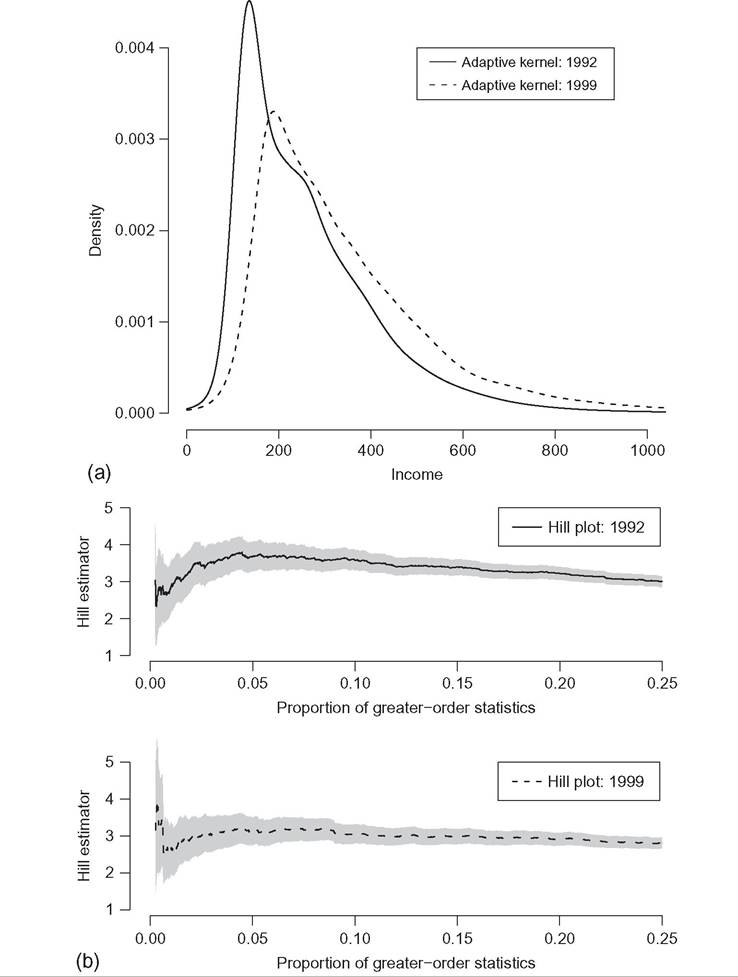
Figure 6.19 Inequality analysis on household income in 1992 and 1999 in United Kingdom: (a) Adaptive kernel density estimation, (b) Hill estimator of the tail index (Hill plots),
(Continued)
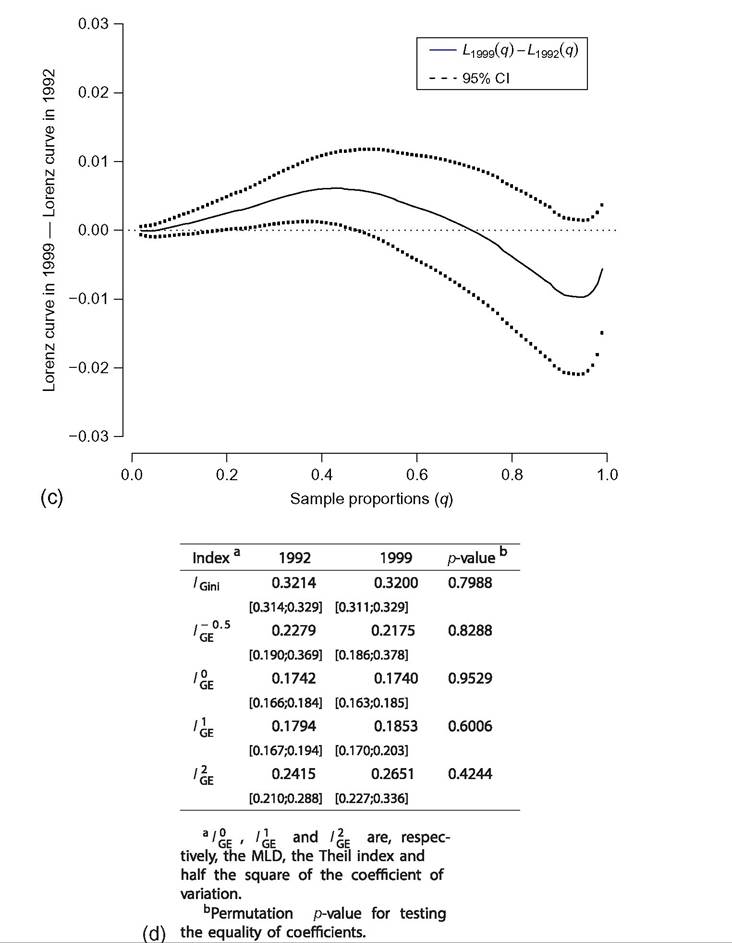
Figure 6.19—Cont'd (c) Difference of Lorenz curves, and (d) Inequality measures, with bootstrap confidence intervals and permutation p-values for testing equality.
6.7.2 A Worked Example
To illustrate these lessons, let us consider an empirical analysis of inequality measurement on the income distribution in the United Kingdom in 1992 and 1999.1
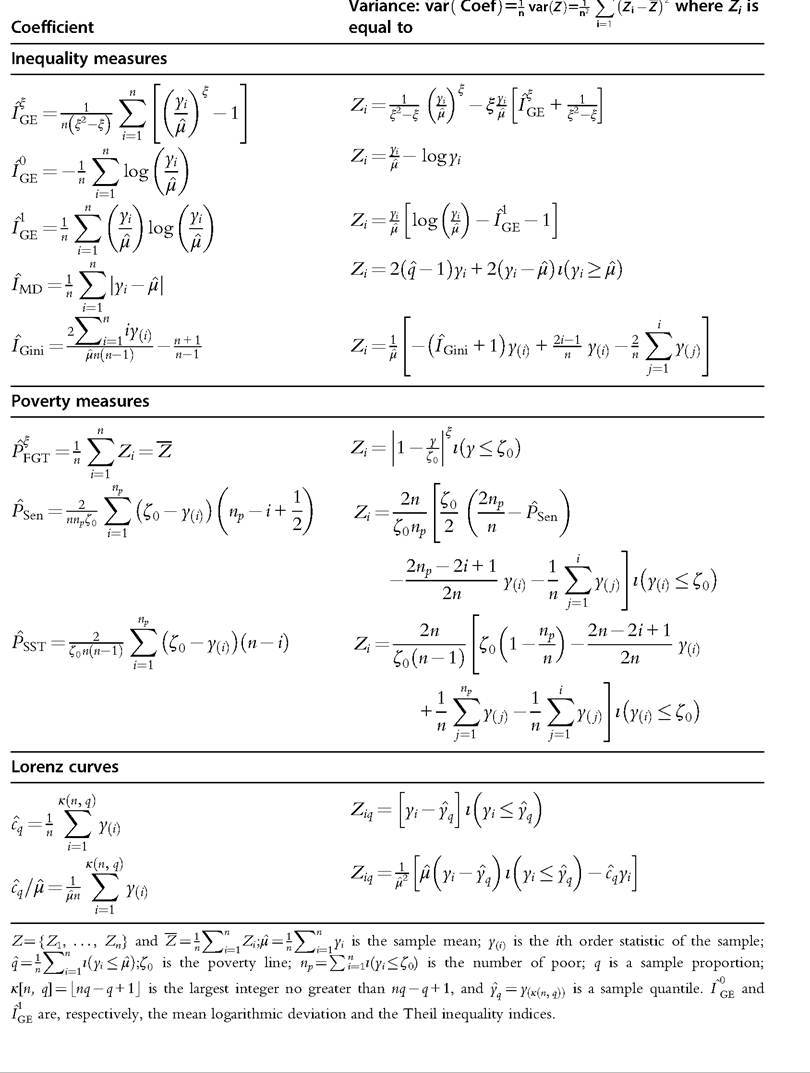
1. As noted in Section 6.7.1, income distributions are usually very skewed and heavy tailed, so fixed-bandwidth kernel density estimation, selected by Silverman’s rule- of-thumb, may not be ideal (see Section 6.3.2). Figure 6.19a shows the application of one of the recommended methods, adaptive kernel density estimation (where the bandwidth varies with the degree of concentration of the data) of income distributions in 1992 and 1999.[208] [209] [210] The distribution in 1999 has a smaller mode and is shifted to the right, compared to 1992. 2. Statistical inference on inequality measures may be unreliable, in particular when the underlying distribution is quite heavy-tailed (see Sections 6.4.5.3 and 6.4.5.4). A Hill plot is a useful tool for studying the tail behavior in empirical studies: It represents the Hill estimator of the tail parameter, against the number of k-greatest order statistics used to compute it. An estimate of the tail parameter can be selected when the plot becomes stable about a horizontal straight line. Figure 6.19b shows Hill plots of income distribution in 1992 and 1999, over the range of 0.25% and 25% of order statistics used to compute it, with 95% confidence intervals (in gray). In 1992, the Hill estimate appears to be slightly more than 3, whereas it is very close to 3 in 1999. It suggests that the distribution in 1999 is slightly more heavy tailed than those in 1992, both being quite heavy tailed.1 3. Strong results on inequality ranking can be drawn from the comparison of RLCs, if the curves do not intersect (see Section 6.5). However, in empirical studies intersecting RLCs are not unusual, and we find that this is the case in our example, with the difference between the two Lorenz curves plotted in Figure 6.19c. The Lorenz curve for 1999 is above that for 1992 at the bottom of the distribution; the situation is reversed at the top of the distribution. It suggests that inequality measures more sensitive to transfers in the top (bottom) of the distribution would be larger (smaller) in 1999 than in 1992. However, the 95% confidence intervals shows that, at each point, Lorenz curve differences are not clearly statistically significant, and, thus inequality measures may not be statistically different in 1992 and 1999. Table 6.13 Formulas for computing coefficient estimates and variances for inequality measures, poverty measures, and (general or relative) Lorenz curve ordinates 4. 6.7.3 A Cribsheet Finally, we offer something for those who are really short of time or patience. In this chapter, we have proposed a unified approach for computing variances and covariances for many inequality and poverty measures, as well as Lorenz curve ordinates. This unified approach involves some quite simple—or at least not very complicated—formulas. Table 6.13 provides a one-page summary of the key formulas for the principal statistical tasks in distributional analysis. Acknowledgments We thank Russell Davidson, StephenJenkins, Michel Lubrano, Andre-Marie Taptue, and the editors, Tony Atkinson and Francois Bourguignon, for helpful comments. Flachaire would like to thank McGill University and CIRANO for their hospitality and the Institut Universitaire de France and the Aix-Marseille School of Economics for financial support. REFERENCES Ahamada, I., Flachaire, E., 2010. Non-Parametric Econometrics. Oxford University Press, Oxford. Aitchison, J., Brown, J.A.C., 1957. The Lognormal Distribution. Cambridge University Press, London. Alvaredo, F., Saez, E., 2009. Income and wealth concentration in Spain from a historical and fiscal perspective. J. Eur. Econ. Assoc. 7 (5), 1140-1167. Anderson, G., 1996. Nonparametric tests of stochastic dominance in income distributions. Econometrica 64, 1183-1193. Atkinson, A.B., 1970. On the measurement of inequality. J. Econ. Theory 2, 244-263. Atkinson, A.B., 1987. On the measurement of poverty. Econometrica 55, 749-764. Autor, D.H., Katz, L.F., Kearney, M., 2008. Trends in U.S. wage inquality: revising the revisionists. Rev. Econ. Stat. 90 (2), 300-323. Bandourian, R., McDonald, J.B., Turley, R.S., 2003. A comparison of parametric models of income distribution across countries and over time. Estadistica 55, 135—152. Bantilan, M.C.S., Bernal, N.B., de Castro, M.M., Pattugalan, J.M., 1995. Income distribution in the Philippines, 1957-1988: an application of the Dagum model to the family income and expenditure survey (FIES) data. In: Dagum, C., Lemmi, A. (Eds.), Income Distribution, SocialWelfare, Inequality and Poverty. In: Research on Economic Inequality 6, JAI Press, Greenwich, pp. 11—43. Barrett, G.F., Donald, S.G., 2003. Consistent tests for stochastic dominance. Econometrica 71, 71—104. Barrett, G.F., Donald, S.G., 2009. Statistical inference with generalized Gini indices of inequality, poverty, and welfare. J. Bus. Econ. Stat. 27, 1—17. Beach, C.M., Davidson, R., 1983. Distribution-free statistical inference with Lorenz curves and income shares. Rev. Econ. Stud. 50, 723—735. Beach, C.M., Kaliski, S.F., 1986. Lorenz curve inference with sample weights: an application to the distribution of unemployment experience. Appl. Stat. 35 (1), 38—45. Beach, C.M., Richmond, J., 1985. Joint confidence intervals for income shares and Lorenz curves. Beran, R., 1988. Prepivoting test statistics: a bootstrap view of asymptotic refinements. J. Am. Stat. Assoc. 83, 687-697. Berger, Y.G., Skinner, CJ., 2003. Variance estimation for alow income proportion. J. R. Stat. Soc.: Ser. C: Appl. Stat. 52 (4), 457-468. Berndt, E.R., 1990. The Practice of Econometrics: Classic and Contemporary. Reading, Mass: Addison Wesley. Bhattacharya, D., 2007. Inference on inequality from household survey data. J. Econ. 137, 674-707. Biewen, M., Jenkins, S.P., 2006. Variance estimation for generalized entropy and atkinson inequality indices: the complex survey data case. Oxf. Bull. Econ. Stat. 68, 371-383. Binder, D.A., Kovacevic, M.S., 1995. Estimating some measures of income inequality from survey data: an application of the estimating equations approach. Survey Methodol. 21 (2), 137-145. Bishop, J.A., Chakraborti, S., Thistle, P.D., 1988. Large sample tests for absolute Lorenz dominance. Econ. Lett. 26, 291-294. Bishop, J.A., Formby, J.P., Thistle, P.D., 1989. Statistical inference, income distributions and social welfare. In: Slottje, D.J. (Ed.), Research on Economic Inequality I. Connecticut: JAI Press, pp. 49-82. Bishop, J.A., Formby, J.P., Smith, W.J., 1991a. International comparisons of income inequality: tests for Lorenz dominance across nine countries. Economica 58, 461-477. Bishop, J.A., Formby, J.P., Smith, WJ., 1991b. Lorenz dominance and welfare: changes in the U.S. distribution of income, 1967-1986. Rev. Econ. Stat. 73, 134-139. Bishop, J.A., Formby, J.P., Thistle, P., 1992. Convergence of the south and non-south income distributions, 1969-1979. Am. Econ. Rev. 82, 262-272. Bishop, J.A., Formby, J.B., Zheng, B., 1997. Statistical inference and the Sen index of poverty. Int. Econ. Rev. 38, 381-387. Boos, D.D., Serfling, R.J., 1980. A note on differential and the CLT and LIL for statistical functions, with application to m-estimates. Ann. Stat. 8, 618-624. Bordley, R.F., McDonald, J.B., Mantrala, A., 1997. Something new, something old: parametric models for the size distribution of income. J. Income Distrib. 6, 91-103. Bourguignon, F., Morrisson, C., 2002. Inequality among world citizens: 1820-1992. Am. Econ. Rev. 92, 727-744. Bowman, A., 1984. An alternative method of cross-validation for the smoothing of kernel density estimates. Biometrika 71, 353-360. Brachmann, K., Stich, A., Trede, M., 1996. Evaluating parametric income distribution models. Allg. Stat. Arch. 80, 285-298. Burkhauser, R.V., Crews Cutts, A.D., Daly, M.C., Jenkins, S.P., 1999. Testing the significance of income distribution changes over the 1980s businesscycle: a cross-national comparison. J. Appl. Econ. 14, 253-272. Burkhauser, R.V., Feng, S., Jenkins, S.P., 2009. Using the p90∕p10 index to measure U.S. inequality trends with Current Population Survey data: a view from inside the Census Bureau vaults. Rev. Income Wealth 55 (1), 166-185. Burkhauser, R.V., Feng, S., Larrimore, J., 2010. Improving imputations of top incomes in the public-use current population survey by using both cell-means and variances. Econ. Lett. 108 (1), 69—72. Butler, RJ.,McDonald,J.B., 1989. Usingincomplete moments to measure inequality.J. Econ. 42, 109—119. Chen, W., Duclos, J., 2008. Testing for Poverty Dominance: An Application to Canada, Discussion Paper 3829, IZA. Chernozhukov, V., Fernandez-Val, I., Melly, B., 2009. Inference on CounterfactualDistributions, Working Paper. Chesher, A., Schluter, C., 2002. Measurement error and inequality measurement. Rev. Econ. Stud. 69, 357-378. Chotikapanich, D., Griffiths, W., 2008. Estimating income distributions using a mixture ofgamma densities. In: Chotikapanich, D. (Ed.), Modelling Income Distributions and Lorenz Curves. Springer, NewYork, pp. 285-302, Chapter 16. Chow, G.C., 1960. Tests of equality between sets of coefficients in two linear regressions. Econometrica 28, 591-605. Chung, E., Romano, J.P., 2013. Exact and asymptotically robust permutation tests. Ann. Stat. 41,484-507. Cowell, F.A., 1989. Sampling variance and decomposable inequality measures. J. Econ. 42, 27-41. Cowell, F.A., 1991. Grouping bounds for inequality measures under alternative informational assumptions. J. Econ. 48, 1-14. Cowell, F.A., 1999. Estimation of inequality indices. In: Silber, J. (Ed.), Handbook on Income Inequality Measurement. Dewenter/Kluwer, Norwell, MA, pp. 269-290. Cowell, F.A., 2000. Measurement of inequality. In: Atkinson, A.B., Bourguignon, F. (Eds.), Handbook of Income Distribution. Elsevier Science B. V., New York, pp. 87-166, Chapter 2. Cowell, F.A., 2011. Measuring Inequality, third ed. Oxford University Press, Oxford. Cowell, F.A., 2013. UK wealth inequality in international context. In: Hills, J.R. (Ed.), Wealth in the UK. Oxford University Press, Oxford, pp. 35-62. Chapter 3. Cowell, F.A., Fiorio, C., 2011. Inequality decompositions—a reconciliation. J. Econ. Inequal. 9 (99), 509-528. Cowell, F.A., Flachaire, E., 2007. Income distribution and inequality measurement: the problem of extreme values. J. Econ. 141, 1044-1072. Cowell, F.A., Jenkins, S.P., 2003. Estimating welfare indices: household sample design. Res. Econ. Inequal. 9, 147-172. Cowell, F.A., Victoria-Feser, M.-P., 1996a. Poverty measurement with contaminated data: a robust approach. Eur. Econ. Rev. 40, 1761-1771. Cowell, F.A., Victoria-Feser, M.-P., 1996b. Robustness properties of inequality measures. Econometrica 64, 77-101. Cowell, F.A., Victoria-Feser, M.-P., 2002. Welfare rankings in the presence of contaminated data. Econometrica 70, 1221-1233. Cowell, F.A., Victoria-Feser, M.-P., 2003. Distribution-free inference for welfare indices under complete and incomplete information. J. Econ. Inequal. 1, 191-219. Cowell, F.A., Victoria-Feser, M.-P., 2006. Distributional dominance with trimmed data. J. Bus. Econ. Stat. 24, 291-300. Cowell, F.A., Victoria-Feser, M.-P., 2007. Robust stochastic dominance: a semi-parametric approach. J. Econ. Inequal. 5, 21-37. Cowell, F.A., Jenkins, S.P., Litchfied, J.A., 1996. The changing shape of the UK income distribution: Kernel density estimates. In: Hills, J.R. (Ed.), New Inequalities: The Changing Distribution of Income and Wealth in the United Kingdom. Cambridge University Press, Cambridge, pp. 49-75, Chapter 3. Cowell, F.A., Davidson, R., Flachaire, E., 2014. Goodness of Fit: an Axiomatic approach. J. Bus. Econ. Stat. forthcoming. Cowell, F.A., Flachaire, E., Bandyopadhyay, S., 2013. Reference distributions and inequality measurement. J. Econ. Inequal. 11, 421-437. Dagsvik, J., Jia, Z., Vatne, B.H., Zhu, W., 2013. Is the Pareto-Levy law a good representation of income distributions? Empir. Econ. 44, 719-737. Dagum, C., 1977. A new model of personal income distribution: specification and estimation. Econ. Appl. 30, 413-436. Dagum, C., 1980. The generation and distribution of income, the Lorenz curve and the Gini ratio. Econ. Appl. 33, 327-367. Dagum, C., 1983. Income distribution models. In: Banks, D.L., Read, C.B., Kotz, S. (Eds.), Encyclopedia of Statistical Sciences, vol. 4. Chichester, Wiley, New York, pp. 27-34. Dalton, H., 1920. Measurement of the inequality of incomes. Econ. J. 30, 348-361. Daly, M.C., Crews, A.D., Burkhauser, R.V., 1997. A new look at the distributional effects of economic growth during the 1980s: a comparative study of the United States and Germany. Econ. Rev. 2, 18-31. Dardanoni, V., Forcina, A., 1999. Inference for Lorenz curve orderings. Econ. J. 2, 49-75. Davidson, R., 2008. Stochastic dominance. In: Durlauf, S.N., Blume, L.E. (Eds.), The New Palgrave Dictionary of Economics. second ed, vol. 7. Palgrave Macmillan, Basingstoke, pp. 921-925. Davidson, R., 2009a. Reliable inference for the Gini index. J. Econ. 150 (1), 30-40. Davidson, R., 2009b. Testing for restricted stochastic dominance: some further results. Rev. Econ. Anal. I, 34-59. Davidson, R., 2010. Innis lecture: inference on income distributions. Can. J. Econ. 43, 1122-1148. Davidson, R., 2012. Statistical inference in the presence of heavy tails. Econom. J. 15, C31-C53. Davidson, R., Duclos, J.-Y., 1997. Statistical inference for the measurement of the incidence of taxes andtransfers. Econometrica 65, 1453-1466. Davidson, R., Duclos, J.-Y., 2000. Statistical inference for stochastic dominance and for the measurement of poverty and inequality. Econometrica 68, 1435-1464. Davidson, R., Duclos, J.-Y., 2013. Testing for restricted stochastic dominance. Econ. Rev. 32, 84-125. Davidson, R., Flachaire, E., 2007. Asymptotic and bootstrap inference for inequality and poverty measures. J. Econ. 141, 141-166. Davidson, R., MacKinnon, J.G., 2000. Bootstrap tests: how many bootstraps? Econ. Rev. 19, 55-68. Davison, A.C., Hinkley, D.V., 1997. Bootstrap Methods. Cambridge University Press, Cambridge. Deaton, A.S., 1997. The Analysis of Household Surveys. Johns Hopkins Press for the World Bank, Baltimore, Maryland. Dempster, A.P., Laird, N.M., Rubin, D.B., 1977. Maximum likelihood from incomplete data via EM algorithm (with discussion). J. R. Stat. Soc. B 39, 1-38. Deville, J.-C., 1999. Variance estimation for complex statistics and estimators: linearization and residual techniques. Surv. Methodol. 25, 193-203. DiNardo, J., Fortin, N.M., Lemieux, T., 1996. Labor market institutions and the distribution of wages, 1973-1992: a semiparametric approach. Econometrica 64, 1001-1044. Donald, S. G. and G. F. Barrett (2004). Consistent nonparametric tests for Lorenz dominance. Econometric Society 2004 Australasian Meetings 321, Econometric Society. Donald, S.G., Green, D.A., Paarsch, H.J., 2000. Differences in wage distributions between Canada and the United States: an application ofaflexible estimator of distribution functions in the presence ofcovariates. Rev. Econ. Stud. 67, 609-633. Donald, S.G., Hsu, Y.-C., Barrett, G.F., 2012. Incorporating covariates in the measurement of welfare and inequality: methods and applications. Econom. J. 15, C1-C30. Dufour, J.-M., 2006. Monte Carlo tests with nuisance parameters: a general approach to finite-sample inference and nonstandard asymptotics in econometrics. J. Econ. 133, 443-477. Dufour, J.-M., Flachaire, E., Khalaf, L., 2013. Permutation tests for comparing inequality measures with heavy-tailed distributions. Technical report. In: Paper Presented at the 53th Conference of the Societe Canadienne de Science ISconomique in Quebec. Dupuis, D.J., Victoria-Feser, M.-P., 2006. A robust prediction error criterion for Pareto modeling of upper tails. Can. J. Stat. 34 (4), 639-658. To appear. Dwass, M., 1957. Modified randomization tests for nonparametric hypotheses. Ann. Math. Stat. 28, 181-187. Efron, B., 1982. TheJackknife, the Bootstrap and Other Resampling Plans, vol. 38. Society for Industrial and Applied Mathematics, Philadelphia. Epanechnikov, V.A., 1969. Nonparametric estimation of a multidimensional probability density. Theory Probab. Appl. 14, 153-158. Escobar, M.D., West, M., 1995. Bayesian density estimation and inference using mixtures. J. Am. Stat. Assoc. 90, 577-588. Fan, J., Yim, T.H., 2004. A cross-validation method for estimating conditional densities. Biometrika 91, 819-834. Ferguson, T.S., 1983. Bayesian density estimation by mixtures of normal distributions. In: Rizvi, M.H., Rustagi, J., Siegmund, D. (Eds.), Recent Advances in Statistics: Papers in Honor of Herman Chernoff on His Sixtieth Birthday. Academic Press, New York, pp. 287-302. Fernholz, L.T., 1983. Von Mises Calculus for Statistical Functionals. Lecture Notes in Statistics,19 Springer, New York. Fishburn, P.C., 1980. Stochastic dominance and moments of distributions. Math. Oper. Res. 5, 94-100. Fishburn, P.C., Lavalle, I.H., 1995. Stochastic dominance on unidimensional grids. Math. Oper. Res. 20, 513-525. Fisher, R., 1935. The Design of Experiments. Oliver & Boyd, London. Flachaire, E., Nuriez, O., 2007. Estimation of income distribution and detection of subpopulations: an explanatory model. Comput. Stat. Data Anal. 51, 3368-3380. Foster, J.E., Shorrocks, A.F., 1988. Poverty orderings. Econometrica 56 (1), 173-177. Foster, J.E., Greer, J., Thorbecke, E., 1984. A class of decomposable poverty measures. Econometrica 52, 761-776. Friihwirth-Schnatter, S., 2006. Finite Mixture and Markov Switching Models. Springer, New York. Gastwirth, J.L., 1971. A general definition of the Lorenz curve. Econometrica 39, 1037-1039. Gastwirth, J.L., 1972. The estimation of the Lorenz curve and Gini index. Rev. Econ. Stat. 54, 306-316. Gastwirth, J.L., 1974. Large-sample theory of some measures of inequality. Econometrica 42, 191-196. Gastwirth, J.L., 1975. The estimation of a family of measures of economic inequality. J. Econ. 3, 61-70. Gastwirth, J.L., Nayak, T.K., Krieger, A.N., 1986. Large sample theory for the bounds on the Gini and related indices from grouped data. J. Bus. Econ. Stat. 4, 269-273. Ghosal, S., van der Vaart, A.W., 2001. Entropies and rates of convergence for maximum likelihood and bayes estimation for mixtures of normal densities. Ann. Stat. 29 (5), 1233-1263. Gibrat, R., 1931. Les Inegalites Economiques. Sirey, Paris. Giles, D.E.A., 2004. A convenient method of computing the Gini index and its standard error. Oxf. Bull. Econ. Stat. 66, 425-433. Gleser, L.J., 1973. On a theory of intersection-union tests. Inst. Math. Stat. Bull. 2, 2330. Good, P., 2000. Permutation Tests: A Practical Guide to Resampling Methods for Testing Hypotheses, second ed. Springer Series in Statistics. Springer, Heidelberg. Guerrero, V.M., 1987. A note on the estimation of Atkinson’s index of inequality. Econ. Lett. 25, 379-384. Hadar, J., Russell, W.R., 1969. Rules for ordering uncertain prospects. Am. Econ. Rev. 79, 25-34. Hajargasht, P., Griffiths, W.E., Brice, J., Rao, D.S.P., Chotikapanich, D., 2012. Inference for income distributions using grouped data. J. Bus. Econ. Stat. 30, 563-575. Hall, P., Racine, J., Li, Q., 2004. Cross-validation and the estimation of conditional probability densities. J. Am. Stat. Assoc. 99, 1015-1026. Hampel, F.R., 1971. A general qualitative definition of robustness. Ann. Math. Stat. 42, 1887-1896. Hampel, F.R., 1974. The influence curve and its role in robust estimation. J. Am. Stat. Assoc. 69, 383-393. Hampel, F.R., Ronchetti, E.M., Rousseeuw, P.J., Stahel, W.A., 1986. Robust Statistics: The Approach Based on Influence Functions. John Wiley, New York. Hasegawa, H., Kozumi, H., 2003. Estimation of Lorenz curves: a Bayesian nonparametric approach. J. Econ. 115, 277-291. Howes, S.R., Lanjouw, J.O., 1998. Poverty comparisons and household survey design. Rev. Income Wealth 44, 99-108. Huber, P.J., 1981. Robust Statistics. John Wiley, New York. Jenkins, S.P., 1995. Did the middle class shrink during the 1980s? UK evidence from kernel density estimates. Econ. Lett. 49, 407-413. Jenkins, S.P., 2009. Distributionally-Sensitive inequality indices and the GB2 income distribution. Rev. Income Wealth 55, 392—398. Jenkins, S.P., Lambert, P.J., 1997. Three ‘I’s of poverty curves, with an analysis of UK poverty trends. Oxf. Econ. Pap. 49, 317-327. Jenkins, S.P., Van Kerm, P., 2005. Accounting for income distribution trends: a density function decomposition approach. J. Econ. Inequal. 3, 43-61. Jenkins, S.P., Burkhauser, R.V., Feng, S., Larrimore, J., 2011. Measuring inequality using censored data: a multiple imputation approach. J. R. Stat. Soc. Ser. A 174 (866), 63-81. Johnson, N.L., Kotz, S., Balakrishnan, N., 1994. Continuous Univariate Distributions, second ed. John Wiley Series in Probability and Mathematical Statistics, vol. 1. John Wiley, New York. Kakwani, N., 1993. Statistical inference in the measurement of poverty. Rev. Econ. Stat. 75, 632-639. Kaur, A., Prakasa Rao, B.L.S., Singh, H., 1994. Testing for second order stochastic dominance of two distributions. Econ. Theory 10, 849-866. Kleiber, C., Kotz, S., 2003. Statistical Size Distributions in Economics and Actuarial Sciences. John Wiley, Hoboken, NJ. Kovacevic, M.S., Binder, D.A., 1997. Variance estimation for measures of income inequality and polarization. J. Off. Stat. 13, 41-58. Langel, M., Tille, Y., 2013. Variance estimation of the Gini index: revisiting a result several times published. J. R. Stat. Soc. A 176, 521-540. Lemieux, T., 2006. Increasing residual wage inequality: composition effects, noisy data, or rising demand for skill? Am. Econ. Rev. 96, 461-498. Li, J., Racine, J.S., 2006. Nonparametric Econometrics. Princeton University Press, Princeton, NJ. Linton, O., Maasoumi, E., Whang, Y.-J., 2005. Consistent testing for stochastic dominance under general sampling schemes. Rev. Econ. Stud. 72, 735-765. Lubrano, M., Ndoye, A.A.J., 2011. Inequality Decomposition Using the Gibbs Output of a Mixture of Lognormal Distributions, Working paper, Greqam 2011-19. Maasoumi, E., Heshmati, A., 2008. Evaluating dominance ranking of PSID incomes by various household attributes. In: Betti, G., Lemmi, A. (Eds.), Advances on Income Inequality and Concentration Measures. Routledge Frontiers of Political Economy. Oxon, New York, pp. 47-69 (Chapter 4). Majumder, A., Chakravarty, S.R., 1990. Distribution ofpersonal income: development of a new model and its application to U.S. income data. J. Appl. Econ. 5, 189-196. Mandelbrot, B., 1960. The Pareto-Levy law and the distribution of income. Int. Econ. Rev. 1 (2), 79-106. Marron, J.S., Schmitz, H.P., 1992. Simultaneous density estimation of several income distributions. Econ. Theory 8, 476-488. Marron, J.S., Wand, M.P., 1992. Exact mean integrated squared error. Ann. Stat. 20, 712-736. McDonald, J.B., 1984. Some generalized functions for the size distribution of income. Econometrica 52, 647-664. McDonald, J.B., Xu, Y.J., 1995. A generalization of the beta distribution with applications. J. Econ. 66, 133-152. McFadden, D., 1989. Testing for stochastic dominance. In: Fomby, T.B., Seo, T.K. (Eds.), Studies in the Economics of Uncertainty. Springer-Verlag, New York, pp. 113-134. McLachlan, G.J., Peel, D., 2000. Finite Mixture Models. Wiley, New York. Mills, J.A., Zandvakili, S., 1997. Statistical inference via bootstrapping for measures of inequality. J. Appl. Econ. 12, 133-150. Modarres, R., Gastwirth, J.L., 2006. A cautionary note on estimating the standard error of the Gini index of inequality. Oxf. Bull. Econ. Stat. 68, 385-390. Monti, A.C., 1991. The study of the Gini concentration ratio by means of the influence function. Statistica 51, 561-577. Nygard, F., Sandstrom, A., 1985. Estimating Gini and entropy inequalityparameters.J. Off. Stat. 1,399-412. O’Brien, G.L., 1984. Stochastic dominance and moment inequalities. Math. Oper. Res. 9, 475-477. O’Brien, G.L., Scarsini, M., 1991. Multivariate stochastic dominance and moments. Math. Oper. Res. 16, 382-389. Ogwang, T., 2000. A convenient method of computing the Gini index and its standard error. Oxf. Bull. Econ. Stat. 62, 123—129. Osberg, L., Xu, K., 2000. International comparisons of poverty intensity: index decomposition and bootstrap inference. J. Hum. Resour. 35, 51—81, Errata. Journal of Human Resources, 35(3), inside front cover page, 2000. Paap, R., Van Dijk, H.K., 1998. Distribution and mobility of wealth of nations. Eur. Econ. Rev. 42, 1269-1293. Pareto, V., 1895. La legge della domanda. G. Econ. Ann. Econ. 10, 59-68. Paul, S., 1999. The population sub-group income effects on inequality: analytical framework and an empirical illustration. Econ. Rec. 75 (229), 149-155. Pen, J., 1974. Income Distribution, second ed. Allen Lane, The Penguin Press, London, pp. 48-59, Chapter 3. Pittau, M.G., Zelli, R., 2004. Testing for changes in the shape of income distribution: Italian evidence in the 1990s from kernel density estimates. Empir. Econ. 29, 415-430. Pittau, M.G., Zelli, R., 2006. Empirical evidence of income dynamics across EU regions. J. Appl. Econ. 21, 605-628. Pittau, M.G., Zelli, R., Johnson, P.A., 2010. Mixture models, convergence clubs and polarization. Rev. Income Wealth 56, 102-122. Polivka, A.E., 1998. UsingEarnings Data for the Current Population Survey after the Redesign. Working Paper 306, US Bureau of Labour Statistics, Washington, DC. Quah, D.T., 1997. Empirics for growth and distribution: stratification, polarization, and convergence clubs. J. Econ. Growth 2, 27-59. Quirk, J.D., Saposnik, R., 1962. Admissibility and measurable utility functions. Rev. Econ. Stud. 29, 140-146. Rao, C.R., 1973. Linear Statistical Inference and Its Applications, second ed. John Wiley, New York. Ray, S., Lindsay, B.G., 2005. The topography of multivariate normal mixtures. Ann. Stat. 33, 2042-2065. Reeds, J.A., 1976. On the Definition of von Mises Functionals: Research Report S 44. Department of Statistics, Harvard University, Cambridge, MA. Resnick, S.I., 1997. Heavy tail modeling and teletraffic data. Ann. Stat. 25, 1805-1849. Resnick, S.I., 2007. Heavy-Tail Phenomena: Probabilistic and Statistical Modeling. Springer Series in Operations Research and Financial Engineering. Springer, New York. Robert, C.P., Casella, G., 2005. Monte Carlo Statistical Methods. Springer, New York. Rothe, C., 2010. Nonparametric estimation of distributional policy effects. J. Econ. 155, 56-70. Roy, S.N., 1953. On a heuristic method of test construction and its use in multivariate analysis. Ann. Math. Stat. 24, 220-238. Rudemo, M., 1982. Empirical choice of histograms and kernel density estimators. Scand. J. Stat. 9, 65-78. Ruppert, D., Sheather, S.J., Wand, M.P., 1995. An effective bandwidth selector for local least squares regression. J. Am. Stat. Assoc. 90, 1257-1269. Sala-i-Martin, X., 2006. Theworlddistribution ofincome: fallingpovertyand... convergence, period. Q.J. Econ. 121, 351-397. Salem, A.B.Z., Mount, T.D., 1974. A convenient descriptive model of income distribution: the Gamma density. Econometrica 42, 1115-1127. Sandstrom, A., Wretman, J.H., Walden, B., 1988. Variance estimators of the Gini coefficient: probability sampling. J. Bus. Econ. Stat. 6, 113-120. Sarabia, J.M., 2008. Parametric Lorenz curves: models and applications. In: Chotikapanich, D. (Ed.), Modeling Income Distributions and Lorenz Curves. Springer, New York, pp. 167-190, Chapter 9. Schechtman, A., 1991. On estimating the asymptotic variance of a function of U statistics. Am. Stat. 45, 103-106. Schluter, C., 2012. On the problem of inference for inequality measures for heavy-tailed distributions. Econom. J. 15, 125-153. Schluter, C., Trede, M., 2002. Tails of Lorenz curves. J. Econ. 109, 151-166. Schluter, C., van Garderen, K., 2009. Edgeworth expansions and normalizing transforms for inequality measures. J. Econ. 150, 16-29. Schmid, F., Trede, M., 1996. Testing for first-order stochastic dominance: a new distribution-free test. Statistician 45, 371—380. Scott, D.W., 1992. Multivariate Density Estimation: Theory, Practice, and Visualization. John Wiley & Sons, New York. Sen, A.K., 1976. Poverty: an ordinal approach to measurement. Econometrica 44, 219—231. Sheather, S.J., Jones, M.C., 1991. A reliable data-based bandwidth selection method for kernel density estimation. J. R. Stat. Soc. 53, 683—690. Shorrocks, A.F., 1983. Ranking income distributions. Economica 50, 3—17. Shorrocks, A.F., 1995. Revisiting the Sen poverty index. Econometrica 63, 1225—1230. Silverman, B.W., 1986. Density Estimation for Statistics and Data Analysis. Chapman and Hall, London. Singh, S.K., Maddala, G.S., 1976.A function for the size distribution ofincome. Econometrica 44, 963—970. Stacy, E.W., 1962. A generalization of the gamma distribution. Ann. Math. Stat. 33, 1187—1192. Stark, O., Yitzhaki, S., 1988. Mergingpopulations, stochastic dominance andlorenz curves. J. Popul. Econ. I, 157-161. Stephens, M.A., 1986. Tests based on EDF statistics. In: d’Agostino, R.B., Stephens, M.A. (Eds.), Goodness- of-Fit Techniques. Marcel Dekker, New York, pp. 97-193. Stone, M., 1974. Cross-validatory choice and assessment of statistical predictions (with discussion). J. R. Stat. Soc. B 36, 111-147. Summers, R., Heston, A.W., 1991. The Penn world table (mark 5): an expanded set of international comparisons 1950-1988. Q. J. Econ. 106, 327-368. Tachibanaki, T., Suruga, T., Atoda, N., 1997. Estimations of income distribution parameters for individual observations by maximum likelihood method. J. Japan Stat. Soc. 27, 191-203. Thistle, P.D., 1989. Ranking distributions with generalized Lorenz curves. South. Econ. J. 56, 1-12. Thuysbaert, B., 2008. Inference for the measurement of poverty in the presence of a stochastic weighting variable. J. Econ. Inequal. 6, 33-55. Titterington, D.M., Makov, U.E., Smith, A.F.M., 1985. Statistical Analysis of Finite Mixture Distributions. Wiley, New York. Verma, V., Betti, G., 2011. Taylor linearization sampling errors and design effects for poverty measures and other complex statistics. J. Appl. Stat. 38, 1549-1576. Victoria-Feser, M.-P., 1995. Robust methods for personal income distribution models with application to Dagum’s model. In: Dagum, C., Lemmi, A. (Eds.), Income Distribution, Social Welfare, Inequality and Poverty. In: Research on Economic Inequality, 6, JAI Press, Greenwich, pp 225-239. Victoria-Feser, M.-P., 2000. Robust methods for the analysis of income distribution, inequality and poverty. Int. Stat. Rev. 68, 277-293. Victoria-Feser, M.-P., Ronchetti, E., 1994. Robust methods for personal income distribution models. Can. J. Stat. 22, 247-258. Victoria-Feser, M.-P., Ronchetti, E., 1997. Robust estimation for grouped data. J. Am. Stat. Assoc. 92, 333-340. Xu, K., Osberg, L., 1998. A distribution-free test for deprivation dominance. Econom. Rev. 17 (4), 415-429. Xu, K., Osberg, L., 2002. The social welfare implications, decomposability, and geometry of the Sen family of poverty indices. Can. J. Econ. 35, 138-152. Yitzhaki, S., Schechtman, E., 2013. The Gini Methodology: A Statistical Primer. Springer Series in Statistics, Springer, New York. Young, A., 2011. The Gini Coefficient for a Mixture of Lognormal Population. Working Paper. Zheng, B., 1999. Statistical inferences for testing marginal rank and (generalized) Lorenz dominances. South. Econ. J. 65, 557-570. Zheng, B., 2001. Statistical inference for poverty measures with relative poverty lines. J. Econ. 101, 337-356. Zheng, B., 2002. Testing Lorenz curves with non-simple random samples. Econometrica 70, 1235-1243. Zheng, B., Cushing, B.J., 2001. Statistical inference for testing inequality indices with dependent samples. J. Econ. 101, 315-335.
More on the topic CONCLUSIONS:
- Conclusions
- Conclusions
- Conclusions
- Conclusion
- Conclusion
- CONCLUSION
- CONCLUSION
- Conclusion
- CONCLUSION
- Conclusion