DISENTANGLING BUSINESS STRATEGY FROM THE BUSINESS MODEL CONCEPT
Since its emergence, the business model concept has gained significant momentum in the domains of Internet economy and information systems (Al-Debei and Avison, 2010), strategic management (Zott et al., 2011) and innovation and technology management (Teece, 2010).
Many works of scholars and business practitioners alike aim at defining the concept and integrating it within the extant literature. The question of how to relate the business model concept to business strategy and business process modeling has attracted considerable attention in particular. A business model typically provides answers to the following questions (Morris et al., 2005):• Offering factors: how to create value?
• Market factors: who to create value for?
• Internal capability factors: what is the source of competence?
• Competitive strategy factors: how to position ourselves?
• Economic factors: how to make money?
• PersonalZinvestor factors: what are the time, scope, and size ambitions?
Accordingly, Osterwalder and Pigneur (2009, p. 14) state that ‘a business model describes the rationale of how an organization creates, delivers and captures value’. Based on this definition they developed a framework known as the business model canvas (Al-Debei, 2010 provides an overview of other definitions). This framework consists of nine elements covering the four key components: customer, offer, infrastructure, and finance (Figure 17.1).
As depicted in Figure 17.1, customers are attracted through a company’s value proposition; that is, how a company’s products or services create value for customers and satisfy their needs (e.g., cheap flights offered by no-frills airlines). The value proposition is conveyed to the customer through communication and distribution channels (e.g., booking
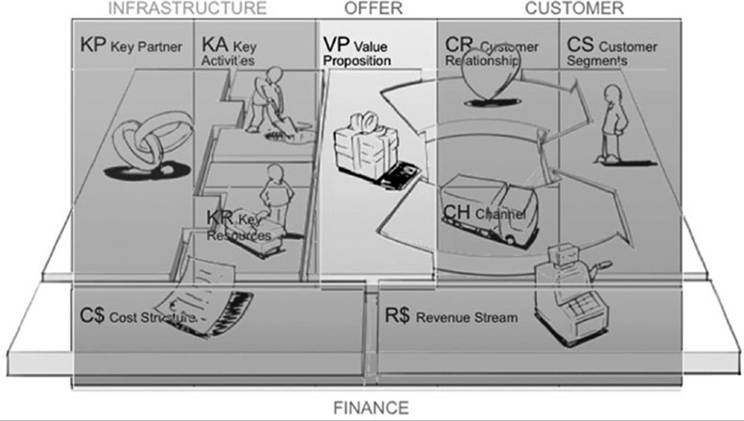
Source: Based on Osterwalder and Pigneur (2009).
Figure 17.1 The business model canvas
exclusively over the Internet) and based on the value proposition it is aimed to establish a long-term customer relationship with each customer segment (e.g., social media). Based on the value proposition revenue streams are generated (e.g., ticket sales, value-added services). Delivering customer value requires access to key resources (e.g., dynamic pricing including the necessary data) and the performance of a number of key activities (e.g., fleet maintenance). Through key partnerships some of these activities can be outsourced and some assets can be acquired externally (e.g., cash management). The costs associated with a business model are summarized in the cost structure component (Osterwalder and Pigneur, 2009).
After having established a common understanding of the business model concept and its components, we now shed light on its relation to corporate strategy and business process modeling. Business process models are used to analyze and improve organizational procedures by increasing process efficiency and quality (see Scheer and Nuttgens, 2000). Thus, the focus of modeling business processes is to support decision-making at the operational level (‘how’) while business models support strategic decision-making (‘what’) (Gordijn et al., 2000). The demarcation between business models on the one hand and corporate strategy on the other hand is more controversial. According to Porter (1985), a strategy depicts how a firm seeks to position itself in a given market by either implementing a cost leadership, differentiation, or focus strategy. Some scholars use the terms ‘business strategy’ and ‘business model’ synonymously (Leem et al., 2004; Kallio et al., 2006), while others regard business models as part of a business strategy (Chesbrough and Rosenbloom, 2002; Shafer et al., 2005). More specifically, they understand a business model as an abstraction of a firm’s strategy that is applicable to more
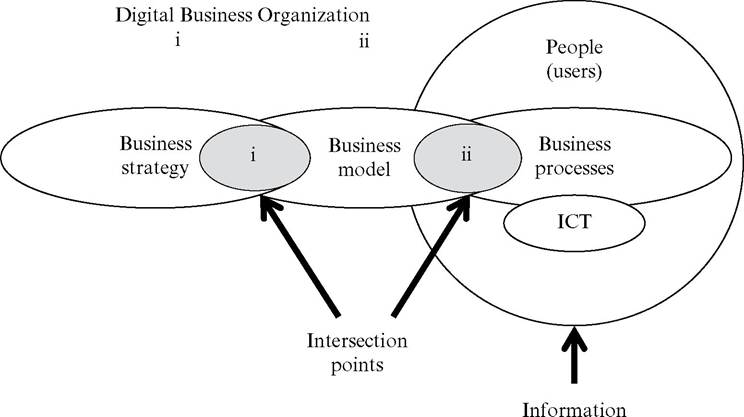
Source: Based on Al-Debei (2010, p.
88).Figure 17.2 Business model intersection points
than one company (e.g., Seddon, 2004). This means that two firms may have different strategies, but employ the same business model (Burkhart et al., 2011). Literature further proposes a third - integrative - perspective. According to this view, business models and corporate strategy are interrelated, however distinct from each other. While a business model addresses how a company creates value and revenues, strategy focuses on a company’s competitive positioning in a given market (Magretta, 2002; Seddon et al., 2004). Correspondingly, business models are viewed as a theoretical layer between corporate strategy and business processes and their supportive information systems (Figure 17.2) (Morris et al., 2005; Osterwalder et al., 2005), which has become necessary because of ‘the shift that the business world experienced from the traditional ways of doing business to the new ways of digital business, which feature a high level of complexity and rapid change’ (Al-Debei, 2010, p. 87).
As depicted in Figure 17.2, there are two transitional points. In the first intersection point (i), the rather generic strategy is translated into a more concrete business logic defining how a firm aims to create value, generate revenues, finance its operations, and establish collaborations with other firms to achieve its strategic goals (Al-Debei and Avison, 2010). At the second intersection point (ii), a business process model is derived based on the business model. The process model specifies at the operational level the corporate activities necessary to perform in order to provide customers with a product or service. Further, it defines the requirements for how information systems can support these tasks. Although business models serve as bases for the configuration of business processes and information systems they do not specify processes and information systems in detail. Some degree of flexibility regarding their implementations remains.
17.3
More on the topic DISENTANGLING BUSINESS STRATEGY FROM THE BUSINESS MODEL CONCEPT:
- LEDAs' enabling processes for local economic development
- When does social capital matter?
- Introduction
- SECTORAL INSTITUTIONS