MULTIDIMENSIONAL INEQUALITY AND DOMINANCE
The route taken by most welfare economists to evaluate the multidimensional distribution of well-being consists of two steps. In a first step, an appropriate measure of individual well-being is derived by answering the question “equality of what?” In the previous section we studied three prominent answers to that question.
In a second step, social welfare or inequality is measured consistently with the analogue of the Pigou-Dalton transfer principle defined in the space of the well-being measures, which have been obtained in the first step. As a consequence, the ethical attractiveness of the Pigou-Dalton transfer principle and the well-being measure are intimately linked.An alternative, more direct route has been followed in the recent literature on multidimensional inequality. It consists of first generalizing the Pigou-Dalton transfer principle toward a multidimensional framework and then imposing this principle directly in the multidimensional space of achievements. At first sight, this route appears to be shortcutting the problem of constructing a well-being measure in the initial step. We have seen indeed that a number of authors within the capability approach are reluctant to construct one single index of well-being. We will investigate whether the methods developed in the literature on multidimensional inequality allow studying the multidimensional wellbeing distribution without constructing such an index.
For this section, we introduce some additional information. Consistent with the pre- 
it will turn out to be convenient to summarize only the achievements of all individuals by means of a so-called distribution matrix. Next we give an example of a distribution matrix L of a society with n individuals and m dimensions of life. be the achievement
of individual i in dimension k.
As before, ‘ refers to the m-dimensional vector of all achievements of individual i (a row of the matrix), and refers to the n-dimensional vector of achievements of all individuals in dimension k (a column of the matrix).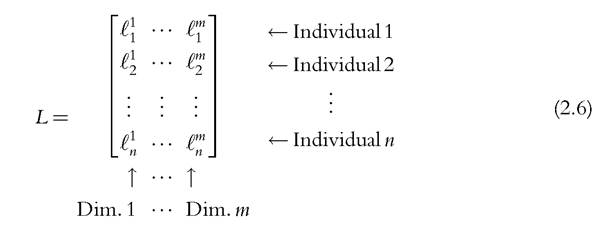
The literature on multidimensional inequality studies how to summarize the information in a distribution matrix by means of a single numerical value.28 By taking a distribution matrix as the only information basis, it is clear that the standard multidimensional social welfare measures proposed in the literature are not sensitive to the preferences held in the society. We return to this topic in the next subsection.
2.4.1 Two-Step Aggregation and Cumulative Deprivation
Although the aggregation of a distribution matrix into a numerical value is not always performed by an explicit two-step procedure, most of the existing multidimensional measures combine two one-dimensional aggregations. One aggregation is across the n individuals in the society. The other aggregation is across the m dimensions of well-being. Different multidimensional measures of social welfare differ in the functional specifications of both aggregations and in the sequencing of both steps.
Let us describe two procedures to sequence this two-step aggregation. In the first procedure, we first aggregate across the different individuals in each dimension. In this step we obtain for each dimension a single summary statistic, so that an m-dimensional vector of summary statistics is generated. In the second step, this vector is further aggregated across dimensions. Kolm (1977) calls this procedure a specific one. Pattanaik et al. (2012) refer to it as the column-first two-step aggregation procedure. In the second [1] We refer the reader to Chapter 3 or Weymark (2006) for detailed surveys on the literature on multidimensional inequality. Following Kolm (1977), a measure of multidimensional inequality can be derived from a measure of multidimensional social welfare as the fraction of the aggregate amount of each dimension that could be destroyed if every dimension of the matrix were equalized while keeping the resulting matrix socially indifferent to the original matrix.
We will focus primarily on measures of social welfare in this section.procedure, the order of aggregation is reversed: in the first step one aggregates for each individual i the dimensions of well-being, which generates a measure of well-being. All the obtained well-being measures generate an n-dimensional vector of individual wellbeing measures. In the second step, this vector is aggregated across individuals. Following Kolm (1977) this second procedure will be referred to as an individualistic one, or a row- first aggregation procedure according to Pattanaik et al. (2012).
In general the two procedures lead to different results (see Decancq and Lugo, 2012; Dutta et al., 2003; Kolm, 1977). Most theoretical multidimensional inequality measures follow the individualistic procedure and aggregate first across dimensions and then across individuals. Some authors have followed the other track, however. A notable example is provided by Gajdos and Weymark (2005), who impose separability between dimensions. Imposing this requirement brings them to a specific procedure. Specific procedures have the operational advantage that they allow the use of different information sources for the different dimensions of well-being. The summary statistic of one dimension may come from one survey, whereas the summary statistic of another dimension may be based on a different survey. A prominent example of such an approach is the HDI, which will be discussed in more detail in the next section.
The flexibility of the specific procedure with respect to the data sources comes at a (high) price, however. The second aggregation function used in a specific procedure aggregates across the different dimensionwise summary statistics. This aggregation may appear to be largely arbitrary. Contrary to an aggregation across dimensions of well-being at the individual level, a theoretical framework for aggregation of summary statistics is indeed missing. This arbitrariness probably underlies the reluctance of various researchers and statistical agencies to pursue an aggregation of summary statistics.
Aportfolio or dashboard of separate summary statistics, which each can be monitored in separation, is often presented as an alternative. This method is consistent with the view that different dimensions of life are incommensurable, as we have encountered, e.g., in our overview of the capability approach.Irrespective of the choice whether and how the summary statistics are aggregated in its second step, a specific procedure has an additional drawback. An important aspect of the information on well-being is lost, namely the correlation between the positions of the individuals across the different dimensions (see Decancq, 2013, for a discussion). When the dimensions of life are correlated, deprivations in one dimension are cumulated with deprivations in other dimensions. Compare, for instance, the following two distribution matrices L and L0:
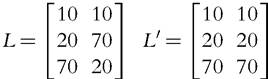
In both matrices, there are two dimensions of life (columns) and three individuals (rows). It is easy to see that each of the four dimensionwise distributions is the same and hence that each specific aggregation across individuals should lead to exactly the same result. Yet, in the distribution matrix L0, there is one individual who is bottom-ranked in both dimensions of life, another individual who is second-ranked in all dimensions, and still another individual who is top-ranked in all dimensions. This society is arguably more unequal than the society represented by L with exactly the same distributional profile in each dimension, but where the achievements of individuals two and three are more mixed. It seems natural to require that the multidimensional evaluation is at least sensitive to the degree to which deprivations in each dimensions are cumulative across dimensions. Pogge (2002, p. 11), for instance, writes: “Consider institutional schemes under which half the population are poor and half have no access to higher education.
We may plausibly judge such an order to be more unjust when the two groups coincide than when they are disjoint (so that no one bears both hardships).”The preceding example illustrated that all measures obtained through a specific procedure are blind to the correlation between the dimensions of life. It follows that a concern for correlation or an aversion to cumulative deprivation rules out the specific (or column-first) sequencing of both aggregations as well as dashboard approaches.[75] This brings us to the alternative, individualistic sequencing in which the dimensions of life are first aggregated for each individual and then across all individuals. Interestingly, this procedure coincides with the welfare economic approach surveyed in the previous section. Although the literature on multidimensional inequality measurement offers a coherent axiomatic justification for the functional specification of the various measures, the link between the formal axioms used (such as homotheticity or separability) and the normative foundations of the implied well-being measure is usually not explained in detail, however.
2.4.2 Multidimensional Pigou-Dalton Transfer Principles and Respect for Preferences
A central question in the literature on multidimensional inequality deals with the generalizations of the standard one-dimensional Pigou-Dalton Transfer Principle and the restrictions that each of these generalizations impose on the functional specifications of the aggregation across dimensions and individuals.[76] In this section we are particularly concerned with the question whether such generalizations can be reconciled with a general respect for individual preferences.
2.4.2.1 Multidimensional Pigou-Dalton Transfer Principle(s)
In a one-dimensional setting, a Pigou-Dalton transfer consists of transferring a positive amount of income from a richer to a poorer individual without reversing the ranking between both individuals. A natural generalization into a multidimensional framework is the following (see Fleurbaey, 2006b; Fleurbaey and Maniquet, 2011).

A positive bundle δ is transferred from a donor j to the recipient i, where the donor has achievements that are at least as good as the recipient in all dimensions of life. In the axiomatic literature on multidimensional social welfare, on the other hand, it is more common to work with transfers where the transferred bundle is a fraction of the difference between the achievement vector of donor and recipient of the transfer, so that  that the achievements of the donor of the transfer should no longer be larger than the achievements of the recipient in all life dimensions. Consequently, the transfers may go in opposite directions for different dimensions. Consider the following distribution matrices L and L" for example, where

One easily checks that a transfer of 30 units is carried out between individuals 2 and 3 in distribution matrix L to reach matrix L00. In the first dimension the units are transferred from individual 3 to individual 2, whereas in the second dimension the 30 units are transferred in the other direction from individual 2 to individual 3.
This example illustrates a fundamental problem with using expression (8) in a richer setting where individuals may have different preferences (Fleurbaey, 2006b). Distribution matrix L00 is obtained from L by a multidimensional transfer. Yet, individual 2 may prefer his bundle in the distribution L to the one in L00, as he may give more weight to the second dimension. Also individual 3 may prefer his bundle in the distribution L, if
31 Any sequence of these transfers can be written as a bistochastic matrix (see Weymark, 2006, for details). The converse of this statement does not always hold. When n > 3 and m > 2 not all bistochastic matrices can be obtained as a sequence of transfers described by expression (8) (Marshall and Olkin, 1979, p. 431). The class of multidimensional transfers that can be expressed by means ofabistochastic matrix is the workhorse of many (axiomatic) studies of multidimensional inequality. It has the advantage of imposing a clear structure on the functional specifications of the aggregation across dimensions and individuals (see, e.g., Kolm, 1977; Tsui, 1995).
he cares more about his achievement in the first dimension. The transfers may therefore go against unanimous individual opinions on the change in well-being. At first sight, this problem seems to be avoided by restricting the transfers to cases where the donor vector dominates the recipient, as in the definition of a multidimensional Pigou-Dalton transfer based on expression (7), so that there is an unambiguous recipient who benefits from the transfer and an unambiguous donor whose well-being is worsened. Yet, we will now see that even these transfers are incompatible with a respect for preferences.
2.4.2.2 The Impossibility of a Paretian Egalitarian
Let us assume, as in the previous section, that all individuals have an informed judgment about what a good life is. Respect for these individual opinions may in this context be expressed by the following Pareto condition:

conflict as soon as at least two individuals have different preferences. This impossibility result is intuitive. The Pareto principle requires that individual preferences are respected, whereas the multidimensional Pigou-Dalton transfer principle advocates some transfers irrespective of the individual preferences. Figure 2.5 illustrates a simple graphical proof (see Fleurbaey and Maniquet, 2011, Theorem 2.1, and also Fleurbaey and Trannoy, 2003). The Pareto principle requires that distribution matrix L1 is strictly better than L4 because for all individuals the achievement vector in L4 is below the indifference curve containing the achievement vector in distribution matrix L1. Similarly, L3 is strictly better than L2. On the other hand, the multidimensional Pigou-Dalton transfer principle requires that L2 is strictly better than L1, and L4 is strictly better than L3, which creates a cycle.
This impossibility reflects a deep tension between two ways of interpreting what it means to respect unanimous preferences. As the donor of the transfer has a higher achievement in all dimensions of life than the recipient, all individuals with monotonic preferences will agree that the donor is indeed better off, so that a transfer from the donor to the recipient is a social improvement. On the other hand, it may be the case that all individuals are indifferent between the current distribution and a new one, where the initial donor now has a lower achievement in all dimensions oflife than the initial recipient. Note that the same tension is underlying the incompatibility between the personal-preference principle and the dominance principle that was discussed in the previous section.
The impossibility result brings us to a crossroad. We can take two directions from here. Either we give priority to the Pareto principle and look for appropriate weakenings of the multidimensional Pigou-Dalton transfer principle. This route is taken by Fleurbaey and Maniquet (2011), among others. A natural weakening of the multidimensional Pigou-Dalton transfer principle is to impose the additional requirement that both donor and recipient of the transfer should have the same preferences (i.e., agree on the
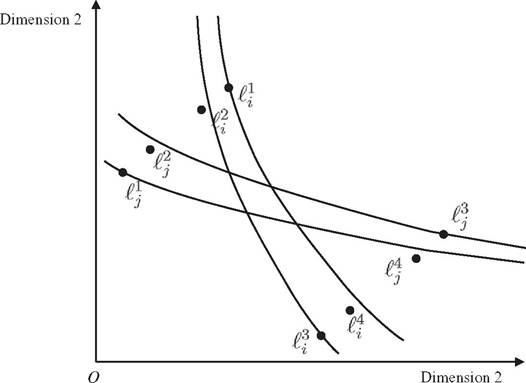
Figure 2.5 Weak Pareto principle and multidimensional Pigou-Dalton principle are incompatible.
good life). This restricted transfer principle is arguably a weak one (as it remains silent on the evaluation of all transfers where donor and recipient disagree on the good life), yet in terms of implications on the social welfare function, it turns out to be very strong. Togetherwith the Pareto principle and the requirement that the comparison of two allocations only depends on the indifference curves at these two allocations, it imposes a lex- imin aggregation across individuals that gives priority to the worse off.This result echoes our earlier findings when we described the problems with the nonconcavity of the equivalent income in the previous section.
Alternatively, one can give priority to the multidimensional Pigou-Dalton transfer principle. This implies that the resulting social evaluation procedure will not be able to respect individual preferences. The literature on multidimensional inequality measurement has taken this second route by assuming that the well-being of a society can be described using information on achievements alone (i.e., a distribution matrix), disregarding information on the preferences of the individuals themselves.[77] This assumption imposes the requirement that the social welfare function is anonymous in the achievement space (see, for instance, Kolm, 1977; Tsui, 1995; Weymark, 2006). A social welfare function is anonymous in the achievement space whenever permuting individual achievement vectors is a matter of social indifference. As a consequence, the well-being measures used to aggregate across dimensions are identical for all individuals. This assumption is defended as requiring equal treatment of all individuals i with the same achievement bundle ‘ either because the observer is unable to distinguish between other possibly relevant individual characteristics (such as the individual opinions on what constitutes a good life) or because the observer considers the other individual characteristics to be ethically irrelevant.
32
In his seminal article Kolm (1977) suggested that a common well-being measure can be seen as “the observer’s evaluation of the individual welfare.” Alternatively, the common objective opinion on the good life is rooted in some “reasoned social agreement on basic components of well-being and on the relative “urgency” of claims to different goods” (Scanlon, 1975). These options are closely linked to the perfectionist approach and the focus on public reasoning that we found within the capability approach by Nussbaum and Sen, respectively.
2.4.3 Dominance and Agnosticism on Preferences
Whether a social agreement on the components of well-being can effectively be reached is doubtful. Yet, even if it is hard to reach a social agreement on which common wellbeing measure to use, it may be possible to reach an agreement on some of its basic features while remaining agnostic on other features. This agnosticism comes at a price, as the social evaluation criterion will become incomplete and indecisive on the comparison of some social situations.
The dominance approach studies these incomplete orderings. In their seminal contribution, Atkinson and Bourguignon (1982) extended the existing one-dimensional dominance approach to a multidimensional framework.[78] A distribution matrix is said to dominate another one if the sum of well-being measures is greater for each and every well-being measure in a given set of measures that satisfy certain sign-restrictions on its partial derivatives.
In general, the class of measures that satisfy given sign restrictions contains infinitely many members, so that checking for dominance involves checking infinitely many inequalities. Luckily, dominance with respect to classes of well-being measures can be shown to be equivalent with implementable criteria. In a two-dimensional framework, Atkinson and Bourguignon (1982) showed, for instance, that dominance with respect to the class of increasing well-being measures with a negative cross-derivative is equivalent to first-order stochastic dominance in terms of the joint distribution functions corresponding to the distribution matrices. Various statistical tests have been developed to test whether distribution functions first-order stochastically dominate one another (see Chapter 6). By imposing a negative cross-derivative, the marginal increase in well-being from having a small increase in the achievement of the first dimension decreases with the level of the achievements in the second dimension. In other words, if some manna would become available in the first dimension, the social planner prefers it to go to the worse-off individual in the second dimension. This restriction introduces again some aversion to correlation and cumulative deprivation between the two dimensions of well-being. Atkinson and Bourguignon also looked for the consequences of imposing further restrictions on the partial derivatives, and later work has extended these results (see Trannoy, 2006, and the references therein). The more sign-restrictions are imposed, the more complete the ordering becomes. However, the results become arguably harder and harder to interpret, as higher-order crossderivatives are involved.
The dominance approach moves us away from the perfectionism that is implicitly underlying approaches that impose a single well-being measure for all individuals. Yet, the unanimous judgment of a class of social welfare functions remains based on a common well-being function for all individuals, so that the dominance approach ignores the diversity of individual preferences. Whether one finds this problematic or not depends on the attitude one takes toward the idea of respecting preferences. Multidimensional inequality measures and dominance approaches are arguably the best way to proceed if one believes that individuals do not have well-defined conceptions of the good life, or that, even when they exist, it is impossible to know them, or that, even when they exist and one can approximate them, one should not do so but rather implement an objective conception of the good life. Again, this is an essentially normative debate.
2.5.
More on the topic MULTIDIMENSIONAL INEQUALITY AND DOMINANCE:
- Atkinson Anthony, Bourguignon François. Handbook of Income Distribution. Volume 2A. North Holland,2014. — 2366 p., 2014
- REFERENCES
- DIFFERENT FACETS OF INEQUALITY
- RESOURCES AND CAUSES OF CONFLICTS