NONMARKET WORK, THE GENDER DIVISION OF LABOR, AND GENDER INEQUALITY
Together with women’s increasing participation in the labor market and commitment to employment, another major and related trend of the second half of the twentieth century was the reduction in the hours of housework, the time women spend at home doing domestic tasks and caring for children or other family members.
In the United States, for example, Bianchi et al. (2012) reported a decline in the time dedicated to housework by women aged between 25 and 64, from an average of 30 weekly hours in 1965 to about 16 h in 2010.[792] In this same period, the time spent by men rose from 4.9 to 10 weekly hours. Similar trends have been observed in other Western/industrialized countries (Gershuny and Robinson, 1988; Sayer, 2010; Sullivan and Gershuny, 2001), but with differences in magnitude and timing. The decline in women’s share of housework was initially sharper in Anglo-American and Nordic countries than in continental Europe, and since the 1990s the change due to men’s participation in housework seems to have been greater in “traditional” countries than in “egalitarian” ones (Geist and Cohen, 2011; Treas and Lui, 2013), as has an increasingly positive social perception about men’s participation in housework (Geist and Cohen, 2011).Despite these trends, cross-country differences remain large and, at the end of the 2010s in OECD countries, the remaining national gender gaps in housework were still impressive, even in the most egalitarian countries: the minimum ratio of women’s to men’s hours of daily housework, in Sweden, is about 1.3; it stands between 1.5 and
1.8 in many other countries, exceeds 2 in some countries such as Ireland and Italy, and it reaches about 5 in Japan.[793] Beyond housework, women also do more other nonmarket work such as volunteer work and care for nonhousehold persons (Miranda, 2011). All in all, the share of nonmarket work in women’s total hours of work (paid and unpaid) was between 60% (Canada) and 74% (Italy) at the beginning of the 2000s.
This means that the major contribution to household production of nonmarket services results from women’s unpaid work. The reduction in women’s housework time (and the fact that this reduction was far from counterbalanced by the increase in men’s time) also results in a much lower total time spent on housework, and in turn in the household production of nonmarket services, than 50 years ago. To sum up: Women still do a higher share of unpaid work than men—albeit of a reduced total amount of unpaid work, and men still do a higher share of paid work than women and have increased their participation in housework. There is very little difference between men’s and women’s total time of work (Burda et al., 2013; Folbre 2009) but still a significant gender difference in the composition of this total amount of work.That women carry out the lion’s share of nonmarket work is not only well documented in statistics and academic literature; it also seems to be a shared perception, as suggested by Burda et al. (2013). In a small ad hoc survey,[794] they asked researchers and students in economics and sociology to give a spontaneous estimate of the difference between men’s and women’s total work in the United States (including paid work and any activity they related to nonmarket work). About 57% of the respondents estimated that men’s total work was at least 5% lower than women’s, and 25% thought it was roughly equal (differing by less than 2.5%). Since the question started by recalling that men do more market work than women, this means that the respondents estimated the quantity of women’s nonmarket work to be large enough to balance out their lower quantity of market work.
As for the gender gap in total work, Burda et al. (2013) found it close to nonexistent over a sample of 27 countries (the positive difference “in favor” of women is statistically significant but small). They identify this state of things as “iso-work,” hence “isoleisure.” However, they wonder about “iso-leisure” when men still work more in the market and their earnings, which are expected to determine their relative power in decision making, are still significantly higher than those of women.
“Three logical possibilities present themselves. Men have more power, but are altruistic toward their spouses and toward women generally, and do not take advantage of it. Another is that economists’ modeling of the household has been incorrect, and market earnings do not generate power in the household. A final alternative is that earnings do generate power, men are not altruistic, but the average man’s utility from his market and home work exceeds that of the average woman’s from the same total amount of work” (Burda et al., 2013, p. 258). Another source of puzzlement is that “iso-work” and hence “iso-leisure” somewhat contradict the decline in women’s subjective well-being observed by Stevenson and Wolfers (2009), especially its decline relative to men while men’s and women’s relative opportunities have converged rather than the contrary. This decline in women’s perception of their well-being relative to men’s is itself consistent with Krueger’s “U-index,”[795] showing no real trend over the past 40 years except for “a shift away from activities associated with unpleasant feelings” among men (Krueger, 2007, p. 205).[796] These results, together with the final alternative proposed by Burda et al., suggest that men benefit from a better combination of market and housework than women and perhaps, as we explore later in this section, a better quality of leisure.Beyond iso-work, which means that men’s and women’s contributions to productive activities are equal, it is then necessary to consider that the structure of “work” remains very unequal, with men allocating a much greater amount of time to market work than women. This may matter a lot: a fundamental difference between market work and nonmarket work is that the former provides incomes in money, whereas the latter does not. The time allocated to unpaid (nonmarket) work relative to paid work, resulting in different outcomes for men and women, therefore has important implications in terms of gender inequality.
This section reviews how the gender division of labor is analyzed today, with a focus on unpaid work. We start by examining the productive dimension of households’ nonmarket activity, and the way it appeared at the same time around the 1960s in parallel streams of research on household behavior and on the measurement of economic performance. This leads us to examine some of the methodological difficulties encountered when it comes to measuring and evaluating what happens outside the market and how it may affect estimates of gender inequality. Then we review the effects of nonmarket work—mostly women’s time—on the economy and on inequality. The remainder of the section is centered on the analysis of specialization within the household, reviewing how recent empirical research analyzes this very persistent dimension of gender inequality.
12.6.1 Nonmarket Work/Household Production
Standard consumer theory considers households as consumers allocating their resources to consumption and leisure and their members as participating in the labor force to obtain the income they will spend on consumption; standard statistics measure the “economy” on the basis of hours of work, monetary incomes, and the volume of goods and services exchanged on the market. Households and the market interact through labor supply and consumption. These representations changed considerably at the turn of the 1960s with the conjunction of two “revolutions”—a new approach to households as producers and recognition of nonmarket activity as a significant dimension of the economy—at a moment when time-use data started to become available on a regular basis (see Juster and Stafford, 1991). This resulted in notable changes in the conception and analysis of economic performances at macro level, in the analysis of individuals’ and households’ behavior at a micro level, and in the approach to economic inequality, with particular implications for gender inequality. Whether at macro or micro level, accounting for households’ nonmarket production (or its counterpart: individuals’ nonmarket work) requires time-use data.
This raises specific methodological issues, especially the need to define which nonmarket activities are considered as production or leisure and to find a method of evaluating the time devoted to these activities.12.6.1.1 Two Conceptual Revolutions
The first revolution, founding the “new home economics,” concerns the approach to household behavior with a focus on the productive dimension of this activity. In the 1960s, the interest in home productive activity was not new—early research dates back to the 1930s[797]—but the turning point was Becker’s (1965) theory on the allocation of time, in his own words: “a basic theoretical analysis of choice that includes the cost of time on the same footing as the cost of market goods” (p. 494). Instead of the household as a consumer, Becker’s theory presents the household acting as a small firm, producing a set of commodities obtained by a combination of time (including time spent on consumption) and market goods; it is these commodities, not goods or time themselves, that provide utility. This approach, which turns consumption into production (and utility maximization into cost minimization), also departs from the traditional approach in terms of a trade-offbetween work and leisure[798]: substitutions between nonmarket and market time and between time and goods are possible, and “leisure” disappears into a general category of nonmarket time. The agent’s constraint, or full income, is then a global resource integrating a goods constraint and a time constraint, and time is allocated depending on its cost relative to the cost of goods in the production of commodities. In multiperson households, the allocation of the household’s total time includes an additional dimension, since the time also has to be allocated between the household members, but this allocation remains determined by the same principle of cost minimization in the production of commodities. It is then the relative market efficiency of the household members that determines how they will be assigned to market or nonmarket activity, entailing reallocations if there are changes in the household members’ relative market efficiency.
Becker’s approach was criticized on various points,[799] especially for the lack of a distinction between housework and leisure, “a good approximation of the role the husband plays in the production activity of the household but does gross injustice to the wife (...) the wife’s allocation of time should therefore be analyzed in terms of a threeway division of work in the market, work at home, and leisure” (Gronau, 1973, p. 634).[800] The new “standard” model of household production finally distinguishes leisure from housework within nonmarket time, following Gronau, basing the allocation of time within the household on a principle of comparative advantage; we examine later in this section what this implies in terms of the division oflabor between men and women.The second “revolution” happened in the measurement of economic activity, with the recognition of the need to complete conventional measures focused on market goods and market time to take into account households’ nonmarket activity. Another limit to conventional aggregates, underlined in gender studies, is that conventional measures neglect a large share of women’s contribution to the economy. 9 The revolution took some time, from the 1960s and a growing concern about the shortcomings of the GDP (gross national product [GNP] at the time), to 1993, when the revision of the System of National Accounts introduced the idea of satellite accounts to “enlarge the concept of production to include household production of services for own use” (UN Statistical Commission, 1993). The idea became an explicit recommendation at the UN Conference of Beijing in 1995 (UN, 1995).
The shortcomings of conventional measures of economic activity were the focus of a conference on “The measurement of economic and social performance” held by the National Bureau of Economic Research (NBER) in 1971. In the introduction to the volume of contributions, Moss (1973) speaks of the GNP as “under attack” for neglecting the negative externalities of growth or failing to provide “appropriate measures of economic performance of households and governments.” One of the propositions emerging from this conference, and much debated, was to develop accounts for households’ nonmarket productive activity based on the measurement and evaluation of households’ time. Gronau (1973) proposed an evaluation of “housewives’ time.” Nordhaus and Tobin (1973) proposed a more encompassing extension, integrating nonmarket time, including leisure, into a “measure of economic welfare.” For 1965 in the United States, their lowest estimate for nonmarket activity represented about 42% of the GNP, and their lowest estimate for leisure was about equal to the GNP (Nordhaus and Tobin, 1973, p. 518). Forty years later, the debate is still open, as illustrated by the recent report of the “Commission for the Measurement of Economic Performance and Social Progress” (Stiglitz et al., 2009). Referring to the same shortcomings of the conventional measures as the NBER conference of 1971, the 2009 report recommends “broaden[ing] income measures to non-market activities.” The extensions discussed are still intended to provide a better account of well-being, moving a step further “towards a notion of‘full income’” (Stiglitz et al., 2009, p. 126), especially with the valuation of leisure (p. 131) or the development of measures of subjective well-being.11 The report specifically recommends
109 This asymmetrical effect of conventional measures had been underlined by Hill (1979a,b), who explained that the types of nonmarket activities typically carried out by women are not taken into account in the “production for own account” conventionally included in the GDP; hence, as he remarks, “the textbook joke” that the GDP goes down when a housekeeper marries her employer because the output is no longer counted, while the output is counted when a mechanic replaces the family car’s engine.
110 See Fleurbaey (2009) and Decancq et al. (2014), Chapter 2, in this volume. taking into account the “services that households ‘deliver to themselves’ such as child care, cooking or parent’s education services to children” (Stiglitz et al., 2009, Recommendation 5, p. 14). The 2009 report is, however, not a repetition of the NBER conference of 1971, and at least two points go further: First, it underlines the need to address gender differences in time use and the issue of the distribution of unpaid domestic work within families—a view that was absent from the debates of 1971. Second, it includes an investigation into subjective well-being, a strand of research that has attracted increasing attention since the 1990s and goes beyond GDP not by developing extended indicators, but by changing the units of measurement to account for individual perceptions and affects—this is the idea behind “well-being accounts” or “national time-use accounting” (Kahneman et al., 2004; Krueger et al., 2009).
12.6.1.2 Measurement and Valuation Issues
The two revolutions differ in their scope and implications, but they are connected by the same “subject”: housework or its output, that is, the services that households provide to themselves. But nonmarket work is not captured by the usual indicators of participation in the labor force. Being unpaid, it does not appear in individuals’ or households’ money income; its output is consumed but there is no market transaction, and hence it does not appear in households’ expenditure. No market hours, no wage, no money income, no price and a product in unobservable quantity: economists and statisticians, then, are deprived of their favorite measurement kit. Basically, the problem is to define which nonmarket activities should be considered as productive, to measure the time spent on them,[801] and to convert it into money. These questions have been debated for decades, with a focus on the evaluation of “productive” time outside the market—our focus here.[802]
12.6.1.2.1 Perimeter
Which nonmarket activities are “productive”? There is no clear theoretical definition, and practice depends on whether measurement is implemented to analyze individuals’ (households’) behavior or in a national accounting perspective. In the first perspective, the focus is on individuals’ (households’) activity, especially in terms of choices of time allocation; in the second it is on the product of this activity.
When focusing on individuals’ activity, the problem is to distinguish leisure from productive activity within nonmarket time. A first approach is that of the household production model—in Gronau’s (1977) revisited version,[803] since Becker’s did not distinguish leisure within nonmarket time: “An intuitive distinction (...) is that work at home (like work in the market) is something one would rather have somebody else do for one (if the cost were low enough), while it would be almost impossible to enjoy leisure through such a surrogate” (p. 1104). In this view, nonmarket work is different from leisure because, unlike leisure, it does not provide utility directly but only through its outcome (provided the absence of process benefits is assumed, as underlined by Pollak and Wachter [1975]). Other approaches to the contrary, in welfare economics or timeuse research, emphasize the “emotional” content of various activities, that is, whether the time spent on it is enjoyed or found pleasant, precisely process preference. Stiglitz et al. (2009, p. 135) evoke this research as a promising way to be able to distinguish between leisure and production in household activities.[804] Folbre (2004) proposes a more encompassing approach to nonmarket work, arguing that the valuation of time does not fully account for the positive externalities—not only within but also outside the household— that can result from it.
The accounting perspective does not rely on a notion of preference or pleasantness but adopts a reference to the output and the market; nonmarket work is generally identified by the fact that it provides services that could have been purchased in the market. Accordingtotheliterature (e.g., Ironmonger, 1996, 2000;Juster and Stafford, 1991; Zick et al., 2008), Reid (1934) is considered to have been the first to propose what is referred to as “the third party” (or person) criterion: “If an activity is of such character that it might be delegated to a paid worker, then that activity is deemed productive” (cited by Ironmonger, 2000, p. 6). This leads to the identification of a set of nonmarket activities broadly including preparing meals, cleaning and laundering, caring for children or other household members, managing the home, repairing the home, gardening and caring or pets, and related shopping and travel.
The various approaches are not necessarily incompatible, and none is completely straightforward.[805] Economic or time-use studies sometimes restrict the perimeter of nonmarket work, for instance, by only keeping routine or “core” domestic work, excluding gardening and pet care (which may have a leisure character) or shopping (its direct relation with the productive activity can be difficult to check). Childcare is often treated separately (one reason being that time cannot be spent on childcare of one’s own children in childless households) and sometimes is refined into “active” and “passive” childcare (or primary and secondary, depending on whether another activity is performed simultaneously; see Allard et al., 2007).
Of course, variations of the perimeter (often related to the perspective of the analysis or the issue addressed, as well as to the accuracy of the information on time use) have a significant impact on the “quantity” of nonmarket productive time measured and on the estimate of men’s and women’s contributions to this quantity or gender gaps in time use. Using the French Time Use survey from 2010 on the population aged 11 and older, Poissonnier and Roy (2013) compared three perimeters. Starting with a restrictive definition limited to core activities (cooking, washing, cleaning, active care of children and dependent adults and related travel time, household management), they obtained a daily average of 2 h 7 min; an intermediate definition, adding shopping, home repair, gardening, and playing with children—or “productive leisure”—results in almost one more hour (3 h 4 min), and an extensive definition, adding driving oneself and pet care, adds about 50 min more (3 h 53 min). In these daily averages, the share of women’s time decreases significantly when the perimeter is extended, with values of 72%, 64%, and 60%, respectively. Using the American Time Use survey from 2010 on the population aged from 25 to 64 years, Bianchi et al. (2012) obtained a similar pattern in the ratio of women’s to men’s time, which falls from 2.9 when the perimeter is restricted to “core” housework to 1.6 for total housework.
These differences reflect the fact that, on average, men and women do not do the same sorts of housework. In short, “women cook, clean and care while men build and repair” says the OECD (2011b, p. 22). Beyond averages, the time spent on housework and care by men and women varies with the composition of the household. Of course, the presence of children has an important effect on the total time spent on care, but it is not the only factor; in the United States, married men and married women spend more time on total housework than the average, and even more on core housework, and women spend more than men; the gender ratio (women’s time to men’s time) for this perimeter is 3.4 versus 2.9, on average (Bianchi et al., 2012). Parents naturally spend more time on childcare, and mothers spend more than fathers (the ratio is 1.9), but they also both spend more time on core housework than the average married men and women— again mothers spend more time than fathers, signaling that the presence of children tends to reinforce the unequal gender division of nonmarket work (Bianchi et al. 2012). The difference is also pronounced in the detailed activities related to childcare: 60% of mothers’ childcare time is devoted to physical care and supervision versus only 45% of fathers’ childcare time; conversely, 41% of fathers’ time is spent on educational and recreational childcare compared with 27% of the mothers’ time (Bianchi et al., 2012). In addition, men’s and women’s “specialization” within nonmarket work may be weighted differently because of the routine versus occasional nature of the core or other housework (Sayer, 2010) or because of a difference in the emotional content of the activities—a direction explored by Stevenson and Wolfers (2009). “Women’s” housework may also be more intensive than men’s if several activities can be carried out simultaneously (e.g., cooking and doing the dishes and looking after the children) or interrupt their leisure time (Bittman and Wajcman, 2000; Sayer et al., 2004). Such differences do not count in an accounting perspective but may count in the perspective of measuring and analyzing gender inequality—hence the interest of going beyond the simple measurement of quantities of time.
12.6.1.2.2 Valuation
Once the relevant activities have been defined and the time spent on them measured, the next step is to obtain a value of the time or product. There are two main approaches to this valuation. The “replacement cost” method consists of estimating the price the household would have paid to obtain the same service on the market (or the money saved if the service is produced at home instead of purchased on the market). The “opportunity-cost” method estimates the earnings the person (or the household) would have received if the time devoted to housework had instead been spent working in the market. As in the perimeter definition problem, there is no generally agreed best method, and either might appear more or less appropriate depending on its application.
The opportunity-cost method is generally used in the analysis of intrahousehold organization and decision making and inequality within the household; it is consistent with the methods used for the valuation of leisure. But it is problematic in the accounting perspective because it results in the same output having different values depending on who produced it (Eurostat, 2003; Landefeld and McCulla, 2000). Using the opportunity cost can also be problematic when the producer of the service does not work in the market. This problem has been discussed at length. Gronau (1973) tested two estimates under the alternative assumptions that women who do not work in the market are more efficient in the home sector or less efficient in the market sector, resulting in a price of time respectively higher or lower than the potential wage rate. Bonke (1992) used the individual wage rate in the case of working men and women and the reservation wage for those who do not work in the market. Another direction of discussion is that the opportunity-cost method assumes that the individual would work for pay instead of doing housework, but this approach neglects the fact that market work is often not offered by the hour. The choice may then be between taking a job or not, or between a full-time or part-time job, and then giving up more hours of market work than the number of hours actually spent on nonmarket work. We cannot exclude the possibility that at the individual level, housework might cost more in terms of foregone leisure time than in terms of foregone earnings; while this does not change the valuation at the household level, it maybe not be so in terms of individual well-being.
The replacement cost method has the advantage of being consistent with the “third person criterion”: the cost of what is available on the market does not depend on the wage of the person buying it (while of course, this wage is relevant in the choice of doing versus purchasing). Eurostat (2003) distinguished two main approaches to the replacement cost: the “specialist” cost (using the wages of specialized wage workers—a cook in a restaurant, a nurse at a daycare center, etc.—or the cost of specialized services at home—e.g., a private nurse, cleaning person, plumber ) and the “generalist” wage (sometimes referred to as the “housekeeper’s” wage). In addition, there is the option of using the minimum wage (when there is one). None of these solutions is fully satisfying (see also Landefeld and McCulla, 2000), first, because in the household, several tasks can be carried out simultaneously, while the corresponding service would require several specialized workers; second, some tasks cannot be carried out by “generalist” workers (e.g., fixing the roof). Another possible drawback of the replacement cost method is the need to find market substitutes for all the services the household provides to itself.[806] [807] It is possible that some of these services are specific to the point of not having market equivalents; more generally, market substitutes can be of poorer (or better) quality than homemade products (not to mention the emotional dimension of some domestic or care tasks; see Folbre, 2004). As with variations of the perimeter, choosing one or another method of valuation can result in wide differences. The opportunity cost always yields a higher value for household production of nonmarket services than any other method. Over a sample of 25 countries, it is at least twice as high as the replacement cost (housekeeper rate) in 7 countries, between 1.5 and 2 times as high in 10 countries, and between 1.1 and 1.5 as high in the 7 remaining countries (Ahmad and Koh, 2011; link to data in OECD, 2011b). Landefeld et al. (2009, p. 219) estimated the value of nonmarket household services in the United States using various options. For 2004, the lowest value is obtained using the minimum wage; compared with this value, the “housekeeper’s” wage gives an estimate 54% higher, the “specialist” wage gives an estimate twice as high, and the opportunity cost gives an estimate five times higher.[808] At the individual (household) level, the difference between the two values (market price vs. opportunity cost) illustrates the possibility that the increase in money earnings from working for pay instead of producing nonmarket services could be higher than the decrease in the value of home production. 12.6.2 Taking Households' Production and ProductiveTime into Account: What Does It Change? As mentioned earlier, one of the aims of measuring household production—responding to long-lasting debates on the limitations of conventional aggregates measuring economic activity,[809] income, or consumption—was to provide a full account of economic and social progress and an accurate basis for the measurement of inequality. At a micro level, the conventional approach, which considers only money income (or expenditure), does not provide a satisfying estimate of the household well-being either because it neglects the actual access to goods and services, which is enhanced by household production. Given the average contribution of men and women to the production of nonmarket services, taking household production into account also allows one to take full stock of the impact of women’s work, especially its distribution between paid and unpaid work, on economic well-being. This impact is rather different depending on the perspective: unpaid work reduces inequality among households but, because it is mostly women’s work, it contributes to gender inequality. 12.6.2.1 Household Production and the Markets At the macro level, it has been shown that household production of nonmarket services represents significant shares of GDP: in 2008, from 15% in Canada to 26% in the United Kingdom, with a replacement costs valuation, and from 40% to 68%, respectively, with the opportunity-cost method (Ahmad and Koh, 2011). The shares of household production tend to be negatively linked to participation in paid work in general (see Miranda, 2011), if only because total time is constrained. Very basically, more time in paid work is associated with more market goods, and less time in paid work (hence more time in nonmarket production) is associated with more household production—even more if one concentrates on women’s participation. So as long as there are significant cross-country differences in the distribution of time between work and leisure and, within work, between market and nonmarket work, taking household production into account tends to have an “equalizing” effect in cross-country comparisons of economic well-being. For instance, the disposable income per head is higher in the United States than in France by 21% points, but only by 16 points when corrected for household production (in 2005; figures from Stiglitz et al., 2009, p. 131). Comparing Finland, France, and the United States between 1995 and 2006, Stiglitz et al. (2009) also remarked that the annual growth rates of households’ extended income, that is, corrected for household production, are significantly smaller than those obtained without this correction—in other words, not correcting for household production results in overestimating growth in well-being. The same was found by Landefeld et al. (2009) over a longer period (1965-2004) when comparing the growth rate of US GDP and an extended measure including nonmarket household services; they interpreted this as reflecting women’s entry into the labor market, which resulted in an increased growth rate of market production, but neglecting its counterpart in terms of reduced household production overestimates the increase in production. The relationship between household production (i.e., the unpaid time spent on housework and care) and market products depends first on how the population is distributed by household type (especially singles versus families) and on the degree of substitutability between household products and market products. It also depends on whether men’s and women’s nonmarket time are perfect substitutes in the household utility function, and it has been found that this is not the case. This is one implication of the tests rejecting the unitary model and a result of other precise tests (see, e.g., Browning and Meghir, 1991, who find that the assumption of substitutability is strongly rejected). Previous analysis of labor supply also had shown that men trade market work for leisure, whereas women trade market work for both housework and leisure (e.g., Killingsworth and Heckman, 1986). This may have changed—as we have seen, men’s housework time tends to increase (albeit slowly), but all in all, this points to women’s allocation of time as the main driver of changes in both labor supply and the relative shares of household products and market products in the consumption of commodities. In turn, changes in the demand for market products have employment effects in the sectors producing market substitutes for home production. This is the question addressed with the “marketization hypothesis”: Freeman and Schettkat (2005) linked the larger amount of time worked in the United States than in the European Union with a more pronounced departure from household production in the United States and the shifts it induces in terms of both “freeing” time and increasing the demand for market substitutes—hence the employment in the sectors producing these substitutes. In turn, the jobs created in these sectors contribute to the increase in women’s employment (although this is primarily low-skill employment; see Section 12.3). Freeman and Shettkat showed that the difference between the United States and European countries is mostly attributable to women’s allocation of time to paid work versus housework; as the authors remark, “substitution of male for female time in housework is modest” (p. 37), and, in the case of men, the trade-off is essentially between paid work and leisure. A striking difference is the time spent by women on childcare, which is much lower in the United States, where the proportions of children younger than 3 years old in formal daycare is more than twice higher than the average in their sample of EU countries. Other studies (Del Boca, 2002; Jaumotte, 2003; Wrohlich, 2004) showed that childcare availability could be more important to the trade-off between market work and household production than its cost (together with other arrangements that help to reconcile work and family responsibilities; see Section 12.3). There is also an ongoing debate in time-use research on the interaction between women’s entry into paid employment, that is, a departure from housework, and expenditure on time-saving domestic appliances (the “mechanization” hypothesis) or reliance on market substitutes (the “buying out” or “outsourcing” hypothesis). New technologies, assumed to increase the productivity of housework, should allow women to devote more time to paid employment. But various studies have found that, contrary to the intuition, either the time spent on housework remained constant, or “the more technology, the more time spent” (Gershuny and Robinson, 1988, quoting themselves, 1972). Likewise, using the Australian Time-Use Survey from 1997, which also provides information on household equipment, Bittman et al. (2004) did not find a significant effect of ownership of appliances on housework or on its division between genders (it even seems to go with more pronounced gender specialization within housework). As for time-saving services (food away from home, childcare, paid domestic services, laundry services, etc.), Bellante and Foster (1984) found a positive association between women’s participation in paid work and buying out, but no relation with the number of hours worked, and most of all a strong relation with the family income. With time use data but a small sample of dual-earner couples, Killewald (2011) found that the relation between the use of market substitutes and housework time (excluding childcare) is, at best, very small (e.g., an increase of 1% point in expenditure on market substitutes was associated with a reduction of 1 min per week spent on cooking and cleaning). All in all, studies provide inconclusive results (see a review by De Ruijter et al., 2005)—probably partly because of differences in data quality and methodologies. 12.6.2.2 Household Production and Inequality Between Households Across households, studies have regularly found home production to be less unequally distributed than money income (Aslaksen and Koren, 1996; Bonke, 1992; Frazis and Stewart, 2011). This is consistent with theoretical prediction: provided there is no process preference, high opportunity-cost individuals will turn to more goods-intensive consumption and, conversely, low opportunity-cost individuals will turn to more timeintensive commodities and therefore spend more time on household production. Taking into account nonmarket production then tends to result in lower estimates of economic inequality than those obtained with conventional measures of income. The “equalizing” power of nonmarket work might have somewhat declined over time, as has been suggested over the last decade or so.[810] Returning to the main link between women’s allocation of time to market or nonmarket work, it seems obvious that the increase in women’s participation in market work goes together with a decrease in household production. However, this may not be completely obvious; one must assume that nonmarket time was not initially totally allocated to leisure (time-use evidence confirms this) or that the increase in market time was not just added to an unchanged amount of nonmarket work (time-use evidence confirms this, too, contrary to what the notion of the “second shift” suggested[811]). Zick et al. (2008) found that, in the United States, the correction due to household production was larger in the 1970s than in the early 2000s. They argued that the shift in women’s time from unpaid to paid work has two opposing effects: on the one hand, women’s entry into the labor market has slowed the increase in money income inequality; on the other, high-wage women have reduced their housework time more than low-wage women, hence creating an increased inequality across households, which is partly limited by the increase, even if small, in time spent on housework by men in high-income couples. These changes have been reinforced by marital homogamy (high-wage men marrying high-wage women), contributing to inequality between couple households. At the same time, changes in family composition, especially the increase in single-parent households (most often headed by women), have reinforced inequality (see a discussion by Kollmeyer, 2013). These results are consistent with those obtained by Gottschalk and Mayer (2002); comparing the 1970s and 1980s, they also showed an equalizing effect of household production for both periods, albeit larger at the bottom of the distribution. This highlights the fact that the size of the equalizing effect also depends on the level of inequality in the distribution of households’ money income, which is itself influenced by women’s earnings (a counterpart of the decline in women’s unpaid work). This influence is essentially studied through counterfactual experiments: what if women had no earnings, or if their earnings were not unequal? Comparing couples’ earnings in 1979 and 1989 in the United States, Cancian et al. (1998) found for both years that including wives’ earnings reduced the inequality in family money incomes, that is, inequality would have been larger if wives had no earnings. However, the level of inequality would have been lower than observed in the absence of inequality in wives’ earnings.[812] Comparing income inequality in 16 countries in the early 2000s, Harkness (2013) found that first, despite large differences in households’ employment structure and the incidence of part-time work among women, the contribution of women’s earnings to household income is quite similar across countries—with the exception of the United States, where this contribution is the largest at close to 30% of gross income. Three counterfactuals are examined. If no women worked, household earnings inequality would increase in all countries, most of all in the United States. If all women worked, there would be a decline in earnings inequality. The third counterfactual consists in closing the gender gap (all else unchanged); here, the results are mitigated, with a decrease in inequality in some countries and an increase in others—especially in Nordic countries—but it would decrease among couples. The analysis also underlines the varying effect of women’s earnings in different types of households, especially between one- or two-earner couples and between couples and one-person households, especially single women. Beyond the general result, a case study of Italy (Del Boca and Pasqua, 2003) also shows that the “correcting effect” of women’s earnings is highly dependent on the level of married women’s participation in paid work. Working on a counterfactual “if no women worked,” Del Boca and Pasqua found that income inequality would have been much higher than observed (in 1977, 1989, and 1998) in northern Italy, where wives’ employment is higher, whereas it would have been comparable in southern Italy, where fewer married women work. They underlined the fact that southern Italy lacks many of the factors facilitating women’s access to employment, especially opportunities for part-time work and childcare facilities, resulting in large inequalities in women’s earnings. It would be especially interesting to combine these results with an analysis of the correcting effect of nonmarket work because Italy is one of the OECD countries where women’s participation in the labor market is the lowest and the amount of housework is the highest (see OECD, 2011b). Unfortunately, no such study yet exists. Nevertheless, despite its probable decline, the equalizing effect of household production remains quite large. Folbre et al. (2013), who compared couples’ market earnings and a measure of extended earnings including nonmarket work (valued at the minimum wage[813]) over nine countries, showed that the Gini coefficients with the measure of extended earnings are reduced, in most countries, by about one-third compared with those for the earnings. There is some variation between countries, but the rankings remain fairly stable—except for the United States,[814] [815] where the equalizing effect is the lowest because of the combined effects of a relatively low share of nonmarket work in total work and a low minimum wage (the lowest of the nine countries relative to aver- 125 age earnings). 12.6.2.3 Housework and Gender Inequality We turn now to the influence of housework on gender inequality. The issue is not only its unequal distribution between men and women per se, but also its consequences on other socioeconomic outcomes. One, pointed out by Becker (1985), is that it may affect women’s earnings: “(...) the earnings of men and women would not be equal even if their participation [in paid work] were equal” (p. S35). This is not because of discrimination in the workplace but the fact that housework and childcare demand so much energy from women that little is left for market activity—a hypothesis that would save human capital theory from the “embarrassment,” in Becker’s words (“failure” in the terms of England, 1982), of not explaining gender earnings differentials. Another is that the “pressure of time” may affect women, who have to combine paid work and family responsibilities, more than men; the “dual burden” or “second shift” would then result in a gender gap in leisure (Hochschild and Machung, 1989; Bryant and Zick, 1996). While this gap is almost closed (on average) in terms of overall quantity, recent work points at a gender gap in the quality of leisure time. Ultimately, both approaches suggest that housework and family responsibilities influence the capacity to focus on and/or benefit from what one is doing when not doing housework. If this is so, it may affect gender inequality in ways that conventional measures of individual living standards or well-being do not capture and may contribute to women’s disadvantage in economic and social outcomes. 12.6.2.3.1 HouseworkandWages According to Becker (1985), women’s family responsibilities affect their potential for effort at work because these tasks drain their “energy.” The more energy spent on childcare and housework (which he describes as being highly demanding in energy), the less left for the job. Hence, a choice ofless demanding and, accordingly, less well-paidjobs or those with lower career opportunities, as analyzed in the literature on the family pay gap since the mid-1990s (see Section 12.3). However, strictly speaking, the family pay gap is an effect of the family status, especially motherhood, not an effect of housework (even if the time spent on housework is not independent from the family status); moreover, the focus is on differences between women. Then arises the question of whether there is an effect of housework that is distinct from the effect of motherhood or family status and of its impact. Following Becker, such an effect should be negative on women’s wages; what is slightly unclear, however, is whether this effect operates indirectly, by influencing the choice of hours and type ofjob (work effort), or directly, by the performance at work (effort on the job) once the occupation, hours worked, and so on have been controlled for. As emphasized by Bielby and Bielby (1988), the notion of “energy” refers not to the quantity of time or the occupation but to the intensity of physical or mental effort required on the job. As for men, the logical complement to Becker’s proposition is that married men (or, more generally, men living in couples) should be able to allocate more energy to their work because they do not suffer the same energy-draining home activity as women and they benefit from their wives’ housework. Testing the assumption of an intrinsic impact of housework on wages is difficult because one must be able to measure the expenditure of energy on both housework and paid work, or to control for the jobs’ actual requirements (e.g., concentration, precision, availability), and to combine this with accurate information on housework. It also poses various estimation problems, particularly because of the potential endogeneity of wages (wages have regularly been found to influence negatively the time spent on housework) and unobserved heterogeneity (a detailed review of the econometric problems is provided by Maani and Cruickshank, 2010). A first question concerns the impact of housework on the expenditure of “energy” at work; this was the question asked by Bielby and Bielby (1988). Their test used an index of work effort based on self-reported information on the demands of the job (physical and mental) and whether the actual effort made goes beyond what is required. Their index was designed to avoid a potential gender bias, for example, exhausted women overreporting the job’s requirements. However, the authors argue, the sociopsychology literature suggests that women tend rather to understate their performance, so that if there is bias, it is more likely to be in the other direction. Their main result is that, controlling for education, occupation, age and family composition, working time and pay, family responsibilities (responsibility for child, childcare hours, domestic work hours), and whether the spouse works, women did not allocate less effort to work than men. Married women or mothers allocated less effort than single women, but this reduction in effort left them at the same level as men. In the case of men, on the contrary, the hours of housework seem to reduce slightly their effort at work, suggesting a trade-off that did not occur in the case of women: Women’s efforts in paid work do not depend on their hours of housework, but men’s do. However, the result for men could be a case of reverse causality, that is, men’s effort in housework might depend on whether they work in more or less demanding jobs. Another limitation, more likely to affect the results for women, is that the estimation (by a sample of men and women working at least 20 h per week) did not account for possible selection into paid work; it could well be that the most exhausted women do not work in the market. This study by Bielby and Bielby remains, to date, the only study directly tackling the issue of the allocation of effort. Hersch’s (1991) study of the United States was one of the first to examine the effect of housework on wages. Controlling for various job attributes (hardship, autonomy, stress), she found substantial differences between men and women in the frequency of these attributes but no significant difference in the returns to them. Housework (self-reported) had a negative effect on women’s wages (not men’s), but only as long as the job attributes were not controlled for. Moreover, the negative effect was found only for housework on work days. Since then, almost all empirical studies have found a negative relation between housework and women’s wages (see a detailed review of empirical work from the 1990s to the 2000s in Maani and Cruickshank, 2010). Hersch and Stratton (2002), also studying the United States, also found that including housework in a decomposition of the gender wage gap substantially increases the explained part of the gap. However, the size of the effects found is highly sensitive to the estimation strategy; the review of results by Maani and Cruickshank (2010) shows that using ordinary least squares (OLS) yields the highest effects, using instruments and two-stage estimation seriously reduces the effect (but satisfactory instruments are difficult to find), and using fixed effects reduces the effect even more. Moreover, some results differ substantially from the dominant evidence, finding no effect of housework on wages. McLennan (2000) found no significant effect once the endogeneity of time spent on housework was controlled for (using the ideal number of children in her instruments—information that is seldom available); but this result could also be because her results were obtained from a sample of younger men and women (mean ages of 34 and 33, respectively) than in comparable US studies. Hirsch and Konietzko (2013), studying German data, found “no impact at all” of housework on wages; contrary to the majority of other studies relying on self-reported housework time, they used detailed diary data matched with register data on earnings. A number of studies from the 2000s also examined whether the type of housework tasks, especially their frequency, flexibility, and timing, has different effects on wages. Noonan (2001) and Hersch and Stratton (2002) found that frequent tasks or inflexible tasks—that is, those that cannot be postponed (and are mostly performed by women)—are the main drivers of the negative impact of housework on wages and of its stronger effect for women than for men. When the tasks are not disaggregated, Noonan (2001) did not find any gender difference in the negative impact. Bonke et al. (2005), using Danish data, showed that the timing and flexibility of housework have an impact on wages; using quantile regressions to estimate the wage functions they also found a surprising positive relation between housework and women’s wages in the 90th quantile of the wage distribution and a negative effect on men’s wages—contrary to their result for the rest of the distribution. The impact of housework also seems to be different depending on the type of working time; for instance, Bryan and Sevilla-Sanz (2011), using British data, found a negative impact of housework on wages except for women working part-time, and Bonke et al. (2005) found a stronger effect for workers whose working time schedule is not flexible. As for the relation between housework and men’s wages, it is less clear, and, when an effect is found, it is weaker than for women. Moreover, Hersch and Stratton (2002), for instance, found that men’s hours ofhousework do not influence the “marriage premium” (see also Section 12.3); but Gray (1997) and Chun and Lee (2001), both using US data, found a negative relation between the hours of wives’ paid work and men’s marriage premium. At first view, these results seem to be conflicting; on closer examination, they suggest that men’s wages are influenced by the amount ofhousework done by their wives rather than by themselves, which would fit with the view that women’s specialization in housework boosts men’s productivity in market work. This would also be consistent with the difference in the composition ofhousework performed by men and women: daily, repetitive tasks (most often women’s) can result in more constraints than occasional tasks (most often men’s) or tasks that can be postponed. But there is also unsupportive evidence of such an effect. Lincoln (2008) did not find a relation between men’s marriage wage premium and the division of housework. More precisely, neither the hours of market work nor the hours of housework performed by wives significantly affect the husbands’ wages, but Lincoln found a small positive effect of the hours of housework performed by husbands on wives’ wages. Finally, is there an effect ofhousework on wages? Empirical results suggest a negative impact of housework on women’s wages rather than no impact, and Maani and Cruickshank, 2010 argued that the bulk of results cannot be suspected of being driven only by endogeneity bias and unobserved heterogeneity. Housework would then be a useful dimension to take into account in explaining the gender wage gap. But beyond the issue of econometric problems, the main limitation of existing studies is that most of them, including those published in the 2000s, are based on US data from the 1980s or early 1990s. Evidence from more recent data, and from other countries, would help to clarify the issue. It would also be particularly interesting to analyze more systematically the relation between men’s housework and wages, now that they seem to participate more in housework, as well as the impact of housework among younger men and women. The fact that, as mentioned above, no impact of housework was found by Bryan and Sevilla-Sanz (2010) or Hirsch and Konietzko (2013) in countries (Germany and the United Kingdom) where the incidence of part-time work in women’s employment is especially high, also call for further investigation. 12.6.2.3.2 Market Work, Housework, Leisure, and Well-Being: Is ISO-Work Equality? Most of the literature on the effects of housework on time use has stressed that paid work on top of domestic work particularly increases women’s burden; this was the message in The Second Shift (Hochschild and Machung, 1989), attracting attention to the fact that women’s additional hours of paid work were not counterbalanced by an equal reduction in their hours of domestic work, even though the figure they provided of women’s weekly hours of total work (paid plus unpaid) exceeding men’s by about 15 h on average is highly unlikely, as underlined by Sayer et al. (2009). Whether performed in the market or in the home, work has the same effect of reducing the amount of free time remaining, but some analyses suggest that domestic work (housework and childcare) may affect this remaining time, and thereby men’s and women’s subjective well-being, in ways that do not appear in the amount of leisure. A first issue is that of the reality of unequal or equal total work. Using the most recent data available from the OECD,[816] it seems that many countries are actually close to iso-work (Table 12.4); in the 16 countries examined, only 5 had a gender gap in total work of more than 15 min per day (in Sweden, the Netherlands, and Denmark, total work seems to be greater among men than among women). However, iso-work covers highly different gender gaps in paid and unpaid work. Japan, where the gap in total work is the lowest, is also the country where the gender gaps in paid work and domestic work are the highest. On the contrary, large gender gaps in paid work do not necessarily result in large gaps in total work, as illustrated by the case of Italy versus Ireland. The next point that can be made from this sample of countries is that the gender gap in leisure is negative in all the countries examined, that is, women have less leisure than men (by only a very small amount in the case ofJapan and by an amount smaller than the gap in total work in the Netherlands). Burda et al. (2006) also found lower amounts of leisure for women using data from the early 2000s and, distinguishing between weekdays and weekends, much higher gender gaps in leisure on weekends. First, this suggests that, contrary to what was implicitly acknowledged earlier in this section (and with all necessary caution, because the computation is based on second-hand data), iso-work does not necessarily mean iso-leisure; in other words, on average, women derive less leisure from each hour of total work than men (see Figure 12.7). Second, the difference between weekdays and weekends (which cannot be examined in the data from the OECD) also suggests that comparing total amounts of time does not reveal all the dimensions of gender differences in time use. 126 Table 12.4 Gender gaps (women - men) in work and leisure in selected Organisation of Economic Co-operation and Development countries (hours and minutes per day) Population aged 15—64 years except in Australia (#8805;15 years) and Sweden (25-64 years). Paid work includes work in all jobs, job search, and related travels; domestic work includes routine housework, shopping, care for household members, and related travels. The data do not allow the exclusion of travel related to study or to unpaid work other than domestic. aAges 20-74. Source: authors' calculations based on Organisation ofEconomic Co-operation andDevelopment data, http://www.oecd. org/gender/data/balancingpaidworkunpaidworkandleisure.htm. However, these results “on average” may not precisely capture the notion of “double burden” or “second shift” because this notion refers not to average men and women but to couples and especially to parents—hence only a fraction of the populations examined above. One might expect the gender gaps in work and in leisure in these cases to be more pronounced than on average; in the United States, married women (with or without children) perform more core housework than women on average, and married men perform more noncore housework than men on average (Bianchi et al., 2012). Both married fathers and married mothers carry out not only more childcare than average married men and women but also more core housework (women more than men). The presence of children also has been found to affect mothers' allocation of time to paid and domestic work more than fathers'. Maume (2006), using US data, or Sayer et al. (2009), using Australian and US data from the late 1990s, show that men do not adjust to their partners' Figure 12.7 Ratio of leisure to total work by gender in selected Organisation of Economic Co-operation and Development countries. hours of employment; Gershuny et al. (2005), however, using panel data from the United Kingdom, Germany, and the United States, suggest that men gradually adjust their participation in housework to changes in their spouse’s employment, even though this does not result in a complete reallocation of housework. Finally, various studies have found that parenthood reinforces a traditional division of labor between spouses (Sayer, 2005 on the United States; Craig, 2006 on Australia; Hallberg and Klevmarken, 2003 on Sweden; Regnier-Loilier, 2009 on France; or Craig and Mullan, 2010 on the United States, Australia, Denmark, France, and Italy). Comparing the United States and three European countries, Anxo et al. (2011) observed that having children causes the “greatest revolution in the time that individuals spend in unpaid work.” Change may be underway: Dribe and Stanfors (2009) find a change in the effect of children between the 1990s and the 2000s in Sweden. In a comparison of 20 countries from 1965 to 2003, Hook (2006) found significant changes in men’s housework and care that were positively associated with women’s participation in market work, and cross-country variations were influenced by the share of women working part-time, the length of parental leave (longer parental leave discourages men’s participation), and whether parental leave is available to men. Yet, for the time being, all studies found that women’s use of time is more affected by their family status than men’s. In addition to gender differences in the amount of time spent on housework and the possible impact on a gender gap in the amount of leisure, several studies underline that women’s leisure time could also be “less leisurely” than men’s (Bittman and Wajcman, 2000), or more fragmented and “contaminated” by other tasks (Mattingly and Blanchi, 2003). Multitasking is also more prevalent among women than men and substantially increases the time spent on housework (Craig 2007; Offer and Schneider, 2011); while it makes it possible to squeeze more activities into a same span of time, it may contribute to feelings of time stress. All these analyses point to the pervasive nature of “family responsibilities”—still, today, more incumbent on mothers than fathers—which fits quite well with Becker’s view of energy-draining activity, but more in the sense that women (mothers) do not benefit fully from their leisure time than that it prevents them from participating in market work. Analyzing the quality of leisure requires detailed data not only on the primary use of time but also on secondary activities to detect simultaneous activities and whether leisure is actually a time free of constraints; it also requires reliable measures that are available only from detailed individual data (see a comparison of measures, and subsequent invitation to caution, by Lee and Waite, 2005). Bittman and Wajcman (2000) resorted to notions of “pure” and “adult” leisure, that is, excluding a secondary nonleisure activity, and measures of the length and number of leisure episodes and whether children are present during these episodes. Using Australian diary data from 1992, they found that men have an advantage in all of their indicators of leisure quality, most of it related to the presence of children, and the fact that parents specialize in different types of care: mothers in primary care and fathers in more leisurely care (see Miranda, 2011). Mattingly and Blanchi (2003) obtained similar results using US diary data from 1999. They also observed that men’s leisure time with children is more often spent in the presence of others, whereas women’s is more often a time spent alone with their children, and that free time is more correlated with reduced feelings of time pressure among men than among women. Focusing on multitasking, Offer and Schneider (2011), using US data collected using beepers,[817] argued that it may allow spouses in dual-earner families to spend more time and more enjoyable time together with their children but, again, that mothers are more likely than fathers to multitask in the presence of children. Their data do not accurately represent all families in the United States (and constitute a rather small sample), but they have the advantage of including measures of emotional state over the day being surveyed. Controlling for work and family characteristics, they found that subjective well-being is positively affected by multitasking in the presence of one’s spouse and that feelings of work-family conflict among mothers are reduced when multitasking in the presence of children. Finally, does housework affect perceived well-being differently for men and women? Very few data sets provide reliable measures of both time use and information that allow one to compute any measure of subjective well-being (feelings of stress, perceived time pressure, or dissatisfaction). Consequently, empirical results are obtained using rather unreliable measures of either the dependent or the key independent variables, making it difficult to answer the question of the impact of housework. Among the small number of studies addressing the issue, two use a measure of time stress (how often the respondent feels rushed or pressed for time), and obtain quite contrary results despite very close methodologies: Hamermesh and Lee (2007) studied couples with at least one partner in the labor market (they mention the same results for two-earner couples) in Australia, Germany, the United States, and Korea, using data that provide self-reported (not diary) hours of market work and housework. They find that more hours of domestic work only increases time stress for women, but the effect is only significant in Australia and Germany; the same was found for the effect of the partner’s market work. One’s own market work increases time stress for both men and women. Time stress also seems to be correlated between the partners. Using the same dependent variable (time stress) on Danish data for two-earner couples, Bonke and Gerstoft (2007) found no significant effect on time stress of either one’s own and partner’s hours of housework or of one’s own and partner’s hours of market work. However, hours of domestic work have a negative coefficient for both women and men, which Bonke and Gerstoft interpreted as a sign that housework acts as a destressor. They used an additional control variable, which they call the “rush hour,” measured as the length of time between market work and housework at the end of each day (excluding commuting time); a short length of this time is interpreted as a sign of time pressure. When this variable is introduced, hours of housework become significant for women; they analyzed this rather unexpected effect as possibly reflecting women’s “preferences” for housework because of their “more family-oriented perspective” (p. 58) and speculated that it gives support to the idea that the work-family conflict affects women more than men. The nature of this time between market work and housework, excluding commuting time, seems at first rather unclear; it is not free time—in this case, the results would only imply that less rushed women (or women who have more leisure) feel less rushed by housework; the only other possibility is that it corresponds to “physiological time” (e.g., a shower or a snack).[818] All the other studies examined (MacDonald et al., 2005, on Canadian data, using a measure of time stress and a measure of satisfaction with work-family balance; Boye, 2009, comparing 25 European countries and using a composite measure of psychological well-being; Mencarini and Sironi, 2012, comparing 26 European countries and using a measure of satisfaction with life) found a negative effect of housework on women’s measure of subjective well-being. Overall, with the exception of Bonke and Gerstoft (2007), the studies examined regularly obtain a significant coefficient (of the expected sign according to the dependent variable) on the hours of housework. The results also strongly suggest that while hours of paid work increase time stress (again, except Bonke and Gerstoft, 2007), they are positively associated with psychological well-being or life satisfaction for women, although none of these effects are significant for men. Another interesting result is that once the hours of housework have been controlled for, the presence of children has no significant effect (MacDonald et al., 2005; Mencarini and Sironi, 2012) or a positive effect (Bonke and Gerstoft, 2007, in their specification with the “rush hour”). However, one weakness of these studies is either their dependent variable (time stress is only a partial approach to subjective well-being or satisfaction with life) or their measures of housework (the last three studies reviewed do not use information from diaries but derive their measure of housework from information given by one respondent on the hours of housework in the household and his or her share of it). Here again, more research using appropriate data on both the dependent and independent variables would provide more precise results. 128 12.6.3 Within the Household: The Persistent Gender Division of Labor So far, gender inequality in the time allocated to paid and unpaid work has just been taken as given. At the end of this section, we turn to a last but no less important question: Why do women do more unpaid work than men? We start with an overview of the economic and sociological approaches to the division of labor within the household and then examine how empirical research has, since the 1990s, also focused on the question of why, when so much has changed in women’s market activity, so little seems to have changed in men’s domestic activity. A last part addresses the issue of the “quiet” but unfinished revolution using comparative research. 12.6.3.1 An Overview of the Theoretical Background: Approaches to the Division of Labor Within the Household in Economics and Other Social Sciences There is no shortage of theoretical tools to analyze the division of labor: economic theory uses rationality, other social sciences focus on power relations, and both use social norms. Whether grounded in economic theory or other social sciences, they are not mutually exclusive; beyond the difference of perspective there is a strikingly large number of common features—and predictions. 12.6.3.1.1 The Economic Approach: Specialization and the Allocation of Time to Paid and Unpaid Work In economics, the basic framework was introduced by Becker’s theory of household production (see Section 12.6.1), in which the household members (henceforth we speak indifferently of spouses or partners) allocate their time according to their relative market productivity to maximize the household’s full income. How time is allocated is not a question of gender (Becker, 1985) but of efficiency—a choice of technology (Lundberg, 2008; Pollak, 2013; Pollak and Wachter, 1975). Each spouse specializes in the activity (market work or housework) in which they have a comparative advantage. Moreover, Becker (1965) argued, no more than one member of the household should work in the market. This is a rather extreme view of specialization, which may have been an idea of the American family back in the early 1960s, but is not very operational nowadays (in particular, it is very difficult to interpret part-time work in this conceptualization: Is it specialization or nonspecialization? Is it expected to be efficient or inefficient?). Comparative advantage is in principle not “gender,” but Becker’s analysis is somewhat unclear when it comes to women’s “intrinsic” advantage, their “biological commitment to the production and feeding of children,” completed with a rational consumer’s behavior—that is, expecting returns to one’s investment and adding a productivity argument: it is quite easy to produce additional children while nursing those already born (Becker, 1991, pp. 21-23). Becker’s approach to the family has been criticized at length (see Section 12.2), and we will not develop the argument further. However, one particularly problematic aspect is that, depending on the point of view, spouses are sometimes assumed to be perfect substitutes (if they are equally productive in the market) and sometimes not (because of the “natural” advantage women have in childcare). A critical point in the perspective of gender (in)equality[819] is that, in principle, how time is allocated to market work or housework does not depend on whether the person is a man or a woman, and that the link between the allocation of time and efficiency is conceived at the level of the household as a whole. From an individual point of view, is it rational to specialize in housework? It depends essentially on whether income pooling and sharing is such that each household member gets their fair share and whether they stay together—or move to another household. Marriage as a formal commitment is then an important condition of stability; the distribution of income within the household is another. Grossbard- Shechtman (1974), in line with Becker (1973), proposed a view of marriage as an exchange of housework based on the comparative advantages of the partners; Grossbard-Shechtman (2003) introduced a notion of quasi-wage as a means to share the gains of specialization; at the equilibrium, the husband’s supply of market work equals the wife’s demand, which depends on the opportunity-cost of her time in housework. In nonunitary models, earnings (precisely, wages as prices; see Pollak, 2005) and relative earnings are among the determinants of the spouses’ bargaining power or threat point, depending on the model (see Section 12.2); power relations are made explicit instead of technology. Introducing household production does not fundamentally change the underlying principle (Apps and Rees, 1997; Browning and Chiappori, 1998; Chiappori, 1997), but unpaid work can be analyzed as a source ofbargaining power exchanged for consumption/resources. This is difficult to test, however, because there are no data on individual consumption/expenditure. An empirical alternative is to consider leisure as the outcome (e.g., Beblo and Robledo, 2008; Browning and G0rtz, 2012; Couprie, 2007; Datta Gupta and Stratton, 2010). 129 To sum up, the main prediction of the economic approach is that, one way or another, wages and housework should be negatively correlated, either because an increase in a spouse’s earnings results in a reallocation of time from unpaid to paid work (time-consuming commodities become more costly and household production decreases) or because an increase in a spouse’s earnings results in an increase in his or her relative power. This relation from wages to housework, together with the possible relation from housework to wages (see Section 12.6.2.3.1) looks like a chicken-and-the- egg question: If domestic work impairs labor market outcomes and poor labor market outcomes imply more housework, this is rather depressing from the perspective of gender equality. The issue has been addressed in a few theoretical models (e.g., Albanesi and Olivetti, 2009; Attanasio et al., 2008; Cigno, 2008; Francois, 1998; Ishida, 2003), all of which conclude that policy interventions can break the vicious circle. 12.6.3.1.2 Sociological Approaches to HouseworkTime: Dependence, Power, and Gender A major difference between the economic approach and other social science approaches is their scope; while the economic approach provides a framework to analyze the allocation of time between paid and unpaid work, these approaches seek to explain the time of housework. Two main theoretical approaches are generally identified in the literature: “time availability” and “resource exchange” theory. The approach in terms of time availability (Coverman, 1985; Hiller, 1984; Shelton, 1992) considers that housework time depends on the time left available to each spouse after deduction of their time of paid work. It therefore takes paid work to be quasi- exogenous. The underlying model is a unitary model, that is, the spouses are motivated by the interest of the family. One weakness is that the time spent in paid work may depend on factors that contribute to the division of housework, especially children. Resource exchange theory basically posits that the organization of the household depends on the relative power of the spouses, which is itself determined by the resources they bring to the marriage (Coleman, 1988; Kamo, 1988; Safilios-Rothschild, 1970, 1976).[820] This approach allows for an unbalanced interdependence; in other words, A’s utility may depend on B’s resources more than B’s utility depends on A’s resources. Moreover, this unbalanced relationship allows B to impose decisions on A. Sticking to the perspective of the distribution of housework, resource exchange means that the spouse who brings in more money income (or other resources) is expected to provide economic support and to obtain, in exchange, more housework from the other spouse— this is the basis of the approach in terms of “dependence” (Brines, 1994) and a formulation of the “male breadwinner” model. While the scope of the resource exchange approach is not the same as that of the economic approach, resources exchange, rational specialization, and the collective model all link the domestic sphere and the market in one way or another. The underlying principle of interdependence brings the collective approach and the resource exchange approach especially close together, and both rest on two basic principles: first, that the allocation of time (housework) is related to the partners’ bargaining power, and second, that a form of income (earnings, wages, possibly assets) plays an important role in determining the spouses’ respective bargaining power. As for the explanation of housework time, the three approaches predict a direct or indirect interaction between the spouses’ relative resources, more precisely that the amount of domestic work carried out by one spouse should decrease if his or her wage/earnings/bargaining power increases and vice versa. This prediction has not systematically been obtained in empirical work, leading research in a third direction: the influence of social norms. 12.6.3.1.3 Social Norms: Doing Gender and Identity Since the widely cited article by Akerlof and Kranton (2000), using social norms to explain economic behavior has become increasingly frequent (Davis, 2006). The concept of identity helps to explain behavior that may at first seem to deviate from economic rationality in the sense that individuals make choices resulting in apparently poorer outcomes than if they had made other possible (rational) choices (see Section 12.3). From the perspective of housework, their identity model allows for an asymmetrical relation between the share of paid work and the share of unpaid work carried out by spouses if social norms prescribe that a man should earn more than his wife—and should not do a woman’s work (i.e., housework). In this framework, the cost in terms of “male identity” of earning less than one’s wife (a deviation from the norm) helps to explain why lower-earner men do less housework than their wives (and conversely why higher-earning women nevertheless do more housework than their husbands). The same idea, albeit not in terms of utility function, was developed earlier by West and Zimmerman (1987) in an influential article entitled “Doing Gender”—almost a trademark in time-use research on wages and housework time (see the survey by Coltrane, 2000). West and Zimmerman highlighted the social dimension of gender roles and used the example of housework as typical of an activity socially perceived as “women’s work”; hence, for a woman, doing the housework is conforming to the social norm of what a woman should do—whatever her wage might be (South and Spitze, 1994, provide one of the first quantitative applications). “Doing Gender” posits that gender (understood as socially defined gender roles) can have an effect even in the absence of unequal resources in the same way as the identity model suggests that individuals can choose actions that seem irrational from the point of view of their economic outcome. It is only recently that both articles have started to be cited in the same articles—another case of parallel strands of literature addressing the same questions but not communicating with each other. A last approach related to social norms, known as “gender ideology,” links intrahousehold arrangements to attitudes about work and family roles.[821] The distribution of housework resulting from these attitudes defines various categories ranging from “traditional” to “egalitarian” and predicts essentially a positive relation between traditional gender ideology (i.e., the male breadwinner model) and women’s housework time (and, conversely, a negative relation with men’s housework time). 12.6.3.2 An Overview of Empirical Results As we have seen, the theoretical toolkit available for empirical work offers many options. However, this multitude of options can be a problem because of the similarity of many of their underlying ideas. Sociological approaches in terms of relative resources, gender ideology and time availability seem to find support in research on the US (Davis and Wills, 2013); but explanations in terms of economic dependence seem challenged in cross-country comparisons (Davis and Greenstein, 2004). All posit that spouses’ allocation of time to housework should vary according to their relative market productivity (measured by their relative wages) or their relative power (measured by their relative earnings or bargaining power) following a unique pattern: more housework should indicate less power, more power should result in less housework, and partners’ behaviors should be symmetrical. But beyond the broad pattern, things can be less straightforward. First, from an economic point of view, a change in the relative wage rates or relative earnings of the partners has not only an effect in terms of power but also a substitution effect and an income effect; second, the relation from wages/earnings to housework can be mitigated by gender or identity effects. 12.6.3.2.1 Some Methodological Issues Beyond broad similarities, empirical studies differ considerably in their methodologies (see Table 12.5), including the dependent variable, which most often is hours of housework but sometimes the share of housework. Housework is defined in more or less inclusive ways; however, most studies exclude childcare. The explanatory variable of main interest can be the partners’ relative earnings or a measure of the woman’s contribution to the couple’s earnings, most often as a measure of economic dependence (following the Table 12.5 Methodological differences in investigations of the determinants of housework time Author (year), Main (2003), Spain 1991 Kingdom France United States, Sweden United Kingdom, United States 1932-1951; 1951 or after CS, cross-section. aSorensen and McLanahan’s (1987) measure. Amount daily Relative wage Relative wage measure proposed by Sorensen and MacLanahan, 1987),[822] or absolute earnings, or relative wages. The sample of couples can be more or less restricted according to age or employment status; sometimes, it is not a sample of couples but a sample of married men and women. Most data sets are cross-sectional or use a cross section of panel data. As always with time-use data, measurement is a serious issue (see earlier in this section), especially considering the difference between self-reported hours and diary data and the definitions ofhousework (e.g., Coltrane, 2000; Sullivan, 2011). Measurement error is also very likely because few (if any) data sets provide reliable information on both time use and earnings or wages. In particular, many results are based on self-reported housework time,[823] and it has regularly been found that this results in under- or overreporting. Finally, issues of unobserved heterogeneity are also very likely to arise.[824] Alast point to be clarified is that most empirical work describes variations across couples, not changes within couples[825]; the effect of relative power or wages is inferred on the basis of the observed distribution at one point in time. 12.6.3.2.2 The Case of “Doing Gender” Most of the existing empirical work can be related to Brines’ (1994) finding of a nonlinear relation between partners’ relative resources and their hours of housework. Basically, wives’ hours ofhousework are negatively related to their relative resources (i.e., the larger their contribution to the couple’s earnings, the lower their hours ofhousework), and husbands’ hours of housework are not really affected, but only up to the point where their wives’ relative resources become larger than their own, that is, the point where they become dependent on their wife. Past this point, husbands do less housework than their wives. Brines analyzed this asymmetry as “gender display.” Since then, a large strand of research has focused on what happens when a wife has greater resources than her husband, confronting the “dependence”/“relative resources” approach and the “doing gender”/“gender display” approach. The type of pattern observed by Brines has been found quite regularly for the United States (Bertrand et al., 2013; Greenstein, 2000; Evertsson and Nermo, 2004; Schneider, 2011), in Spain (Alvarez and Miles, 2003; Sevilla-Sanz et al., 2010), in Australia (Baxter and Hewitt, 2013; Bittman et al., 2003), and in Sweden (Hallerod, 2005). The interpretation is that a deviance-neutralization process occurs, with the wife exaggerating her “woman’s work” or the husband reducing his contribution—“inflection points” have been found from 50% to 75%—and husbands, or wives, contribute more or less in neutralizing the deviance. For the United States, Brines and Greenstein found that it is rather husbands who contribute, but Schneider found that it is mostly wives; for Australia, it seems to be wives. The broad picture is that husbands’ and wives’ housework time is believed to result from the combined effects of relative resources and gender; as long as wives remain the lower earners, relative resources operate, but more strongly for women than for men (men’s housework time is generally found to be rather flat). Past the point of deviance, gender talks, and men, or women, act to neutralize the gender deviance. But it seems that this result is not systematic. For instance, Evertsson and Nermo (2004) obtained the standard result for the United States in 1991 but not in 1999. For Sweden, they did not find that higher-earner wives did more housework, but among two-earner couples with children, Hallerod (2005) found that dependent husbands tended to do less housework; moreover, a significant share of husbands with lower market productivity than their wife nevertheless had higher earnings: instead of doing more housework, they worked longer hours. The scope of a “gender-deviance neutralization effect” has been much questioned since the mid-2000s on other grounds than (sparse) cross-country evidence, starting with serious methodological drawbacks highlighted by Sullivan (2011). England (2011), drawing on later research on the United States and Australia, argued that focusing on the point where the wife out-earns the husband resulted in “missing the big picture.” Several limitations have been underlined.[826] First, the “gender-deviance neutralization effect” is at best very small, both in magnitude and because of the small share of couples above the inflection point (for instance, only 4% in Australia, according to Baxter and Hewitt, 2013). Second, the neglect of absolute earnings leads to confusion between higher-earner wives and high-earning women (Gupta, 2007). Third, related to the neglect of absolute earnings, the relation between earnings and housework is not the same for low-earning wives and high-earning wives, partly because high-earning wives have already reduced their hours of housework and outsourced many basic tasks (Killewald and Gough, 2010). 12.6.3.2.3 Changing Patterns? Contrary to the broad picture conveyed by the previous results, with husbands either not responding to changes in the economic status of their wives or husbands or wives resisting their threatened gender identities through the performance of housework, other research based on longitudinal data or using wages instead of earnings provides a more nuanced picture. 136 Comparing Denmark, the United Kingdom, and Spain, Esping-Andersen et al. (2013) found a significant relation (with the expected sign) between spouses’ relative wages and men’s paid and unpaid work in the United Kingdom and Spain but not in Denmark. The division of labor across couples is also more heterogeneous in Spain and the United Kingdom than in Denmark. Rather than lending support to an interpretation in terms of “doing gender,” they suggested that this is an indication of more or less stable and widespread equilibrium related to different stages of the “ongoing revolution of women’s roles.” The ongoing revolution involves adaptations in men’s roles, too. Gershuny et al. (2005), using longitudinal data, analyzed whether spouses’ allocation of time to housework responds to a change in employment status; they found that, when the wife starts a full-time job, both wives and husbands (but more slowly) adjust their time of housework, resulting in an increase in the housework carried out by the husband. Also using longitudinal data, Evertsson and Nermo (2007) found that changes in spouses’ relative resources between 1991 and 2000 had a small negative effect on wives’ share of housework, mainly because of an increase in husbands’ time spent on housework, resulting in men doing a larger share of the (smaller) total amount of housework. Studying French parents’ simultaneous time adjustments to differences in wages, Bloemen and Stancanelli (2014) found that for fathers and mothers, own market and nonmarket hours are related in the expected way to their own wages. They also found a negative relation between the father’s wage and the mother’s market hours, but no significant relation between the father’s wage and the mother’s nonmarket time. Mothers’ hours of paid work then seem to depend on the partners’ relative market productivity, but their hours of housework depend only on their own market productivity, and their parental time does not seem affected by their wage. Father’s parental time, however, seems responsive to their wife’s wage; in other words, mothers cannot increase their housework/childcare hours further, but fathers can, suggesting that a continuing trend of reduction of the gender wage gap could result in a reduction in the gender housework and childcare gap. Focusing on childcare in the United States, Connelly and Kimmel (2009) found that both spouses seem to adjust their childcare time to their partner’s paid hours or relative wage on weekdays—but not on weekend days—suggesting substitution effects. In the United Kingdom, Kalenkoski et al. (2009) do not find such an effect: men’s time use seems rather unresponsive to their wife’s and even their own wage, but there is a significant positive association between their own wage and their time of primary childcare on weekend days. Taken together, these results suggest that another social norm, under which housework or childcare is not a marker of gender identity, could be emerging. This is a possible interpretation of results from research into the divergence between spouses’ reports of their own and partner’s hours of housework. As mentioned earlier, self-reported housework time is particularly likely to be biased by overreporting, and it has regularly been found that both men and women are prone to overreporting (Coltrane, 2000; Kamo, 2000). Comparing self and partner’s reports in 35 countries, Geist (2010) showed that there are considerable cross-country differences in the disparities in reports of both men’s and women’s housework time, including for the division of housework in specific tasks. She found that discrepancies are stronger for men’s housework hours than for women’s: men self-report more hours of housework than their partners say that they do, whereas the difference is much less pronounced in the case of women. Kamo (2000) argued that such discrepancies are related to frustrations and social desirability, which brings us back to norms. Geist (2010) suggested that men overestimate their own contributions to “fit better the model of a supportive husband, even though they may not do much work at home”; however, she also found that discrepancies are greater in countries where the overall time of housework is higher. Treas and Tai (2012) also found that men emphasize shared household management but that shared decision making is more prevalent in more egalitarian countries, where women’s participation in the labor market is also higher. These findings fit rather well with the analysis by Gershuny et al. (2005) or Esping-Andersen et al. (2013) in terms of lagged adaptation and changing equilibrium. 12.6.3.2.4 ChangingContexts While most of the empirical research on intrahousehold organization has focused on individual-level (or household-level) explanations, as soon as a comparative perspective is adopted it is obvious that contexts matter. There are actually few reasons to think either that what happens within households is completely unrelated to a broader environment or that “gender” talks universally. Many researchers share the idea that comparative perspectives—across comparable countries—is central to a better understanding of what shapes the patterns of labor division within households. Some even argue that it is more important than individual-level factors (Treas and Lui, 2013). Whether it is more or less important can be debated; however, virtually all comparative research observes that patterns of the division of labor in couples differ across countries, generally according to welfare regimes and the impact of public policies on the work-family balance (Aassve et al., 2014; de Henau et al., 2013; Fuwa and Cohen, 2007; Geist, 2005; Gornick and Meyers, 2003; Hook, 2010; Ruppanner, 2010; Sayer, 2010). Whether referring to EspingAndersen’s (1990) typology of welfare states or another type ofclustering, all found that greater gender equality, in terms of labor market participation and access to individual rights not mediated by the family structure, is associated with more equal/less unequal sharing of housework within couples. In terms of policies, the main focus is on those that facilitate mothers’ participation in employment, essentially the provision of public childcare,[827] parental leave policies, and policies aiming to increase fathers’ participation in childcare (see Section 12.3).[828] On average, childcare is not the largest component of housework time, but having children, in addition to the immediate changes induced (see Anxo et al., 2011), has probably the most pervasive effects in shaping routine housework organization. Childcare policies are therefore a means of influencing what happens within the private sphere both directly— and policies aimed at fathers may reinforce their impact—and indirectly, by their effect on mothers’ participation in employment and access to full-time employment. However, childcare policies are only but one factor contributing to gender equality in the home. Analyzing the case of Portugal—in a rare comparison of southern European countries—Tavora (2012) showed that a high employment rate such as that in Portugal (one of the highest among European countries) can remain associated with very unequal sharing ofhousework(see Section 12.6.2). In addition to childcare policies, taxation and tax schemes—through their effect either on access to an independent income (de Henau et al., 2013) or on the labor market participation of a “second earner”—also influence how housework is shared within the household by changing the partners’ relative resources. However, even though the sharing of housework depends on gender (in)equality in general (Fuwa, 2004), even in the most egalitarian countries, housework does not seem to be equally shared (Aassve et al., 2014; Geist and Cohen, 2011). Whether this is a case of lagged adaptation (Gershuny et al., 2005), incomplete revolution (EspingAndersen, 2009), or stalled revolution (England, 2010) remains an open question. As for the impact of State policies, Dex (2010) underlines that the main changes seem to have produced policy changes rather than the contrary. This section has examined gender inequality in nonmarket work, the other side of the considerable changes related to the rise in women’s participation in the labor market and increased commitment to paid work over recent decades. On the one hand, these changes have generated tensions referred to as “second shift,” “dual burden,” and then, increasingly, “work-family balance” (or work-family reconciliation). On the other hand, they also result in increased economic independence, which has transformed women’s opportunity sets within and outside the household and the economic foundations of marriage because there are fewer economic incentives to marry (see Lundberg and Pollak, 2013). These changes have also—to a greater or lesser extent in different countries—transformed the terms of gender (in)equality in general and the basis of intrahousehold allocations of time and money, with several broader social and economic consequences. Breen and Cooke (2005) proposed a game theoretical model in which threat points can be divorce or fertility within marriage; the outcome depends on whether men prefer to live with an economically independent woman at the price of doing more housework or divorcing. Several researchers have pointed out the consequences of gender inequality in terms of fertility (e.g., Craig and Siminski, 2011; de Laat and Sevilla- Sanz, 2011; Haan and Wrohlich, 2011). Picturing couples as battlefields, with each partner fighting to maintain or increase their relative power/earnings (possibly resulting in both of them overworking) is no more realistic than picturing them “doing gender” over the dishes. One possibility is that women have changed faster than contexts, norms, and conceptual tools. As underlined by Gregory (2009): “With women’s progress in the labor market already undermining the basis of the Beckerian approach to the division of labor within the household, economic analysis will increasingly need a new paradigm for analyzing gender inequality” (p. 307). The same applies to sociological analysis. It is a challenge, involving analysis of the difficult level of observation of the “intrahousehold” and conceptualization of the interactions between men and women within the household, between social norms and individual behaviors and contexts. The increasing availability of time-use data will be crucial for such progress, under two conditions: one, which is essential, is that time-use surveys include more than one respondent per household; the other is to find ways to improve non-time-use information, especially about incomes and wages, to escape the trade-off between reliable time-use information or reliable information on market wages. 12.7.
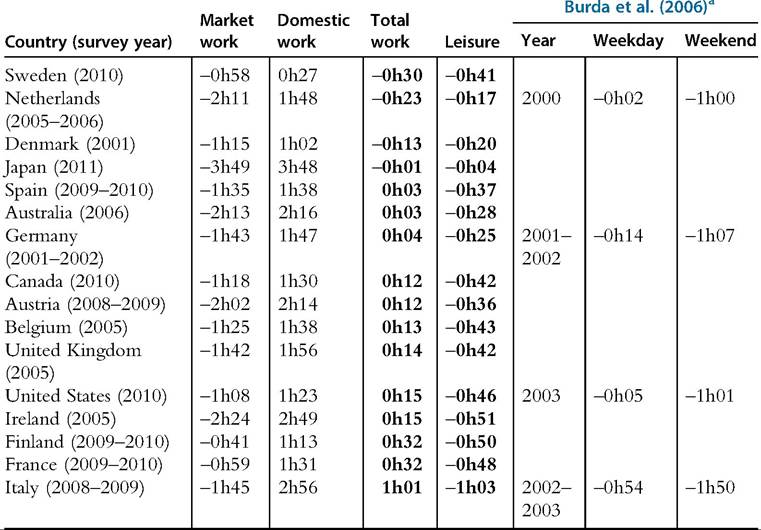
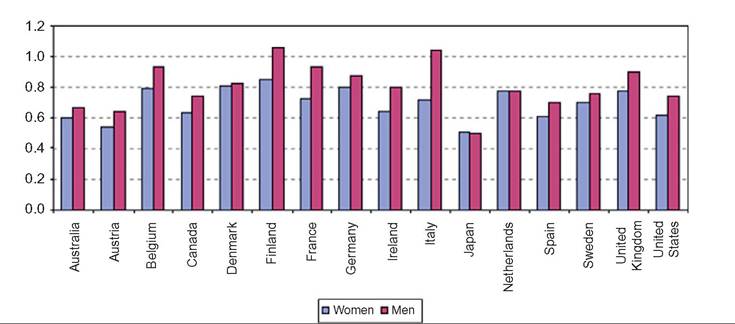
country Data Hours Population Perimeter Measure of hours independent variable Brines (1994), CS Self-report Couples No childcare Amount weekly Dependencea United States 1983-1985 Age #8805;18 in 1983 (current and long-term) Greenstein (2000), CS Self-report Couples No childcare Amount weekly Dependence United States 1987-1988 Age lt;65 Schneider (2011), CS Diary Married men and No childcare Amount daily Dependence United States 2003-2007 women Age 18-65 Gupta (2007), CS Self-report Married women No childcare Amount weekly Annual earnings United States 1992-1994 Age 18-65 Relative earnings Gupta and Ash CS Self-report Couples No childcare Amount weekly Annual earnings (2008), United 1992-1994 Age 18-65 Relative earnings States Wage Killewald and Panel Self-report Married men and No childcare Amount weekly Annual earnings Gough (2010), 1976-2003 women Earnings share United States Age lt;60 Employed FT Bittman et al. CS Diary Couples No childcare, Amount daily Dependence (2003), Australia 1992 Age lt;55 shopping converted to excluded weekly Connelly and CS Diary Married parents of Nonpaid Amount daily on Wage Kimmel (2009), 2003-2004 children aged lt;13 activities weekdays and Relative wage United States weekends Baxter and Hewitt Panel Self-report Women living in a No childcare Amount weekly Absolute earnings (2013), Australia 2001 couple Relative earnings Hallerod (2005), CS Self-report Two-earner couples — Shares of domestic Dependence Sweden 1998 with children work and childcare Relative wage Evertsson and Longitudinal Self-report Couples No childcare Amount weekly Dependence Nermo (2007), Sweden 1991 and 2000 Age 20-56 in 1991
Alvarez and Miles CS Self-report Two-earner couples Sevilla-Sanz et al. CS Diary Two-earner married (2010), Spain 2002-2003 couples, both working full-time Age 20-65 Kalenkoski et al CS Diary Couples with (2009), United 2000-2001 children aged lt;18 Bloemen and CS Diary Couples with Stancanelli (2014), bgcolor=white>1998 children Evertsson and CS Self-report Couples Nermo (2004), 1974-1999 Age 18-65 Gershuny et al. CS and Self-report Couples (2005), Germany, longitudinal Born lt;1932; Esping-Andersen CS Diary Couples et al. (2013), Denmark, United Kingdom, Spain Early 2000s Age 25-60
No childcare Amount weekly Relative earnings Only childcare Amount daily Wage Amount daily Wage No childcare Amount weekly Dependence No childcare Wife’s weekly share Employment status — Share daily Relative wage