Beliefs, Rituals, and Ceremonies
According to both field and literary research, the Bakarwal society is patriarchal in nature and is governed by elderly male members. They are the adherents of Islamic faith and follow Sunni5 school of thought.
Nonetheless, the entirety of their system of beliefs, rites, and ceremonies must be viewed through the lens of their pastoral way of life. According to Khatana (1984), these social systems fall into three categories: annual cycles, life cycles, and unique rituals and avoidances.According to yearly cycles, the Bakarwals practise religious festivals, irrespective of their faith, the most important of which are Eid, Nawroz, and Baisakhi. Although Baisakhi is not a Muslim festival; rather it is a cultural festival and mostly celebrated in Punjab and Jammu regions. As Bakarwals share the cultural traits with these areas and share historical roots in this respect, they also celebrate Baisakhi with rigour. Additionally, during their annual migrations, they visit several holy men’s or pirs' shrines for blessings and prayers. They make offerings to these shrines in the form of animals, cash, or fabric and in exchange seeking protection of their families and livestock from supernatural perils. These shrines are scattered throughout the region, and many of them have been spotted in the Himalayan peaks as well. They may take the form of graves or the shapes of stone memorials. Additionally, they visit several significant mountain passes, such as Rattan Pir Shah and Pir ki Gali, which are named after these pirs. When speaking with one of the elderly Bakarwals6 about this, he stated:
Pirs and their memorials have been an integral part of our lives. They are regarded as the intermediaries who stand between us and God. If any of us wishes for our prayers to be accepted, there is no other way than to please these almighty's beloved.
On various occasions, Gujjar-Bakarwals pay homage (Niaz) to these shrines and pirs by slaughtering an animal, offering clothing or blankets, and so on. When the Bakarwals cross the high-altitude mountains, they frequently tie woollen threads to the shrines as a sign of good fortune (Figure 3.1). Khatana (1984) also observed that they tie a bundle of offerings together that may consist of eatables and other household items, in a piece of cloth, and
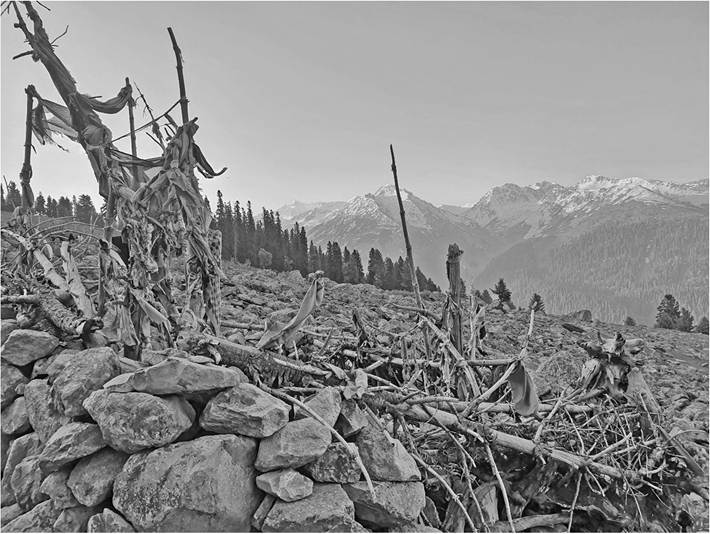
Figure 3.1 A Shrine in the Greater Himalayas Where the Bakarwals Tie Threads While Traversing the Passes
Source: Author
throw them into high altitude lakes; if they float, it is interpreted as a good omen for human and animal welfare. However, if the same item sinks into the water, it is regarded as a bad omen for the entire group.
Figure 3.1 displays a shrine in the Mathar region of the Greater Himalayas. This shrine is constructed entirely of stone that has been arranged in a circular pattern and is supported by tree branches. The structure, being situated on the high altitude pass of Mathar, paves the way to the summer pastures, which are only a day's travel away from this location. This spot for the shrine is supposed to have been utilised by their pir as a resting area in ancient times, and as such is believed to be blessed with a little water stream that bursts in the centre. Thus, drinking a glass of water from this site and tying a woollen ribbon or fabric for the wellbeing of both humans and animals is considered a good omen while crossing the pass. When asked if the region has a presiding deity, they stated that the spirits of their pirs are constantly present and bless them and their animals as they traverse these routes.
As the concept of life cycle rituals is defined, it includes rites associated with birth, marriage, and death.
3.2.1 Birth Rituals
Children born into the tribe experience a variety of significant life stages.
It is recommended that after the birth of a child in the Bakarwal family, the child's ear is whispered with the Islamic call to prayer, 'Azaan’. This ritual is usually performed by the pir or the molvi, but if neither of them is available, any senior and respected member of the community may perform it. This assures that the child's first words are those of the Azaan, which laud God and declare His oneness, as well as the veracity of Prophet Muhammad's teaching. Following that, the community is invited to a feast during which a goat or sheep is slaughtered, and the child is given a proper name chosen by their family or kafila pir. Naming is done on the day of birth, on the third day, or on or after the seventh day. A child is given a suitable name that is followed by the family names. In the case of a female child, her name is typically suffixed with 'Akhter', 'Bi', or 'Banu'. Following that, male children are circumcised by a barber who may or may not be a member of the tribe or a medical practitioner in front of community members. Because there is no set age for this practice, Bakarwals typically circumcise their children prior to the age of five. Circumcision7 is performed on children as young as three days old and as old as five years old as is found in this study. It is known locally as Khutna, and on this occasion, women perform traditional songs; a sheep or goat is sacrificed in the name of God - Allah,s and a feast is thrown for relatives and friends. They all pray to Allah for the child's welfare and long life. Additionally, blessings are bestowed by wishing the child to possess large flocks and horses.3.2.2 Marriage Rituals
Marriage is one of the most culturally diverse social structures among Muslims. It is an obligation in Islam. "The best people in my nation are those who marry and choose their wives," the Prophet Muhammad states, "and the worst people in my nation are those who avoid marriage and live their lives as bachelors” (Nuri 1987).
Islamic marriage is intended to follow Shari'ah principles as closely as possible, with the least influence from traditional practices. However, the majority of Bakarwal marriages incorporate rites and rituals in addition to those mandated by Islam, and both families adhere to them wholeheartedly. This fusion of Islamic law and cultural elements culminates in a highly polished affair that exemplifies cultural synchronisation to the hilt.After approximately 25 years or sooner, Bakarwals marry and are considered adults. Previously, they married off their offspring at a much younger age following the guidelines set by Islam whereby the early marriages are preferred, but as a result of continuous interaction with indigenous populations of Kashmir and Jammu regions like Kashmiris, Dogras, etc., the age of marriage has increased as new elements are introduced. Bakarwals practise endogamy and patrilocal marriage, with the women relocating to their husband's family following marriage. The ceremonies connected with marriage have been directly influenced by their mode of life and their belief system. After both parties agree to marry, the groom's relatives pay a visit to the bride's home to deliver gifts and schedule the nikah ceremony. The ceremony starts with the recitation of Islamic prayers and all the people present in the gathering ask for the goodness in the marital bond from the Almighty. Then while selecting the dates for the marriage ceremony, Tuesdays, as well as the third, 13th, and 23rd days of the traditional calendar month, are typically avoided as they are considered inauspicious for any economic activity or important social events. Additionally, days that coincide with migrations are not recommended for the ceremony. When both parties agree on a date, the groom, along with relatives and friends, pays a visit to the bride's house to perform the nikah ceremony in the presence of the molvi or pir. But before going to take the bride, the groom and the people accompanying him should visit the graveyard where their kin are buried and pray for them and get their blessings for the marital bond.
Following this the bride price (mahr)9 is determined by the elders in the presence of the bride and groom's fathers and is then handed over to the bride's father during the nikah ceremony. The girls' family hosts a feast for community members and the groom's family. But if we look at this from an Islamic standpoint, then the groom’s family is supposed to give the feast to relatives from both sides which is known as Walima.10 But this aspect of Bakarwal marriage is now replaced by the feast given by the bride’s family. Following that, the bride is escorted to the groom's house by her family and friends, who are treated to a reciprocal meal at the groom's house. Among the Gujjar Bakarwals, marriages are not consummated immediately after the wedding, even if the bride visits the groom's family. The girl is to remain with her mother-in-law for seven days, or in some cases three days, and is not to be seen by her husband during this time. Violation of this rule is regarded as a grave disrespect to the bride's family.Due to the Bakarwal society's patriarchal nature, sons are preferred over daughters, resulting in a large gender disparity. Additionally, it was observed that many men have died at a much younger age as a result of the Himalayas' difficult terrain. Thus, this demographic imbalance has a direct effect on their marriage pattern, as women are more likely to marry multiple times. This has also resulted in a relaxation of marriage-related norms within specified social boundaries. Widow marriages are also common and preferred among the Bakarwals. The first author was able to identify three such polygynous relationships in which men married for the second time as a result of the women being left alone following their husbands' deaths. Thus, there is no taboo against widow marriage in Bakarwal society. Islam also promotes widow marriages and allows the marriage of one man with the maximum of four women and this is evident among the Bakarwals as well.
As the daily life revolves around the concept of Sunnah11 among the tribe, it is also regarded as a good deed to marry a widow to support her and her children both socially and economically.3.2.3 Death Rituals
Death rituals vary by culture and are typically related to religion (Chachkes & Jennings 1994). While Islam has established criteria for rituals from birth to death, the historical context and process of acculturation have a significant influence in deviating from the established regulations. Kashmir's cultural diversity has facilitated the development of rituals linked with many religious groups, resulting in rites that are distinct from those observed by groups in other locations. When a person is on the verge of death, he or she is laid in the direction of Mecca, i.e., qibla, and fellow Muslims are invited to assist by bringing the dying person some water to drink or by reciting the shahada.12 It contains passages from the Quran and prayers ("I bear witness that there is no deity but God, and I bear witness that Muhammad is God's messenger"), as well as Quranic chapters and prayers. It is considered sunnah of the prophet to encourage the dying to imitate the shahada in order to reassure them that these are their final words.
When a Bakarwal dies, his or her eyelids are closed and, preferably, a white cloth is wrapped around the head to bind the jaw. Later, the body is undressed and draped in a clean white cloth, while the limbs are straightened in unison with the body. Then, family members and friends are permitted to have one final glance at the deceased's face; and the body is quickly prepared for ceremonial cleansing (ghusl), shrouding (kafan), and burial (dafan). Ghusl, kafan, salat-al-janaza (funeral prayer), and dafan are all regarded fard-e- kifaya (collective obligations) of Muslims, and as such, if these commitments are met by a large number of individuals, other persons may be excused from their responsibilities.
Bakarwals bury their dead according to Islamic traditions and execute the same procedures on their graves. If a person dies while migrating, the deceased is buried along the migration route. At the location, a heap of stones called a cairn is built, and each year, they pay homage to the departed soul by passing by it and lighting a candle on the grave. They perform Fatiha Khwani13 on the anniversary of the deceased's death, in which a pir is summoned to read Quranic verses for the deceased's better afterlife; and a sheep or goat is sacrificed for a community feast. As per the Islamic belief, even if the body of the person dies, the soul enters the Barzakh, a state of waiting, until the day of judgement.14 On the day of judgement, all of the souls shall be blown into the graves of their owners and the day of resurrection will begin. The Bakarwals also follow this belief and pray for the better afterlife of the soul and the good reward at the time of resurrection. These rituals vary substantially according to region and season. If the death occurs in the summer pastures, the pir is unable to attend the incident. In this instance, the deceased is either carried to the mainland or the ceremonies are conducted during the subsequent migratory cycle. During the research for this study, a woman died in the highland meadows, and her body was carried down to the Kashmir valley, approximately 60 kilometres away, where she was buried in a local graveyard and ceremonies were performed during the following migratory cycle. Thus, rites and beliefs are strongly influenced by ecological factors and are well suited to the Bakarwals' migration cycle.
3.3
More on the topic Beliefs, Rituals, and Ceremonies:
- Beliefs, Values, Symbols, and Artifacts
- Life-Cycle Rituals
- Fertility Rites
- Combat in Rituals and Festivals
- Study of Selected Rituals of the Kuki Traditional Religion
- Life Cycle Rituals
- Southern Agricultural Religions
- Sacred Language and Sacred Time
- Confucianism and Daoism as Ways of Life
- The Speech, Beliefs, and Affiliations of Government Employees