Communicating with the Spirit World
Many African religions believe that the world of spirits and the world of humans are closely intertwined. Spirits live near human beings in the same communities and often exist in a reciprocal relationship with them.
Because spirits can interact and interfere with the lives of humans, religious rituals and ceremonies often focus on communicating with spirits or accessing their power. People may ask spirits to intervene with God on their behalf or to assist with particular problems in family or work life. In this section, we will discuss three practices associated with communicating with the spirit world: sacrifice, divination, and spirit possession.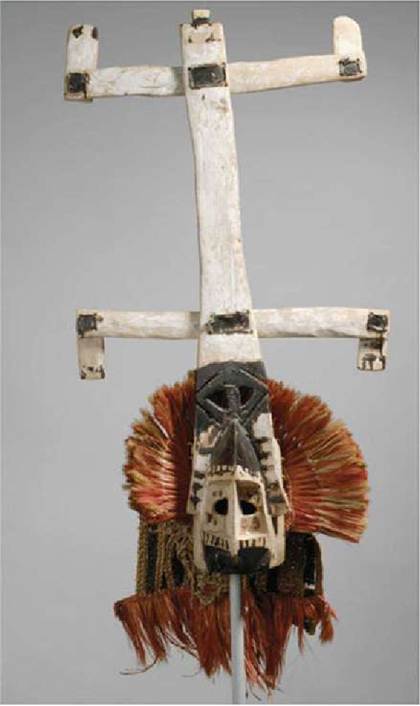
Among the Dogon, the dama is a rite of passage for young men, which also helps the recently deceased enter the state of being ancestors. The rite happens only once every several years, and masked participants dance to usher the recently deceased into the world of the spirits. The masks prepared for the dama are elaborately carved and represent animals and the mythical ancestors.
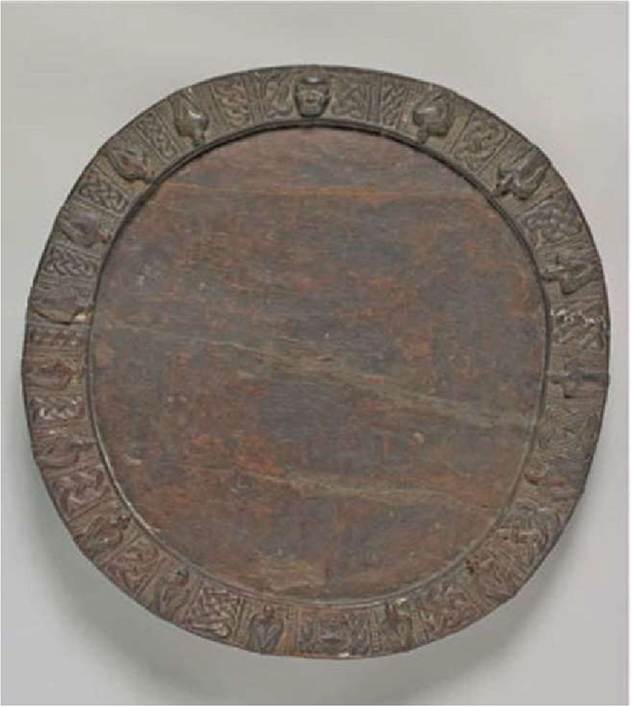
This early twentieth-century wooden tray is used to determine future events with the Ifa divination system, a part of Yoruba religion.
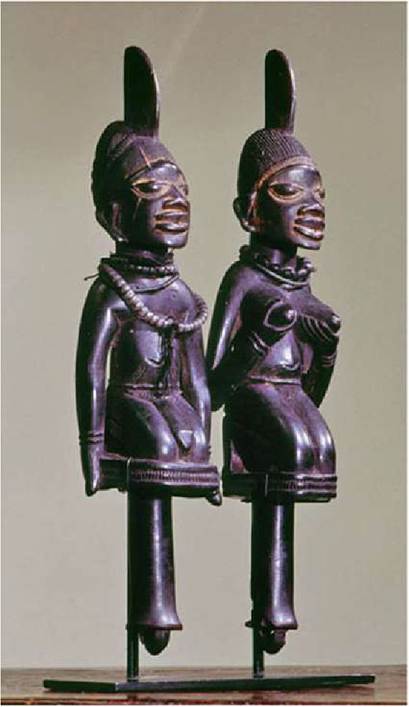
These nineteenth-century Yoruba sculptures from Nigeria commemorate twins who died. Twins are of great significance in many African religions, as among the Dogon, discussed in this chapter.
Sacrifice
In African religions, people communicate with supernatural beings primarily through sacrifice. In many religions the world over, the dedication of something valuable to a spirit—a sacrifice—has the power to influence that spirit.
A sacrifice can be relatively small, like a prayer or a portion of one’s daily food or drink. In some religions, such as the Yoruba, individuals may have a special relationship with one or more spirits or gods, and they might make these small offerings every day to maintain their goodwill. Yoruba families often have household shrines at which they make similar offerings to the spirits of the dead.In other African contexts, larger sacrifices, such as an animal, are necessary. In some religions, there has traditionally been a close relationship between practices of healing and sacrifice. Illnesses may be attributed to a spirit’s punishment of a person’s bad behavior. In such cases, an animal may be sacrificed as a form of repentance and as a request for forgiveness from the aggrieved spirit. The Nuer, for example, typically sacrificed animals as a substitute for the person who was afflicted with an illness. The animal was offered to the spirits in exchange for the health of the person. However, in recent years, as Nuer people have begun attributing illness to biological causes instead of angry spirits and as more have adopted Christianity, the use of animal sacrifice in healing has diminished.22
Divination
In some African religions, people use a practice called divination to communicate with spirits. Divination is the attempt to predict the future through supernatural agents or powers. The Yoruba use a divination system called J/h to communicate with the spirit world. A person called a diviner performs the divination. Yoruba religion teaches that Ijfa was developed when the High God removed himself from the earthly world. His children remained behind, and he gave them a divinatory system to communicate with him. They shared this system with human beings. Through Ifa, humans are able to communicate with and make requests of the gods and the spirits of the dead.
Yoruba diviners also use Ifa to predict the destinies and future of individuals. The diviners use a special collection of poetic verses and palm nuts to foresee future events and converse with supernatural beings.
Most of the verses are from sacred Yoruba texts, and they tell of the time of the gods and ancestors. Diviners select specific verses because they contain the solution to problems that faced the ancestors and are thus helpful in solving current problems.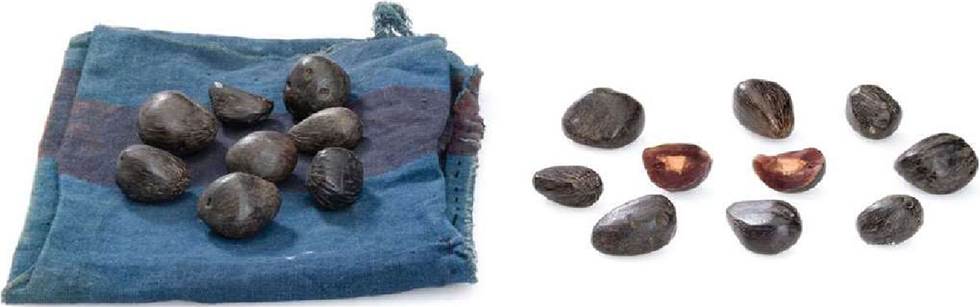
Palm nuts with a blue cloth bag, used by the Yoruba people for divination.
Spirit Possession
Another way people communicate with the spirit world is through spirit possession. A belief in spirit possession is prevalent throughout Africa, and in many places this sort of interaction with spirits is a normal part of daily life. People communicate with spirits through a medium —an individual who has become possessed. Although both women and men may become possessed, in many cultures women are far more likely to become so. The possessed individual is called a medium because she mediates between the human world and the spirit world. The spirit takes over the medium’s body, and the medium then acts according to the will of the spirit while she is possessed. Because spirit possession usually takes place in public, many people can witness the possession and interact with the spirit through the medium. When a spirit possesses a person, she enters a state of trance. Others may then talk to or make requests of the spirit through her.
Throughout Africa, people ascribe different meanings to possession. Some traditions view possession negatively. It might cause illness or cause the medium to harm others. In such cases, a spiritual healer may be called upon to drive the spirit away. Elsewhere, people may encourage possession in order to communicate with the spirit world. Individuals may use special dancing, music, and drumming to entice a spirit. In such contexts, some people may be more prone to spirit possession than others. Sometimes, people who have the ability to become possessed achieve a special religious status.
In West Africa, there is a widespread belief in spirits known as bori who have the power to possess people. There are many different bori, and they have individual personalities. Among the Mawri people of Niger, spirits such as Maria, a flirtatious young prostitute, regularly possess mediums.-3 In Northeast Africa, the zar spirits are similar to the bori and are prominent throughout the region. Possession beliefs are also prevalent among Muslims and Christians in Africa. As these religions gained adherents in sub-Saharan Africa, many elements of preexisting religious practice remained. For example, Mawri people began converting to Islam in the mid-twentieth century, but the bori spirits remain. In Northeast Africa, the zar spirits possess both Muslims and Christians.
Why do people become possessed? What does it mean for those who become possessed? Many scholars have tried to answer these questions. Some have argued that spirit possession is therapeutic for those who have mental or physical illness. Others suggest that spirit possession is a way for people to deal with rapid cultural change and the problems of modernity. For example, when the spirit Maria possesses Mawri women, they might be expressing an internal conflict between their desire to be traditional wives and mothers and the temptations of urban life and consumer culture, which Maria loves.-4
Women often play a prominent role in possession complexes, and throughout Africa women are often more likely to become possessed than men. When possessed, a woman becomes a powerful representative of the spirit world. Some scholars have argued that this allows women to achieve a temporarily high status in male-dominated societies and in religions in which men control mainstream religious practice.-5 However, women’s spirit possession practices are frequently at the center of religious life, not relegated to the margins. In Nigeria, Edo women participate in the worship of the god Olokun, who is at the heart of Edo religion. In Edo cosmology, Olokun is a very important god who has authority over fertility and wealth. By participating in the possession cult, Edo women gain permanent high status in the community. And although women who serve Olokun as priestesses do not have political authority in the same way men do, they can exert a great deal of power by settling disputes and acting as medical advisors.—
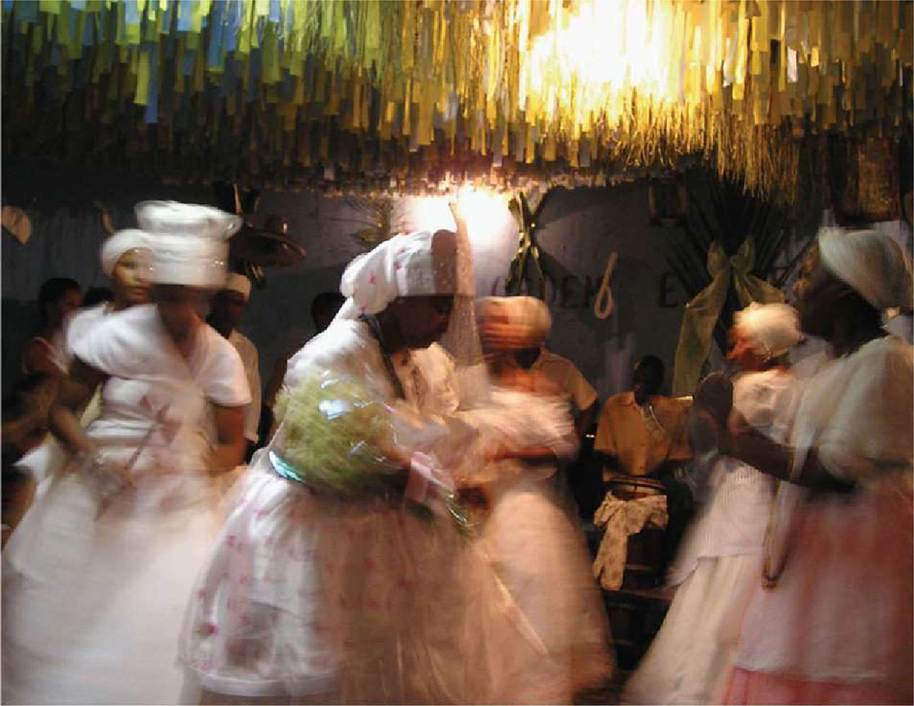
Two Orixas, or orishas, who possess the women, dance in their finery at a Candomble festival in Brazil held in their honor.
More on the topic Communicating with the Spirit World:
- This chapter explores the question of ontology, particularly that presupposed by Cartesian ontology, which divides the world between res cogitans and res extensa, that is, spirit and matter.
- Chapter 1 When First Diagnosed: Understanding and Communicating about HIV
- Spirit Possession and Women in Pauline Churches
- A. Feminine Language for Spirit: A Survey of Sources
- From its early days as a mechanism used to perform data processing, the digital is becoming the de facto medium for transmitting information, communicating and for sharing social life.
- Shamanism, Spirit-Possession and Ecstasy
- The Spirit as Mother in Early Syriac-Speaking Christianity
- Early Christian authors from the richly expressive religious environment of northern Mesopotamia were comfortable appropriating images of the feminine spirit of God known from the Hebrew tradition and developing their own language and images for her.
- Reforming the Sharita Courts at the Close of the Ottoman Empire: an Ottoman Project in the Spirit of Western Colonialism
- India, the seventh largest country in the world, is the most populous country in the world.
- On 4 February 2005, military guards welcomed guests arriving at the Livadia Palace near Yalta, as they had done sixty years earlier on the first day of the Yalta Conference, which brought together Franklin D. Roosevelt, Winston Churchill, and Joseph Stalin to discuss the shape of the world after the Second World War.
- The Human in the World
- World Peace
- IX The Game of the World
- Community and World Order[‡‡]
- Epilogue: The Puzzle of World Peace
- The fragmentation of the Third World
- Creation and the Nature of the World
- THE WORLD OF HUMAN BEINGS
- The essence of the social world