CULT SITES
A great deal of our information about Italic religion comes from the archaeological investigation of sanctuaries. Many cult sites have been known for hundreds of years, but a huge range of them have been excavated only quite recently, as a result of the intensification of activity by the archaeological authorities in regions such as Umbria, Marche, Abruzzo and Molise.
Cult sites are often found in urban contexts, but the evidence for these is mostly late in the Hellenistic period, and typical Italic shrines are rural, open air and occupying places of exceptional natural significance (Riva 2007: 103). This latter type of site was also well known to the Romans, as well as to many other ancient Mediterranean societies.Very common are sanctuaries on mountain peaks, spread along the great massif of the Apennine chain. A high density of such sites is known from Umbria, where the deposition of small votive figurines on many of the high peaks probably follows Etruscan precedents (Colonna 1970; G. Bradley 1997). An emblematic site is the peak of Monte Torre Maggiore which rises to a height of 1120 metres over the plain occupied by the important city of Interamna Nahars. The earliest frequentation is indicated by votive figurines of the fifth century BCE. Monumental temples on two different alignments were later set up here, probably in the third and second centuries BCE. A similar situation, where an early cult site is later monumentalized, can be found in Samnium at Monte Pallano in the Sangro valley (Faustoferri & Lloyd 1998). Peak sanctuaries are also commonly found in other Mediterranean regions, such as Crete and Attica (Malone & Stoddart 1994: 184).
Other places of natural significance that seem to have encouraged the setting up of cult sites include groves. The most famous example is the sacred grove of Diana Nemorensis in Latium, “ruled” by an escaped slave (Ovid Fasti 3.259-74; C.
M. H. Green 2007). Other sites are known in Latium, such as the groves of Ferentina and of Diana at Corne near Tusculum (Ampolo 1993), and in other Italic regions, notably Lucus Angitiae on the shore of the Fucine Lake, in the territory of the Marsi. Again, worship of deities associated with groves is familiar from Roman literary sources such as Cato (De agricultura [On Agriculture] 139), who gives a prayer which implies that the deity might be unknown (“Whether you are a god or goddess to whom this grove is dedicated...”), and Seneca the Younger (Letters 41.3), who notes that the Romans also venerate “the sources of great rivers; we build altars where large streams of water suddenly burst forth from hidden regions; we worship hot springs; and we consecrate certain lakes because of their darkness or depth”. Here again there are many Italic parallels, such as the Umbrian shrine at the source of the river Clitumnus (Pliny the Younger Letters 8.8; Scheid 1997) and the Lucanian cult of Mefitis at the sulphurous springs of the Lacus Ampsanctus (De Cazanove 2007b). Springs were also frequently the site of cult, and some deities, such as Hercules and the goddess Cupra, seem to have a particular connection with them.Italic cult sites are also found in natural caves, which usually have seen considerably earlier prehistoric activity, such as the cave of Grotta Bella in southern Umbria, and the Grotta del Colle at Rapino in the territory of the Marrucini (Monacchi 1986; Campanelli & Faustoferri 1997: 58-61). Other open-air cult sites are also referred to in inscriptions, such as the hurz (probably similar to Latin hortus, garden) of Ceres where sacrifices at fifteen altars were specified in the Agnone Table (Prosdocimi 1996).
Open-air cult sites were, as we have seen with the case of Monte Torre Maggiore, frequently replaced or augmented with monumental structures. These usually took the form of temples, whose stone podia and terracotta architectural decoration survive better than their wooden superstructures (note for example the fine terracotta figurative cycles from Civitalba in Umbria and Monterinaldo in Picenum, from the second and first c.
BCE). The gradual development of a sanctuary is particularly clear at Monte Torre Maggiore where the original votive deposit was discovered under the pronaos (the colonnaded porch) of one of the temples. This sort of development was undoubtedly common elsewhere, despite the difficulty of tracing the fragile archaeological remains of votive deposits and ancient buildings in the same zone. Although some temples are found as early as the fourth (and perhaps even sixth) century BCE in Umbria, most examples in Italic areas date from after the Roman conquest (Torelli 1999: 125; G. Bradley 2000: 158-63). This means that the development of Italic cult sites in monumental fashion is intimately associated with the complex processes subsumed under the term “Romanization” (to which we return later). In Samnium the great period of monumentalization is the second century BCE, when impressive temples were set up at sites such as Pietrabbondante, luvanum and Schiavi d’Abruzzo (Figs 15.3-15.5; Bispham 2007: 205). The standard “Etrusco-Italic” form of temple consists of a podium with steps up to a central cella (chamber), and columns at the front; often an altar stood at the front of the temple. By the end of the second century BCE more elaborate theatre-temple complexes were being created, at sites such as Praeneste in Latium and Pietrabbondante in Samnium (Torelli 1999: 130). The association of temple and theatre shows that dramatic performances (and perhaps also political meetings) were an integral part of the religious festivals held at these sites.Sanctuaries often played a critical role in Italic states, encouraging their formation and anchoring the identities of those who participated in festivals held there. It is often supposed that this is particularly true of sanctuaries in Italic areas like the central Apennines and Samnium where full urban centres were rare before the first century BCE. In such districts they might act as civil, economic and administrative centres (Campanelli & Faustoferri 1997: 29), although it is debatable whether this should be taken as part of a genuine non-urban institutional “system” of pagi (Latin “districts”) and vici (“villages”) (Stek 2009: 107-21).
It is certainly the case that sanctuaries often play what we might call an aggregative function, acting as poles around which communities (and sometimes urban centres) formed. A case can be made for this role in Umbria where sites like Ameria and Spoletium were used as cemeteries and for the deposition of votive objects some time before they became urban centres between the fourth and second centuries BCE. Though somewhat later, there are also clear cases of this in Samnium, as with the creation soon after 90 BCE of a municipium (a Roman administrative town centre) around the sanctuary complex at luvanum (discussed below). The existence of Italic sanctuaries on boundaries, such as that recorded in the Cippus Abellanus, on the border between Abella and Nola in Campania, must show an appreciation and perhaps appropriation of the territory of the community through the placement of the sanctuary, as is well documented in archaic Greece (De Polignac 1995). Various laws and regulations governing the activities at these sanctuaries have been found. At Rapino a text is described as totai maroucai lixs, a “law for the (or a) touta, i.e. community, of the Marrucini” (Vetter 1953: 218). At Iguvium in Umbria, the Iguvine Tables prescribe rituals to be followed that help unite and define the participants as a community (lustratio, piaculum) (Prosdocimi 1989: 478-80). The central ceremony of expiation (la-Ib 9, elaborated in Via 1-VIb 47) is described with the formula “for the ocar (stronghold), for the tota (community)”.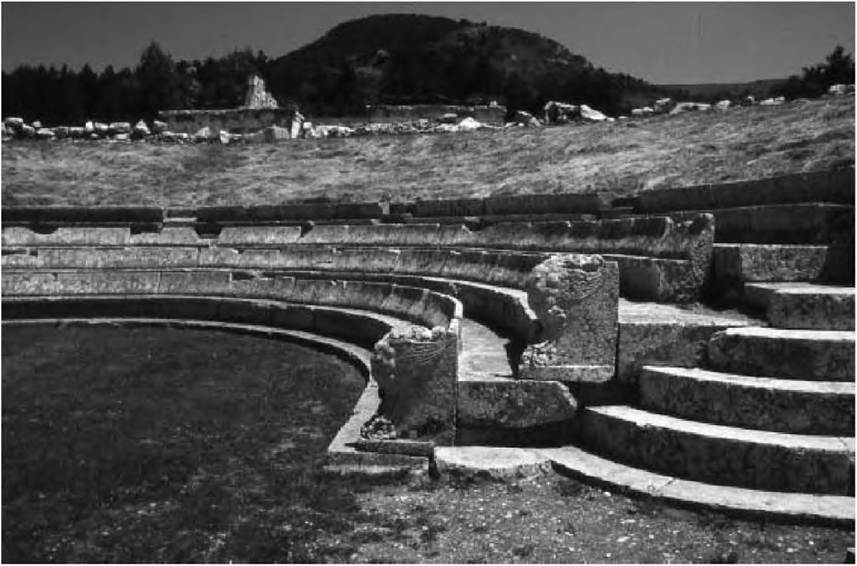
Figure 15.3 Pietrabbondante: theatre-temple complex (Temple B), ca. 100 BCE. Photo: Guy Bradley.
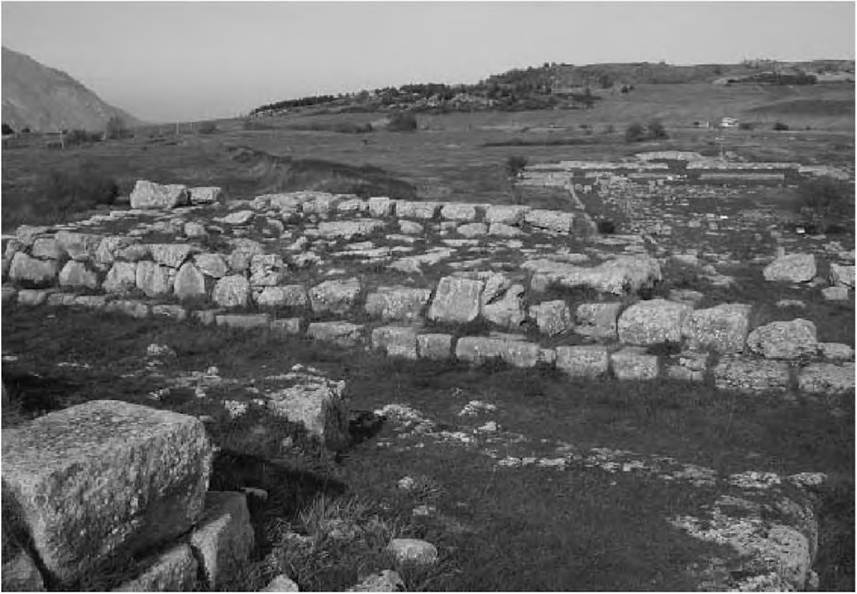
Figure 15.4 luvanum: view of monumental forum (early imperial era), from the acropolis. In the foreground are the corner of Temple A (first
half of the second century BCE) and a side view of Temple B (mid-second c.
BCE). Photo: Guy Bradley.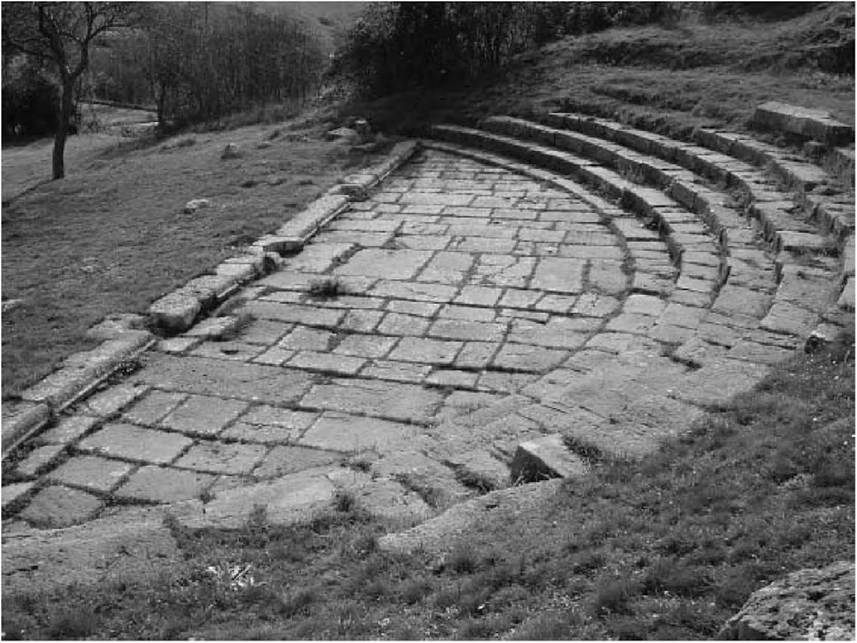
Figure 15.5 luvanum: theatre built into the slopes of the acropolis (second
c. BCE). Photo: Guy Bradley.
Many sanctuaries also played a vital economic role. This is less well documented in Italic areas than in the Tyrrhenian coastal districts of Etruria, Rome and the bay of Naples, probably because the inland economy was less sophisticated. Nevertheless, in the Apennine districts where urbanism was slow to develop, sanctuaries were often important market centres. At luvanum in Samnium two temples and a theatre were constructed in the second century BCE on an elevated site overlooking a large meeting ground (Figs. 15.4 and 15.5; G. Bradley 2005b; Lapenna 2006). The economic function of the latter can be reasonably hypothesized on the basis of its later formalization as the extensive paved forum of the town in the mid-first century CE, and was perhaps earlier linked to transhumance, certainly an important part of the later economy. A famous example is the sanctuary of the goddess Feronia at Lucus Feroniae, a centre of cult and trade for the surrounding peoples from the archaic period (Livy 1.30.5, 26.11; the earliest archaeological evidence is fourth/third c. BCE). Dionysius of Halicarnassus (3.32.1-3) describes it as “honoured in common by the Sabines and the Latins”. “To this sanctuary”, he says, “people used to come from the neighbouring cities on the appointed festival days, many of them performing vows and offering sacrifice to the goddess, and many with the aim of trading during the festive gathering as merchants, artisans and herdsmen; and the fairs held here were more celebrated than anywhere else in Italy”. The economic importance of sanctuaries such as this is driven home by reports of the plunder of sacred objects and treasure by enemies, as happened here in 211 BCE, when Hannibal’s troops sacked the site.
Some sanctuaries were located on the coast, where sea-borne traders might call in.
Characteristic of their function is their extra-urban position, a more neutral meeting ground than inside city walls, under a protective presiding deity or deities, often female (Cornell 1995: 109). The presence of the gods presumably helped sanctify business pacts. The best-known examples of these “emporia” are in Etruria, at Pyrgi and Gravisca, but emporia also crop up in Italic areas, on the coast of Latium, for example at Minturnae, and in Picenum, for example at Cupra Marittima (Colonna 1993; Riva 2007: 103). This last sanctuary was, according to Strabo (5.4.241), established by the Etruscans, who were also present further north along the Adriatic at Spina and Adria.This type of sanctuary, with its ready accessibility to outsiders, seems often to have been multi-ethnic in character: Gravisca and Pyrgi have very strong Greek and Phoenician presences, for instance, and Dionysius’s description of Lucus Feroniae would seem to imply that many different peoples participated in the life of this sanctuary. Whether this inclusiveness was limited to lowland Tyrrhenian zones is unknown. Rituals excluding foreigners are known from the Italic heartlands of the Apennines: the Iguvine Tables prescribe banishment for foreigners present during the lustration, whether Etruscans, lapudes or Narhartes (described in terms of “names”), or Tadinates (a local Umbrian group described in terms of “tribe” and “community”). On the other hand, this kind of restriction can be paralleled by the exclusion of hostes (foreigners) from certain (but not all) sacrifices in Rome (Paulus-Festus 72L; De Cazanove 2007a: 45). Different rituals and festivals must have had their own specific and appropriate rules.
The most dramatic and remarked upon Italic cult sites are the so-called federal sanctuaries, where pan-state groups came together. Usually this concerned particular ethnic groups like the Umbrians, and it is often supposed to have involved cooperation in military and political issues as well as religious concerns (Aigner Foresti 2005: 105). This type of sanctuary is well known from Rome, Etruria and other Mediterranean areas. The Alban Mount, for instance, was probably the most important federal sanctuary of the Latin peoples, where representatives of each community would take part in an annual sacrifice and banquet; in Etruria, the Fanum Voltumnae near Volsinii is recorded by our literary sources as the site of an annual festival involving participants from the Duodecim Populi, the Twelve Etruscan Cities (e.g. Livy 5.1.3-7; see Jean M. Turfa’s chapter on Etruscan religion in this book); in southern Italy, the Italiote League of Greek cities in the fifth century BCE met at the sanctuary of Hera Lacinia, near Croton.
Italic sanctuaries for which scholars have suggested regional significance include the Villa Fidelia at Spello (Umbrians), Pietrabbondante (the Pentrian
Samnites, if not all Samnites), Rossano di Vaglio (Lucanians) and Rapino (the Marrucini). None of these sanctuaries is as well documented by literary evidence as comparable examples from Latium and Etruria, which hampers our appreciation of their significance. But archaeological and epigraphic evidence helps to highlight their exceptional character. The sanctuary at the Villa Fidelia, outside Spello (ancient Hispellum), was certainly the site of an annual gathering of Umbrian and Etruscan peoples in the 320s CE, as is specifically recorded by a letter to Hispellum from the Emperor Constantine (CIL XI 5265). An amphitheatre, theatre and huge terracing walls show its use three centuries earlier in the Augustan era for games and theatrical performances. Evidence of Umbrian religious activity on the site dates back to the archaic period, with a third or second century BCE Umbrian dedication to Jupiter (G. Bradley 2000: 244- 5; Sisani 2006: 113; Manconi 2010). At Rossano di Vaglio in Lucanian territory, the diversity and sophistication of the finds, including armour, inscriptions, about a thousand coins, and marble statuary, indicate that the sanctuary enjoyed more than local significance. The site was monumentalized from the fourth century BCE with a large paved courtyard, an altar and water-collecting channels (Isayev 2007: 84-6).
The best known of the “federal” sites is Pietrabbondante, in the Pentrian area of Samnium (Fig. 15.3). The sanctuary itself was monumentalized in several phases, initially with an “Ionic temple” of the second half of the third century BCE, a new temple (Temple A) in the second quarter of the second century BCE, and ultimately a grand theatre-temple complex (Temple B) around 100 BCE. Strikingly there is a reference on an incomplete inscription to a safinim sak[araklum], a “Samnite sanctuary”, possibly indicating that Temple A was of significance for the whole of Samnium (De Cazanove 2007a: 53; Stek 2009: 40-41). The regional significance of the sanctuary is again indicated by the types of finds, including weaponry that may have been dedicated as a result of collective Samnite military activities (and not just against the Romans and their allies, as is shown by the typologies and dates of the arms found). The dedication of spoils of war is a practice well known in the Mediterranean world, for example at Olympia, and at Pietrabbondante recalls the dedication offered during the Social War to Victory (Poccetti 1979: n. 16). It therefore seems likely that this type of sanctuary played an important ethnic role in the Italic as well as Etruscan and Latin regions.
More on the topic CULT SITES:
- MITHRAS AND CHRIST
- Ritual Violence and Human Sacrifice in the Americas
- CHAPTER FOUR Town and Country Urban devotions and rural rituals
- Bredholt Christensen Lisbeth, Hammer Olav, Warburton David. The Handbook of Religions in Ancient Europe. Acumen,2013. — 456 p., 2013
- B. Mary as Earth-Goddess
- Public inferiae for Lucius
- The Mantramarga
- Bibliography
- Chapter 6 Roxolana’s Memoirs as a Garden of Intertextual Delight
- The King Is Dead