Divine Healers at the Hot Springs
In the absence of dedications that explicitly name the divine healers credited with miracles, we can only speculate about their identity. Among Greek and Roman visitors, it is likely that Asklepios, the healing god par excellence, was the focus of visitors’ hopes for a miracle.
The most persuasive evidence in Palestine for the link between Asklepios and the hot springs can be found in coins issued by the city of Tiberias that depict Hygeia, the daughter of Asklepios and the goddess of health, sitting on a rock from which a stream emerges, holding a serpent in her right hand, and feeding it from a phiale in her left hand (Meshorer 1985, 34 no. 78; Rosenberger 1977, 64 no. 6-7).[367] The stream depicted on these coins is meant to represent Hammat Tiberias, and the snake invoked Asklepios, to whom the animal was sacred. Hygeia’s link to Asklepios was made more explicit in a variation of this type produced in the third century that depicted Hygeia, still with serpent and phiale, standing opposite her father Asklepios (Meshorer 1985, 35 no. 86; Rosenberger 1977, 67 no. 19).[368] Elsewhere in Palestine, the cult of Asklepios Leontouchos is known from Ashkelon (Finkielsztejn 1986; Mastrocinque 2012, 104-10), and a cult of Serapis-Asklepios seems to have existed in the Roman colony of Aelia Capitolina.[369] Circumstantial evidence from the region of Hammat Gader can be found in an inscription set up by a man named Asklepios (Di Segni 1997, no. 5), whose name could reflect the god's popularity in the region, and in the discovery in Umm Qays (ancient Gadara) of carved gemstones depicting Asklepios and Serapis (Henig, Whiting, and Wilkins 1987, 377-78).For the identity of the healer envisioned by Jewish and Christian visitors, I return to the pilgrimage diary written by Antoninus of Placentia. He describes Hammat Gader as a place with “hot waters, which are called the springs of Elijah (thermae Heliae), where lepers are healed” (Itinerarium 7.14).
This tells us two things: first, that in the sixth century the baths were named for the prophet Elijah, and second, that healing at this time was primarily restricted to lepers.[370] The association between lepers and Elijah was likely based on the story of Na‘aman, who in the Hebrew Bible was healed from this disease after immersing seven times in the Jordan River (2 Kgs 5:1-14). While it was not actually the prophet Elijah who performed this miracle, but rather his student Elisha, it would seem that in the region surrounding Hammat Gader, Elisha’s deed was assimilated to the reputation of the far more popular Elijah (Hirschfeld 1997, 5).[371] Indeed, already in the fourth century, pilgrims such as Egeria were being shown the cave of Elijah on the east side of the Jordan River in the region of Gilead, not far from the hot springs (Itin. 16.1, 3).Elijah was already associated with Hammat Gader in the century before Antoninus wrote his account. When Empress Eudokia visited the site in the middle of the fifth century, she composed a poetic inscription that was set into the pavement of the Hall of Fountains (Area D; see figures 2 and 5). Her inscription lists sixteen parts of the bath complex, one of which she calls, “pure Elijah” (’HXlac; ayvoc;):
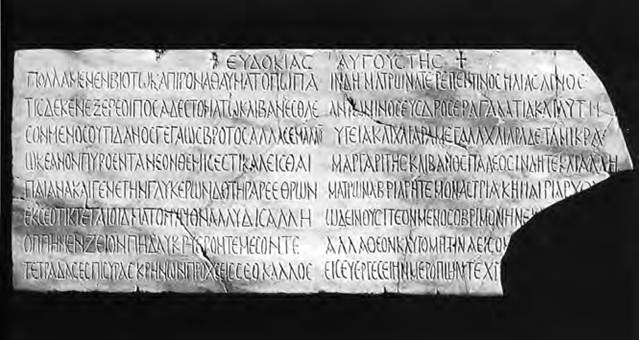
Figure 5. Fifth century inscription dedicated by Eudokia at Hammat Gader; Di Segni 1997, 231, fig. 45; used with the permission of the Israel Exploration Society.
+ Of the Empress Eudokia +
[Column 1] In my life many and infinite wonders have I seen
But who, however many his mouths, could proclaim, O noble Clibanus
By your strength, having been born a worthless mortal? But rather
It is just that you be called a new fiery ocean.
Paean and life source, provider of sweet streams.
From you is born the infinite swell, here, once there another.
On this side boiling, but there in turn cold and tepid.
You pour fourth your beauty into four tetrads of springs.
[Column 2] An Indian woman and a matron; Repentinus; pure Elijah;
Good Antoninus; dewy Galatia and
Hygieia herself; the large warm (baths) and the small warm (baths);
The Pearl; the old Clibanus; an Indian woman and also another
Matron; the strong (woman) and the nun, and the (spring) of the Patriarch.
For those in pain your mighty strength (is ever constant).
But (I will sing) of god, famous for wisdom...
For the benefit of men and.
Eudokia’s inscription confirms that Elijah was connected with the hot spring by the fifth century CE, but I would suggest that it also allows for the possibility of a much earlier association. Efforts have been made to identify the “four tetrads of springs” listed in the inscription’s second column to a set of sixteen fountains or pools in the archaeological remains. While this has not been possible, Di
Segni (1997, 230) is nevertheless likely correct that the names corresponded in some way to “individual parts of the baths or elements of the water system” that Eudokia saw as she toured the site. Among the eponymous names are two that date to the second century CE. The oldest identifiable name in the inscription is in line 11, Αντωνΐνος ευς (“good Antoninus”), a shortened form of Αντωνίνος ευσεβής, the name by which the emperor Antoninus Pius was known in the East. As the successor of Hadrian, whom rabbinic tradition placed at Hammat Gader, Antoninus Pius may have also visited the site and contributed to its beautification.[372] Another early patron, Repentius, is found in line 10. A newly discovered Latin inscription from the site identifies Sex. Cornelius Repentinus as the leg(ato) Aug(usti) pr(o) pr(aetore), under whose command a vexillatio of Legio VI Ferratae completed a building project (Eck 2014, 212-14).
The name Repentius is otherwise not attested in this region (Green and Tsafrir 1982, 87-88), making it highly probable that the unspecified Repentius mentioned in Eudokia's inscription was this same governor. According to Eck (2014, 213), enough is known about the career of Cornelius Repentius that this inscription must be dated between 189 and 192 CE. Antoninus Pius and Repentius, therefore, were likely associated with the thermae from its early years. Sandwiched between these two names is Elijah. If sections of the bath complex in the immediate vicinity of the one named for Elijah date to the second century, then it is possible that the association between Elijah and the hot springs is of similar antiquity.In light of this link between Elijah and Hammat Gader, I return to R. Judah ha-Nasi, who was credited with the controversial ruling about travel between Gadara and the hot spring on the Sabbath. Among the many medical complaints that rabbinic texts attribute to R. Judah was a prolonged toothache described in the Yerushalmi:
Rabbi lived in Sepphoris for seventeen years and ofthat time he spent thirteen suffering from a toothache... Elijah came to him in the guise of Rabbi Hiyya the Elder.. [Elijah] put his finger on the tooth and healed it. The next day Rabbi Hiyya the Elder came to him and said, “How does my lord do? As to your teeth, how are they doing?” He said to him, “From that moment at which you put your finger on it, it has been healed.” (y. Ketub. 12:3)
The appearance of the prophet Elijah in this passage marks a significant departure from accounts of him in the Hebrew Bible and rabbinic texts. In biblical stories, Elijah was known for his prophecies and for his ability to bend the laws of nature. For example, Elijah orchestrated a three-year drought and later caused it to rain (1 Kgs 17-18), and he brought about the spontaneous combustion of a waterladen altar (1 Kgs 18:36-40). While Elijah did perform a healing miracle in the raising of the widow's son (1 Kgs 17:17-23), such cures were not commonly ascribed to him in the Hebrew Bible.
Talmudic accounts of Elijah likewise credit him with miracles, but Kristen Lindbeck (2010, 95-135) demonstrated that most of these miracles do not relate to illnesses or physical ailments. Rather, these episodes revolve around a disguised Elijah rescuing a Jewish protagonist from a dangerous predicament. In fact, the episode in which Elijah heals R. Judah's toothache comprises one of only two stories in the Talmud when the prophet healed someone.[373] The absence of miraculous cures credited to Elijah in both biblical and rabbinic literature becomes more prominent in light of his association with Hammat Gader.I propose that the story of R. Judah's thirteen-year toothache and his vision of Elijah as the agent of his cure are not informed by the stories of Elijah found in the Hebrew Bible or elsewhere in the Talmud, where the prophet rarely performed miraculous cures. Rather, by the time that the Jerusalem Talmud with its story of R. Judah's toothache was completed in the fifth century, a long-standing link between Elijah and Hammat Gader may well have conditioned rabbinic authors to see the prophet as a source of healing, a connection that manifested itself in the story about the rabbi's toothache. Furthermore, R. Judah's relief from a legendary toothache and incubation at Hammat Gader share a similarity beyond the figure of Elijah; in both situations, healing was administered through a dream or vision. I would suggest that this form of epiphany underscores that influence of ritual incubation at Hammat Gader on this rabbinic story.
In conclusion, two tentative hypotheses can be offered. First, on the basis of Eudokia's inscription, Elijah's name may have been associated with the bath complex as early as the second century. It was not named exclusively after him at this point, but as a local wonder-worker, his name was given to part of the baths, alongside the names of important benefactors and figures from Greek myth, such as Hygeia and the nymph Galatea. The area named for Elijah might have even been a portion of the complex where Jewish visitors congregated. Second, Elijah may have been seen by both Jews and Christians as the agent of healing in their incubation dreams. This is possible on the basis of his name's appearance at the site alone, but it finds more support in the story of R. Judah's dream, in which Elijah is clearly portrayed as a healer. The coexistence of Asklepios and Elijah as divine healers for their respective populations is perhaps understandable, as Elijah's miracles and fiery chariot to heaven (2 Kgs 2) parallel Asklepios's wondrous cures and divine ascent in Greek myth.
More on the topic Divine Healers at the Hot Springs:
- Divine Healers at the Hot Springs
- THE DIVINE LADDER
- Incubation at Hammat Gader
- Conclusion
- Sites of ritual healing are known throughout the ancient Mediterranean world, particularly those related to the cult of Asklepios.
- Rabbinic Attitudes towards the Hot Springs
- Identity of Visitors to the Hot Springs
- THE DIVINE ROSARY
- THE DIVINE KA
- THE UNIQUE DIVINE NAME