Jacob
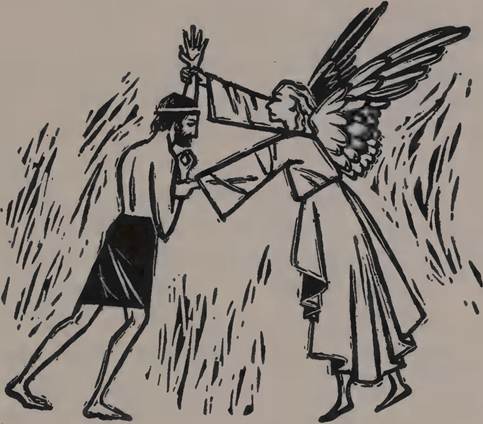
Now the story turns definitely to Jacob, and the manner in which he, and not Esau, fell heir to the covenant.
Twice, Esau had done wrong, first, in selling his birthright and, second, in marrying outside his clan. Still, he had not yet lost entirely, for Isaac had not formally indicated which son was to inherit.However, Isaac had gone blind with age and feared he might be about to die. For that reason, he felt he ought to give his formal blessing (in modern times, we would think of it as making his will). Consequently, he asked Esau, the hunter, to catch deer and prepare a dish of venison for him, after eating of which, he would bless Esau.
Rebekah overheard this and at once saw a chance to obtain the blessing for her own favorite, Jacob. She suggested that she prepare a dish of kid meat which Jacob would bring Isaac. Jacob was reluctant, feeling that Isaac would catch on to the deceit and curse him. Rebekah urged him on, however, and in order to enable Jacob to pass for Esau (since Esau was hairy and Jacob was not), she placed strips of hairy kidskin on his hands and neck.
When Jacob brought the dish, Isaac was suspicious because there hadn’t seemed time to catch the deer. Furthermore, the voice did not sound right. Isaac asked to feel the man’s hands:
27:22. And Jacob 'went near unto Isaac bls father; and he felt him, and said, The voice is Jacob's voice, but the hands are the hands of Esau.
This has become a common saying now, to express the hypocrisy of a person who says one thing and does another.
Isaac ate the meat and blessed Jacob. Part of the blessing went as follows:
27:29. Let people serve thee, and nations bow down to thee: be lord over thy brethren, and let thy mother's sons bow down to thee...
Isaac was thus saying that in the future the descendants of Jacob would conquer the descendants of Esau (rather than vice versa, which was what he thought he was saying).
This was mdeed an expression of what happened later in history. When the Israelites (the descendants of Abraham and Isaac through Jacob) invaded Canaan about 1200 b.c., they found the Edomites (the descendants of Abraham and Isaac through Esau) already on the spot. Esau was, after all, the elder brother. Furthermore^ the Israelites and Edomites were enemies from the start and continued so throughout their mutual history, as though reflecting the original enmity of Jacob and Esau.
Under David, the Israelites conquered Edom and ruled over the Edomites for over two hundred years, thus bearing out the words of Isaac’s blessing.
With the blessing safely obtained, Jacob left. Shortly after came Esau with his own meat. Now Isaac saw through the deceit but it was too late. His blessing had been given and could not be withdrawn.
Yet Esau pleaded for something and Isaac did his best:
27:40. And by the sword shalt thou live, and shalt serve thy brother; and it shall come to pass when thou shalt have the dominion, that thou shalt break his yoke from off thy neck.
In other words, Edomites would break free every chance they got, and this, too, was what actually happened. In 849 b.c., Edom revolted successfully and remained independent for fifty years, before being reconquered. Moreover, once Nebuchadrezzar destroyed Jerusalem and carried the Jews into exile, the Edomites were freed of Jewish overlordship for a second time. Under the pressure of Arabic attacks from the south, they moved into the southern portions of what had been the Jewish kingdom and established themselves in the neighborhood of Hebron, the old city of Abraham.
By the Greeks and Romans this southern section of Judea was therefore called “Idumaea,” a name which derives from “Edom.”
The Jews were restored to Jerusalem by the Persians about 520 b.c. and for some centuries lived side by side with the Edomites, or “Idumaeans,” in continual enmity. As long as the Persians ruled
JACOB / 163 both, however, nothing could be done by either side.
After the Persian Empire was overthrown, about 330 b.c., the Greeks under the successors of Alexander the Great ruled both, and still nothing could be done.However, in 167 b.c., the Jews revolted against the Greeks and, under the Maccabees, won their independence once more. Quickly, they attacked Idumaea, conquered and forced the Idumaeans to accept Judaism. This was the final defeat of the descendants of Esau, and Isaac’s blessing to Jacob was fulfilled.
But Isaac’s blessing to Esau still stood also, and the descendants of Esau had one last stroke left them. Rome brought an end to the Maccabean kingdom in 63 b.c. and made Judea a Roman province. The Romans governed it for a century thereafter through a family of whom the most important was Herod the Great, who reigned from 37 to 4 b.c.
Herod was of Idumaean descent and that was one of the reasons why the Jews always resented his rule, although he was a capable man who kept the land at peace and did his best to win his subjects over by beautifying their temple, and so on. The enmity between Jacob and Esau thus remained to the very end under the descendants of Herod. Finally, the Romans destroyed Jerusalem in 70 a.d., the Idumaeans were heard o£ no more, and the Jews went into permanent dispersion.
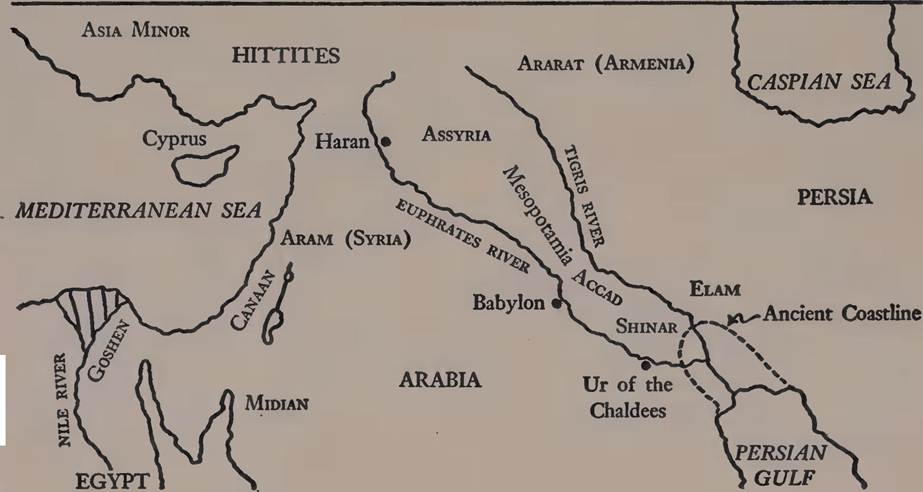
But, to get back to Jacob himself, the immediate consequence of his deceit was that Esau determined to kill the deceiver once Isaac was dead. At once, Rebekah, who heard of this, too, urged Jacob to leave home. She talked Isaac into sending Jacob to the city of Haran, to her brother Laban. In this way, he would not only be safe from Esau he would also have the opportunity to find a wife who was a descendant of Terah.
On his way to Haran, Jacob had a vision:
28:11. And he lighted upon a certain place, and tarried there all night, because the sun was set; and he took of the stones of that place, and put them for his pillows, and lay down in that place to sleep.
28:12. And he dreamed, and behold a ladder set up on the earth, and the top of it reached to heaven: and behold the angels of God ascending and descending on it.
God then appeared above the ladder and repeated the promise of giving the land to the descendants of Jacob. The covenant made with Abraham and Isaac
JACOB /165 was thus renewed with Jacoby and Isaac’s blessing was confirmed.
This is an impressive passage in the Bible but it was made use of in a way not so impressive, for “Jacob’s ladder” became a slang term for any rickety flight of steps.
A stranger flight of fancy concerning this story has to do with the coronation of kings of Scotland. This was done at a place called Scone, about 35 miles north of Edinburgh. The man who was to become king sat on a large stone in a ritual that dated back to primitive days. The stone was called the Stone of Scone.
In 1296, Edward I of England captured it in his Scottish campaigns and brought it back as a trophy to London. It is in Westminster Abbey now and is placed under the throne on which the English kings (who have claimed to be kings of Scotland ever since Edward I, and have actually been kings of Scotland since James I) are crowned.
In order to prove the sanctity of the stone and to show that it wasn’t a hang-over from heathen days (which, of course, it was) the rumor was put out that it was the authentic stone on which Jacob had slept when he had had his vision. It is therefore sometimes called Jacob’s Stone.
Jacob himself was greatly impressed and overawed at the vision. Upon awakening, he set up the stone upon which he had slept and poured oil on it as a sign that he was dedicating it to God.
28:19. And he called the name of that place Bethel...
In Hebrew, “Bethel” means “house of God’ and Jacob says this specifically:
28:22. And this stone, which 1 have set for a pillar, shall be God's house...
Jewish tradition made this the reason why the town of Bethel, eleven miles north of Jerusalem, was considered holy in later years. In addition to Jacob’s experience, there is the description in the twelfth book of Genesis of Abraham passing near the area in this first passage southward through Canaan.
Later on, the prophets Elijah and Elisha lived in Bethel for a time.For a period, however, Bethel became a symbol of disgrace, rather than holiness, to the Jews. When the kingdom of David and Solomon broke in two, Bethel became part of the northern half, while Jerusalem remained as capital of the southern half.
The northerners considered Bethel the most holy town in their part and set up religious rites there,
JACOB / 167 which the southerners considered improper and idolatrous. Eventually, after the destruction of the northern kingdom by the Assyrians, a reforming king of the southern kingdom, Josiah, destroyed all traces of idolatry at Bethel.
Bethel, because of its meaning, has retained a special place in the language. A place of worship is often called a “House of God” after all, and in England, chapels for certain Protestant sects, and especially places of worship for seamen, are sometimes called “bethels.”
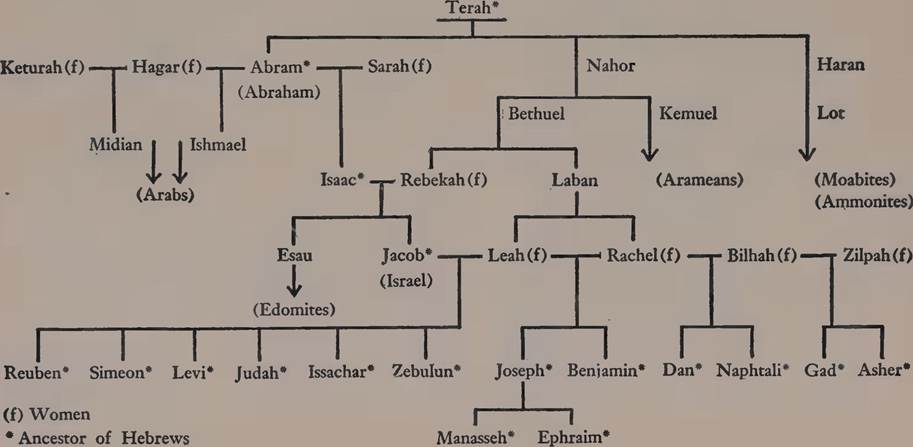
Reaching Haran, Jacob found that Laban had two daughters, Leah and Rachel. Eventually, Jacob married both, taking with each one a personal maid who served as a subsidiary wife. Leah’s maid was named Zilpah and Rachel’s was Bilhah.
By these four wives, Jacob had a total of twelve sons, of whom eleven were born during the time he remained in Laban’s house. With Jacob, the process of selecting among the descendants of Terah was ended, and all twelve together, with their descendants, were considered to have inherited the covenant with God. In fact, the later Jews considered themselves as members of one or another of twelve family groups, each of which was descended from one or another of Jacob’s sons. Those sons, in other words, were the eponymous ancestors of the various Jewish clans. When the descendants of Jacob conquered Canaan, that land was divided into districts named after Jacob’s sons.
The list of those sons is as follows:
First, Leah had four children, Reuben, Simeon, Levi, and Judah. Then Bilhah gave birth to Dan and Naphtali.
Then Zilpah gave birth to Gad and Asher. After that, it was Leah’s turn again and she bore Issachar and Zebulun (as well as a daughter named Dinah).In all this time, Rachel had had no children despite the fact that, of the four, she was the one whom Jacob truly loved. It was only after ten sons were born that Rachel finally had a child, an eleventh son named Joseph.
For the most part, these sons of Jacob are shadowy figures in the Bible, existing in a group, but not appearing as individuals. Of the eleven mentioned, only three play important parts in their own persons and these are Reuben, Judah, and Joseph. It seems fitting that these three names leave the clearest traces in the language.
In the days when Old Testament names were popular among countryfolk, Reuben was one of the favorites. It was so common, in fact, and seemed so
JACOB / 169 queer to the cityfolk, that a “reuben” became a slang word for an unsophisticated countryman. This has been shortened to “rube” and that is still used, in an insulting way, to mean a yokel or bumpkin.
When circuses and carnivals toured the countryside, it was common to take advantage of the unsuspecting farmers in a variety of small, cheating ways. Occasionally, the farmers, who might be inexperienced and not worldly-wise, but who were intelligent enough, caught on, and there would be a fight. The carnival man who had to meet the sudden onslaught would raise the cry Hey, rube,” meaning that the “rubes” were becoming violent, and the other carnival men would gather in self-defense. “Hey, rube” is still the common rallying cry among show people whenever rioting threatens.
The name of Judah lingers on in a more important way. When the Hebrews invaded Canaan, the descendants of Judah were assigned a large tract in the south and became the most powerful group in the southern half of the land. David, who was the most capable and powerful of the rulers of the land, was himself one of the descendants of Judah. Under him and under his son Solomon, Judah might be said to have ruled all the descendants of Jacob.
However, when Rehoboam, the son of Solomon, came to the throne, the northern groups revolted against the overlordship of Judah, broke away and became independent. Less than half the kingdom remained to the descendants of David, and this half consisted mostly of Judah itself. From the time of Rehoboam on, that part of the kingdom was called Judah.
The kingdom of Judah lasted from 933 b.c., the time of the successful northern rebellion, to 586 b.c., the time of its destruction by Nebuchadrezzar, a period of three and a half centuries.
After over four centuries of domination by the Babylonians, Persians, and Greeks, the people of Judah regained their independence once more (from 168 b.c. to 63 b.c.) under the leadership of a family known to us as the Maccabees. Two books giving the account of the rebellion that led to this independence, 1 Maccabees and 2 Maccabees, are included in the Apocrypha by the Jews and Protestants. The Catholics, however, consider them canonical and include them as the last two books of the Old Testament in the Douay Version, with the spelling “Machabees.”
The books of the Maccabees have come down to us in Greek and in the English translation, the kingdom of Judah is spelled Judea, which is closer to the Greek version of the name. Throughout the Greek
jacob / 171 and Roman period the land is called “Judea” and the people “Judeans.”
The word “Jew” is a shortened form of “Judean” (reaching English via the French) with the relationship obscured by the loss of the d. The religion of the Jews is, however, “Judaism,” where the name of Jacob’s fourth son shows plainly.
The ancient and traditional language of the Jews is still called “Hebrew” but there is a language now that is often referred to as “Jewish.” This is the German dialect picked up by the Jews in central Europe during the Middle Ages. This was carried eastward by them when they migrated into Poland, Romania, and Russia. It was then carried westward again when they entered England and the United States. This German dialect, which has picked up a fair sprinkling of Slavic words in east Europe, then, on top of that, another sprinkling of English words in America, is also called “Yiddish.” This is a version of the German word for “Jewish.”
The name Judah was popular among the Jews of the Greek and Roman period and was made more popular still by the fact that the hero of the rebellion against the Greeks was named Judah. Because of his hammerlike blows against the enemy, he was called “Judah, the Hammerer.” In Greek, “Judah” adds a final s, and the English version of the name becomes “Judas.” (Most Greek names end with s, as I said in Chapter 2, and when the Greeks came across any foreign name that did not, they often put an y at the end of it so that it would seem more natural to themselves as a name.) “The Hammerer,” in Greek, is “Maccabeus,” and so the hero of the rebellion was “Judas Maccabeus” and from that is derived our version of the family name “Maccabees.”
In the New Testament, there are a number of characters named Judah, spelled always in the Greek form of Judas. These include one of the brothers of Jesus and, according to the list in the Gospel of Luke, two of the twelve apostles. Because one of the apostles, Judas Iscariot, betrayed Jesus, the name Judas (but not Judah) has come to mean “a traitor.”
Another form of the name is “Jude” and a short epistle written by someone of that name is included among the books of the New Testament.
A feminine version of the name is “Judith.” A woman named Judith is the heroine of one of the books of the Apocrypha known as “the book of Judith.” It is considered canonical by the Catholics and is included in the Douay Version. The book tells of the siege of the Jewish city of Bethulia by Holo- fernes, a general of Nebuchadrezzar, and the manner
jacob / 173 in which Judith, by trickery, manages to kill the general and save the city.
Far and away the most popular of the names of Jacob’s sons in the modern world is, however, Joseph. So popular is it that one might jestingly suppose it to be the name of any American taken at random, so that you can address a stranger as “Say, Joe...” or speak of soldiers generally as “GI Joe.”
It is popular in other languages as well, taking up forms we may not always associate with “Joseph.” In Spanish, it is Jose, for instance, and in Italian, it is Giuseppe. There are also feminine versions, such as Josepha and Josephine.
In the Greek, “Joseph” adds a final 5 and becomes “Joses.” The New Testament contains individuals with names of both forms. There is Joseph of Arima- thea, who arranged to bury Jesus after the crucifixion. And, on the other hand, one of the brothers of Jesus is listed as Joses.
The Latin version of the name is Josephus (the common Latin ending for a name is “-us” and I have already mentioned the case of “Jacob" becoming “Jacobus” in Latin). This spelling has been made famous by one man, Joseph ben Matthias, a Jewish general who fought in the rebellion against Rome (67-70 a.d.) during which Jerusalem was destroyed. He was captured by the Romans, was well treated, and took the Roman name of Flavius Josephus.
Under that name, he wrote a history called Antiquities of the Jews, most of which was a version of the Bible. He also wrote a history of the Jewish rebellion. Next to the Bible itself, Josephus is our best authority on the early history of the Jews.
Of the remaining names I have so far mentioned, “Simeon” occurs in the New Testament as the name of a pious old man who recognizes the special nature of the infant Jesus. It occurs more commonly, however, in the simpler form Simon. The name of the apostle Peter, for instance, is actually Simon. Peter, which is the Greek word for “rock,” is only his nickname. He is Simon Peter or “Simon, the Rock.”
Another Simon of the New Testament is mentioned in the book of Acts. He was supposed to be skilled at sorcery and so came to be referred to as Simon Magus (“Simon, the Magician”) by the early Christians. He offered to buy from the apostles the power of giving spiritual benefits. This was indignantly refused him and ever since the buying or selling of positions in a religious body has been called “simony.”
“Levi” comes down to us chiefly because, in
jacob / 175 later Jewish history, it was felt that priests could only be selected from among certain of his descendants. The term “Levite” has therefore come to mean a priest. The third book of the Bible, which deals chiefly with instructions as to the rituals that priests must perform, is Leviticus. The surname Levy has become widespread among Jews because of this connection with the priesthood, as was true of the surname Cohen.
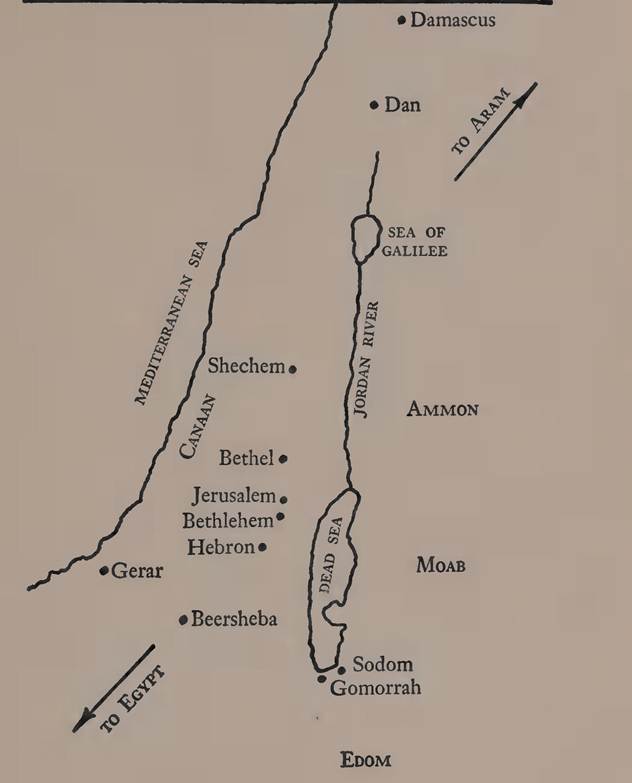
Dan is chiefly notable in that his descendants founded a city in the far north of Canaan, which they called after the name of their ancestor. This was the other half of the phrase “from Dan to Beersheba” which I mentioned earlier in the book.
The name sounds as though it were common among us moderns. Actually, however, the numerous Dans we may come across are not usually names in themselves, but are shortened forms of Daniel, which was the name of a prophet living in the time of the Babylonian exile. The name Dinah is a feminine form of Dan.
There is nothing much to say about the remaining five names, Naphtali, Gad, Asher, Issachar, and Zebulun.
Chapters 29, 30, and 31 tell of Jacob’s life with Laban. Both men were shrewd, worldly-wise men,
but Jacob was the cleverer. Laban tried to cheat Jacob, but the latter neatly turned the tables on the former. In the end, after twenty years of labor, Jacob, who had come to Laban alone and penniless, found himself with a large family and much wealth.
But now it was time to leave, for Jacob felt that Laban was growing to hate his son-in-law’s success. Without telling Laban, therefore, Jacob set forth on his way back to Canaan. He took with him his family and all he had earned, but in one respect, and without realizing it, he took more than his own.
31:19.... Rachel had stolen the images that were her father's.
The Hebrew word, translated here as “images,” is teraphim. These were family gods, common among superstitious primitive people. They were considered to be special spirits with the task of guarding the home in which they were placed. In the Revised Standard Version, in fact, the verse reads: “Rachel stole her father’s household gods.”
The Greek word for “image” is eidolon and from that comes our word “idol.” (The Douay Version says, “Rachel stole away her father’s idols.”) The worship of idols is “idolatry” and this is condemned in many places later in the Bible. The word is now used to represent any very great love, even where
jacob / 177 the supernatural is not involved. For instance, a young man might say he “idolizes” a young lady in order to show how much he loves her.
Another Greek word for “image” is eikon, and this is spelled “icon” in English. The images of the saints used in the Eastern Orthodox Church are called icons. Between 726 and 797 a.d. a series of emperors at Constantinople decided that the use of icons in the church was becoming too great. They felt the practice had become mere idolatry and should be forbidden. They started a program of destroying the icons and were known as the Iconoclast (“imagebreaking”) Emperors. For this reason, anyone who destroys some cherished idea or belief is called an “iconoclast” today.
But back to Jacob — Laban pursued his fleeing son-in-law and caught up with him. Rachel, however, successfully hid the images and Jacob talked Laban into a peaceful separation. Now it remained to meet Esau, who, Jacob felt, might still be angry over what had taken place twenty years before.
Jacob prepared gifts to mollify Esau and sent his family and herds across the river Jabbok into Canaan. He remained alone on the far side and there wrestled all through the night with someone in the shape of a man, whom Jacob considered to be an angel, or even God Himself. Apparently, this event implied some new type of relationship with God and this deserved a new name. At the conclusion of the wrestling bout, the man speaks to Jacob:
32:28. And be said, Thy name shall be called no more Jacob, but Israel: for as a prince hast thou power with God and with men, and hast prevailed.
Unlike the case of Jacob’s grandfather, the change in name is not complete. After Abram became Abraham, he was never referred to as Abram again. Jacob, however, is referred to as Jacob even after the change in name.
Nevertheless, in one respect, the name Israel is extremely important, for under that name, Jacob is the eponymous ancestor of all the Hebrews who later invaded Canaan.
His descendants are frequently referred to in the Bible as “the children of Israel,” and we call them Israelites. Once, the Israelites occupied Canaan, that became known as “the land of Israel,” or, simply, Israel.
When, in 933 b.c., the land of Israel split into two portions, the northern under Jeroboam I, the southern under Rehoboam (a grandson of David), the northern portion kept the name of Israel. The north- jacob / 179 ern kingdom of Israel lasted until 722 b.c., when Sargon II of Assyria destroyed its capital and carried off its people into slavery. For 2670 years after that there was no land called Israel on the face of the map.
Even so, the name could not be forgotten, for it lived on in the Bible. And then, on May 15, 1948, when an independent Jewish state was founded in Palestine again, it once more took the ancient name of Israel. An inhabitant of modern Israel is an “Israeli.”
With the gift of this new name, all went well at first. Jacob met Esau, who proved forgiving, and the two brothers came to an understanding.
33:16. So Esau returned that day on his way unto Seir.
Seir is the name of a mountain range extending from the southern tip of the Dead Sea southward to the Red Sea. It is included in the land later occupied by the Edomites, and Esau, the ancestor of the Edomites, already lived there. Seir is sometimes used (as it is here) as a synonym for Edom.
As for Jacob, he and his family settled near Shechem, the place where his grandfather, Abraham, had once built an altar during his early days in Canaan.
However, troubles come. The 34th chapter of Genesis describes warfare between the people of Shechem and the households of Simeon and Levi, two of the sons of Jacob. As a result, Jacob felt it wiser to leave the neighborhood and travel southward toward Hebron, where his father, Isaac, still lived.
They passed through Bethel, where Jacob had another vision of God, and then, south of Bethel and just a little short of the town of Ephrath, they had to pause. Rachel, it seemed, was about to give birth to a second child. It proved to be a son and Jacob named him Benjamin. (This name has proven fairly popular in modern times. One example is the early American scientist and statesman Benjamin Franklin. Another is the 23 rd president of the United States, Benjamin Harrison.) Rachel, unfortunately, did not survive:
35:19. And Rachel died, and was buried in the way to Ephrath, which is Bethlehem.
Bethlehem, the later name of Ephrath, is mentioned here for the first time. It is a town, about seven miles south of Jerusalem, which was later considered holy by both Jews and Christians, for David was born there and so was Jesus. Bethlehem still exists and pilgrimages are made to the traditional place of Jesus’ birth every Christmas.
Towns in far-distant places of the world have been named for it. The largest of these is the Bethlehem in eastern Pennsylvania, which has a population seven times that of the Bethlehem in Palestine, and which is noted as a steel-manufacturing center.
Bethlehem enters the English language in a very odd way. In 1402 a.d., the hospital of St. Mary of Bethlehem in London began to be used as a lunatic asylum. It was notorious enough to give rise to the custom of calling a lunatic or a lunatic asylum a “bethlehem” in colloquial language. Since “bethlehem” is a clumsy word in English it got shortened first to “bethlem,” then to “bedlam.”
In the days before modern programs of taking care of the mentally ill had been developed, a lunatic asylum was full of the wailing and shrieking of the mad. For that reason, “bedlam” has come to mean any scene of wild uproar.
As if Rachel’s death weren’t enough, Reuben, who was Jacob’s eldest son, behaved improperly and greatly offended his father.
Finally, Jacob reached his father at Hebron and was in time to be at his side when Isaac died at the age of 180. Jacob and Esau met again for the last time to bury their father.
With the death of Isaac, the Biblical story shifts its concentration to the children of Israel and in order to clear the way, there is a quick summary of matters pertaining to Esau. This is done in the 36th chapter of Genesis, in the usual way, by listing Esau’s descendants.
The most interesting of the descendants was one of the sons of Esau’s eldest son, Eliphaz:
36:12. And Timna... bare to Eliphaz Amalek...
This grandson of Esau, Amalek, was the eponymous ancestor of the “Amalekites” who, when the Israelites invaded Canaan centuries later, were among the most bitter of their enemies.
Some of the descendants are given a title:
36:15. These were dukes of the sons of Esau...
“Duke” is from the Latin dux, meaning “leader.” Under the Roman Empire, it meant a military leader, a man whom we might call a colonel or a general. During the Middle Ages, however, the title of “duke” became more and more important until it was applied to the most powerful noblemen.
The use of the word “duke” in this chapter of Genesis has therefore become misleading and the Revised Standard Version says instead, “These are the chiefs of the sons of Esau,” and uses the word “chief” for “duke” throughout the chapter.
Joseph
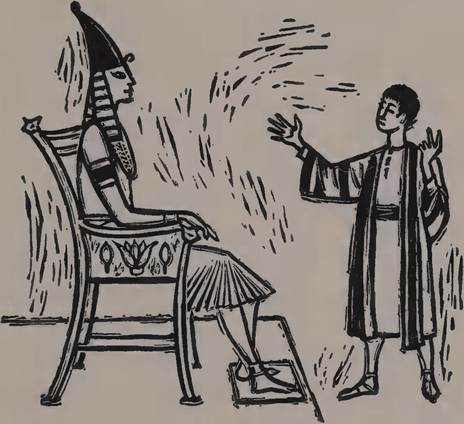
Of all his sons, Jacob loved Joseph and Benjamin most. In the first place, they were the youngest, and secondly, they were the sons of his beloved Rachel. And it was Joseph, in particular, that was his favorite:
37:3. No'W Israel loved Joseph more than all his children, because he was the son of his
old age: and he made him a coat of many colors.
For this reason, a colorful riding-cloak that was in fashion in the eighteenth century was called a “joseph,” while a plant known as the amaranth, which has leaves that are green above and reddish purple below, is sometimes called the “Joseph’s-coat.” Nevertheless, although the phrase “a coat of many colors” is famous, it does not seem to be an accurate translation. The Revised Standard Version has it: “and he made him a long robe with sleeves.”
This sort of favoritism naturally made young Joseph (only a teen-ager at the time) vain, and his older brothers jealous, joseph carried tales about his brothers to his father. He also had dreams that seemed to indicate he would rule over his brothers someday, and he was so foolish as to tell them about it.
There came a time, then, when the older sons were in charge of pasturing the flocks at Shechem, a considerable distance from their home at Hebron. (Herds often have to be taken long distances in search of pasture in dry countries.) Jacob sent Joseph after them to bring back any news of importance, and the older brothers saw Joseph approaching while he was yet at a distance.
37:19. And they said one to another, Behold, this dreamer cometh.
In many early cultures it was believed that dreams were sent by gods, you see, and might carry a message of future events. The second book of the Iliad, for instance, deals with a lying dream sent to Agamemnon by Zeus. The later Hebrews did not believe in such things and the prophets denounced magic cults that centered about dreams.
Just the same, the Bible does contain accounts of dreams that are recorded as true visions of God or true prophecies of the future. Jacob’s dream at Bethel is an example. So were Joseph’s dreams, in the view of the Biblical writers, though his brothers did not know that at the time.
A “dreamer” among many primitive peoples was someone who might take herbs to bring about a restless sleep and then predict the future from the dreams he had. It was with reference to this that the brothers used the sarcastic term “dreamer” when they saw Joseph coming. Nowadays, “dreamer” is more likely to mean someone who is so full of fantasy and impractical thoughts that he seems removed from the ordinary world.
It occurred to the brothers, out of envy, that they ought to kill him. However, Reuben refused to allow that, so Joseph was merely stripped of his coat (the sign of Jacob’s favoritism) and placed in a dry pit, while the brothers continued the argument.
37:25.... and, behold, a company of Ish- meelites came from Gilead 'with their camels bearing spicery and balm and myrrh, going to carry it down to Egypt.
Gilead is a mountainous region east of the Jordan River, noted for its trees and shrubs that exuded a gummy sap. (The Revised Standard Version has “gum” in place of “spicery” in this verse.) This sap is “balsam,” which is often shortened to “balm.” One of the uses of such gums was in the preservation of dead bodies, which is why it was being carried to Egypt, for in that land bodies were carefully preserved and made into mummies. We still use the expression “embalm” for such procedures.
On the other hand, cool and pleasant ointments can also be made from these gummy products, and the word “balm” has come to mean anything that is soothing, even an occasional kind word. As for “myrrh,” that, too, is a kind of gum, noted for being bitter (the name comes from a Hebrew word meaning “bitter”). It was used for incense and in per-
Joseph / 187 fumes. It is possible that the myrtle tree obtains its name from the word “myrrh.”
When the Ishmaelites (spelled “Ishmeelites” in this verse for some reason) came in sight, Judah suggested they sell Joseph to them as a slave. Thus they would be rid of their irritating younger brother without killing him. This was done. (In a later verse, the Ishmaelites are referred to as Midianites, but this is a minor matter. Whether they were descended from Abraham’s son Ishmael by Hagar, or through Abraham’s son Midian by Keturah, was probably of little concern to the later Jews. What was meant in either case was that they were of an Arabic clan.)
The brothers dipped the coat of many colors into the blood of a kid and brought it to Jacob, pretending that this was evidence that Joseph must have been eaten by wild animals in the wilderness. Jacob was stricken with grief and would not be consoled. When his family tried to comfort him, he said:
37:35.... For I 'will go down into the grave unto my son mourning....
The word “grave” in this verse is a translation of the Hebrew word Sheol and in the Revised Standard Version it is left untranslated. Jacob says, “... I shall go down to Sheol...”
The word Sheol was applied by the Hebrews to the underground land of the dead. The Jews did not make much of Sheol in early days; it was visualized merely as a place involving the absence of light and separation from God.
Other cultures also had a belief in an underground region of the dead, perhaps because it was common to bury dead bodies underground. The old Norse legends had such a place, in charge of a goddess named Hel, and from this arises the English word “hell” as a synonym for Sheol. The word “hell” is used in many places in the Old Testament. The Greeks also imagined such a region, in charge of a god named Hades, and the word “Hades” is used for Sheol in the New Testament.
Both the Norse and the Greeks thought of the underground region as at least partly a place of punishment for evil done on the earth. This picture grew sharper among the later Jews and the early Christians, who thought of hell, usually, as involving the burning of sinners in eternal fires. “Hellfire” is used therefore for any violent punishment, sometimes even for the punishments one inflicts on oneself, as when we speak of the “hellfire of remorse.”
About 1310, the Italian poet Dante Alighieri (usually known simply as Dante) wrote a long poem about his visions of the afterlife. The first third de-
Joseph /189 scribes his visit to all portions of hell and that section of the poem is entitled “Inferno.” This Italian word is derived from a Latin term meaning “lower” and has come to be used as still another synonym for the land of the dead.
In “Inferno,” Dante describes horrible tortures very vividly, with hellfire only a very small part of it. This is the clearest picture of hell ever presented, and from this sort of picture come words like “hellish” and “infernal,” meaning anything of monstrous wickedness or evil.
Just the same, the Hebrew Sheol had nothing of the torture chamber about it, and in later times the idea grew that there was an outer section on the border of hell, called Limbo (from a Latin word meaning “border”). Dante describes it as a shadowy place without punishment except for the absence of light and the separation from God, so that Limbo would seem to be exactly like the Hebrew conception of Sheol. In the Douay Version, Jacob’s remark is translated, “I will go down to my son into hell...” but in the edition I am using, a footnote explains that what is really meant is Limbo.
The story is interrupted in the 38th chapter of Genesis to recount a story involving the birth of several sons to Judah, including the twins Pharez and Zarah. The importance of this to the later Jews was that the royal house of David was descended from Judah, and this chapter explained the origin of the various chief divisions of the clan. Thus, David is later recorded as being of the “Pharzite” branch of the family, a descendant of Pharez, in other words.
With the 39th chapter, however, the story of Joseph is taken up again.
The Ishmaelites or Midianites, whichever you choose to call them, having bought Joseph from his brothers, took him to Egypt and sold him to Potiphar, a captain of Pharaoh’s guard. Joseph showed himself to be very capable and trustworthy so that he was gradually placed in more and more authority, until finally he was supervising the entire household.
However, his misfortunes continued. Potiphar’s wife fell in love with the handsome Joseph and made advances to him. Joseph felt that his loyalty to his master came first and kept away from her. Potiphar’s wife, furious, falsely accused Joseph of having tried to make love to her and the enraged Potiphar sent Joseph to prison.
Because of this story, a person who resists temptation by women is sometimes called “a Joseph.” On the other hand, a. lying woman is a “Potiphar’s wife.”
In prison, Joseph’s ability was again appreciated, and he received a position as a trustee. Two other
Joseph / 191 prisoners, former officials of Pharaoh, had dreams which puzzled them, and Joseph offered to interpret their meaning. One of them, Pharaoh’s butler, was released three days later and restored to office exactly as Joseph had predicted on hearing his dream. The other, Pharaoh’s baker, was hanged, again as Joseph had predicted.
After that:
41:1.... it came to pass at the end of two full years, that Pharaoh dreamed...
There is no telling which particular Pharaoh this one is. To find out we would first have to know exactly when Joseph was carried off to Egypt. In the early 1600’s, an archbishop of the Anglican Church, named James Ussher, worked out a scheme of dates, based on his study of the Bible, in which the creation was calculated as having taken place in 4004 b.c. Ussher’s dates are included in many editions of the Authorized Version, including the one I am using.
By Ussher’s calculations, Joseph was sold into Egypt in 1729 b.c. At this time, our old Egyptian records tell us, there were only weak Pharaohs in Egypt and their names are not recorded.
In any case, Pharaoh, whoever he was, dreamed two dreams. In one of them seven lean cows ate seven fat cows and yet remained lean, and in the other, seven thin ears of corn ate seven full ears and yet remained thin.
None of Pharaoh’s wise men could explain the dream and then the butler remembered the young Hebrew prisoner who had explained his own dream two years before. He told Pharaoh about Joseph, and Joseph was brought out of prison and stood before Pharaoh.
He warned Pharaoh that the dreams meant that there would be seven years of plenty followed by seven years of famine. He went on to suggest that food during the good years be stored for use in the years of famine and Pharaoh made the young Hebrew his prime minister in charge of fulfilling this plan.
Joseph became the most powerful and honored man in the kingdom, and even married into the Egyptian nobility:
41:45. And Pharaoh... gave him to wife Asenath the daughter of Potipherah priest of On....
Some suggest that Potipherah and Potiphar are the same person and that Joseph’s old master now became his father-in-law.
On was an Egyptian city six miles northeast of modern Cairo. It had huge temples dedicated to Egypt’s sun-god and, in later times, it was therefore
Joseph / 193 known by the Greek name Heliopolis, or “City of the Sun.”
There is an obelisk in Central Park in New York City, which is called Cleopatra’s Needle, although it was constructed thousands of years before Cleopatra’s time. It is called a “needle” because it is a tall, thin structure (like the Washington Monument, in fact, for that is a modern example of an obelisk). The word “obelisk” comes from a Greek term meaning “skewer” so that the official name, itself, had a needlelike quality about it. In any case, this obelisk originally stood in Heliopolis, so that New Yorkers have in their midst an actual reminder of the ancient city of Joseph’s wife.
By this wife, Joseph had two sons in Egypt:
41:51. And Joseph called the name of the firstborn Manasseh...
41:52. And the name of the second called he Ephraim...
This is one case where marriage with a foreign wife turned out well, for although Manasseh and Ephraim are here described as being half Egyptian, each was the eponymous ancestor of a clan of Israelites. In fact, in later times, no division of the land of Israel bore the name of Joseph. Instead there was one division known as Ephraim and another known as Manasseh. These are sometimes lumped together as the “Joseph clans.”
This did not mean that there were thirteen divisions altogether, as you might think, since one of Jacob’s sons, Joseph, gave rise to two clans. If the other eleven sons had given rise to a clan each, there would indeed be thirteen divisions altogether. However, the clan of Levi was reserved for the priesthood and did not take up a special segment of the land of Israel. This meant the twelve divisions were named after ten of the sons of Jacob (excluding Levi and Joseph) and two of his grandsons (Manasseh and Ephraim) for a total of twelve altogether.
] he Greek form of the name Manasseh is Manasses. One of the last of the kings of Judah was named Manasseh and he plays a role in the Bible under the Greek version of the name. He ruled from 692 to 639 b.c. and was considered by the Biblical writers to have been a very wicked king, since he worshiped idols. He was captured by the Assyrians, according to the book of 2 Chronicles and while in prison repented of his sins and prayed to God for forgiveness. God heard his prayer. He was restored as king and after that lived a life of virtue.
The prayer he is supposed to have uttered is contained in a single chapter of fifteen verses called the Prayer of Manasses. It is, however, to be found only
Joseph / 195 in the Apocrypha. Neither Jews, Catholics, nor Protestants consider it canonical.
The famine, once it hit Egypt, struck in Canaan, too, but there no wise administrator had stored food. Jacob and his family were in trouble and it was necessary to buy food in near-by Egypt. For this purpose, Jacob sent his ten older sons, retaining the youngest, the one remaining son of his dead wife Rachel:
42:4. But Benjamin, Joseph’s brother, Jacob sent not 'with his brethren; for he said, Lest peradventure mischief befall him.
It is for this reason that the pet child of a family, the parents’ favorite, is sometimes called “a Benjamin.”
The term “brethren” by the way, is an old-fashioned plural form of “brother.” The Revised Standard Version replaces it by the modern plural “brothers.” Nevertheless, the tale of Joseph is almost always referred as “Joseph and his Brethren.”
The ten sons of Jacob appeared before Joseph without, of course, recognizing him. Joseph did not reveal himself, but spoke through an interpreter, and asked after personal details on the pretense of believing they were spies. The brothers told Joseph they had a younger brother at home and Joseph demanded at once that they bring Benjamin with them to prove
196 / WORDS IN GENESIS their honesty, and imprisoned Simeon as a hostage.
However, he allowed them to buy food and then had the money they paid secretly placed in their sacks. When they found the money, the brothers were much troubled, for they felt they might be accused of robbery.
Jacob was angry at their return without Simeon and refused flatly to allow Benjamin to go back with them. However, the food supply was consumed and it was either return or starve; yet they could not return without Benjamin. At long last, Jacob was persuaded to allow Benjamin to go along and he insisted, moreover, that they take a double supply of money, returning the quantity for the first supply of food and using additional money for the second supply.
When they appeared before Joseph once more, Simeon was released and all eleven brothers were feasted and honored. But Joseph could not help but show favoritism to his one full brother.
43:34. And he took and sent messes unto them from before him: but Benjamin's mess was five times so much as any of theirs...
For this reason, “Benjamin’s mess” or “Benjamin’s lot” is a way of saying “the lion’s share.”
But Joseph was not quite done repaying his brothers for their wicked deed of long ago. When they
Joseph /197 left with the grain they had bought, all the money was again placed in the sacks. In addition, Joseph ordered that his own cup be secretly placed in the portion of the grain supply which was in Benjamin’s charge.
He then sent soldiers after them, accusing them of having returned evil for good. The brothers insisted on their innocence and agreed to be searched, saying that if any of them had stolen the cup, he should be executed. And it was found in Benjamin’s sacks.
They were brought back before Joseph, and the brothers were in extreme misery, for how could they return to tell their father that Benjamin had been executed?
Judah, in one of the noblest passages in all literature, pleaded with Joseph, explaining that Jacob could not live without Benjamin and offering to remain behind as a slave in place of Benjamin. Thus the brother who had first suggested selling Joseph into slavery was willing to be a slave himself to save Joseph’s brother.
At that point Joseph, who had been having trouble keeping up the pretense from the very beginning, could contain himself no more. He broke down and revealed his identity. There was a grand reconciliation and Joseph pointed out that good had resulted from the evil his brothers had planned, for he had
been sent into Egypt in advance in order that he might preserve lives during the famine. Now the rest of the family must come, too. For he said:
45:10. And thou shalt d'well in the land of Goshen, and thou shalt be near unto me, thou, and thy children, and thy children's children, and thy flocks, and thy herds, and all that thou hast.
Exactly where Goshen was is not entirely certain. Most scholars suspect it was in northeastern Egypt just west of the present site of the Suez Canal. It would be the first part of Egypt that immigrants from Canaan would enter, so it would be a natural place to settle. Goshen was more fertile and a generally more comfortable place to live in than was Canaan, particularly during the time of the famine. Furthermore, later on, when plagues afflicted Egypt, Goshen was spared. For these reasons, “Goshen” has come to mean a kind of Utopia, and “land of Goshen” is sometimes used as an exclamation by those who don’t like to say “Heavens! ”
All this was done and when Jacob, scarcely able to believe his happiness, was brought to Egypt, Pharaoh asked to see him. The old man stood before him and Pharaoh asked his age.
47:9. And Jacob said unto 'Pharaoh, The days of the years of my pilgrimage are an hundred and thirty years...
The word “pilgrimage” is a translation of a Hebrew word meaning a “sojourning”; that is, a “temporarystay,” and the verse reads, “The days of the years of my sojourning” in the Revised Standard Version. What Jacob seems to imply is that life is only temporary at best, for only God lives forever.
The use of the word “pilgrimage” implies something else, however. It comes from a Latin word meaning “foreigner” so that it refers to anyone who travels abroad to a land in which he is a foreigner. The Pilgrims of American history, for instance, traveled from England, first to Holland, and then to the New World.
During the Middle Ages, ordinary people rarely traveled except to visit some famous religious site — to go to Rome, for instance, or to Jerusalem, or to Mecca. A “pilgrimage” came to mean, therefore, a trip taken for religious purposes.
Well, to use “pilgrimage” here shows that the later Jews and early Christians came to consider life as something more than just a temporary stay on earth. It was an exile in a foreign land, for man’s true home was in Heaven. Life, they felt, was to be lived in such a way that you would be sure to return at last to Heaven when the weary pilgrimage of life was over.
This way of interpreting life turned up in an allegory published in 1678. (An allegory, from Greek words meaning “to speak otherwise,” is a story in which each character spoken of actually represents something other than what he seems to. A giant may represent the feeling of pride; a snake may represent treachery, and so on.) This allegory, perhaps the best ever written, was by an English preacher, John Bunyan, who was in jail at the time. Since it dealt with a progress of man toward the final goal of Heaven, it was entitled Pilgrim’s Progress.
And so Jacob and his children and grandchildren settle down:
47:11.... in the land of Egypt, in the best of the land, in the land of Raineses...
Here we have an anachronism. There were indeed a series of Pharaohs, twelve altogether, that bore the name Rameses or Ramses. (They are sometimes lumped together as the “Ramessides.”) The most famous and powerful of them was Rameses II, who ruled Egypt for 67 years, carrying on many wars and building many monuments. He probably won more fame abroad than any Pharaoh in Egypt’s long history so that it was reasonable to consider Egypt
Joseph / 201 (or just Goshen perhaps) as “the land of Raineses.” Although that might have meaning to the Jews who eventually put down the book of Genesis, it would not have had meaning to Joseph himself. The first Rameses did not become Pharaoh till 1315 b.c., four hundred years after the time of Joseph, and Rameses II reigned, according to one system of dating, from 1292 to 1225 b.c.
But now it had come time for Jacob to die. He had been in Egypt seventeen years and he was 147 years old. He called Joseph to him and blessed him and his sons:
48:5. And now thy two sons, Ephraim and Manasseh... as Reuben and Simeon, they shall be mine.
This indicated, as I said before, that they were to be eponymous ancestors of clans in Israel, although they were grandsons and not sons of Jacob. He then called in his two grandsons that he might bless them personally:
48:14. And Israel stretched out his right hand, and laid it upon Ephraim's head, who was the younger, and his lejt hand upon Manasseh’s head, guiding his hands wittingly...
The right hand, which was the more honorable
202 / WORDS IN GENESIS should have been to the head of Manasseh, who was the older, but Jacob refused to change the position of his hands, for he foresaw that the younger son, Ephraim, would end as the more powerful clan. Thus he repeated what his father had done, in giving a younger son a superior blessing.
Through much of Israel’s history, Ephraim was indeed the most powerful of the clans. Joshua, the successful general under whom the Israelites invaded and conquered Canaan, was an Ephraimite, and so was Jeroboam, under whom the northern part of the kingdom successfully revolted against the house of David. In fact, the northern kingdom of Israel was so much under the control of that most powerful of the northern clans that it was sometimes called Ephraim, just as the southern kingdom was called Judah.
Manasseh, while less prominent than Ephraim, contributed two heroes, Gideon and Jephthah, to the early history of the Israelites in the days before a king was established over them.
All the sons now gathered about Jacob’s bedside and he blessed each individually in terms that were supposed to foretell the future of the descendants of each.
He began in order of age, with Reuben:
49:3. Reuben, thou art my firstborn...
49:4. Unstable as water, thou shalt not excel...
As descendants of the oldest son, the clan of Reuben might have been expected to rule over the Israelites. It did not do so and the Bible blames that on the offense Reuben committed after the death of Rachel. In any case, the clan of Reuben plays no great part in Israelite history and peters out early, being absorbed by the stronger clan of Gad to the north and by the alien Moabites to the south.
Simeon and Levi come next:
49:5. Simeon and Levi are brethren; instruments of cruelty are in their habitations.
49:7.... 1 will divide them in Jacob, and scatter them in Israel.
The anger here is against the war between these clans and the people of Shechem which forced Jacob to leave that neighborhood. Thus, the second and third sons lose their chance at ruling.
The territory of Simeon was at the extreme south of Canaan and was early absorbed by the much stronger clan of Judah to its north. Neither Reuben nor Simeon contributed any particularly great men to Israel’s early history.
From the clan of Levi were chosen the priests, but the clan itself had no settled territory. However, Moses, who led the Israelites out of Egypt, and his brother Aaron were Levites.
It is the fourth son of Jacob, then, that inherits the kingship.
49:8. Judah, thou art he whom thy brethren shall praise... thy father's children shall bow down before thee.
49:10. The sceptre shall not depart from Judah, nor a lawgiver from between his feet, until Shiloh come...
In line with this prophecy, David, who became king of Israel about 973 b.c., seven hundred years after the traditional date of Jacob’s death, was of the descendants of Judah. The line of David continued to rule over the kingdom of Israel and then of Judah for nearly four hundred years until the destruction of Jerusalem by Nebuchadrezzar.
Now the prophecy says that the clan of Judah will rule “until Shiloh come,” but what that means and who or what Shiloh is has never really been determined. Perhaps it is a figure of speech meaning “forever,” but if so it has become garbled and we cannot make it out.
There was a town named Shiloh in central Israel,
Joseph /205 about thirty miles north of Jerusalem, which was an important religious center in Israel’s early history. However, it was destroyed by the Philistines even before David became king; in other words before the sceptre even came to Judah.
Some people have suggested that Shiloh might be a reference to Jesus. The Revised Standard Version has the verse read “until he comes to whom it belongs” and the Douay Version reads “till he comes that is to be sent.” Scholars are by no means satisfied with this possibility, but the theory has led to the word “Shiloh” being used in naming churches. That in turn has led to the word marking a bloody passage in American history.
There was a Shiloh Church near the town of Pittsburg Landing in southwestern Tennessee. On April 6 and 7, 1862, a terrific battle was fought in that area between Union soldiers under Grant and Confederate soldiers under Johnston, which ended in a very narrow Union victory. This “Battle of Shiloh” was one of the hardest fought of the Civil War.
The next six sons — Zebulun, Issachar, Dan, Gad, Asher, and Naphtali — each have a verse or two that probably had meaning at the time they were written down. We can only guess as to what events in the early days of Israel’s history they must refer. These were not among the major tribes, however. The
most important personality they produced was Samson, of the descendants of Dan, who was the Israelite “strong man” of numerous legends.
But for Joseph, Jacob’s favorite son, there is the prediction of great prosperity and, in the end, the two groups of Ephraim and Manasseh, together, were even more powerful than Judah through most of Israel’s early history.
49:22. Joseph is a fruitful bough, even a fruitful bough by a well; whose branches run over the wall:
Now most people take this to be a figure of speech indicating the growth of the descendants of Joseph. A tree, growing near a well, so that it has an ample water supply, will extend its branches over a near-by wall. In the same way, Ephraim and Manasseh, growing in population and power, will extend their rule over weaker neighbors.
However, this verse has had a curious importance in American history. A young man named Joseph Smith claimed that he had been directed by an angel to a set of golden plates covered with strange signs. With divine help he translated these signs and published it in 1830 as “the Book of Mormon.”
This book begins at the time when Jerusalem is about to fall to Nebuchadrezzar. Certain descendants
Joseph / 207 of Joseph escape and make their way westward across the Atlantic to the New World, which they colonize and where they live for centuries. Some of them became the American Indians.
Those who followed the teachings of Joseph Smith formed the Church of Jesus Christ of Latter-day Saints, a group usually called “the Mormons” after the book. To the Mormons, the verse that begins Jacob’s prophecy concerning Joseph is evidence of the truth of the Book of Mormon. They take the phrase “whose branches run over the wall” to be a reference to the descendants who crossed the Atlantic Ocean, for the ocean might be considered a kind of wall separating Europe from America.
All this might be unimportant if it had ended there. However, the Mormons, although forced by hostile neighbors to wander here and there, grew in strength. Joseph Smith was killed by a mob in 1844, but under a new leader, Brigham Young, the Mormons headed westward and eventually settled in the neighborhood of the Great Salt Lake. Here they founded a prosperous community which played an important part in the development of the American West and which eventually entered the Union as the State of Utah.
The Mormons are still a powerful group in Utah and in Nevada. What’s more, they actively seek converts and have missionaries all over the world.
But that still leaves Benjamin:
49:27. Benjamin shall ravin as a wolf...
Benjamin, although a small clan, was indeed warlike and, in Israel’s early history, was almost wiped out at one time as a result of a war in which it took on all the rest of Israel. Saul, who was the first king of Israel, was a Benjaminite.
However, although the descendants of Judah (David) replaced those of Benjamin (Saul) in the kingship, when Israel broke into two parts after the time of Solomon, the clan of Benjamin remained with Judah. It was the only one to do so.
At the conclusion of Jacob’s speech, the Bible summarizes matters thus:
49:28. All these are the twelve tribes of Israel...
The word “tribe” is used to mean any group of people supposedly descended from a common ancestor. The word itself comes from the Latin tribus, used by the ancient Romans to describe their own group divisions. It is possible that originally the Romans considered themselves as divided into three clans and that tribus means “one of three.”
If so, to speak of twelve tribes would be a little odd except that the “one of three” meaning, if it ever
Joseph /209 really existed, was quickly lost. Indeed, the most famous use of the word is in the phrase “the twelve tribes of Israel.”
So close is the connection between “tribe” and “Israel,” that the word is sometimes used in reference to Jews even through modern times. Shakespeare has Shylock, the Jew, say at one point, “For sufferance is the badge of all our tribe” (meaning that Jews were forced by circumstance to learn to be patient and enduring). Modern Jews may even jokingly refer to a fellow Jew as “one of the tribe.”
And now Jacob died. His age at death was less than that of his father and grandfather, but it was still great by our own standards. Abraham had died at 175, Isaac at 180, and Jacob at 147. These three long-lived men were the ancestors of a large population, and therefore they are “patriarchs” for reasons I explained in Chapter 3.
They did not live as long as the antediluvian patriarchs or postdiluvian patriarchs are described as having lived. Nevertheless, the history of Abraham, Isaac, and Jacob is told in so much more detail, and their interest to us is so much greater than is that of men like Lamech and Peleg, who are only names to us, that Abraham, Isaac, and Jacob are the patriarchs. The period of history between 2000 b.c. and 1700
b.c. is sometimes called the Age of the Patriarchs in consequence.
Jacob was taken back to Canaan and buried there, as he requested. He was laid to rest in the cave of Machpelah, where Abraham, Sarah, Isaac, Rebekah, and Leah all lay buried. (Rachel had a grave of her own near Bethlehem.)
Joseph then had to reassure his brothers that he planned no vengeance against them now that Jacob was dead. All ended their days in peace, presumably, but only the death of Joseph himself is mentioned:
50:26. So Joseph died, being an hundred and ten years old: and they embalmed him, and he 'was put in a coffin in Egypt.
Tradition states that he was the first of the brothers to die. Since he was the second youngest, all must have reached advanced ages. Only Benjamin could possibly have been alive at the time of Joseph’s death and yet have died younger than 110. For that reason, the sons of Jacob are sometimes also referred to as patriarchs. Not only did they reach great old ages, but each was the ancestor of an Israelite tribe, Joseph himself being the ancestor of two.
In fact, there are a group of speeches supposed to have been delivered by each of the sons of Jacob to their own children as they were dying. The collec-
Joseph /211 tion of these forms a book called Testaments of the Twelve Patriarchs. The book, however, is not considered canonical and remains in the Apocrypha.
With the death of the children of Jacob, the Age of the Patriarchs is over. In fact, verse 50:26, dealing with the death of Joseph, is the last verse of the book of Genesis.
And with the end of the book of Genesis, this book comes to an end, too. There is much to be said beyond this point, for the second book of the Bible opens on a completely new scene. Several centuries have passed. The Israelites are no longer a single family group, but consist of many thousands of individuals. Their place in Egypt has changed from that of honored guests to that of slaves who await liberation.
To take up the tale at that time, and show how the words of later portions of the Bible survive in our language and thought, must remain a task for future days.
Wilderness of Paran
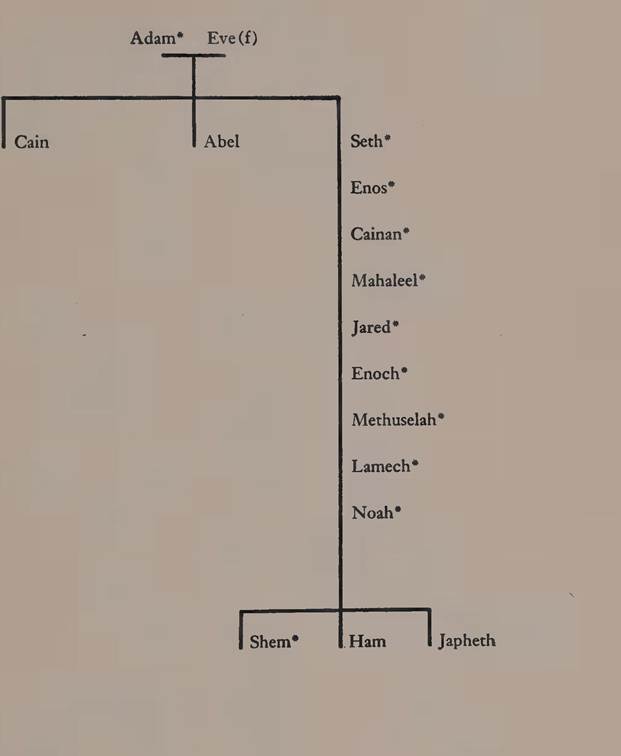
(f) Woman
• Ancestors of Hebrews
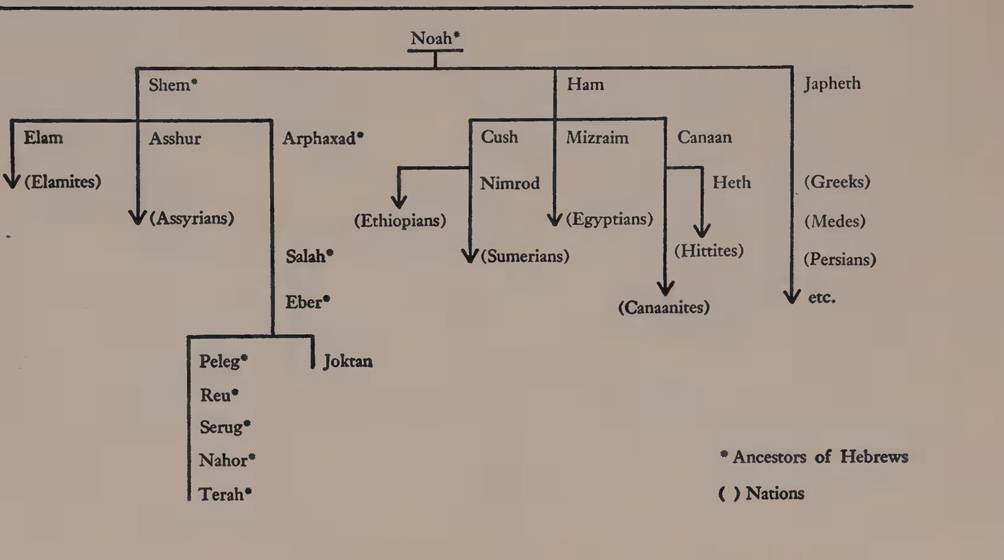
( ) Nations
Index
Aaron, 204 Abel, 66
murder of, 71 Abimelech, 134, 157 Abraham, 105, 125, 131ff, 166
birthdate of, 134, 135 death of, 145 Abram, 105, 124
childlessness of, 120
in Egypt, 110 Accad, 96 Adam, 49
age of, 74
punishment of, 61 Adamites, 54 Adam’s ale, 54 Adam’s apple, 59 Adam’s profession, 54 Adam’s wine, 54 Adonay, 45 Adonis, 45, 46 Aeneid, 21 Agamemnon, 185
Ages, Biblical, 74, 105
Akiba ben Joseph, 7
Akkad, 96
Aidermen, 118
Alexandria, 10, 11, 75
Allah, 30
Allegory, 200
Allen, Ethan, 48
All Hallows’ Day, 41
All Hallows’ Evening, 41
All Saints’ Day, 41
Almighty God, 125
Alphabets, 47, 78
Altar, 67
Amalek, 182
Amalekites, 182
American Standard Version, 19 “Am I my brother’s keeper?” 71
Amraphel, 114
Anesthetics, 53, 61
Angel, 121
Animals, clean and unclean, 85
Antediluvian patriarchs, 75
Antioch, 75
“Antiquities of the Jews,” 173 Anti-semitism, 100 Apocalypse of Noah, 92 Apocalypse of St. John, 76 Apocalyptic, 76
Apocrypha, 77, 170, 195, 211
Apple, 59
Apples of Sodom, 129
Arabs, 146
Aram, 138
Aramaic, 10, 138, 139
Arameans, 138
Aram-Naharaim, 142
Aran, 108
Ararat, 86
Arborvitae, 64
Archangel, 122
Argo, 88
Arioch, 114
Ark, 82
Armenia, 87
Arphaxad, 105
Aryan languages, 100
Asenath, 192
Asher, 168
Assyria, 51, 97, 107, 139,178, 194
Astor, John Jacob, 150
Authorized Version, 18
Babble, 104
Babel, 96 tower of, 103, 104
Babylon, 10, 29, 51, 55, 96, 103, 107, 114
Bahr Lut, 128
Ball, John, 62
Balm, 186
Barbarian, 104
Bashemath, 157
Bedlam, 181
Beech tree, 2
Beeri, 157
Beersheba, 132, 134
Begats, 73
Benjamin, 180, 183, 195, 208
Benjamin’s mess, 196
Bethel, 166, 180
Bethlehem, 180
Bethuel, 139, 143
Bethulia, 172
Bible, 7
American Standard Version, 19
Authorized Version, 18 books of, 20ff.
Catholic, 18 chapters of, 23, 24
Douay Version, 18 English, 16ff.
genealogies in, 73
German, 16
Greek, 11
Hebrew, 12
King James Version, 18
Latin, 12 printed, 23
Revised Standard Version, 19
Revised Version, 19 verses of, 24
Bible paper, 23
Bibliography, 6
Bibliophile, 6
Bigot, 28
Bilhah, 167
Bird of Paradise, 55
Birthright, 156
Blasphemy, 44
Bless, 39, 62
B’nai B’rith, 126
Boghazkeui, 140
Book, 2
apocalyptic, 76
apocryphal, 77, 170, 195, 211 Biblical, 20ff bound, 22
Book of Books, 20
Bunyan, John, 200
Burnt offering, 67
Butler, Pharaoh’s, 191
Buz, 138
Byblos, 6
Cain, 66
mark of, 72
sin and, 70 Cainan, 74 Calneh, 96 Canaan, 91, 95, 102, 108 Canaanite, 92 Canon, 8 Caphtor, 136 Carrhae, 109 ■Catholic, 14 Chaldean, 107 Cham, 80 Chaos, 29, 36 Chapter, 24 Chapter and verse, 24 Charlemagne, 119 Charran, 108 Chederlaomer, 114 Cherub, 64, 65 Cherubic, 65 Cherubim, 64 ■China, 4 Christ, 8, 9 Christian, 9
sabbath and, 38 Church, The, 14 “Cinderella,” 122 Civil War, 205 Clean, 85 Cleopatra’s Needle, 193 Code of Hammurabi, 114 Codex, 22 Cohen, 119 Columba, 89 Confound, 104 Constantinople, 75, 176 Constellations, 88 Corvus, 88 Council of Jamnia, 7 Council of Trent, 18 Covenants, 89, 90, 126 Cow, sacred, 69 Crater, 91 Creation, 31 Creator, 31 Creature, 32
Crete, 136
Critter, 32
Crocodile, 35
Cross over Jordan, 112
Cubit, 82
Curse, 62
Cush, 95, 97
Cuss, 63
Cyrus, 10
Dago, 153
Damascus, 138
Damasus I, 12
Dan, 168, 175
Daniel, 175
book of, 76, 122
Dante, 55, 187
Daughter of Eve, 63
Daughter of Heth, 158
David, 140, 161, 169, 180, 204 descent of, 190
Day, holy, 39
Day of Judgment, 123
Dead Sea, 115, 128, 155, 179
Dead Sea fruit, 129
Declaration of Independence, 31
Deluge, 84
Devil, 58
Diabolical, 58
Diacritical marks, 46
Dickens, Charles, 98
Diego, 153
Dinah, 168, 175
Divine Comedy, The, 55
Dominic, 151
Dominicans, 151
Douay, 18
Douay Version, 18
Dream, 185
Jacob’s, 164
Joseph’s, 185
Pharaoh’s, 191
Pharaoh’s baker’s, 191
Pharaoh’s butler’s, 191
Dreamer, 185
Duke, 182
Earthly Paradise, 55, 64
Eastern Orthodox Church, 13, 170
Eber, 102
Eden, 50
loss of, 63
Edom, 155
Edomites, 155, 161, 162, 179 Edward I, 165
Egypt, 1, 10, 11, 95, 101, 110, 147, 190, 200
El, 30
Elam, 114
Elder, 118
Elijah. 166
Eliphaz, 182
Elisha, 166
Elizabeth I, 17, 18
Ellasar, 114
Elohim, 31
Elon, 157
Embalm, 186
England, 153, 165
English, 16ff, 47
Enoch, 76, 79
books of, 76
Enoch (son of Cain), 73
Enos, 74, 78
Enosh, 78
Ephraim, 193, 201
Ephraim (nation), 202 Ephrath, 180
Eponymous ancestor, 92 Erech, 96
Esau, 148, 154, 159, 177, 179
birthright of, 155, 156 blessing of, 162
descendants of, 181
marriage of, 157
Ethiopia, 95, 101
Eumenes II, 4
Euphrates, 51, 96, 107, 138, 142 Eusebius Hieronymus, 12 Eve, 63
Ezekiel, 65
book of, 49
Fairy godmother, 122
Faith, 120
Fallen angel, 122
Faro, 111
Fig leaf, 60
Firmament, 34
Flavius Josephus, 173
Flood, 30, 80
Folio, 22
Forbidden fruit, 58, 59
France, 18, 151
Franklin, Benjamin, 180
French Revolution, 151
From Dan to Beersheba, 132
Gabriel, 123
Gad, 168
Garden of Eden, 50
Garfield, James Abram, 126
Gee whiz, 44
Genealogy, Biblical, 73
Genesis, 26
Genteel, 94
Gentile, 93
Gentle, 94
Gentleman, 94
Gerar, 129, 134, 157
German, 16, 47, 79
Germany, 100
Ghost, 33
give up the, 145
Ghost, Holy, 33
Giddy, 27
Gideon, 202
GI Joe, 173
Gilead, 186
Giraffe, 84, 85
Giuseppe, 173
God, 6, 268
Adam and, 528
angels and, 121
covenants with, 89, 90
God {Cont.)
creation and, 35 disobedience to, 70 faith in, 120 holiness of, 39 names of, 30, 42, 119 punishment by, 60, 71, 8 Iff, 127ff
rebellion against, 57, 121, 122 spirit of, 32ff stealing from, 69 testing by, 137
Godfather, 28 Godmother, 28 Golly, 44 Gomer, 93 Gomorrah, 127 Good-bye, 27 Good Friday, 27 Gopher wood, 82 Gosh, 44 Goshen, 198 Gossip, 28 Great Salt Lake, 115 Greek, 11, 78, 93, 136, 163 Greek Orthodox Church, 13 Green Pastures, 91 Guardian angel, 122
Hades, 187 Hagar, 120, 121, 131 Hagarenes, 146 Halibut, 41 Hallow, 39 Halloween, 41 Ham, 79, 86, 91, 101 descendants of, 95
Hamitic languages, 99 Hammurabi, 114 Haran, 105
Haran (city), 108, 143 Harrison, Benjamin, 180 Heathen, 88 Heaven, 44, 199
Heber, 102 Hebrew (language), 10, 46, 78
Hebrews, 102, 116
descent of, 74
Philistines and, 135
Hebron, 140, 146, 147, 162, 179,
184
Hel, 187
Heliopolis, 193
Hell, 187
Hellfire, 187
Hellish, 189
Helpmate, 52
Help meet, 52
Henoch, 79
Heretic, 17
Herod, 163
Herodotus, 136
Heth, 140
daughters of, 158
“Hey, rube,” 169
Hiddekel, 51
Hindus, 69
Hittite, 140, 158
Hobbes, Thomas, 36
Holiday, 40
Holocaust, 89
Holofernes, 172
Holy, 39, 68
Holy Ghost, 33
Holy One, 39
Holy Spirit, 33, 39
Husband, 90
Husbandman, 90
Huz, 138
Iago, 154
Ibrahim, 147
Icon, 176
Iconoclast, 177
Idol, 176
Idolatry, 176
Idumaea, 162
Iliad, 21, 185
India, 99
Indo-European languages, 99
Indo-Germanic languages, 99
Infernal, 189
Inferno, 188
Infidel, 120
Ink, 2
lonians, 93
Irad, 73
Iran, 100
Isaac, 131
birthdate of, 135 blessing by, 160, 161
death of, 181 marriage of, 141ff sacrifice of, 137 sons of, 154ff, 159ff
Ishmael, 124, 131, 132, 134 death of, 146 descendants of, 146
Ishmaelites, 146, 186
Ishmeelites, 187
Islam, 146
Ismail, 147
Ismailians, 148
Israel, 177
children of, 178
Israel (nation), 129, 136, 178, 202
tribes of, 208
Israeli, 179
Israelites, 161
Issachar, 168
Jack, 150, 152
TucliPt* Hl
Jacob,’148, 150, 154, 187, 195
blessing by, 202ff
blessing of, 161
death of, 201ff
Joseph and, 183ff
Laban and, 175 marriage of, 167 name of, 177
Pharaoh and, 198, 199
sons of, 167ff
vision of, 164
Jacobean, 153
Jacobin, 151
Jacob’s ladder, 165
Jacobus, 150, 153
Jacquerie, 151
Jacques, 150
Jacques Bonhomme, 151 James, 152
James I, 17, 153, 165
James II, 153
James III, 153
Jamnia, 7
Japheth, 86, 92
Jason, 88
Jaunty, 94
Javan, 93
Jehovah, 47ff
Jehovah’s Witnesses, 49
Jephthah, 202
Jeremiah, book of, 86 Jeroboam I, 178, 202
Jerome, 12
Jerusalem, 75, 117, 140, 163, 173, 206
Jesus, 8, 9, 10, 27, 44, 123, 139, 180, 205
brothers of, 152, 173
Jewish, 171
Jews, 6ff, 170
Mohammed and, 146 sacrifice and, 67
Semitic descent of, 100 Jiminy Christmas, 44 John, 48
Johnstown flood, 83, 84 Jordan, 112, 115
Jordan (nation), 147
Jose, 173
Joseph, 168, 172
blessing of, 206
brethren of, 195
death of, 210
dream interpretation by, 191,
192
Egyptian stay of, 190ff
Jacob and, 183ff
rule of, 192
sons of, 193
Josepha, 173
Joseph ben Matthias, 173 Joseph clans, 194
Josephine, 173
Joseph of Arimathea, 173
Joseph’s coat, 184
Josephus, 173
Joses, 173
Joshua, 202
Josiah, 166
Judah, 168, 187
Joseph and, 197 kingship and, 204 sons of, 189, 190
Judah (nation), 170, 202
Judaism, 170
Judas, 171
Judas Iscariot, 172
Judas Maccabeus, 171
Jude, 172
Judea, 7, 57, 163, 170
Judith, 172
Judith (Hittite), 157
Kassites, 97
Kemuel, 138
Keturah, 145
Kimmerians, 93
King James Version, 18
Kirjath-arba, 140
Kossaeans, 97
Laban, 144, 164, 167
Jacob and, 175
Lamech, 73
Land of Goshen, 198
Land of Israel, 178
Land of Nod, 72
Land of Promise, 110
Land of Rameses, 200
Langton, Stephen, 23
Language families, 99
Larsa, 114
Last trump, 123
Latin, 12, 47, 78
Leah, 167
Lebanon, 6
Levi, 168, 174, 179, 194, 203
Leviathan, 35
Leviathan, 36
Levite, 174
Leviticus, 174
Levy, 174
Limbo, 189
Lincoln, Abraham, 126
Lord, 43
angel of the, 121
Lord God, 45
Lord’s Day, 38
Lot, 109
capture of, 115
escape from Sodom of, 127, 128
separation from Abram of,
112
Lot’s wife, 128
Low, Seth, 150
Luther, Martin, 15
Lutherans, 15
Maccabees, 163, 170
books of, 170
Machpelah, cave of, 140, 145, 147, 210
Madai, 93
Magog, 93
Manasseh, 193, 201
Manasses, 194
Marduk, 36
Mark of Cain, 72
Masoretes, 12, 46
Masoretic text, 12
Matriarch, 75
Matriarchy, 75
Medes, 93
Mehujael, 73
Melchizedek, 116, 119
Men, holy, 40
Meshech, 93
Mesopotamia, 142
Mess, 156, 157
Methusael, 73
Methusaleh, 77
Michael, 122
Middle Ages, 14, 55, 199
Midgard serpent, 35
Midian, 145
Midianites, 187
Milton, John, 55
Mizraim, 95
Moby Dick, 124
Modern Sodom, 113
Mohammed, 146
Mohammedans, 146
Money, Biblical, 143
Mormon, book of, 206
Mormons, 95, 207
Moses, 204
Moslems, 146
Mosque, 147
Most High, the, 119
Mount Ararat, 87
Myrrh, 186
Myrtle tree, 187
Myths, Babylonian, 29, 36, 45, 65
Greek, 29, 45, 59, 88, 187 Norse, 35, 187
Persian, 56
Nablus, 109
Nabuchodonosor, 10η
Nahor, 105, 142
descendants of, 137, 138
Names, Arabic, 147
Biblical, 77ff, 148
changes of, 125, 177
English, 148
Greek, 148
Hebrew, 30 power of, 43, 58
Roman, 148 substitutions for, 44
Teutonic, 148
Naphtali, 168
Neapolis, 109
Nebuchadnezzar, 10
Nebuchadrezzar, 10, 107, 172,
206
Negroes, 101, 113
New Babylonian Empire, 107
New Testament, 9
Newton, Isaac, 150
Nile, 3
Nimrod, 96, 97 Noachian Flood, 80
Noah, 30, 80, 81ff, 86 descendants of, 92ff drunkenness of, 90, 91
Noah’s ark, 84, 88
Noah’s dove, 89
Noah’s raven, 89
Noah’s wine-cup, 91
Nod, land of, 72
Noe, 80
Non-Aryan, 100 Normans, 27
Obelisk, 193
Octavo, 22
Odyssey, 21
Offering, burnt, 67
Old Adam, 70
Old Serpent, 58
Old Testament, 9 names from, 149
On, 192
Original sin, 70
Orthodox, 13
Padan-aram, 143
Pagan, 88
Palestine, 136
Paper, 5
Paper, Bible, 23
Papyrus, 3
Paradise, 54
Paradise Lost, 55, 122 Paran, 134
Parchment, 4
Patriarchate, 75 Patriarchs, 75, 209
Age of, 210 antediluvian, 75 Christian, 14, 75 postdiluvian, 105
Paul, 9
Pergamum, 4
Persia, 56, 162
Peter, 174
Petra, 155
Pharaoh, 110, 111, 191ff, 198 Pharez, 189
Philistines, 134, 157 Phoenicia, 6
Phut, 95
Pickwick Papers, 98 Pig, 85
Pilgrimage, 199 Pilgrims, 199 Pilgrim’s Progress, 200 Pittsburg Landing, 205
Pope, 14 Postdiluvian patriarchs, 105 Potiphar, 190
Potiphar’s wife, 190 Potipherah, 192 Pottage, mess of, 156 Prayer of Manasses, 194 Presbyterian, 118
Priest, 117 Printing, 22 Promised Land, 110 Prophet, 129, 130 Protestants, 16, 24
names among, 149 Ptolemy Philadelphus, 11
Quarto, 22
Rabbi, 7
Rachel, 167, 176
death of, 180 Rameses, 200 Rameses II, 200 Ramessides, 200 Ramses, 200 Raphael, 122 Rebecca, 139 Rebeccaites, 144 Rebecca riots, 144 Rebekah, 139, 143, 157, 160, 164 Rehoboam, 169, 178 Reign of Terror, 152 Reuben, 168, 181, 186
tribe of, 203 Revelation of St. John, 76 Revised Standard Version, 19
Revised Version, 19
Rheims, 18
Rib, 53
Roman Catholic Church, 14
Rome, 3, 4, 12, 94, 163, 173
Root, Elihu, 30
Rube, 168
Sabbatarians, 39
Sabbath, 38
Sacerdotal, 118
Sacred, 68
Sacred cow, 69
Sacrifice, 68
Sacrilege, 69
Sacristan, 119
Sacristy, 118
Sacroiliac, 69
Sacrum, 69
Saint, 40
Saintly, 40
Salaam, 116
Salem, 116
Salt Sea, 115
Samson, 206
Sanctify, 39, 68
Sanskrit, 100
Santiago, 154
Sarah, 126, 131
death of, 139, 140
Sarai, 109, 124
Hagar and, 120, 121
Sargon, 96
Sargon II, 178
Satan, 56, 121
Saturday, 37
Saturn, 37
Saul, 208
Scotland, 153, 165
Scriptures, 7
Sea monster, 35
Sect, 16
Sectarian, 16
Seed, 89, 90
Seir, 179
Sela, 155
Sem, 78
Semite, 80
Semitic languages, 99 Senator, 118 Septuagint, 11, 26 Seraphim, 122
Serpent, 56
Seth, 74, 78
Seventh-Day Adventists, 39 Sexton, 119
Shechem, 109, 179, 184 Shekel, 143
Shem, 78, 86
age of, 105
descendants of, 102
Sheol, 187
Sheth, 78
Shiloh, 204
battle of, 205
Shiloh Church, 205 Shinar, 96, 114, 142 Sichem, 109
Siddim, vale of, 115 Simeon, 168, 174, 179, 196 tribe of, 203
Simon, 174
Simon Magus, 174
Simon Peter, 174 Simony, 174 Simpson, James, 53
Sin, 70
original, 70
Sky, 34
Smith, Adam, 149
Smith, Joseph, 206 Snake in the grass, 56 Sneezing, 62
Sodom, 113
destruction of, 127ff Solomon, 169 Son of Adam, 49 Son of Man, 49 Soul, 50
Spirit, 32
Spirit, Holy, 33 Stephens, Robert, 24 Stone of Scone, 165 Subtle, 56
Sumer, 96, 114, 142
Sunday, 38
Synagogue, 21
Syria, 139
Tammuz, 45
Tempt, 137
Terah, 105
Testament, 9
Testaments of the Twelve Patriarchs, 211
Tetragrammaton, 43
Tiamat, 36
Tidal, 114
Tigris, 51, 96, 142
Tilden, Samuel J., 30, 31
Till, 90
Timna, 182
Tiras, 93
Tithe, 119
Tobias, 123
Tobit, book of, 123
Tower of Babel, 103, 104
Transjordan, 147
Tree of good and evil, 51, 58, 59
Tree of life, 51, 64
Tribe, 208
Tubal, 93
Tyler, Wat, 62
Tyndale, William, 17
Unclean, 85
Urartu, 87
Ur of the Chaldees, 106, 107
Uruk, 96
Ussher, James, 191
Vellum, 4
Verse, 24
Victoria, 53
Volume, 5
Voluminous, 5
Vulgar, 12
Vulgate, 12, 18
Washington Monument, 193
Wealth of Nations, The, 149
Webster, Daniel, 31
Webster, Noah, 150
Week, 37
Whale, 35
Wilderness, 133
Writing, Iff
Wycliffe, J )hn, 16, 17
Yahveh, 48
YHVH, 43, 47
Yiddish, 171
Young, Brigham, 207
Zarah, 190
Zebulun, 168
Zeus, 29, 185
Ziggurat, 103
Zilpah, 167
More on the topic Jacob:
- Author Biographies
- Jacob's Well (John 4:4-42)
- REFERENCES
- Acknowledgements
- NOTES
- THE CONFLICT MANAGEMENT PROCESS
- Algert Nance, Rogers Kenita S.. Conflict Management and Dialogue in Higher Education. Information Age Publishing,2020. — 227 p., 2020
- The Revival of Esoteric and Neo-Pagan Thought
- NOTES