Jewish Mysticism
The origins of mystical thinking in Judaism can be found in the Hebrew Bible, in which at least one prophet, the sixth-century figure of Ezekiel, recorded visionary trances in which God appeared to him as a figure of infinite mystery, seated upon a throne:
Above the expanse...
was the semblance of a throne, in appearance like sapphire; and on top, upon this semblance of a throne, there was the semblance of a human form. From what appeared as his loins up, I saw a gleam as of amber—what looked like fire encased in a frame; and from what appeared as his loins down, I saw what looked like fire. There was a radiance all about him. Like the appearance of the bow which shines in the clouds on a day of rain, such was the appearance of the surrounding radiance.—Ezekiel 1:26-28
Visionary passages like these testify to a tradition of ecstatic meditation in biblical Judaism in which a prophetic writer experiences the presence of God in a manner that is at once direct and mysterious. For centuries, Ezekiel’s vision of the heavenly throne (which is also a chariot) served as an inspiration to mystics who sought a comparable glimpse of God and of the heavenly beings who, according to biblical tradition, surround his throne.
Another popular biblical text that served as inspiration for Jewish mystics was the opening chapter of the book of Genesis, in which the creation of the world and of humankind is described. What distinguished this school of mystical writers—known as kabbalists—from other visionaries was a fascination with the mysterious process of world creation and a deep curiosity about the role of the Creator in this process. This type of mystical inquiry, referred to in Hebrew as Kabbalah (i.e., “received tradition”), is often accompanied by some form of esoteric biblical interpretation, and it often incorporates some of the boldest kinds of cosmological speculation Jewish writers have ever indulged in.
Key to the writings of the Kabbalah is one underlying cosmic metaphor, the image of the Sephirot. The Sephirot are ten in number, and they can be visualized as connected “spheres” of divine power, or as stages in a process of divine self-revelation. As such, they represent at least one of two things: the primary attributes of God and the dynamic emanations of his creative force.
However, the goal of mystical meditation in Kabbalah goes well beyond a desire to describe God or his relation to our world in quasi-mythological terms. The kabbalists were united in their desire to reconnect heaven and earth through a process of contemplative prayer and restorative moral actions. Thus, every blessing that a Jew utters in praise of God, or every mitzvah that is performed in strict accordance with tradition, they taught, can now be invested with an almost magical power to “heal” the world (Hebrew, tikkun olam) and is directly related to the soul’s longing to reunite with its Creator. The end goal of this longing, kabbalists believe, is devekut, or a “clinging” to God that represents the highest state in mystical Judaism of the covenant relationship.
The Lurianic system of Kabbalah, in particular, has had tremendous appeal. In the “beginning” before creation, Rabbi Isaac Luria taught, God (whom kabbalists refer to as the Ein Sof, or “Infinite One”) withdrew into himself, thereby creating an empty space within which a material universe could take shape. Having performed this voluntary act of selfcontraction (Hebrew, tzimtzum), the Creator then allowed rays of light to penetrate the void, resulting in a concentration of this creative force into ten spheres (the Sephirot). However, the ten “vessels” God had prepared to hold this Sephirotic light mysteriously shattered, leaving the material universe in disarray. According to Luria, this cosmic event was the true origin of evil and disorder in the world, and this partly inexplicable catastrophe resulted in the scattering of divine “sparks” throughout the cosmos and within the human soul.
Within each of us, therefore, is an intermingling of good and evil; even the worst human beings, he believed, retain some small portion of divine goodness. With the coming of the Messiah, all of these sparks would be reunited with God. Until that eschatological event transforms the world forever, each person has the potential to liberate that divine “spark” for himself or herself through a process of repentance and return to God (Hebrew, teshuvah).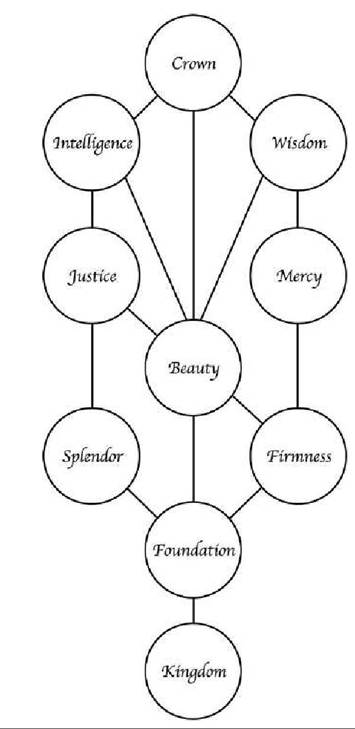
The traditional arrangement of the Sephirot is designed to evoke either the tree of life or the human body.
Ideas and images derived from Kabbalah continue to exert some influence on contemporary Jewish thought, and particularly for those associated with the Jewish “Renewal” movement.3 Admirers of Rabbi Abraham Joshua Heschel (1907-1972) and, more recently, followers of Rabbi Zalman Schachter-Shalomi (1924-2014)—who are determined to bring about a reinvigoration of Jewish spirituality—insist that such concepts as teshuvah and tikkun olam cannot be confined to the synagogue or to a life of conventional religious observance. For some, teshuvah entails a sincere and disciplined internalizing of our longing for God in the form of true piety, affecting every aspect of our behavior. For others, however, tikkun olam means, quite literally, actions that benefit humankind and promote peace in the world.
Self-Assessment 11.1
[Please note: You must be using an online, browser-based eReader in order to view this content.]
More on the topic Jewish Mysticism:
- Jewish Mysticism
- The Kabbalah
- A Closing Word
- Foundations for Contemporary Jewish Thought
- Prophecy and Divination
- TONGUES OF FIRE
- The Mystery of Mohenjo-Daro
- 39 Nations Afloat
- Sailing between a Lull and Storm Clouds
- Brodd Jeffrey, Little L., Nystrom B., Platzner R., Shek R., Stiles E.. Invitation to World Religions. 4th edition. — Oxford University Press,2022. — 1196 p., 2022