Judaism
Jeffrey Brodd
California State University, Sacramento
Layne Little
University of California, Davis
Bradley Nystrom
California State University, Sacramento
Robert Platzner
California State University, Sacramento
Richard Shek
California State University, Sacramento
Erin Stiles
University of Nevada, Reno
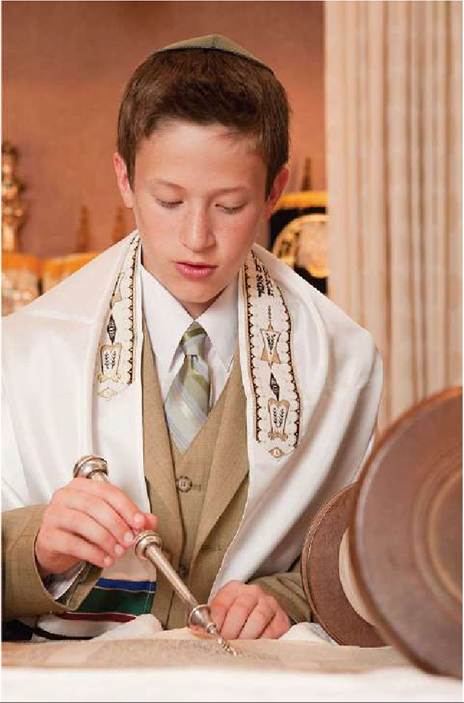
The Bar Mitzvah stands behind a lectern, facing an open Torah scroll, preparing to read his scriptural passage in Hebrew.
IT IS A SATURDAY morning, and Seth is waiting to read from the Torah—the most ancient of Jewish Scriptures. Seth has spent the past ten months preparing for this moment, and he is about to become a Bar Mitzvah (Hebrew, “son of the commandment”). In late antiquity, a young Jewish male became a Bar Mitzvah simply by turning thirteen years old, but by the later Middle Ages a formal rite of passage had developed that signaled a young man’s entry into religious manhood. By demonstrating that he can read directly from and comment on the Torah, Seth is proclaiming, before an entire congregation of worshipers, his intention to enter the Jewish community as a literate adult.
Moving a silver pointer shaped like an outstretched hand across the Torah scroll, Seth reads the passage assigned for that particular Sabbath morning. The sacred text before him is especially difficult to decipher because, as in ancient times, it is written in the ancient Hebrew language; however, Seth has reviewed this passage many times and has practically memorized it. After the service, Seth will be joined by friends and family who will celebrate his accomplishments with a party, gifts, and praise. This coming-of-age ritual has been enacted countless times over the centuries in Jewish communities throughout the world, but it is only since the 1920s that the privilege of participating in this ritual has been extended to young
women (a Bat Mitzvah—a “daughter of the commandment”).
Nevertheless, it has become quite common today for twelve- and thirteen-year-old Jewish girls to perform the same ritual acts that their male counterparts do and to receive the same recognition.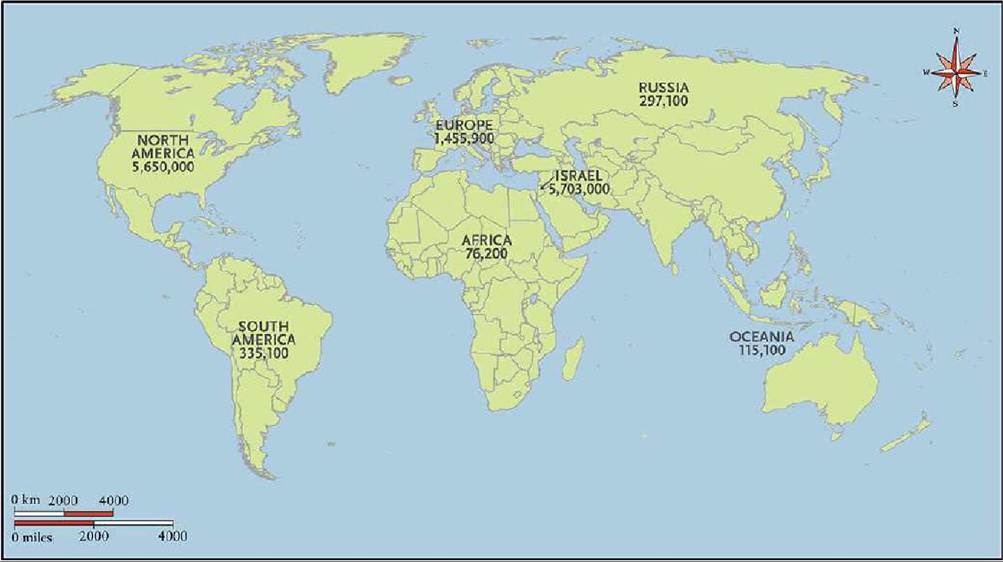
Total number of Jews presently living in the world.
Of all of the life-cycle events in Judaism, the Bar and Bat Mitzvah rite reflects the most fundamental of Jewish beliefs. At the core of the Judaic belief system is the assumption that a very special historical and spiritual relationship—referred to, traditionally, as a covenant— exists between the one God of heaven and earth and the people of Israel. By demonstrating both religious literacy and a willingness to freely embrace a life of sacred duties and obligations, adolescent Jewish boys and girls renew that covenant in a public and deliberate way.
The Bar or Bat Mitzvah ritual is not, however, a prerequisite for membership in the Jewish community. Historically, the only precondition of Jewish identity has been whether or not one has been bom to a Jewish mother. Although Judaism has always accepted converts, the majority of the world’s Jews have been persons whose ancestors are also Jewish. Nevertheless, this rite of passage has achieved its present popularity because it symbolizes a commitment to a communal religious life and to Judaism as the collective faith experience of the Jewish people.
Judaism is one of the world’s oldest extant religions. In addition to examining the teachings and practices of the Jewish religion, we will also survey the historical context out of which they emerged and to which they responded. But first we present an overview of Judaism’s teachings.
TIMELINE
Judaism
| c. 1210 BCE | Pharaoh Merneptah’s victory over “Israel.” |
| c. 1000 BCE | King David unites kingdom. |
| 922 BCE | Division of Kingdom of David and Solomon. |
| 722 BCE | Israel conquered by Assyrians. |
| 587 BCE | Destruction of First Temple; Babylonian exile. |
| 539 BCE | Cyrus of Persia conquers Babylon. |
| 333-323 BCE | Alexander the Great conquers Egypt, Palestine, and Persia. |
| 167-140 BCE | Maccabean revolt against Seleucid rule. |
| 140 bce | Establishment of the Hasmonean Dynasty. |
| 63 BCE | Pompey invades Syria-Palestine; Judea becomes Roman province. |
| 66-70 CE | First Jewish War with Rome. |
| 70 | Destruction of the Jerusalem Temple. |
| 132-135 | Second Jewish War with Rome. |
| 135 | The defeat of the would-be Messiah Bar Kochba. |
| c. 200 | Rabbi Judah the Nasi compiles the Mishnah. |
| c. 500 | Completion of the Babylonian Talmud. |
| 882-942 | Saadiah ben Joseph serves as Gaon of Sura, Babylonia. |
| 1135-1204 | Moses ben Maimon (Maimonides) flees Spain for Egypt. |
| 1492 | Jews expelled from Spain. |
| 1570- 1572 | Rabbi Isaac Luria establishes a community of mystics in Safed, Palestine. |
| 1666 | Shabbetai Tzevi declares himself the Messiah. |
| 1700- 1760 | Israel ben Eliezer establishes the Hasidic movement. |
| 1792 | France confers citizenship on the Jews. |
| 1845 | Reform movement of Germany defines the movement’s goals and beliefs. |
| _X J, co co co co co | bgcolor=white>The trial and retrial of Captain Alfred Dreyfus. |
| 1917 | The Balfour Declaration. |
| 1939- 1945 | World War II and the Shoah. |
| 1948 | State of Israel established. |
| 1951 | The Israeli Parliament declares the 27th of Nisan as Yom HaShoah (Holocaust Remembrance Day). |
| 1967 | Six-Day War between Israel, Egypt, Syria, and Jordan. |
| 1972 | Sally Jane Priesand ordained as a rabbi by Hebrew Union College. |
| 1995 | The assassination of Yitzhak Rabin. |
Click here to learn more in an interactive timeline.
Click here to compare to other Abrahamic religions.
More on the topic Judaism:
- The Teachings of Judaism
- 39 Against God-Fearers, Conversion to Judaism, and Profanation of Sunday
- The Afterlife
- The Messiah and the Messianic Age
- Urban African-American Religions
- The Minor Festivals
- APPENDIX ON BUBER
- The Renewal Movement
- On God, the Human Condition, and Spiritual Liberation
- Contents