Marriage and Family
Marriage and family life are the cornerstones of Muslim communities. Devout Muslims, who strive to follow the example of the Prophet in their daily lives, consider Muhammad to have set the example of marriage and to have been the ideal husband and father.
As a result, marriage is generally regarded as incumbent upon all Muslim men and women when they reach adulthood. Celibacy is not normally encouraged, and sexual pleasure is considered a gift from God to be enjoyed within a marriage.Much variation exists throughout the Muslim world concerning marriage arrangements, weddings, and the organization of the family life. In some areas, marriages for young people are arranged by their parents, whereas in others, women and men select their own marriage partners. However, in most Muslim communities, dating is not an acceptable practice—even among Muslims living in North America. Furthermore, adult children in many Muslim families live with their parents until they marry, even if they are financially able to live on their own. Regardless of the method of arranging marriages, according to the shari'a, young men and women may reject a marriage partner they deem unsuitable; the consent of both the bride and the groom is necessary for the marriage to take place. However, this legal right does not always coincide with community or cultural norms. In some cultures, a bride’s silence about her parents’ choice of a marriage partner is considered to indicate acceptance of the proposal.
In Islam, a marriage is considered a contractual relationship. For the marriage to be valid, the bride, the groom, and witnesses must sign a marriage contract. The contract designates the mahr, which is the gift a bride will receive from the groom and his family. The gift may be cash or other property. The marriage contract may be considered invalid without the mahr, though the amount may vary greatly from family to family and culture to culture.
The amount depends not only on the family’s wealth but also on community norms. For example, urban Muslims in the Middle East might give a mahr of thousands of dollars, whereas the normal amount in a small village might be much less. According to shari'a, the mahr is solely the property of the bride. However, in many cultures, a bride’s parents may take some of the mahr due to customary practices and local expectations.In Muslim weddings, the bride and groom may be separated for most of the festivities on the wedding day. The groom usually signs the marriage contract in a mosque in the company of his male friends and relatives. The marriage official, often an imam, then takes the contract to the bride in her family’s home, where she is accompanied by her female relatives and friends. Wedding celebrations are often large affairs, and feasting, Qur’an recitation, and sometimes music and dancing may accompany the signing of the contract. In many communities, men and women celebrate entirely separately. This is because some Muslims do not consider it acceptable for men and women to socialize together. In some cultures, the bride is taken to the groom’s home in a big procession at the end of the day. There, the new couple shares a special meal and begins their life together.
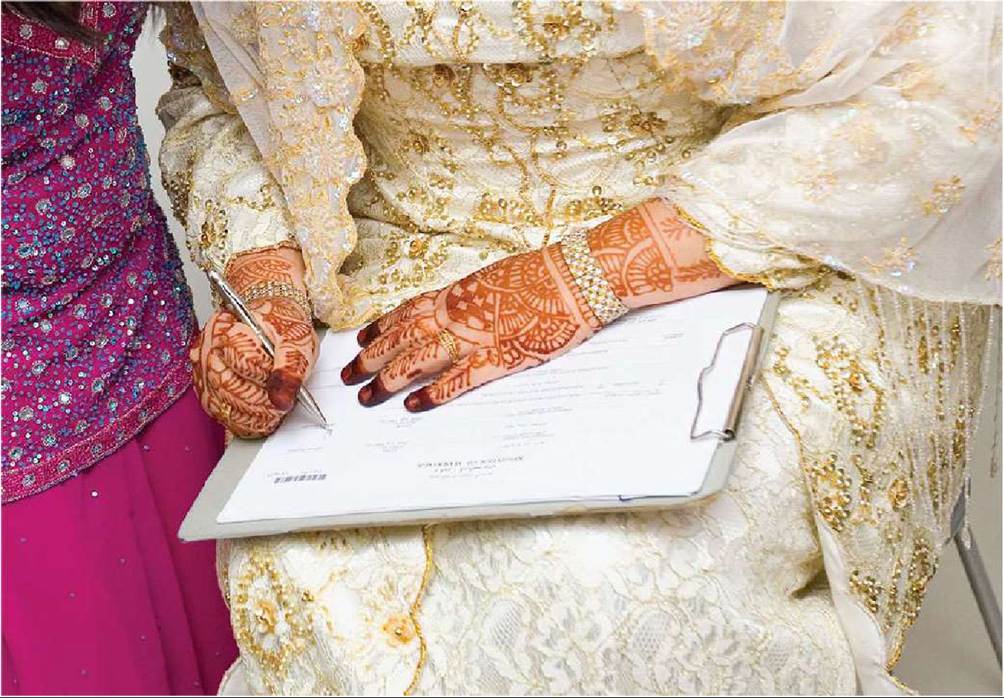
A Muslim bride signs her marriage contract.
According to most interpretations of Islamic law, Muslim men are allowed to marry up to four wives. However, this is only under certain conditions, and only if the man can support all his wives and treat them equally. For example, the verses in the Qur’an concerning polygamy suggest that the practice is appropriate in times of warfare when there may be many unmarried women. Furthermore, the Qur’an states, “Marry such women as seem good to you, two, three, four; but if you fear you will not be equitable, then many only one” (4:3). A later verse says that “You will not be equitable between your wives, even if you try” (4:129).
Some thinkers, such as the Egyptian reformer Muhammad Abduh (about whom you read earlier in this chapter), argued that these two verses actually prohibited polygamy because the later verse stated that no man could possibly treat multiple wives equitably, which is a necessary condition of polygamy. Abduh also contended that although polygamy may have been necessaiy in the time of the Prophet to protect women who had no one to care for them, it was destructive in the modern context. However, most Muslims have considered polygamy legal, though the occurrence of the practice varies tremendously around the world, and some countries, like Tunisia, have banned it entirely.Several types of divorce are permitted in Islam. Guidelines for divorce come from both the Qur’an and hadith literature. One type is divorce by male unilateral repudiation. In this type of divorce, a man writes or pronounces the formula “I, (the man’s name), divorce you, (the wife’s name).” In classical Islamic law, this type of divorce does not need the approval of the wife or a legal authority. However, in many countries today, unilateral divorce is no longer permissible, and men and women must both file for divorce in court. According to shari'a, women may seek divorce from Islamic judges on a variety of grounds. Stipulations for divorce are occasionally written into the marriage contract. For example, a woman may specify that she can divorce her husband if he marries another wife. Divorce is common in some Muslim countries and uncommon in others. In some places, a divorced man or woman is dishonored and finds it difficult to remarry, whereas in others there is little or no stigma attached to divorce.
More on the topic Marriage and Family:
- Summary
- Nuer Marriage in the Sudanese Context
- Marriage and marriage dissolution
- Solemnizing the union
- The Unification Church
- FOURTEEN Conclusion
- Conclusion
- THERE WERE SUCH GREAT TAILORS
- Contemporary notions of justice, informed by the ideals of human rights, equality and personal freedom, depart substantially from those that underpin rulings in classical fiqh (Islamic jurisprudence) and established understandings of the Shari,a.
- CASE 101: Impaired Consent: Madness